
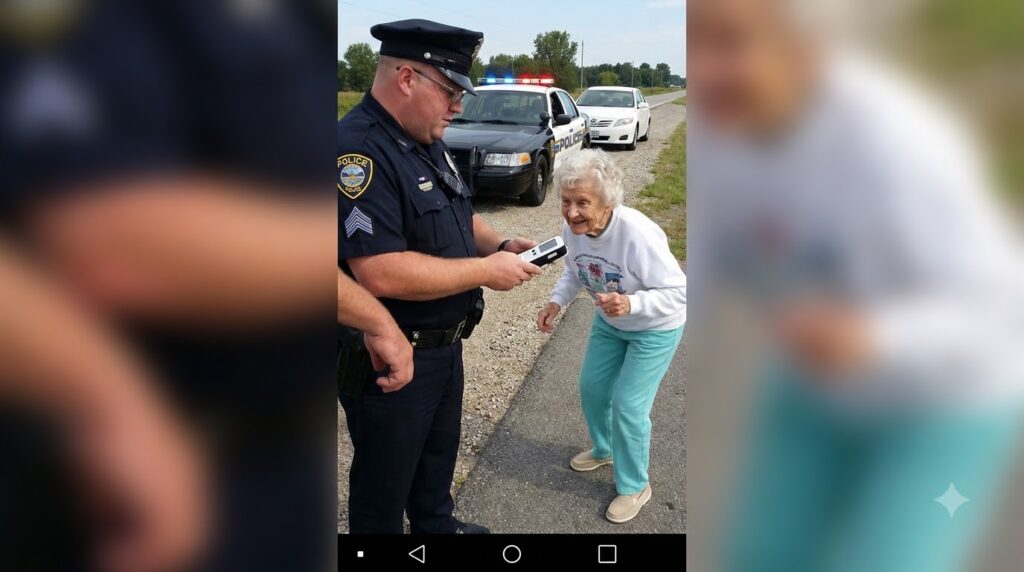
The Dry Gravel Run on County Route Nine and the Reckoning of Sergeant Miller
CHAPTER 1: THE DUST ON ROUTE NINE
“License, registration, and step clear of the runner before I call a tow,” Sergeant Miller said, his boots grinding the loose limestone on the shoulder of County Route Nine into white powder.
The heat off the asphalt hit Evelyn Harper through the thin soles of her beige slip-ons before she even had both feet on the gravel. Above them, the midday sun sat heavy over the dry brush, turning the metal hood of her ninety-eight sedan into a radiant stove. The red and blue LEDs on Miller’s cruiser didn’t just flash; they cut raw, rhythmic gouges across the bleached yellow weeds lining the ditch.
Evie didn’t reach for her purse. She rested one hand on the warm roof of her car, her aqua pants catching the dust drifting off the passing log trucks. Her graphic sweatshirt—faded soft through a hundred wash cycles—barely stirred in the draft.
“You clocked me at thirty-four in a forty-five, Sergeant,” Evie said. Her voice didn’t rise. It had the dry, level tone of someone who had watched thirty summers of county politics burn off like morning mist over the creek. “Unless they changed the laws on tractor clearance while I was buying flour, slow isn’t an arrestable offense.”
“You touched the white line twice past the grain silo,” Miller barked. He stepped closer, his heavy frame blocking the sun. Sweat ran in clear, distinct tracks from under his black peaked cap down the fold of his neck, soaking the navy wool beneath his brass chevrons. His duty belt creaked under the weight of steel and leather—cuffs, radio, baton, sidearm—a fifty-pound cage of authority he carried like armor. “And you’re veering right now, ma’am. Stand straight.”
Ten yards back, parked beside an idle flatbed truck, a local store clerk leaned out his open window. The sun glinted off the black glass lens of a raised smartphone held flat against the door frame. Miller saw it out of the corner of his clear spectacles. His jaw tightened, the muscles along his clean-shaven cheek locking hard. He didn’t look at the phone, but his stance widened, his heavy boots taking up the entire breakdown lane.
“I am standing straight, Miller,” Evie said mildly. She looked past his shoulder at the secondary cruiser idling twenty feet behind them. Inside, a junior deputy sat behind the glass, hands restive on the wheel, eyes locked forward. “Your road has a crown on it. Has since your father laid the asphalt back in eighty-four.”
Miller reached down to his right side, his fingers snapping the leather retention strap on a small, rectangular pouch. He didn’t pull a summons pad. He pulled a white-and-black portable breathalyzer, its small digital display dark in the glare.
“I smell alcohol,” Miller lied. The word hung in the hot air between them, heavy and greasy. “Hands out of your pockets. We’re doing a field test right here.”
Evie looked at the small plastic mouthpiece held three inches from her nose. She didn’t flinch. She didn’t look away. Instead, a small, quiet line formed at the edge of her mouth—not fear, but the sharp, dangerous amusement of an old woman who knew exactly what a desperate man looked like when his boots started to slip.
“Blow steadily into the tester until I tell you to stop,” Miller commanded, his thumb pressing the side ignition button.
The digital screen flickered to life with a low, sharp beep, but as Evie leaned in, her eyes caught the yellow calibration sticker on the underside of the housing—a small paper seal with a date stamped four months in the past.

CHAPTER 2: THE UNCALIBRATED SEAL
“You’re four months past inspection on that unit, Sergeant,” Evie said. Her thumb traced the rusted seam of her car door, feeling the dry grit that had settled into the metal after weeks of drought. “Or does County Route Nine run on a different calendar than the state highway patrol?”
Miller’s face didn’t change, but the red flush rising from under his collar spread fast, darkening the thick skin of his throat. He pulled the portable tester back half an inch, his heavy thumb immediately covering the yellow paper seal on the bottom casing. His clear spectacles caught the harsh glare of the midday sun, turning his eyes into opaque white discs.
“This unit was recalibrated at the district shop in May,” Miller said. His voice dropped an octave, raspy and dry, like two pieces of slate sliding together. He didn’t look down at the display. He didn’t need to. “And the reading says you’ve got a system full of vapor. Step around to the rear bumper, ma’am. Keep your hands where I can see them.”
“The display says zero, Miller,” Evie said flatly. She didn’t move her feet. The heat off the asphalt was soaking straight through her slip-ons now, burning into the balls of her feet, but her posture stayed level. “My eyes might be seventy-eight, but I can still read a digital digital readout from three feet away.”
Ten yards behind them, the store clerk in the parked pickup shifted his weight. The door frame creaked, a sharp, metallic pop that carried over the low, idle rumble of Miller’s cruiser. The clerk’s phone didn’t drop an inch; the camera lens stayed locked on the space between Miller’s navy shirt and Evie’s soft sweatshirt.
“I said step around to the bumper,” Miller repeated, his voice cutting louder over the passing whine of a grain truck. He took a heavy half-step forward, his broad chest cutting off the slight breeze that had been coming through the ditch. “We’re doing a full three-point sobriety walk. You touch the white line, you’re in cuffs for reckless endangerment.”
“And if I walk it straight?” Evie asked. “Then do I get my license back, or do we invent a flat tire?”
Miller reached for his duty belt. His thick fingers hovered over the leather holster of his sidearm before sliding lower, settling heavy on the plastic casing of his radio. “You don’t set the terms of a traffic stop, Mrs. Harper. Your late husband might have owned half the timber rights on the north ridge, but Arthur isn’t around to call the sheriff for you anymore. You’re just a driver on a public road, and right now this road belongs to the county.”
Evie’s eyes narrowed slightly, the fine lines around her temples tightening. It wasn’t the mention of Arthur that hit her—Arthur had been in the ground six years, and his memory was as solid as the limestone foundation under her porch. It was the way Miller said timber rights. The way his voice lingered on the word county, like he was reading off a property line rather than a traffic code.
“Arthur never needed to call the sheriff, Miller,” Evie said, her tone dropping into a quiet, icy register that made the heavy officer pause. “Arthur knew your father was too crooked to lay a straight driveway, and it looks like the apple didn’t fall far from the ditch.”
Behind them, the junior deputy in the second cruiser clicked his driver-side door open. The metallic latch sounded loud in the dry heat. The young officer placed one boot on the gravel shoulder, his face pale under his stiff brimmed hat, his eyes darting from Miller’s broad back to the clerk’s raised phone.
“Sergeant?” the deputy called out, his voice cracking slightly against the noise of the cicadas. “Dispatch is asking if we need a transport unit.”
“Tell dispatch to hold!” Miller snapped over his shoulder, never taking his eyes off Evie. “We’ve got an uncooperative driver refusing a lawful field assessment.”
“I haven’t refused anything,” Evie said. She unclasped her hands from the warm roof of her car, letting them fall naturally to her sides. Her fingers felt nimble, light, untired despite the heat. “You asked for a test. I blew into your little expired box. It told you what everyone in this township already knows. So give me my license, Sergeant, or arrest me and explain to the judge why you’re holding a senior citizen on the side of Highway Nine in ninety-degree heat because her car is old.”
Miller didn’t reach for his ticket book. He didn’t reach for his cuffs either. Instead, he stepped closer, his boots grinding deeper into the limestone shoulder, kicking up a small cloud of white dust that settled over Evie’s aqua pants. He leaned in until the smell of stale coffee and hot wool was thick in her face.
“The sensor errored out,” Miller whispered, his voice low enough to stay under the clerk’s microphone. “The heat warps the internal cell on these cheap units. I know what I saw when you came off the ridge, Evie. You were crossing the yellow line because you can’t keep your head up. Now you can walk the line, or I can take your keys right now under the elder safety protocol and have the county hold your car until a state physician clears you.”
Evie looked at the heavy man standing over her. She saw the sweat dripping from his chin, the frantic, rigid set of his jaw, and the desperate, possessive way he held that useless plastic tester in his fist.
She didn’t get scared. She didn’t get angry.
A slow, bright smile broke across her lined face, illuminating the sharp, mischievous light in her eyes that eighty years of hard winters hadn’t managed to dim.
“You really want to see me walk a line, Miller?” she asked softly.
“I ordered you to walk it,” Miller growled, taking a quarter-step back to give her room, his hand resting heavy on his belt, expecting her to turn around and shuffle along the painted edge of the road.
Evie didn’t turn around. She bent her knees slightly, dropping into a springy, crouched stance that looked less like an eighty-year-old grandmother preparing for a sobriety test and more like a sprinter waiting for the gun.
“Then you’d better keep up,” she said.
CHAPTER 3: THE DUST AND THE DEMONSTRATION
Evie didn’t wait for his permission. Her beige slip-ons dug into the calcified dust of the breakdown lane, her light frame springing forward three quick, nimble paces before Miller’s brain even registered that her feet had moved.
The heavy sergeant recoiled like he’d stepped on a copperhead. His boots skidded backward across the loose gravel, limestone powder exploding in white puffs around his trousers. His hand whipped toward his duty belt, grabbing wildly at the leather strap of his holster before his elbow caught his own radio antenna, sending a sharp, crackling screech through the idling patrol car behind him.
“Ma’am! Hold your position!” Miller roared, his voice cracking against the dry heat. His broad face flushed a deep, mottled purple as he stumbled backward along the ditch line, his heavy boots tangling in the dry sweetgrass. “I said hold!”
Evie stopped on a dime, five feet in front of him. She didn’t press the distance. She stood on the painted white line, perfectly balanced, her arms resting easily at her sides while the hot draft of a passing livestock trailer ruffled the hem of her soft sweatshirt.
“I walked the line, Sergeant,” she said smoothly. She extended one foot forward, heel-to-toe, tapping the asphalt with deliberate, effortless rhythm. “Straight as an arrow. Didn’t wobble once. Want me to do it backward, or do you need another breath test to make sure my knee joints are sober?”
Behind them, the store clerk’s smartphone didn’t shake. The clerk’s elbow was propped hard against the truck door, catching every inch of Miller’s frantic retreat. Ten yards down the shoulder, the young deputy had stepped completely out of the secondary patrol car. His hat was pushed back on his forehead, his mouth slightly open, his hand hovering uselessly two inches above his belt as he watched his direct superior back away from a five-foot-two widow.
Miller’s heels hit the steel bumper of his own cruiser with a dull, hollow thud. He rattled against the hood, his duty belt clattering loudly against the push-bar. Sweating profusely now, the clear lenses of his spectacles fogged at the edges, catching the fierce midday glare.
“You’re interfering with a traffic investigation, Mrs. Harper!” Miller gasped, his chest heaving under the stiff navy wool of his uniform. He held the small white-and-black breathalyzer in front of him like a wooden cross, his thumb covering the expired calibration stamp so hard his knuckle turned white. “You stepped out of the safety perimeter!”
“There isn’t a perimeter on Route Nine, Miller, there’s just a shoulder and a ditch,” Evie replied, taking one calm, deliberate step toward the driver’s side door of his cruiser. Her eyes weren’t on his sidearm or his badge. They drifted past his broad shoulder, through the tinted glass of his windshield, settling on the dash.
Tucked between the dashboard ventilation slits and a heavy metal clipboard was a fat manila folder with a bright orange county surveyor’s tab sticking out the side. Stenciled across the tab in dark block ink were four numbers Evie knew better than her own phone number: T-14-R-9.
It was the township parcel designation for the lower thirty acres of Arthur’s old timber plot—the flat stretch running right along the ditch of Route Nine where the county had been quietly dumping crushed stone for three weeks.
Miller noticed her gaze shift. His reaction was instantaneous and disproportionate: he shoved his arm through the open driver-side window, sweeping his heavy hand across the vinyl dash to knock the folder flat into the footwell, out of sight.
“Get away from the vehicle!” Miller barked, his voice rising into a sharp, thin strain that carried straight over the roar of the cicadas. “Deputy! Get over here and secure this driver!”
The young deputy didn’t move forward. He took one step sideways, his boots grinding slowly into the gravel, his eyes darting from the clerk’s steady camera to Miller’s sweat-soaked collar.
“Sergeant,” the deputy said quietly, his voice low enough that it barely reached the hood. “The unit cleared her. The reading was zero-point-zero.”
“The unit’s cell is heat-warped!” Miller shouted back, turning his head just enough to snap at the kid, his face twitching with a mix of fury and mounting panic. “I told you, the ambient temp in the trunk compromised the sensor! She’s swerving, her motor control is erratic—you saw her lunge at me!”
“She didn’t lunge, Miller,” the clerk called out from the window of the flatbed, his tone bone-dry and echoing clearly across the sun-baked road. “She took three steps on the white line because you told her to walk it. Got it all right here on four-K video. Clear as day.”
Miller’s head snapped toward the clerk. The red flush on his neck turned a dark, bruised violet. The social script he’d run on Route Nine for fifteen years—the unwritten rule that a badge and a loud voice meant absolute obedience—was dissolving in the heat, leaving nothing underneath but the raw, awkward weight of a heavy man cornered on a public road.
Evie didn’t press the clerk’s advantage. She stayed right where she was, her hands tucked lightly into the front pocket of her sweatshirt, her posture relaxed, her eyes fixed on the spot where the manila folder had vanished under the seat.
“You aren’t worried about my driving, Miller,” Evie said softly, her voice carrying a quiet, razor-sharp certainty that cut through the idling rumble of the V8 engines. “And you aren’t worried about that expired box in your hand. You’ve been sitting on the shoulder outside my driveway three times this week because the county road committee meets on Tuesday, and you need Arthur’s easement signed before the state grant expires.”
Miller’s breath caught in his throat. His spectacles slipped a fraction of an inch down the bridge of his nose, revealing the small, bead-like panic in his eyes.
“That’s county business,” Miller rasped, his hand tightening around the breathalyzer until the plastic casing creaked under the pressure. “This is a traffic stop.”
“Then finish the traffic stop,” Evie said, holding out her small, wrinkled palm, palm-up in the bright afternoon light. “Give me my license.”
Miller stood frozen against the steel push-bar of his cruiser, the red and blue LEDs casting unnatural violet shadows across his wet face. He looked at her open hand, then at the deputy who was refusing to step in, and finally at the black lens of the smartphone catching every second of his silence.
Slowly, deliberately, Miller reached into his breast pocket. But instead of pulling out her laminated license, his fingers closed around a yellow citation pad.
CHAPTER 4: THE PAPER AND THE REFUSAL
The cardboard backing of the yellow citation pad snapped against Miller’s palm with a sound like a dry branch cracking in winter. He didn’t unclip his pen. He held the pad high against his navy chest, using his broad shoulders to block Evie’s view of the text pre-filled across the top voucher.
“Refusal to complete a secondary field assessment under suspected thermal sensor fault,” Miller said, reading the phrase off the paper like a judge pronouncing a sentence. His voice had lost its panicked edge, flattening into the rigid, rehearsed drone of a man seeking safety inside bureaucracy. “Vehicle subject to immediate ninety-minute administrative hold until a secondary transport officer arrives with a calibrated stationary unit.”
Evie didn’t look at his face. Her eyes remained locked on the yellow pad. Through the thin, carbonless top copy, she could see the heavy blue-ink impression Miller had pressed into the sheet long before he ever flipped his emergency lights on. The date at the top wasn’t today’s date. It was stamped three days prior, under the header: County Secondary Impound & Right-of-Way Inspection Protocol.
The Decoy Secret sat right there in plain ink—Miller’s official cover story. He wasn’t just claiming her breath test was invalid because the roadside tester had overheated in his trunk; he was utilizing a pre-issued heat-fault waiver to declare her vehicle mechanically unserviceable and force her car off the shoulder and into the county impound lot.
“You wrote that citation before I left the grocery store, Miller,” Evie said quietly.
“I’m exercising administrative discretion under County Code Four-Twelve,” Miller snapped, his thumb pressing down hard over the pre-stamped impound order. “Your breath sample is void. The sensor cell overheated. That makes your legal status unconfirmed, and an unconfirmed driver doesn’t put four thousand pounds of steel back on Route Nine.”
“The sensor cell didn’t overheat,” Evie said. She stepped past his right arm, ignoring his heavy gasp as she reached straight for the window frame of his cruiser. “And that paper in your hand isn’t about my driving.”
“Stay back from the cruiser!” Miller shouted, his heavy frame shifting sideways to block her, his duty belt clattering loudly against the door frame. “Deputy, secure her!”
The young deputy took two fast steps across the gravel, but he didn’t grab Evie. He stopped right beside the open driver-side window, his eyes falling directly onto the floorboard where the manila folder had landed when Miller knocked it off the dash. The folder had spilled open against the transmission hump.
Prominently displayed across the top blueprint was a bold red stamp from the State Highway Administration: EASEMENT DENIED – PRIVATE RESIDENTIAL TITLE PREVAILS.
The deputy froze. He looked at the red stamp, then at the yellow citation pad in Miller’s hand, then at Evie, whose face remained entirely unbothered.
“Sergeant,” the deputy said, his voice dropping into a tight, flat strain. “The easement on parcel T-14 isn’t cleared. The state turned down the county’s right-of-way expansion last week.”
Miller’s head snapped around toward the kid, his eyes bulging behind his sweat-smudged spectacles. “Shut your mouth, Millerson! Step back to your vehicle!”
“He can’t shut his mouth, Miller,” Evie said softly, her voice carrying a dry, terrible clarity. “Because the clerk behind you has had his phone live-streaming to the county community board for the last four minutes.”
Ten yards away, the store clerk leaned even farther out the window of his flatbed, holding the phone with both hands now, a cold, mocking grin spread across his sun-burned face. “Three hundred people watching live, Sergeant. They’re really enjoying the part where you try to impound a seventy-eight-year-old’s Buick because her late husband wouldn’t sell you forty feet of ditch.”
Miller turned back toward Evie, his jaw working silently. The yellow citation pad shook in his grip. The sweat on his forehead was pouring freely now, running down his nose and dripping onto the yellow paper, smudging the blue ink of the pre-filled impound order.
His official line of defense—the heat-faulted breathalyzer, the administrative safety hold, the procedural necessity—had crumbled completely under the weight of the spilled folder and the live video feed. He stood exposed on the hot limestone shoulder, a man holding a false document in front of three witnesses and a camera.
“You’re going to hand me my license, Sergeant,” Evie said, taking one small, firm step forward until her soft graphic sweatshirt was less than six inches from his navy chest. “And then you’re going to explain to the sheriff why you’re using county paper to settle a private real estate grudge.”
Miller looked down at her. For fifteen years, his authority had been absolute because no one on Route Nine ever called his bluff. No one ever looked past the badge to see the small, frightened clerk underneath who needed his brother-in-law’s road project to pass so he could pay off his mortgage.
He didn’t hand her the license.
In a final, desperate attempt to regain control of the scene, Miller shoved the yellow citation pad into his belt, grabbed the portable breathalyzer off the hood, and turned toward his open driver-side door.
“Vehicle is being impounded under Code Four-Twelve,” Miller growled, his voice thick with unreasoning malice. “Key handover is mandatory. Step away from the door, Mrs. Harper, or I will physically remove you from the roadway.”
He reached for his handcuffs.
Evie didn’t back up. She didn’t flinch. She bent her knees once more, her posture dropping into that same nimble, springy stance.
“Try it, Miller,” she whispered.
CHAPTER 5: THE GRAVEL RUN
Miller reached for the steel cuffs on his belt, his heavy frame leaning forward to grab her wrist, but he never touched cloth.
Evie didn’t pull back. She didn’t turn to run into the ditch. She crouched low, her aqua pants catching the blinding midday glare, and sprang straight forward into his lane. Her movement was sharp, light, and startlingly sudden—a seventy-eight-year-old woman launching herself like a bird off a fence line.
The heavy sergeant panicked. He didn’t see an elderly driver complying with an order; he saw a threat breaching his space before his boots could set. The sheer shock of her forward lunge sent his fifty-pound frame into total recoil. His heels caught the loose limestone on the shoulder, his knees buckled, and his arms flailed in a wild, uncoordinated arc.
“Whoa—stay back!” Miller screamed, his voice cracking into a high, breathless pitch that cut through the roar of passing traffic.
He didn’t draw a weapon. He didn’t stand his ground. The rigid, immovable authority of County Route Nine turned on his heel and fled.
Miller’s heavy boots pounded the dry asphalt of the breakdown lane, kicking up clouds of white limestone dust and dried weeds. Sweat poured off his clean-shaven cheeks in sheets, soaking his navy short-sleeve uniform until the cloth stuck dark and heavy to his back. His duty belt clattered wildly against his hips—handcuffs banging against radio, baton knocking his thigh—as he ran toward the rear bumper of the secondary patrol car, his clear spectacles slipping halfway down his nose.
Evie followed right behind him. She didn’t sprint at full speed, nor did she press close enough to trip him. She dropped into a light, springy crouch-run, her beige slip-ons whispering over the gravel three yards behind his retreating back. Her graphic sweatshirt fluttered in the hot draft of the highway, her short curly white hair catching the sun, her face illuminated by a wide, irrepressible grin.
“You wanted a foot test, Sergeant!” Evie called out, her voice remarkably clear over the thumping rhythm of his boots. “Don’t stop now, we’re just getting to the white line!”
“Ma’am, stay back!” Miller gasped, glancing over his shoulder in sheer, breathless terror. His heavy face was contorted into a mask of pure panic, his mouth agape as he saw the grandmother keeping effortless pace with his frantic retreat. “Stop chasing me right now!”
Ten yards back, the store clerk leaned half his body out the window of the flatbed truck, his smartphone held high and steady. The camera tracked the pursuit in uninterrupted four-K resolution: a six-foot, two-hundred-and-seventy-pound uniformed police officer in full-blown, panic-stricken flight from a petite, seventy-eight-year-old widow in aqua pants.
“Keep going, Miller!” the clerk shouted, laughing so hard the truck’s side mirror shook. “You’re clearing the lane real nice!”
In the secondary patrol car, the young deputy stood frozen by his open door. His jaw had dropped entirely. He looked at his superior officer sprinting down the shoulder, then at the camera recording every second, and finally at Evie, who was trotting along with the lightfooted agility of a child playing tag on a schoolyard.
“Sergeant!” the deputy yelled, completely at a loss for what protocol covered a senior officer being pursued down a state highway by the person he’d pulled over. “Should I… should I call dispatch?”
“Tell them to send back-up!” Miller wheezed, his lungs burning under the scorching afternoon sun. He reached the rear bumper of the secondary cruiser, tried to plant his boots to pivot, and slid two feet through the loose gravel, his hands slapping flat against the hot metal trunk lid to keep from falling into the ditch. “She’s… she’s pursuing an officer!”
Evie pulled up five feet away, her breathing light, her feet planted shoulder-width apart on the edge of the shoulder. She didn’t look tired. She didn’t even look winded.
“I’m not pursuing you, Miller,” Evie said, her voice dropping back into that dry, level tone that made his chest tighten. “I’m just waiting for you to finish the traffic stop. You said my motor skills were impaired. I thought we were demonstrating.”
Miller leaned heavy against the trunk of the deputy’s cruiser, his chest heaving like a bellows. Sweating profusely, he pulled off his clear glasses with a trembling hand, wiping his dripping forehead with his sleeve. The black-and-white breathalyzer was still clutched in his left fist, its small digital screen long gone dark.
“You… you disrupted a lawful command,” Miller gasped, his voice raspy and broken. He tried to pull himself upright, tried to adjust his black peaked cap to restore a shred of his dignity, but his knees were visibly shaking under his navy trousers. “You lunged at an officer of the law.”
“The video says she stepped forward when you ordered her to walk, Sergeant,” the young deputy said quietly from the driver’s door. He wasn’t looking at Miller anymore. He was looking at his own dashboard computer, where the county dispatch channel was already blowing up with text alerts from local residents who had just opened the clerk’s live-stream. “And Sergeant… the Sheriff just logged into the county feed.”
Miller went dead still. The color drained from his face so fast he looked grey under the hot sun.
“The Sheriff?” Miller whispered.
“He wants to know why you’ve got Highway Nine blocked off for an unregistered easement check,” the deputy said, his voice completely flat. “And he said to bring Mrs. Harper’s license back to her car right now before he drives out here himself.”
Evie looked at the heavy man leaning against the cruiser hood. She didn’t gloat. She didn’t raise her voice. She simply held out her hand again, palm-up, the sun catching the fine gold band of Arthur’s ring on her finger.
“My license, Miller,” she said.
Miller reached into his breast pocket with fingers that wouldn’t stop shaking. He pulled out her laminated driver’s license. But as he handed it back, his thumb slipped on the plastic, revealing a second document tucked directly behind it—a blue folded state voucher stamped with Arthur’s original agricultural exemption number.
Evie’s eyes narrowed as she took the cards. The decoy of the heat-warped breathalyzer and the fake impound order was completely gone now. But as her fingers touched the blue voucher, she realized the real target hadn’t just been the land along the ditch.
The voucher was dated forty-eight hours ago, bearing the signature of the county treasurer—and it wasn’t a request to buy the easement. It was an official notice that the county had already declared Arthur’s title abandoned due to unpaid agricultural taxes that Evie had personally settled three months prior at the courthouse.
Miller hadn’t just been trying to intimidate her into signing away the road right-of-way. He and his brother-in-law had actively falsified the county land registry to seize the entire lower forty acres before the state highway expansion grant expired at the end of the month.
Evie held the blue paper in her hand, the dry heat of Route Nine rising around them, and looked Miller dead in the eye.
CHAPTER 6: THE PUBLIC RECORD
The blue voucher felt stiff between Evie’s thumb and forefinger, the paper hot from Miller’s chest pocket. The ink along the seal wasn’t dry-pressed like an official state document; it was fresh, blue carbon paste that left a thin, greasy smear across her thumb.
Miller didn’t reach to pull it back. He couldn’t. He stood pressed back against the secondary cruiser’s rear bumper, his chest heaving, his mouth half-open as he watched her unfold the sheet.
“This is an administrative copy,” Miller rasped, his voice barely making it past the dust in his throat. He tried to straighten his peaked cap, but his hand was shaking so hard the brim sat crooked over his brow. “It doesn’t concern the traffic stop, Mrs. Harper. Hand it back.”
“You filed an abandonment lien on parcel T-14 on Wednesday,” Evie said. She didn’t raise her voice, but the silence on the shoulder was so complete that every word carried straight to the open window of the flatbed truck ten yards away. “You signed it as the deputy county assessor pro tem.”
Behind them, the store clerk lowered his phone two inches, his eyes widening as he adjusted his zoom. “Did she say abandonment lien? On Arthur Harper’s lower forty?”
“Your brother-in-law sits on the county drainage board, Miller,” Evie continued, her eyes sweeping the sharp, blue-ink lines of the legal description. “The state highway grant requires three hundred feet of unencumbered frontage to widen the Route Nine culvert. The county offered Arthur sixty thousand five years ago, and he told them to pound sand because it cuts straight through the old springhouse.”
She stepped closer to Miller—not running, not lunging, just taking two firm strides until the blue paper was resting flat against the navy wool over his sternum.
“So when Arthur died, you waited,” she said softly. “You thought an eighty-year-old widow wouldn’t check the courthouse ledger in June. You thought if you pulled me over on a Friday afternoon, took my license, and threatened to impound my car under some fake heat-sensor rule, I’d be too rattled to notice you were serving a road-expansion seizure notice on my dashboard.”
“It’s a legal county procedure!” Miller choked out, his broad face flushing dark purple again as he cast a desperate glance toward the young deputy. “Millerson, tell her! The board voted on right-of-way condemnation in May!”
“The board voted on a survey study, Sergeant,” Deputy Millerson said. His voice was cold now, completely stripped of deference. He stepped away from his patrol car, pulling his small department radio off his shoulder strap. “They didn’t vote on filing a false tax delinquency against an active landowner. My uncle is on that drainage committee, Miller. I know what was on that docket.”
Millerson brought the radio to his mouth, his thumb depressing the side button with a heavy, mechanical click.
“Unit Four to Dispatch,” Millerson said, his voice echoing clearly over the idle of both V8 engines. “Be advised, traffic stop on Route Nine is clear. Sergeant Miller’s patrol vehicle is currently unserviceable. Requesting Deputy Chief or Sheriff on scene immediately for a civil documentation dispute involving county property records.”
“Millerson, cancel that call!” Miller yelled, taking a frantic half-step toward the kid, but his knees gave out slightly under his own heavy weight, forcing him to grab the cruiser’s trunk lid to stay upright. “You don’t cross chain of command on an open channel!”
“The channel isn’t open, Sergeant,” the clerk called out from his truck, his arm propped high as he turned the smartphone around so the screen faced the road. “The live stream has four hundred and twelve local views right now. The County Prosecutor’s office just commented from their official account asking for the location marker.”
The silence that followed was heavier than the heat off the asphalt.
Miller looked at the clerk’s phone, then at the young deputy who had stepped three paces back to separate himself, and finally down at Evie.
The grand sergeant of Route Nine—the man who had spent fifteen years using a badge, a heavy voice, and a fifty-pound belt to bully farm trucks and elderly residents off the shoulder—looked small. His uniform looked too big for his heavy shoulders; his clear glasses were fogged with sweat, and his hands hung uselessly at his sides, fingers twitching around nothing.
Evie folded the blue tax voucher carefully, slipping it into the front pocket of her soft sweatshirt right alongside her driver’s license. She reached into her pocket, pulled out her car keys, and let the brass ring rest against her palm.
“You’re going to move your cruiser out of my lane now, Miller,” Evie said quietly.
Miller didn’t argue. He didn’t quote county code. He didn’t reach for his ticket pad.
Without a word, the heavy sergeant fumbled for his keys, his boots dragging through the crushed limestone dust as he shuffled around to his driver’s side door like a man walking in his sleep.
CHAPTER 7: THE CLEAR ROAD HOME
“Engine off, Miller,” Deputy Millerson commanded from ten paces back. His hand didn’t rest on his belt holster, but his fingers hovered precise and still above his radio mic. “Leave the cruiser right where it sits. Deputy Chief is turning onto Route Nine right now from the bypass.”
Miller’s door stayed open three inches. The heavy sergeant hung suspended between the hot vinyl of his driver’s seat and the blinding glare of the breakdown lane. His black peaked cap sat crooked, the sweat soaking through his collar until the navy wool clung dark and heavy across his shoulder blades. Through the gap in the door, the small white-and-black breathalyzer lay face-down on the rubber floor mat, its digital screen dark, its expired paper seal torn at the corner where his thumb had dug in.
He didn’t turn the key in the ignition. He couldn’t. His broad, clean-shaven face had lost its dark flush, settling into a dull, chalky grey as the low rumble of an approaching siren echoed across the dry pasture land to the west.
Evie didn’t wait for the secondary cruiser to pull up. She walked past Miller’s open door with the unhurried rhythm of a woman who had walked this same stretch of ditch since forty-four. Her beige slip-ons kicked up tiny plumes of limestone dust that settled softly against the hot chrome of her front bumper.
Her sedan stood idling, the air intake whistling faintly under the baking hood. The heat coming off the engine block rose in shimmering waves, distorting the dry weeds along the ditch line, but inside the cabin, the bench seat was cool, smelling faintly of dried lavender and the paper flour sacks stacked in her trunk.
She slid behind the thin plastic steering wheel, her small, wrinkled hands resting at ten and two. Her graphic sweatshirt felt soft against her arms, the cuffs pushed up to her elbows. In her right front pocket, the blue tax-abandonment voucher sat folded neat and tight next to her laminated license—a solid piece of paper that would be resting on the district judge’s desk before the courthouse closed at five.
Beside her driver’s window, Deputy Millerson stepped up to the door frame. He didn’t lean in, and he didn’t reach for his belt. He took off his stiff brimmed hat, holding it against his belt buckle, his eyes catching hers through the glass.
“Mrs. Harper,” Millerson said, his voice low enough to stay under the noise of the idling flatbed behind them. “The Sheriff’s car is pulling in behind my unit right now. He’s going to need a statement for the county administrative review.”
“The statement is in my pocket, son,” Evie said mildly, her thumb tracing the smooth curve of her brass ignition key. “And the clerk on the flatbed has the rest of it on his little screen. You tell the Sheriff if he wants to talk about parcel T-14, he can come up to the porch after four o’clock. I’ve got two bags of unbleached flour in the backseat that aren’t getting any cooler sitting in ninety-degree heat.”
Millerson looked down the road. A white SUV with the Sheriff’s star emblazoned across the door was already cutting its emergency lights as it pulled onto the gravel shoulder behind Miller’s stalled cruiser. The driver’s door opened, and a tall, grey-haired man stepped out, his face set in a hard, grim line as he looked from Miller’s slumped frame to the store clerk’s raised smartphone.
Millerson turned back to Evie, a small, weary nod passing between them. “Yes, ma’am. Drive safe, Mrs. Harper.”
“I always do,” Evie said. “Thirty-four in a forty-five. Just like I told the Sergeant.”
She shifted the column selector into drive. The old transmission engaged with a soft, familiar clunk, the tires grinding over the loose gravel before finding the solid, sun-baked asphalt of the travel lane.
As the sedan pulled out onto Route Nine, Evie glanced once into her side-view mirror.
In the small glass frame, Sergeant Miller was standing by his open door, his head bowed, his broad shoulders hunched against the heat as the Sheriff approached him on the shoulder. Beyond them, the store clerk was still holding his phone high, the live stream catching every second of the county’s long-overdue accounting.
Evie looked back at the road ahead. The asphalt stretched out flat and bright toward the ridge, cut clean through the dry brush under the clear American sky. She eased her foot down on the pedal, letting the ninety-eight sedan carry her home along the road Arthur had helped pave forty years ago—unblocked, unbothered, and entirely her own.







