
CHAPTER 2: THE UNCALIBRATED SEAL
“You’re four months past inspection on that unit, Sergeant,” Evie said. Her thumb traced the rusted seam of her car door, feeling the dry grit that had settled into the metal after weeks of drought. “Or does County Route Nine run on a different calendar than the state highway patrol?”
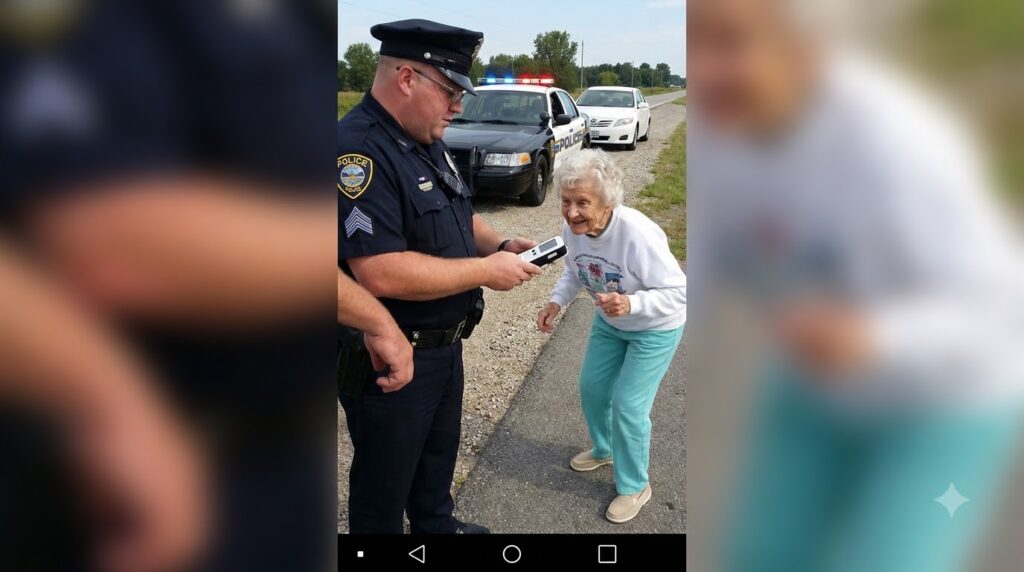
Miller’s face didn’t change, but the red flush rising from under his collar spread fast, darkening the thick skin of his throat. He pulled the portable tester back half an inch, his heavy thumb immediately covering the yellow paper seal on the bottom casing. His clear spectacles caught the harsh glare of the midday sun, turning his eyes into opaque white discs.
“This unit was recalibrated at the district shop in May,” Miller said. His voice dropped an octave, raspy and dry, like two pieces of slate sliding together. He didn’t look down at the display. He didn’t need to. “And the reading says you’ve got a system full of vapor. Step around to the rear bumper, ma’am. Keep your hands where I can see them.”
“The display says zero, Miller,” Evie said flatly. She didn’t move her feet. The heat off the asphalt was soaking straight through her slip-ons now, burning into the balls of her feet, but her posture stayed level. “My eyes might be seventy-eight, but I can still read a digital digital readout from three feet away.”
Ten yards behind them, the store clerk in the parked pickup shifted his weight. The door frame creaked, a sharp, metallic pop that carried over the low, idle rumble of Miller’s cruiser. The clerk’s phone didn’t drop an inch; the camera lens stayed locked on the space between Miller’s navy shirt and Evie’s soft sweatshirt.
“I said step around to the bumper,” Miller repeated, his voice cutting louder over the passing whine of a grain truck. He took a heavy half-step forward, his broad chest cutting off the slight breeze that had been coming through the ditch. “We’re doing a full three-point sobriety walk. You touch the white line, you’re in cuffs for reckless endangerment.”
“And if I walk it straight?” Evie asked. “Then do I get my license back, or do we invent a flat tire?”
Miller reached for his duty belt. His thick fingers hovered over the leather holster of his sidearm before sliding lower, settling heavy on the plastic casing of his radio. “You don’t set the terms of a traffic stop, Mrs. Harper. Your late husband might have owned half the timber rights on the north ridge, but Arthur isn’t around to call the sheriff for you anymore. You’re just a driver on a public road, and right now this road belongs to the county.”
Evie’s eyes narrowed slightly, the fine lines around her temples tightening. It wasn’t the mention of Arthur that hit her—Arthur had been in the ground six years, and his memory was as solid as the limestone foundation under her porch. It was the way Miller said timber rights. The way his voice lingered on the word county, like he was reading off a property line rather than a traffic code.
“Arthur never needed to call the sheriff, Miller,” Evie said, her tone dropping into a quiet, icy register that made the heavy officer pause. “Arthur knew your father was too crooked to lay a straight driveway, and it looks like the apple didn’t fall far from the ditch.”
Behind them, the junior deputy in the second cruiser clicked his driver-side door open. The metallic latch sounded loud in the dry heat. The young officer placed one boot on the gravel shoulder, his face pale under his stiff brimmed hat, his eyes darting from Miller’s broad back to the clerk’s raised phone.
“Sergeant?” the deputy called out, his voice cracking slightly against the noise of the cicadas. “Dispatch is asking if we need a transport unit.”
“Tell dispatch to hold!” Miller snapped over his shoulder, never taking his eyes off Evie. “We’ve got an uncooperative driver refusing a lawful field assessment.”
“I haven’t refused anything,” Evie said. She unclasped her hands from the warm roof of her car, letting them fall naturally to her sides. Her fingers felt nimble, light, untired despite the heat. “You asked for a test. I blew into your little expired box. It told you what everyone in this township already knows. So give me my license, Sergeant, or arrest me and explain to the judge why you’re holding a senior citizen on the side of Highway Nine in ninety-degree heat because her car is old.”
Miller didn’t reach for his ticket book. He didn’t reach for his cuffs either. Instead, he stepped closer, his boots grinding deeper into the limestone shoulder, kicking up a small cloud of white dust that settled over Evie’s aqua pants. He leaned in until the smell of stale coffee and hot wool was thick in her face.
“The sensor errored out,” Miller whispered, his voice low enough to stay under the clerk’s microphone. “The heat warps the internal cell on these cheap units. I know what I saw when you came off the ridge, Evie. You were crossing the yellow line because you can’t keep your head up. Now you can walk the line, or I can take your keys right now under the elder safety protocol and have the county hold your car until a state physician clears you.”
Evie looked at the heavy man standing over her. She saw the sweat dripping from his chin, the frantic, rigid set of his jaw, and the desperate, possessive way he held that useless plastic tester in his fist.
She didn’t get scared. She didn’t get angry.
A slow, bright smile broke across her lined face, illuminating the sharp, mischievous light in her eyes that eighty years of hard winters hadn’t managed to dim.
“You really want to see me walk a line, Miller?” she asked softly.
“I ordered you to walk it,” Miller growled, taking a quarter-step back to give her room, his hand resting heavy on his belt, expecting her to turn around and shuffle along the painted edge of the road.
Evie didn’t turn around. She bent her knees slightly, dropping into a springy, crouched stance that looked less like an eighty-year-old grandmother preparing for a sobriety test and more like a sprinter waiting for the gun.
“Then you’d better keep up,” she said.








