CHAPTER 6: THE PUBLIC RECORD
The blue voucher felt stiff between Evie’s thumb and forefinger, the paper hot from Miller’s chest pocket. The ink along the seal wasn’t dry-pressed like an official state document; it was fresh, blue carbon paste that left a thin, greasy smear across her thumb.
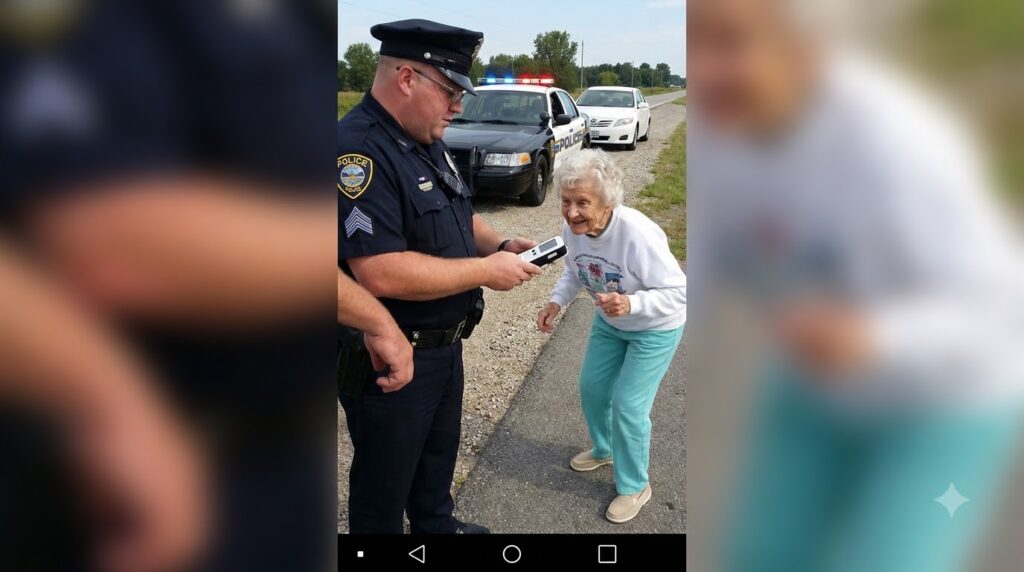
Miller didn’t reach to pull it back. He couldn’t. He stood pressed back against the secondary cruiser’s rear bumper, his chest heaving, his mouth half-open as he watched her unfold the sheet.
“This is an administrative copy,” Miller rasped, his voice barely making it past the dust in his throat. He tried to straighten his peaked cap, but his hand was shaking so hard the brim sat crooked over his brow. “It doesn’t concern the traffic stop, Mrs. Harper. Hand it back.”
“You filed an abandonment lien on parcel T-14 on Wednesday,” Evie said. She didn’t raise her voice, but the silence on the shoulder was so complete that every word carried straight to the open window of the flatbed truck ten yards away. “You signed it as the deputy county assessor pro tem.”
Behind them, the store clerk lowered his phone two inches, his eyes widening as he adjusted his zoom. “Did she say abandonment lien? On Arthur Harper’s lower forty?”
“Your brother-in-law sits on the county drainage board, Miller,” Evie continued, her eyes sweeping the sharp, blue-ink lines of the legal description. “The state highway grant requires three hundred feet of unencumbered frontage to widen the Route Nine culvert. The county offered Arthur sixty thousand five years ago, and he told them to pound sand because it cuts straight through the old springhouse.”
She stepped closer to Miller—not running, not lunging, just taking two firm strides until the blue paper was resting flat against the navy wool over his sternum.
“So when Arthur died, you waited,” she said softly. “You thought an eighty-year-old widow wouldn’t check the courthouse ledger in June. You thought if you pulled me over on a Friday afternoon, took my license, and threatened to impound my car under some fake heat-sensor rule, I’d be too rattled to notice you were serving a road-expansion seizure notice on my dashboard.”
“It’s a legal county procedure!” Miller choked out, his broad face flushing dark purple again as he cast a desperate glance toward the young deputy. “Millerson, tell her! The board voted on right-of-way condemnation in May!”
“The board voted on a survey study, Sergeant,” Deputy Millerson said. His voice was cold now, completely stripped of deference. He stepped away from his patrol car, pulling his small department radio off his shoulder strap. “They didn’t vote on filing a false tax delinquency against an active landowner. My uncle is on that drainage committee, Miller. I know what was on that docket.”
Millerson brought the radio to his mouth, his thumb depressing the side button with a heavy, mechanical click.
“Unit Four to Dispatch,” Millerson said, his voice echoing clearly over the idle of both V8 engines. “Be advised, traffic stop on Route Nine is clear. Sergeant Miller’s patrol vehicle is currently unserviceable. Requesting Deputy Chief or Sheriff on scene immediately for a civil documentation dispute involving county property records.”
“Millerson, cancel that call!” Miller yelled, taking a frantic half-step toward the kid, but his knees gave out slightly under his own heavy weight, forcing him to grab the cruiser’s trunk lid to stay upright. “You don’t cross chain of command on an open channel!”
“The channel isn’t open, Sergeant,” the clerk called out from his truck, his arm propped high as he turned the smartphone around so the screen faced the road. “The live stream has four hundred and twelve local views right now. The County Prosecutor’s office just commented from their official account asking for the location marker.”
The silence that followed was heavier than the heat off the asphalt.
Miller looked at the clerk’s phone, then at the young deputy who had stepped three paces back to separate himself, and finally down at Evie.
The grand sergeant of Route Nine—the man who had spent fifteen years using a badge, a heavy voice, and a fifty-pound belt to bully farm trucks and elderly residents off the shoulder—looked small. His uniform looked too big for his heavy shoulders; his clear glasses were fogged with sweat, and his hands hung uselessly at his sides, fingers twitching around nothing.
Evie folded the blue tax voucher carefully, slipping it into the front pocket of her soft sweatshirt right alongside her driver’s license. She reached into her pocket, pulled out her car keys, and let the brass ring rest against her palm.
“You’re going to move your cruiser out of my lane now, Miller,” Evie said quietly.
Miller didn’t argue. He didn’t quote county code. He didn’t reach for his ticket pad.
Without a word, the heavy sergeant fumbled for his keys, his boots dragging through the crushed limestone dust as he shuffled around to his driver’s side door like a man walking in his sleep.