The Iron Layer Lies Beneath the Freshly Laid Turf of Every Quiet Suburban Empire

CHAPTER 1: THE COLLAR OF CLAY

The clay didn’t want to give. It was old Ohio earth, packed tight by forty years of matching tract homes and the steady weight of riding mowers until it had the density of unbaked brick. Every strike of the spade sent a sharp shock straight through the fiberglass shaft, vibrating up into the callus at the base of his thumb. He didn’t look at the house. He didn’t look at the white-trimmed porch or the custom-painted shutters that matched the color of the late June sky, because the earth didn’t care about decor.

Underneath the manicured fescue, four feet down, the main line was weeping. The leak didn’t show on the surface yet, but the telemetry at the pumping station didn’t lie; thousands of gallons of treated grey water were turning the deep subsoil into a subterranean marsh.

He leaned his weight into the step of the shovel, his boots coated in the slick, iron-red grease of the lower layer. A sharp clink echoed from the trench bottom—not the dull thud of limestone or the hollow scrape of PVC, but the metallic ring of heavy iron meeting solid aggregate. He stopped. He dropped to his knees, his khaki trousers soaking through instantly with damp earth, and used his bare hands to clear the remaining silt.

It wasn’t just the water main. There was an old, unmapped concrete collar surrounding the pipe, stamped with an unlisted industrial mark that predated the subdivision by thirty years. A thick, black secondary conduit disappeared directly into the concrete, running horizontally—not toward the street where the city grid lay, but dead straight under the concrete footings of the chain-link fence.

A shadow broke the glare on the wet grass.

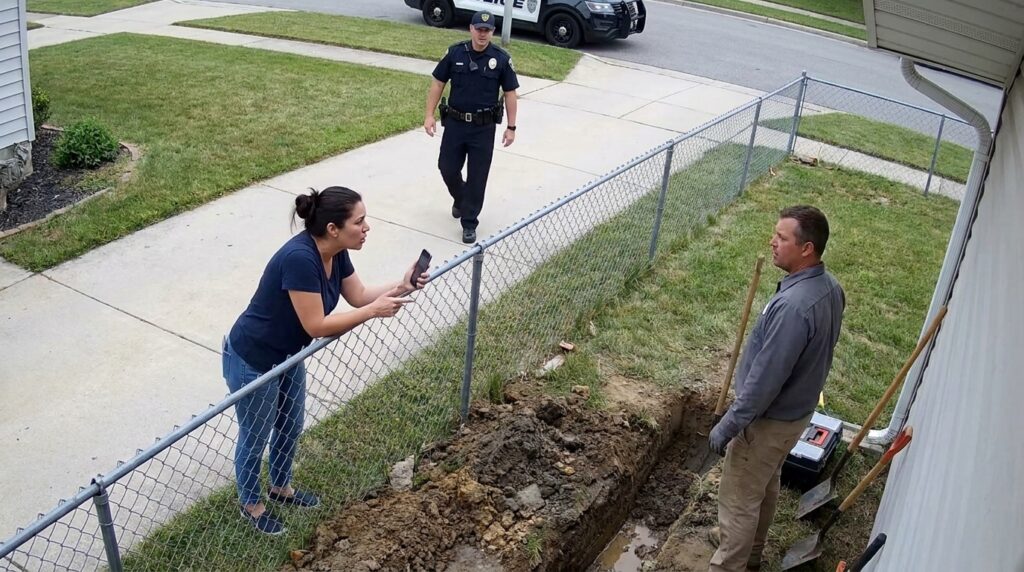
“You touch that fence rail with that machine and I’ll have a deputy out here before the engine cools,” she said from the other side of the zinc-coated mesh. Her phone was already held chest-high, the small black lens focused directly on the sweat ring darkening the collar of his work shirt. She wore a dark navy top that looked too formal for the time of day, her hair pulled back into a knot so tight it seemed to pull the skin of her cheekbones flat.

He didn’t stand up immediately. He stayed down in the dirt for three long seconds, his fingers still resting on the cold concrete collar, calculating the distance between his shovel and the line of her sod.

“Morning, ma’am,” he said, his voice level, dry from the road dust. He took his leather gloves off one finger at a time, tucking them into his hip pocket next to the rolled blueprint of the city easement map. “We’ve got a drop in pressure on the five-inch side. The valve box shows the junction sits right about here.”

“The junction is in the street,” she said, her thumb tapping the glass screen twice without her eyes ever leaving his face. “This yard belongs to lot forty-two. I have the survey from the closing in ninety-eight. You’re six inches past the line, and you’re digging up the root system of my arborvitae.”

He looked past her toward the hedge of cedar trees, their needles already yellowing at the base from the rot below. Then he looked back down at the unmapped conduit disappearing under her soil. The black cable was warm to the touch.


CHAPTER 2: THE MEASURE OF DECEIT

“I don’t need to look at your blueprints,” she said. The smartphone didn’t waver. The plastic casing of her device was clean, a sharp, white rectangle that seemed entirely foreign to the red clay coating his fingers. “I know exactly where my pins are. The town code says municipal contractors must provide forty-eight hours written notice before breaching a private perimeter. You’re an hour early, you don’t have a county flag on your truck, and you’re tearing up private turf.”

He spat into the dry weeds at the base of the post. The dust in his throat tasted like limestone dust and diesel exhaust from the morning route. “The county doesn’t flag easement mains, ma’am. That’s third-party locator work. And this line belongs to the regional district.”

He stepped back down into the trench, his heavy leather work boots sinking an inch into the soft mud around the concrete collar. The weight of his labor was a familiar anchor—the slow, rhythmic ache in his lower back, the way his flannel shirt stuck to the space between his shoulder blades. But the warmth coming off that black conduit wasn’t normal. A low-voltage line for a landscape lighting system or a dog fence didn’t hum against the palm of his glove like a live transformer. It had heat in it. It had the distinct, chemical smell of hot insulation and overloaded copper.

“I’m dialing the non-emergency dispatch now,” she announced. Her voice didn’t rise; it had the flat, practiced cadence of someone who had practiced her complaints in a mirror. “They’ll have a cruiser here in five minutes. Let’s see how much your supervisor likes explaining a property damage citation to the magistrate.”

“Go ahead,” he murmured, not looking up.

He picked up the iron water wrench—the five-pound tool scratched and grayed by twenty years of service in every ditch from here to the county line. The iron was cool, but as he rested the heavy jaw against the concrete casing, the vibration traveled straight through the metal and into his forearm. He wasn’t just working near a leak. Someone had cut into the structural sleeve of the main water trunk to shelter an unrecorded tap.

He could hear her speaking into the phone now, her words drifting over the zinc-coated mesh of the fence. She was using terms like destruction of property, unauthorized sub-contractor, and imminent structural hazard to a private dwelling. She was building her case in real-time, her boots clicking against the concrete walkway as she paced the boundary, never letting the phone camera drop below eye level.

He ignored the noise. He cleared another six inches of clay from the collar, his fingers tracing the rough aggregate until he found the edge of the secondary conduit. It wasn’t standard PVC. It was high-density polyethylene, the kind used for industrial fiber-optic runs or commercial-grade power bypasses. And it didn’t belong to the township.

From three houses down, the low, steady whine of a residential riding mower died out. The silence that followed was heavy, characteristic of a mid-morning suburban cul-de-sac when the ambient noise drops enough for the neighbors to hear the gravel crunching under a strange car. On the porch across the blacktop, an elderly man in an unbuttoned undershirt stepped out into the shade of his awning, a coffee mug balanced on his palm, his eyes locked onto the white utility truck parked at the curb.

They were watching. They always watched when the orange cones went out, but today they were watching for the show.

The sound of an engine came from the turn of the avenue—not the rattling diesel of a city crew, but the clean, muffled idle of a Ford Interceptor. The blue-and-white cruiser slowed as it passed the fire hydrant, its tires throwing up a small spray of loose stone against the curb before coming to a stop directly behind the utility trailer. The driver’s side door didn’t swing open immediately. For ten seconds, the car sat there, its air conditioning compressor clicking under the hood, the dark tint of the windshield blocking the light.

The Neighbor Woman stopped her pacing. She didn’t drop the phone, but her posture straightened, her shoulder blades squaring under the navy shirt as if she were stepping onto a stage she had personally bought and paid for.

“Down here, Officer,” she called out, her voice carrying that sharp, civic clarity. “Right by the lot boundary.”

He didn’t move from the ditch. He remained on his knees, his hands resting on the iron wrench, his eyes fixed on the point where the illegal black line disappeared into the foundation of her chain-link fence. The rust on the bottom rail was fresh, weeping red flakes onto the newly laid sod below. He knew what a standard service map looked like, and he knew that whatever was vibrating beneath his boots wasn’t on any ledger at the town hall. He just needed the clay to clear before the boots on the grass made their decision.

CHAPTER 3: THE STRIDE AT THE BORDER

The crunch of tactical soles against the loose road gravel was a dry, heavy rhythm. The Police Officer didn’t hurry. He adjusted the utility belt riding low on his hips, his thumb hooked habitually near the heavy leather holster of his sidearm, his eyes scanning the orange perimeter cones before they ever dropped to the trench. The morning sun was climbing, drawing a sharp line of heat across the blacktop and turning the exhaust fumes behind the cruiser into a visible shimmer.

“Officer,” the Neighbor Woman said, her stride accelerating along her side of the zinc rail. Her smartphone camera stayed level, tracking the navy fabric of the officer’s sleeve as he neared the interaction lane. “I’ve got an unauthorized excavation happening within six inches of my primary property line. No county notice, no municipal flags, and they’ve already compromised the stabilization turf for my hedge.”

The officer stopped at the edge of the asphalt, his shadow falling across the wet mound of excavated clay. He looked at the white utility truck, then at the brass municipal logo stamped on the technician’s gray work shirt. He didn’t look at her screen. “Ma’am, let’s keep the phone back a foot. Let me see what we’re dealing with here first.”

He didn’t answer her directly. Instead, he turned his cap slightly against the glare and looked down into the three-foot ditch where the iron water wrench rested against the concrete collar. “You with the district water authority, buddy?”

“Yes, sir,” he replied, remaining on his knees. He reached back and pulled the thick, grease-smeared folder from his hip pocket, the thick municipal blueprint unfolding with a crisp, fibrous snap. He didn’t try to climb out of the red muck. “We’re tracking a main-line pressure drop between the street gate and the cul-de-sac. This is the regional district’s primary right-of-way easement. Six feet from the curb centerline belongs to the utility corridor.”

“That easement was restricted during the ninety-eight subdivision expansion,” she interrupted, her voice dropping into a hard, legalistic cadence. She reached into a matching blue folder tucked under her arm, pulling out a crisp, white page bearing a notary’s embossed seal. “The variance is registered with the township board. The city relinquished the secondary access strip when the retaining fence was installed.”

The technician wiped his fingers on his thigh, leaving three thick red streaks across his khaki trousers. He pointed the iron tip of his spade toward the base of the chain-link post. “The fence post is set directly into the concrete sleeve of the main casing, Officer. Someone poured an aggregate footer right over the old cast-iron valve box.”

The officer knelt down, his uniform trousers straining against his knees as he peered into the dark gap beneath the zinc mesh. The gray dust around the post wasn’t standard limestone gravel; it was raw hydraulic cement, the kind used to seal high-pressure water leaks in a hurry without calling the county registry. He pulled a small, black tactical flashlight from his belt and clicked it on, the narrow beam cutting through the damp shadow of the ditch.

The light caught the thick, black polyethylene conduit he had uncovered minutes before. Under the intense white beam, the plastic sleeve wasn’t just warm—the outer coating was lightly sweating against the cool subsoil clay. It thrummed with a rhythmic, high-frequency pulse that caused the small puddles of grey water at the bottom of the trench to ripple in perfect circles.

“What’s that line running into?” the officer asked, the beam tracking the black conduit straight through the illegal concrete footer and directly toward the crawlspace vent beneath the neighbor’s porch.

“It’s not on the regional main map,” the technician said, his voice dropping into a flat, pragmatic tone. He tapped the blueprint with a muddy thumb. “The five-inch iron pipe is city infrastructure. This black sleeve is a third-party pull. Someone drilled right through the structural collar of our main to use the line casing as a conduit for their own private feed.”

The Neighbor Woman’s hand twitched slightly, her phone tilting three degrees off center for the first time since the cruiser had parked. “That’s a protective ground wire for the low-voltage landscape timers. The developer put it in when the subdivision was engineered. It’s completely within our lot allowance.”

The technician didn’t argue. He picked up his iron water wrench again, the heavy tool scraping against the aggregate with a raw, metallic screech. He placed the heavy jaw directly against the concrete collar, right where the black line disappeared into the foundation. “Landscape wires don’t draw forty amps of continuous draw, ma’am. And they don’t hum loud enough to shake the mud off my boots.”

The officer stayed quiet, his flashlight beam lingering on the point where the fence post had been anchored into the municipal asset. He turned his head toward the house across the street, where the elderly man on the porch was now leaning over his railing, his coffee mug forgotten on the wooden post. Two doors down, a woman in a grey sweatshirt had stopped her walk, her eyes fixed on the blue-and-white patrol car. The public pressure was silent, but it was growing with the heat of the morning.

The officer stood up slowly, the leather of his rig creaking as he straightened. He looked at the white notary sheet she was holding out, then at the grease-smeared blueprint resting on the damp mound of clay. The logic of the street was shifting, the small, clear lines of bureaucratic law beginning to fray under the weight of the physical evidence in the ditch.

“Ma’am,” the officer said, his voice level but heavier now. He reached into his pocket for a small notepad. “Who did you say installed that landscape system for you?”

CHAPTER 4: THE BRASS ANCHOR

The steel bristles of the hand brush made a harsh, dry screech against the side of the stone block. He didn’t look at the officer’s notepad or the pale screen of the phone that was still trained on his head from behind the zinc fencing. He concentrated entirely on the layer of calcified white crust that had formed where the black polyethylene conduit entered the concrete casing. With every short, violent stroke of his arm, a fine cloud of gray dust rose from the pit, settling into the damp red clay around his boots like dried flour.

“There’s nothing under there but the subdivision ground assembly,” the Neighbor Woman said. Her smartphone remained level, but the tone of her voice had lost its flat, melodic cadence. It was tighter now, clipping the ends of her vowels as she stood on the dry thatch of her lawn. “The contractor who built this phase signed off on the perimeter layout with the county surveyor. If you damage that footing, you’re looking at a structural failure of a code-compliant barrier.”

He didn’t look up. He blew a hard breath into the gap, clearing the loose grit until his fingers found the edge of a flat metal plate embedded directly into the aggregate. It wasn’t standard iron. It was solid municipal brass, pitted by decades of acidic ground runoff but still showing the heavy, block-letter engraving of the original regional water board.

“Hold the light here, sir,” the technician murmured.

The officer leaned over the lip of the trench, his utility belt clicking against the top rail of the chain-link fence as he angled the white LED beam down into the clay. The light hit the brass plate. The engraving didn’t read Lot 42 Boundary. It read District Main Access Trunk—BM 114. Below the designation, a thick, cold line had been machined straight into the brass, marking the absolute center of the public utility corridor.

The fence post wasn’t six inches outside the line. The heavy galvanized post anchor had been driven directly through the eastern edge of the brass disc, shearing through the old county seal to pin the fence wire into the concrete sleeve below.

“That’s a benchmark disc from seventy-four,” the technician said, his fingers tracing the cold, rough edge of the sheared brass. “The subdivision wasn’t even drawn until ninety-six. This marker means the entire main line sits dead center under this fence strip. The whole perimeter rail is built inside the public easement.”

The officer shifted his light from the brass plate to the black conduit running alongside it. The plastic sleeve was vibrating aggressively now, the high-frequency hum clicking against the iron jaw of the wrench that still rested in the mud. He reached down with his gloved left hand and touched the polyethylene surface, then pulled his fingers back slightly from the heat.

“This isn’t a landscape ground line, ma’am,” the officer said, turning his face toward the fence rail. The white beam of his light caught the navy fabric of her sleeve, throwing her shadow long and distorted against the side of her house. “A low-voltage timer doesn’t generate enough resistance to cook the mud around it. What is this line tapping into?”

“I don’t manage the utility routing for the property,” she said, her phone hand dropping three inches until the lens was aimed at the officer’s shoulder rather than his face. “My husband handles the home infrastructure. We purchased the lot with the improvements already certified by the title company. If there’s an administrative discrepancy with an old benchmark, that’s an insurance issue, not a trespass.”

The technician picked up his small hand spade, using the flat edge to scrape away the remaining silt from the top of the black conduit. As the clay came away, it revealed a secondary splice box—a heavy, waterproof commercial fiber-optic junction box bearing a bright orange tag with no corporate logo, only a hand-written tracking number in permanent marker. The line didn’t pull power from the house; it was a high-capacity commercial data bypass, drawing its primary signal directly from the main regional fiber trunk that ran parallel to the water system.

It was an illegal tap, run inside the city’s concrete protective sleeve to avoid the state telecommunication tolls and the township zoning registry. The neighbor’s husband hadn’t just built a fence; he had used the fence line to conceal a private, commercial-grade network connection that cut straight through the municipal infrastructure.

“The line’s live,” the technician said, his voice completely flat as he tapped the orange tag with his spade. “And it’s leaking current into the ground casing. That’s what’s cooking the valve seal on our water main. The electrolysis from this data line is eating the iron pipe from the outside out.”

The silence from the surrounding porches was total now. The elderly man three houses down had stepped completely off his grass, his slippers clicking on the hot asphalt as he walked toward the rear of the patrol cruiser to get a clearer view of the ditch. The woman in the grey sweatshirt stood fifty feet away, her arms crossed tight against her chest, watching the officer’s notebook as he began writing down the serial number from the orange tag.

The Neighbor Woman didn’t move her feet, but her fingers gripped the galvanized rail of the fence until her knuckles showed white under the morning light. The phone in her hand was completely still now, its screen dark, the performance of neighborhood authority entirely shattered by the cold, pitted brass marker that lay three feet below her sod.

“Officer,” she said, her voice dropping into a low, transactional whisper that barely carried over the top wire of the fence. “We need to wait for my husband to come home before anyone touches that line configuration.”

The officer didn’t close his notepad. He looked from her face down to the warm, humming box in the mud, then back to the technician who remained knees-deep in the clay. “Buddy, you have the authorization to shut down the main zone to isolate that leak?”

“I do,” the technician said, his hand moving toward the heavy iron wrench. “But when I drop the pressure to fix the iron, everything running through this sleeve goes dark.”

CHAPTER 5: THE WEIGHT OF THE LEDGER

The wrench didn’t slip; it bit. When the heavy iron jaw clamped onto the main valve nut, the connection didn’t yield with the clean grease-slip of a maintained municipal asset. Instead, a sharp, violet arc of static snapped out from the concrete collar, striking the steel shaft of the tool with the sound of a dry leather whip cracking against raw stone. The jolt traveled instantly through the thick rubber of his utility glove, a localized explosion of heat that smelled immediately of ozone and scorched canvas.

He threw his weight backward, his mud-slicked boots losing purchase against the bottom of the ditch as his shoulders slammed hard into the dirt bank. The iron wrench dropped into the grey water below, hissing like an anvil dropped into a cooling tub.

“Step out of the hole,” the officer barked, his right hand instantly dropping to the heavy plastic clasp of his duty belt, his leather shoes skidding on the loose gravel at the lip of the trench. “Don’t touch the iron. Stay clear of the water.”

The technician lay back against the cold clay, his right arm throbbing with a dull, pins-and-needles ache that ran from his wrist straight into the meat of his bicep. The water in the pit wasn’t bubbling from water pressure anymore; it was steaming, a thin, white vapor carrying the foul smell of melting PVC insulation and over-cooked soil. The black polyethylene conduit had split down its seam under the sudden surge, revealing a core of silver-plated coaxial bundles that had no business being within ten miles of a residential water main.

“It’s cross-grounded,” the technician muttered, his throat dry as he rolled his knees beneath him and forced his weight up the sloping edge of the trench. His work shirt was soaked across the ribs, the gray fabric turned black by the foul puddle water. “The house ground isn’t neutral. Someone didn’t just tap the fiber—they used the cast-iron casing of the county main as the primary electrical return for their whole secondary data node.”

The Neighbor Woman hadn’t dropped her phone, but she had retreated three paces up her grass, her white shoes stained around the edges by the red silt weeping through the lower wires of the fence. Her face had gone the color of unbaked lime, the tight knot of her hair slightly frayed where the strap of her sunglasses caught the rim of her ear.

“The system is automated,” she said, her voice rising an octave, stripping away the last remnant of her legalistic cadence. She directed the screen toward the front door of her house, where a low, rhythmic chime had begun to sound through the open screen door—the distinct, mechanical chirp of a commercial backup generator kicking in to handle an unmapped power drop. “It has a regional override code. You can’t just kill the feed without a district supervisor’s signature. There are commercial accounts linked to that terminal.”

The officer didn’t look at her notepad anymore. He walked to the driver’s side of his cruiser, his fingers clicking the plastic latch of his radio mic before his door was even fully open. “Dispatch, this is Unit Four. I need a county building inspector down on Elm Street, lot forty-two. And notify the regional utility desk—we’ve got an unmapped high-draw line tapped directly into the water main sleeve. The casing is live.”

The street was no longer silent. The elderly man from across the blacktop had reached the curb, his slippers crunching over the loose gravel until he stood just five feet behind the officer’s rear bumper. Two more neighbors—one holding a garden trowel, another in an oil-stained work apron—had joined the woman in the grey sweatshirt. They didn’t speak to the Neighbor Woman. They stood in a loose, heavy circle, their eyes shifting between the steaming trench and the pristine white trim of her porch. The performance of suburban order had broken down, leaving only the raw, messy mechanics of the infrastructure underneath.

The technician pulled the blueprint folder from his pocket. The paper was wet now, the blue ink starting to run into the margins, but as he spread it across the hood of the utility truck, the physical reality of the township maps became undeniable. He reached into the truck’s side box and pulled out a secondary document—an older, leather-bound county ledger from seventy-four that he kept for checking old benchmark offsets. The pages were yellow, the ink faded to a dark rust-brown, detailing the original farm tracts before the developers had laid down the first square yard of sod.

He traced the old layout with his thumb. According to the original county clerk’s log, the easement wasn’t six feet wide. It was twelve. The entire property line for lot forty-two had been pushed forward during the ninety-eight construction phase to give the houses a deeper front footage, cutting the public right-of-way in half to satisfy the subdivision’s marketing plan. The fence didn’t just encroach on the easement; the entire front yard of the property was built on land that had been deeded to the township before the neighbor’s house was even a blueprint.

“Look at the ledger margins, Officer,” the technician said, his voice level despite the tremor in his right forearm. He didn’t point with his fingers; he used the wooden handle of his brush. “The developer didn’t just shift the pins. They buried the infrastructure under the lot lines to hide the fact that the houses were built eight feet closer to the water main than state safety code allows.”

The officer turned from his radio, his face dark under the shadow of his patrol cap. He walked back to the fence line, looking at the notary paper she was still holding against her hip, then down at the yellowed page of the seventy-four registry. The contradiction was absolute. The legalistic shield she had used to protect her perimeter wasn’t just flawed—it was a document written over an institutional lie that had stayed buried under her grass for nearly thirty years.

“Ma’am,” the officer said, his voice dropping into that heavy, authoritative register that marked the end of civil mediation. He pointed a leather-gloved finger toward the porch where the generator continued to whine. “I suggest you go inside and call whoever authorized that notary seal. Because when the county inspector gets here with the backhoe, that fence is the first thing that’s coming down.”

CHAPTER 6: THE SILENT RETREAT

“This is an unconstitutional seizure of private lot assets,” she said, though she didn’t say it to the officer’s face anymore. She directed the words at the glass screen of her phone, her thumb jerking across the display to kill the live stream feed as her arm finally dropped to her side. The device looked impossibly small against the wide, sun-bleached expanse of her lawn, a clean sliver of plastic that had completely failed to hold the line.

She didn’t wait for the officer to reply. Her heels dug deep into the sod, leaving two small, torn plugs of green fescue in the turf as she turned her back to the fence. She marched up the gentle slope toward her front porch, her shoulders pinned back so hard her navy shirt bunched between her blades. The front screen door didn’t slam; the heavy hydraulic closer caught it at the last half-inch, shutting it with a dull, pressurized hiss that sounded like a long-held breath escaping an iron valve.

The technician didn’t watch her go. He remained down on the edge of the asphalt, his fingers tracing the rusted underside of the fence rail where the zinc coating had completely peeled away. The metal was pitted, the orange oxidation coming off on his skin in dry, chalky scales that smelled faintly of rotten sulphur and dead soil.

“The line’s still drawing,” he said, nodding toward the split polyethylene conduit down in the mud. The steam had thinned out, but the foul chemical heat still lingered in the bottom of the trench, a quiet, expensive hum that vibrated the loose stones around his boots. “If the backup generator inside her house is matching the frequency, her husband’s data hub is burning through its own infrastructure right now. It won’t hold twenty minutes before the primary switches melt.”

The officer stepped back from the trench, his black leather utility belt giving a long, creaking groan as he shifted his weight. He didn’t look up the hill toward the closed door. He turned his face down the street, where the crowd of neighbors had grown by three more households.

The old man from across the blacktop had reached the edge of the municipal truck’s bumper. He had set his coffee mug down on the metal tailgate, his thick, veiny hands hooked into the pockets of his gray trousers as he stared at the exposed brass marker.

“That’s the old line benchmark, isn’t it?” the old man asked. His voice was low, gravelly from a lifetime of foundry smoke, carrying no neighborly warmth—only the cold curiosity of someone who had watched this subdivision rise out of a bean field thirty years before. “The one the county crew put in when they widened the culvert back in seventy-four.”

“Yes, sir,” the technician said, clearing a handful of loose limestone from the edge of the disc. “The surveyor’s line tracks straight through that garage wall down at the corner of the bend. Every property stake on this side of the lane is shifted eight feet into the road allowance.”

The neighborhood woman in the grey sweatshirt let out a short, dry laugh. She didn’t look at the house at lot forty-two. She looked at the old man, her arms crossed tight against her ribs to ward off the rising morning heat. “My husband told the HOA board two years ago that our title insurance maps didn’t match the township tax grid. They threatened to fine us for parking our trailer on the easement strip. Said we were violating the aesthetic boundary.”

The silence that followed was heavy, the kind of stillness that settles over a street when people realize the rules they’ve been paying dues to enforce were written by the people who stole the ground underneath them. No one spoke up for lot forty-two. No one looked toward the house with the brick facade or the custom-painted shutters. They stood in the dust, their shadows shortening as the midday sun climbed into the center of the Ohio sky, watching the red clay slowly weep water back into the municipal ditch.

The technician reached down and retrieved his five-pound iron water wrench from the bottom of the pit. The tool was black now, the original gray enamel scorched off the jaw by the static arc from the illegal bypass. He used a piece of coarse burlap from his truck bed to wipe the grimy grease from the handle, the friction making a dry, rhythmic hiss that was the only sound left on the blacktop.

“We’re going to have to bring the line truck down from the yard,” the technician told the officer, his voice flat with the pragmatic exhaustion of a man who still had five more hours on his shift. “We can’t patch the iron with this bypass still pulsing. The weld won’t stick while there’s current in the pipe.”

The officer nodded, his fingers tapping the small leather case of his notebook against his thigh before slipping it back into his pocket. “The building inspector’s supervisor just called back on the secondary band. They’re pulling the original plat maps from the county seat right now. I’m staying here until the county truck drops its jacks.”

He looked down the line of the fence, where the galvanized rail stretched straight and true across three more lawns, its silver mesh glittering under the fierce, clean light. Every single post was set into the same concrete casing. Every single yard was an encroachment. The neighbor’s phone had gone dark, but the physical evidence was just beginning to surface, an entire neighborhood built over an unrecorded lie that was finally starting to rust from the inside out.

CHAPTER 7: THE RUSTED PAPERWORK

The carbon sheet in the regional water board logbook was so dry the upper corner snapped away under the pressure of his thumb. He sat on the metal bench seat of the utility truck, the door flung wide to catch the heavy midday heat, his grease-blackened fingers pinning down the edge of the 1974 plat overlay. The paper had a chalky, sulfurous odor, the product of three decades spent inside an unsealed iron lockbox at the district pump house.

“The county recorder’s office just pushed the digital duplicates to the terminal,” the officer said, leaning his forearm against the truck’s open window frame. The heavy fabric of his sleeve was gray with stone dust from the ditch line, and the plastic edge of his radar unit gave a low, metallic beep as the dispatch network refreshed. “They’re matching the nineteen-ninety-eight variance filed by the builder. The dimensions check out on their screen.”

The technician didn’t look at the officer’s digital display. He took a short, flat steel ruler from his breast pocket and laid it across the hand-inked scale of the old paper ledger. “The builder’s screen is wrong, sir. Look at the benchmark stamp on the lower margin. It’s a two-pin reference, not a three.”

He leaned closer to the page, his thumbnail tracing the dry, red line that marked the absolute boundary of the public utility corridor. The original ink—formulated with copper sulfate before the clean-water regulations took effect—had eaten slightly into the fiber of the page, leaving a faint, green-tinged shadow where the twelve-foot allowance had been recorded.

“The subdivision layout used a three-pin configuration to draw the fence line,” the technician said, his voice dropping into that flat, unyielding register of a man who trusts the metal over the document. “They calculated the easement from the edge of the asphalt instead of the center of the water main. That gave the developer an extra six feet of marketable lot width per house. They didn’t just shift the pins to hide the line—they falsified the primary benchmark to clear the foundation inspections.”

The officer shifted his stance, the heavy leather of his utility rig giving a short, wet creak against the hot steel of the door panel. He looked down the length of Elm Street, where the silver chain-link fence ran in an unbroken, glittering line across five straight lawns. Every single post anchor was set into the exact same red clay layer. Every single driveway was an eight-foot trespass over a five-inch high-pressure main trunk that had been laid down before the first tree had been cut for the cul-de-sac.

The front screen door of lot forty-two remained closed, but the small white generator on the side porch had dropped its pitch. The steady, high-frequency whine had given way to a wet, rhythmic rattling—the distinct sound of an ungrounded system choking on its own residual current. Inside the house, the data terminal was starving, its commercial-grade servers overheating behind the drawn blinds because the iron pipe in the ditch could no longer sink the stolen voltage.

The old man from across the blacktop was still standing by the truck’s tailgate. He had picked up his coffee mug, but he hadn’t taken a drink; his eyes were fixed on the deep red stain running down the sleeve of the technician’s gray work shirt.

“The county inspector’s truck is turning off the state route now,” the old man said, pointing with the handle of his spoon toward the intersection. “They’ve got the heavy trailer with them. The one with the dual-wheel excavator.”

The technician closed the leather-bound book with a heavy, hollow thud that threw a small cloud of grey soot into the cab. He slid his boots back into the red muck of the ditch, the wet clay suctioning against the rubber soles with a wet, heavy smack. The iron water wrench was still cool at the base of the hole, its handle resting against the pitted brass disc that had started the collapse.

The physical reality of the street was no longer a matter of private titles or aesthetic variances. The infrastructure was asserting its own logic, the decaying iron pipe beneath the sod demanding the ground back with every drop of pressure that leaked into the lower subsoil. The neighbor’s smartphone had been a tool of digital surveillance, an attempt to police the surface with a plastic screen, but the true authority was written in the three feet of rotten clay and the ungrounded copper that was currently melting inside her wall.

“We aren’t going to patch it from the ditch,” the technician told the officer, his hand clamping onto the cold iron of the wrench handle. “The electrolysis has taken out the whole section under the concrete footer. When the state crew drops their blade, they’re going to have to rip the entire corner off that lot just to keep the main from blowing the street out.”

The officer didn’t answer. He turned his head as the heavy diesel rumble of the county line truck began to echo through the cul-de-sac, the orange strobe lights on its cab casting a rhythmic, warning glare across the manicured lawns and the silent porches. The neighborhood watchers didn’t scatter; they moved closer to the curb, their faces pale under the midday sun, waiting for the first piece of galvanized steel to hit the turf.

CHAPTER 8: THE RETURN TO EARTH

The yellow steel teeth of the county backhoe bucket didn’t glide through the lawn; they struck with the heavy, concussive thud of an artillery piece dropping into raw stone. When the operator pulled the hydraulic levers back, the three-ton bucket bit deep into the manicured fescue of lot forty-two, shearing cleanly through the fresh sod and the underlying gravel sub-base with a deafening, metallic screech. The earth split open in a ragged, jagged red wound, throwing up a shower of dry clay clods and fragmented stones that rattled against the utility truck’s steel fenders like hailstones.

He stood back at the edge of the asphalt, his fingers tucked into the grimy waistband of his tool belt, his chest rising and falling in slow, heavy counts. Time seemed to drag under the weight of the machine’s roar. He watched the heavy steel bucket descend again, tracking the path of the original nineteen-seventy-four benchmark line. The tooth of the bucket caught the top rail of the chain-link fence, the zinc-coated wire screaming as it was twisted into a tight, useless knot of silver hair.

The galvanized corner post—the one she had guarded with her smartphone screen just hours before—didn’t lift out cleanly. It tore from its concrete sleeve with a dull, subterranean boom, ripping up forty square feet of root system and exposing the massive, unmapped concrete casing of the municipal water gate beneath.

The Neighbor Woman came out onto her porch one final time, but the phone was gone. She stood behind the white-painted square pillars of her entryway, her arms hanging limp at her sides, her navy shirt completely darkened across the chest by sweat and dust from the diesel exhaust. She didn’t call out. She didn’t produce any more notary papers. Her mouth stayed closed as she watched the county crew systematically dismantle the perimeter of her lot, the heavy rubber tires of the loader crushing her yellowing arborvitae into a wet, green paste against the clay.

The technician looked down into the widening pit. With the fence post removed, the true layout of the infrastructure was fully visible under the harsh, white glare of the afternoon sun. The five-inch cast-iron water main sat exactly where the yellowed pages of the old ledger had placed it—dead center beneath her former boundary, its rusted surface sweating under the pressure of the district flow.

The illegal black data conduit had been severed by the first pass of the blade. Its silver-plated coaxial core lay exposed in the mud, sparking weakly as the household backup generator finally seized up inside her basement, its ungrounded circuit dying with a series of sharp, mechanical pops that sounded like dry kindling snapping under a heavy boot.

The old man from across the street stepped up beside him, his thick leather slippers covered in the fine, gray limestone dust that had settled over the entire cul-de-sac. He set his empty coffee mug down on the curb, his hands returning to his pockets as he looked at the open trench.

“They’re going to have to do the same thing to every house down to the corner, aren’t they?” the old man asked. His voice was nearly lost beneath the rattle of the excavator’s engine, but it carried the quiet, unyielding weight of a truth that could no longer be kept under the earth.

“Every single one,” the technician said, his voice level, completely stripped of rancor or triumph. He picked up his five-pound iron water wrench from the side box of the truck, the cold gray steel heavy and solid in his grip. “The whole street sits on the county line. The town’s going to clear the entire twelve feet back to the nineteen-seventy-four pins before we can lay the new sleeve.”

The officer stood by his cruiser, his notebook closed, his fingers resting casually on his utility belt as the county crew set their hydraulic jacks into the road surface. He didn’t issue any citations. He didn’t need to. The unyielding logic of the grid had executed its own judgment, the buried iron asserting its right to the ground through three feet of raw clay and thirty years of engineered deceit.

The technician walked toward the edge of the pit, his boots sinking into the loose, red silt as he prepared to descend for the afternoon weld. The air smelled of burnt transmission fluid, wet dirt, and the sharp, metallic tang of oxidized iron. The neighborhood watchers remained on the curb, their faces silent and still as they watched the machine lift the last remnant of the fence wire into the air, leaving the street completely open to the wider, unvarnished horizon of the county road.

Similar Posts

Leave a Reply

Your email address will not be published. Required fields are marked *