
The Iron Beneath the Sod: A Novel of Property Lines, Protocol, and Private Boundaries

CHAPTER 1: THE ACCUSATION AT THE LATCH

The shadow fell across the cut rye grass before the boots hit the fence line.

Clara didn’t stop her trowel. The soil was damp three inches down, rich with late-spring rot, clingy enough to stain her palm through the weave of her garden gloves. Beside her, Barnaby—eighty pounds of light brown mutt with a graying muzzle—shifted his weight on the stone paver, his tail thumping once against the cedar post before going completely motionless.

“Unlock the latch,” the man said.

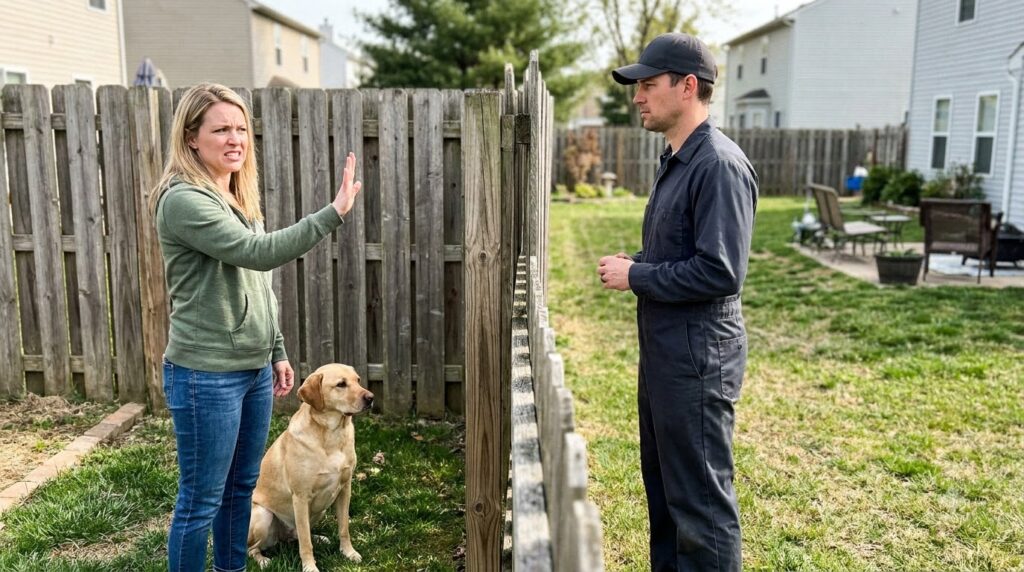
He stood on the gravel alley side of the six-foot privacy fence, his dark cap pulled low enough to cut a shadow across his cheekbones. His uniform was dark charcoal, unbadged on the chest except for a rubberized municipal crest stitched onto the shoulder. Under his arm rested a heavy vinyl clipboard, its top clip holding a stack of yellow triplicates that fluttered in the cross-wind.

Clara stood slowly, wiping her trowel against the thigh of her denim jeans. Her green hoodie smelled of woodsmoke and damp earth. She didn’t reach for the brass drop-latch on her side of the gate. She didn’t move toward the fence at all.

“You’re on private property,” Clara said. Her voice didn’t carry past the top rail, but it didn’t need to. The alley was narrow, framed by cedar pickets on one side and old telephone poles on the other. “And the gate stays locked.”

The responder shifted his posture, bringing his chest square to the cedar pickets. “I have an active dispatch for a setback hazard and an unpermitted secondary drainage obstruction along this boundary. Code Enforcement Section 4-B gives us immediate entry authority for active utility site assessments.”

Across the gravel lane, old man Henderson’s kitchen blinds twitched. Clara didn’t look, but she knew the rhythm of the block. A dark uniform in the alley meant gossip by six o’clock; a clipboard meant a lien if you let the paper sit too long on your counter.

“Section 4-B applies to emergency water main breaches and municipal utility lines,” Clara said, taking two deliberate steps toward the fence line, her arm rising in a sharp, flat gesture that cut the air directly between them. “This fence sits three inches inside my deeded boundary. You don’t have a warrant, you don’t have an emergency order, and you cannot just come into my space and ignore my boundaries.”

The responder froze. His fingers tightened around the aluminum lip of his clipboard. For a second, the institutional certainty in his face wavered, revealing the tired, overworked bureaucrat beneath the dark cap. He looked past her shoulder at the immaculate line of her raised vegetable beds, then down at the quiet dog sitting rigid beside her knee.

“I hear you,” he said, his voice dropping an octave, tightening into a practiced, rehearsed de-escalation tone designed to calm angry homeowners without surrendering an inch of territory. “Let’s keep this calm. But I have a signed affidavit from an adjacent property owner reporting an illegal structure built over a city easement. If I can’t verify those plot pins right now, I’m required to issue an administrative obstruction notice.”

He tapped the top yellow sheet on his board. Prominently displayed across the header was a stamped red seal, and directly below it sat a photostat map outlining Clara’s rear fence line in thick black marker—with a bright red diagonal strike marking the exact spot where her feet were planted.


CHAPTER 2: THE PAPERWORK AT THE FENCE

Clara didn’t reach across the top rail to touch the paper. She leaned in just enough to smell the fresh toner on the yellow triplicate sheet—industrial, metallic, still crisp from an office laser printer.

“That’s a photostat,” she said. Her voice stayed low, under the whisper of the wind through the cedar pickets. “The county seal at the top is grayed out, but that red line was drawn with a fresh marker.”

The responder’s eyes narrowed under the bill of his dark cap. He pulled the clipboard back an inch, a subconscious defensive pull that told Clara more than any ordinance code could.

“It’s a dispatch map printed straight from the municipal GIS terminal thirty minutes ago,” he replied, though his voice had lost its flat, practiced edge. “Code Enforcement doesn’t draw on these by hand.”

“Then someone did it before it went into your queue,” Clara said. She turned her gaze past his shoulder, down the gravel alley where a silver sedan sat idling near the corner. The driver’s side window was down two inches, just far enough for a glint of sunlight to bounce off a pair of dark tortoiseshell sunglasses. Henderson’s wife wasn’t even pretending to weed her hydrangeas today.

Barnaby let out a low, vibration-only growl deep in his chest. Clara laid two fingers flat against the dog’s ribcage, feeling the steady, warm rhythm of his breathing.

“I’m going to my porch,” Clara said, stepping backward without turning her spine to the fence line. “I’m getting my weather folder. You stay on that side of the cedar posts.”

“If you lock yourself inside, I’ll have to call for dispatch backup,” the responder called after her, his boots scraping against the loose gravel as he shifted his stance to maintain eyes on her. “Standard protocol for uncooperative entry.”

“Call them,” Clara said over her shoulder. “Tell them to bring the chief inspector while they’re at it.”

She didn’t run. Running gave authority figures something to pursue. She walked at a measured pace across the damp lawn, her boots leaving shallow depressions in the rye grass. The air carried the heavy, iron-rich scent of the turned garden soil, mixed with the faint sulfur smell of the old municipal well line two streets over.

The back porch steps were raw fir, grayed by five winters of Oregon rain. Under the second step sat a dark, heavy-gauge vinyl folder—waterproof, zipper-sealed, and hidden behind a stack of terracotta pots. She had kept it there since March, ever since the first anonymous notice about her compost bin had appeared tucked under her windshield wiper.

Clara unzipped the folder with a sharp, dry rasp. Inside lay three sheets of heavy vellum, protected by clear plastic sleeves. She didn’t grab the top sheet—the basic property description everyone gets when the title company clears escrow. She slid her fingers down to the second tier, pulling the folded, triple-stamped county survey map from April of three years ago.

Attached to the corner of the survey was a small, plastic evidence bag. Inside it sat a single chip of flaked orange paint, recovered from the grass three weeks after she moved in, right where a sledgehammer had struck the original iron corner pin.

She turned back toward the yard just as the responder raised a heavy black radio to his shoulder.

“Control, this is Unit Four,” the responder said, his voice carrying clearly over the fence rail. “I have a refusal at the rear access point on Elm Lane. Subject is non-compliant, claiming boundary variance. Requesting secondary verification on file number 84-C.”

Clara stopped at the edge of her garden bed, five feet from the fence line. She held the vinyl folder against her chest like a shield made of thick paper and dry ink.

“File 84-C?” Clara asked, her eyes fixing on his badge clip. “You’re running this off an eighty-four series file?”

The responder lowered the radio, a flicker of hesitation crossing his face before he smoothed it over with a hard set of his jaw. “File eighty-four-C is the primary drainage corridor easement for this block.”

“File eighty-four-C,” Clara said, her voice dropping into a dangerous, quiet precision, “was opened forty years ago when the county tried to put a storm culvert through this lot. It was never executed.”

“The system shows an active flag,” he insisted, though his fingers tapped nervously against the edge of his clipboard.

“The system shows whatever someone uploaded to the online portal during the public review window last Tuesday,” Clara countered. She unzipped the plastic sleeve and pulled out the survey map, unfolding it with a crisp, dry snap. “This is a certified land survey signed by a licensed county surveyor fourteen months ago. The iron pin sits eighteen inches below the sod right under your left boot.”

The responder looked down involuntarily at his boots, shifting his heel away from the base of the cedar post.

“You want to inspect a setback?” Clara continued, stepping directly up to the fence line until only six inches of air separated her hoodie from the wooden pickets. “Get a shovel. Dig four inches down right where you’re standing. If you hit concrete or a pipe, you can break my latch. But if you hit an iron pin with orange chalk on the cap, you’re standing on private land without a permit—and every second you stay there is recorded on the lens right behind my eaves.”

She pointed up toward the shadow of the roofline, where the small glass eye of her security camera reflected the gray sky, its red status LED pulsing silently once every three seconds.

Across the alley, the silver sedan’s engine revved once, then went dead silent.

CHAPTER 3: THE CODE OF EXHAUSTION

“You think the lens changes the code, ma’am?”

The responder’s voice was lower now, raspier, the thin glaze of customer-service composure cracking down the center. He didn’t look up at the black dome mounted under Clara’s eaves, but his shoulders hitched higher under his charcoal uniform shirt. He tapped the edge of his clipboard against the top cedar rail—clack, clack, clack—a dry, rhythmic strike that made Barnaby’s ears swivel backward.

“The lens records the trespass,” Clara said. She didn’t retreat an inch from the fence line. Her boots stayed planted in the damp grass, three inches inside her property line. “And it records the fact that you haven’t produced an entry warrant, a signed access order, or a verified utility emergency dispatch.”

“I have an administrative dispatch ticket,” he said, turning the clipboard slightly so the white glare of the afternoon sky bounced off the laminated surface. “File 84-C isn’t an internet upload. It’s a recorded municipal easement corridor for the entire east side of Elm Lane. You don’t get to opt out of the town storm-water management grid just because you put up six-foot cedar pickets.”

“File 84-C is forty years old,” Clara repeated, watching his eyes. “And if it was an active easement, your department wouldn’t have issued a building permit for this fence when the previous owner put it up in ninety-eight.”

The responder hesitated, his thumb scraping along the metal spring clip at the top of his board. In that fraction of a second, Clara caught a detail she hadn’t seen when he was holding the papers at his waist: tucked behind the top yellow sheet was a pink index slip—the kind used exclusively for private intake complaints at the front counter of the county building, not digital dispatches sent to field units. Across the top margin of the pink paper, written in tight, slanted blue ink, was a parcel number that didn’t belong to her lot.

It belonged to the 1.2-acre parcel directly behind her—the house with the silver sedan and the manicured, weed-free hydrangeas.

“The ninety-eight permit was issued under prior county parcel maps,” the responder said, stepping closer until his dark belt buckle pressed against the outside pickets. He leaned over the top rail, bringing his face within two feet of hers. “Maps that didn’t account for the nineteen-eighty-four storm runoff declaration. I’m not here to argue title law with you on a Friday afternoon, Miss Vance. I’m here because if there’s an obstruction in this easement when the spring rain hits, the water backs up into three basements down the line. That makes it a public hazard.”

“There is no pipe under this lawn,” Clara said, her voice dropping into a flat, unyielding register. “There is no culvert. There is no public drain. There is four inches of topsoil, eight inches of river rock, and three feet of tight clay. If Henderson has water in his basement, it’s because his downspouts dump directly onto his own patio foundation instead of the alley gutter.”

The responder’s jaw muscles tightened. He reached down to his utility belt, unclipping a heavy, rubberized flashlight—not to illuminate anything in the bright afternoon sun, but to hold something heavy and solid in his hand.

“I’m giving you a formal verbal directive,” he said, leaning his weight forward so the top rail groaned under the pressure. “Unlock the rear gate. Allow me five minutes to conduct a surface visual assessment of the easement corridor, or I mark this file as an active physical obstruction. That triggers an automatic enforcement lien and a mandatory hearing before the county magistrate in twenty-one days.”

“Do it,” Clara said.

The word hung between them, hard and cold as an iron stake.

The responder blinked, his hand freezing on the body of the flashlight. “What?”

“Mark it,” Clara said, stepping forward until her hoodie brushed the inner face of the cedar posts. “Mark it as an active obstruction. Put your name on the signature line at the bottom of that yellow sheet. Write down that you inspected the site, verified the 84-C easement, and refused to review the 2021 certified survey presented by the property owner on site.”

She pointed a gloved finger straight at the pink slip peeking out from under his clipboard stack.

“And make sure you attach that private intake slip from Henderson,” she added, her voice chilling the warm spring air. “The one with his parcel ID written in the margin. Because when I file the counter-affidavit for harassment under Section Twelve of the Civil Standards Act, the magistrate isn’t going to look at your storm-water map. He’s going to ask why a field inspector executed an emergency entry protocol based on an unverified complaint from a neighbor who tried to buy this three-foot strip from the bank during my foreclosure proceeding three years ago.”

The responder’s posture went instantly rigid. His eyes darted down to the pink slip, then back to Clara’s face, the institutional confidence draining out of him like water through a cracked pipe.

Behind him, the gravel in the alley crunched under a second set of heavy tires. A white county SUV with a high-mounted light bar pulled up behind his parked service sedan, its engine humming with a low, deep idle that shook the cedar fence posts.

CHAPTER 4: THE IRON UNDER THE SOD

The driver’s side door of the white county SUV opened with a heavy, pressurized thunk.

A woman stepped out onto the gravel lane. She didn’t wear a dark cap or a utility shirt; she wore a high-visibility orange vest over a canvas barn jacket, a brass-rimmed magnifying loupe dangling around her neck by a leather cord. She pulled a worn leather binder from the passenger seat, resting it against her hip as she took in the scene with a quick, practiced sweep of her eyes.

The responder turned sharply toward her, his posture snapping into a rigid, defensive straightness. “Inspector Miller. I was just conducting the preliminary access check on dispatch file 84-C.”

“I heard the dispatch radio call,” Miller said. Her voice was dry, raspy, conditioned by thirty years of breathing dust in county archive basements and road-crew trenches. She didn’t look at the responder. Her eyes drifted over the top of the cedar pickets, landing directly on Clara, then shifting down to the waterproof vinyl folder held firmly against Clara’s ribs. “You called for secondary verification.”

“The resident is refusing entry,” the responder said, gesturing toward the gate. “She’s disputing the active drainage easement.”

Clara didn’t wait for Miller to ask. She dropped to one knee right in the damp rye grass, five inches inside her fence line. The cold soil soaked through the knees of her denim jeans instantly, but she didn’t care. She reached into her hoodie pocket, pulled out the flat-head trowel, and sliced a neat, six-inch square into the turf directly below the cedar post.

“What are you doing?” the responder demanded, taking a half-step toward the fence rail.

“Exposing the record,” Clara said without looking up.

She levered the trowel under the sod. The grass roots groaned as they parted from the clay beneath, peeling back in a clean, square flap. Underneath lay four inches of dark, undisturbed topsoil mixed with crushed river stone. Clara dug her gloved fingers straight into the dirt, clawing through the cold silt until her nails struck something dense, unyielding, and metallic.

Clink.

The sound was sharp, resonant—the unambiguous ring of heavy forged steel buried deep in the earth.

Clara scraped the loose dirt away from the top of the object. A round iron cap, roughly the size of a silver dollar and heavily encrusted with flaked orange surveyor’s chalk, sat flush against the clay strata. Across its face, stamped deep into the steel forty years ago, were four raised numbers: 1984-PIN.

“There’s your 1984 boundary anchor,” Clara said, her breath fogging slightly in the cool air as she stood up, her palm covered in red-clay mud. She pointed down through the fence pickets at the exposed iron head. “Eighteen inches inside the alley gravel. Three inches outside my cedar post. Your 84-C file isn’t an open corridor—it’s an easement reservation that was tied to the old county storm culvert project.”

Inspector Miller stepped closer to the fence, her heavy work boots crunching deliberately over the loose gravel. She reached down, unhooked the magnifying loupe around her neck, and bent over the top rail to peer down into the small square hole Clara had cut into the turf.

“Let me see that folder, Miss Vance,” Miller said softly.

Clara unzipped the clear plastic sleeve and held the county-stamped 2021 survey map over the top rail. She didn’t let go of the paper; she held it flat so Miller could read the raised embossed seal at the bottom right corner.

Miller examined the seal, then reached out with one gloved finger and flipped back the top yellow triplicate sheet on the responder’s clipboard, exposing the full document underneath.

There, stamped in faded, eighty-four blue archival ink along the bottom margin of the original municipal record, was the physical evidence Clara had been hunting for: a recorded reservation clause granting the county a twenty-foot wide drainage corridor running directly across the rear third of the parcel.

The responder leaned in, a triumphant glint returning to his eyes. “There it is,” he said, pointing at the blue stamp. “Eighty-four easement clause. Right there on the master deed record. That corridor covers this entire lawn, six feet deep.”

Clara felt a cold knot tighten in the pit of her stomach. The survey in her hands showed clean boundaries, but the document on the responder’s board—the actual 1984 county master record—contained an active, un-cancelled drainage reservation stamp that she had never seen before. Her 2021 survey had cleared the title based on local boundary pins, but it hadn’t erased the underlying archival easement reservation sitting quietly in the county’s legacy system.

Miller didn’t declare victory for either side. She drew a slow breath, her thumb tracing the edge of her leather binder.

“The 1984 easement reservation is real, Miss Vance,” Miller said, her voice dropping into a grave, heavy register that carried across the quiet yard. “It’s stamped right here on the master parcel map. As far as this clipboard is concerned, this entire fence sits inside a restricted county drainage zone.”

Across the alley, the driver’s door of the silver sedan clicked open. Henderson stepped out onto the gravel, a thin, satisfied smile playing across his lips as he straightened his sweater vest and began walking toward the fence line.

CHAPTER 5: THE STANDOFF AT THE BOUNDARY

“I told you the easement was valid, Arthur.”

Henderson’s voice drifted over the cedar pickets, smooth and dry as seasoned firewood. He stopped two feet behind the responder, his hands tucked neatly into the pockets of his beige cardigan. His leather loafers made a sharp, grinding noise against the alley gravel—a sound that sent a cold spike of adrenaline straight up Clara’s spine.

“It’s not your call to make, Henderson,” Clara said. She didn’t rise from her knees immediately. She stayed grounded, one dirt-caked glove resting flat against the cold top of the iron pin, holding her position like a soldier defending a breach. “You don’t work for Code Enforcement.”

“No, but I pay county taxes on three adjoining parcels,” Henderson replied, leaning slightly to peer over the responder’s shoulder. His eyes flicked down to the exposed pin, then to the yellow triplicate form on the clipboard. “And when a property owner obstructs a designated regional drainage corridor, it creates an actionable nuisance for the entire block. Inspector Miller knows the administrative code.”

The responder looked between Henderson and Miller, clearly relieved to have a prominent local resident backing his initial assessment. “Inspector, if the eighty-four reservation stamp is active on the master file, protocol requires an immediate preliminary halt-work and fence removal order for the encumbered corridor.”

Clara stood up slowly, wiping her clay-stained glove down the thigh of her jeans. Her chest felt tight, the air cold and thin in her lungs. The decoy record—that eighty-four stamp—had trapped her. The survey in her hands was a certified boundary map, but it didn’t automatically strike a legacy municipal reservation off the county’s central ledger.

“Look at the pagination,” Clara said, her voice cutting through the rising wind.

Inspector Miller paused, her fingers hovering over the heavy leather binder resting on her hip. “What did you say, Miss Vance?”

“Look at the bottom corner of the master record in your binder,” Clara said, stepping directly to the fence rail, her green hoodie pressing against the cedar pickets. “The yellow sheet on his clipboard has the eighty-four stamp. But your archival ledger has page numbers in the bottom right corner. What page is that yellow sheet copied from?”

Miller frowned, unclipping her magnifying loupe again. She reached out and pulled the responder’s clipboard toward her, turning the yellow sheet over to examine the bottom edge where the paper had been fed through a high-volume scanner.

Across the alley, Henderson’s hands slid out of his cardigan pockets. His left thumb twitched against his knuckle.

“The copy on the clipboard is listed as Page Three of File Eighty-Four-C,” Miller murmured, her eyebrows knitting together under the brim of her work hat. She flipped open her leather-bound master ledger, her gloved thumb running rapidly through thick, yellowed sheets of archival vellum. “Page one… page two… page three…”

She stopped. Her thumb froze against the edge of a crisp, white page that had been inserted into the book with a heavy plastic hinge.

“Page three in my master ledger isn’t a drainage reservation,” Miller said, her voice dropping into a flat, deadly quiet. “Page three is a municipal vacation certificate.”

The responder blinked, looking bewildered. “A what?”

“A deed vacation,” Clara said, the pieces snapping together in her mind with the force of a slammed trap. She looked past the responder’s shoulder, her eyes locking onto Henderson’s tight, pale face. “A vacation order means the county formally abandoned the drainage corridor forty years ago when they rerouted the storm culvert down Main Street.”

“That… that copy was pulled directly from the public portal this morning,” the responder stammered, pointing a shaking finger at the yellow sheet. “The file was uploaded as an active exhibit under File Eighty-Four-C.”

“Uploaded by whom?” Miller asked, turning her head slowly to look at Henderson.

The wind rustled through the cedar pickets, carrying the faint, bitter smell of exhaust from the idling white SUV. Nobody spoke. Two neighbors across the lane stepped out onto their back porch steps, watching the huddle at the fence line in complete silence.

Henderson didn’t flinch, but his jaw set into a hard, rigid line. “The public portal accepts certified record submissions from affected property owners. If there’s a discrepancy between the legacy files and the digitized archive, that’s an administrative error for the county recorder to clear up—not a reason to allow an unpermitted fence to block historical water flow.”

“It’s not a discrepancy,” Clara said, her voice ringing out crisp and clear over the cedar posts. “It’s a redacted record. You submitted Page Three from the nineteen-eighty-four draft file and left out the two-thousand-two vacation certificate that cleared my deed.”

She raised her hand in a final, unyielding boundary gesture, her gloved fingers pointing directly at the gate latch.

“Inspector Miller,” Clara said. “Check the county digital GIS log right now. See whose user account uploaded that redacted PDF to my property file last Tuesday.”

CHAPTER 6: THE DISPATCH AUDIT

Inspector Miller didn’t ask Henderson for permission. She reached into her barn jacket pocket, pulled out a thick, rubber-armored county tablet, and tapped the glass screen with the tip of her fingernail. The cold backlight cast a pale blue glow over her weathered knuckles as she booted the administrative GIS terminal directly from the white SUV’s wireless relay.

“You don’t need to do that here,” Henderson said, his voice losing its polished composure, a sharp, metallic edge cutting through his words. “This is an active code enforcement check, not a public records audit. If there’s an issue with the document indexing, the county recorder handles it on Monday.”

“I handle code enforcement dispatches in this district, Mr. Henderson,” Miller replied without looking up from the screen. “And when a field officer is called out on an emergency priority code based on an online portal upload, I verify the audit trail before I sign an entry order.”

The responder stood frozen between them, his clipboard held slack against his thigh. He looked from Henderson’s tight, pale face to the screen in Miller’s hand, his throat moving in a hard, dry swallow.

The tablet emitted two sharp, digital beeps. Miller swiped her thumb across the glass, her eyes scanning the row of audit metadata scrolling across the screen.

“File Eighty-Four-C,” Miller read aloud, her voice carrying across the gravel alley into the quiet yards beyond. “Document uploaded Tuesday at eight-fourteen PM. User account: Public Portal Guest ID six-seven-nine. Submitting IP address matches the registered land parcel at Four-Twelve Elm Lane.”

She paused, lifting her eyes from the screen to fix them squarely on Henderson.

“Four-Twelve Elm Lane,” Miller said softly. “That’s your primary residence, isn’t it, Arthur?”

“The portal is open to any tax-paying resident who wishes to submit historical title evidence,” Henderson said, his chin tilting upward, though his hands remained clenched tight inside his cardigan pockets. “I provided the county with a certified copy of the nineteen-eighty-four easement from my own title policy binder. If the county database failed to cross-reference the two-thousand-two vacation order, that is a system defect, not a fraud.”

“You submitted Page Three of the draft proposal,” Miller said, turning the tablet screen around so the responder could see the red audit flags highlighted in yellow text. “And you omitted the attached Board of Commissioners Vacation Order recorded under Deed Book Four-Hundred, Page Twelve, which formally extinguished that easement twenty-four years ago when the storm culvert was relocated to Main Street.”

She turned her gaze back to the responder, her expression unreadable under the brim of her hat.

“Officer,” Miller said, her tone flat and decisive. “Your dispatch was triggered by a redacted submission that does not represent an active municipal easement. There is no public drainage corridor across this property. There is no code violation.”

The responder stared at the tablet, the color draining entirely from his face. He looked at the yellow triplicate sheet on his clipboard, then slowly unclipped it, folding the paper in half with a crisp, final crease.

“Dispatch file cleared,” the responder muttered, tapping his shoulder radio. “Unit Four to Control. Clear the access check on Elm Lane. Complaint is unsubstantiated. Record closed.”

Henderson didn’t utter another word. He turned on his heel, his leather loafers grinding harshly against the loose gravel as he walked back toward his driveway, the driver’s side door of his silver sedan slamming shut three seconds later with a heavy, hollow thud.

Clara stood at the fence line, her hand resting against the top cedar rail. The cold wind ruffled the fabric of her green hoodie, carrying the clean, sharp smell of damp rye grass and turned garden soil.

“Miss Vance,” Inspector Miller said, stepping up to the wooden pickets and handing Clara a white official receipt card through the gap. “I’m entering a formal administrative note into the master GIS record. This parcel is flagged as fully unencumbered. No further access requests will be approved without a judicial warrant.”

“Thank you, Inspector,” Clara said.

Miller gave a single, firm nod, turned toward her SUV, and climbed inside. The responder followed without a word, stepping into his service sedan and pulling away down the alley, leaving only the settling dust and the quiet hum of the suburban afternoon.

Clara looked down at the exposed square of turf beside her boots. The iron pin sat silent and solid in the clay, its orange-chalked head catching the last gold rays of the setting sun. She knelt, replaced the square of sod over the metal cap, and pressed the damp grass firm with the palm of her hand.

CHAPTER 7: THE UNYIELDING LINE

The silence that settled over the alley was dense and heavy, filling the space where diesel engines and raised voices had echoed just minutes before.

Clara remained on one knee in the cool rye grass, her palm pressing the square patch of sod firmly into place over the buried iron survey pin. The soil beneath her fingers felt steady, damp, and solid—unbothered by the administrative storms that had raged across its surface. The orange surveyor’s chalk was hidden once more beneath four inches of earth, but the iron stayed where it had been driven forty years ago: three inches inside her cedar posts, anchor-locked into the Oregon clay.

Beside her, Barnaby let out a long, shuddering sigh. He stretched his front paws forward, lowered his belly to the stone pavers, and rested his chin against his paws. His dark eyes remained fixed on the rear gate, watchful, but the tension had left his shoulders.

Clara stood up slowly. Her knees creaked, stiff from the cold dampness of the ground, and her palms were stained a deep, rust-like red from the clay soil. She unzipped her hoodie just enough to breathe in the crisp evening air. The wind had dropped to a quiet breeze that smelled of damp cedar, cut grass, and the faint, sweet scent of blossoming fruit trees two yards over.

She picked up her waterproof vinyl folder from the grass. Inside, nestled beside her certified 2021 land survey, sat the white administrative receipt card Inspector Miller had handed her through the pickets. Written across the card in Miller’s tight, angular handwriting was a single line of permanent blue ink: GIS Parcel #412-A—Verified Unencumbered Private Property. Complaint #84-C Closed with Prejudice.

Across the gravel alley, the curtains in Henderson’s rear window twitched once, then fell back into place. The silver sedan sat silent in his driveway, its hood glinting under the pale yellow glow of the streetlamp at the corner. There would be no more anonymous notes under windshield wipers. There would be no more forged municipal portal uploads. The record had been audited, sealed, and locked in the county ledger behind a digital wall that no redacted PDF could breach.

Clara walked over to the cedar gate. She ran her fingers along the smooth, weathered grain of the wood—six feet of solid cedar pickets, square-cut and plumb, held together by heavy galvanized screws. She reached for the brass drop-latch, lifting the heavy bar and letting it fall back into its catch with a sharp, heavy clack.

The sound resonated through the quiet yard. It wasn’t a gesture of anger or fear. It was the simple, practical closing of a door.

She carried her garden trowel back toward the raised beds at the center of the lawn. The turned soil lay dark and rich, waiting for the tomato starts she had set out on the porch bench. She set the trowel down on the wooden edge of the bed, wiped her muddy gloves against her denim jeans, and looked out over the perimeter of her land.

The sun dipped below the crest of the western hills, casting long, cool shadows across the rye grass. The shadows stretched from the house to the cedar fence line, touching the exact spot where the iron pin lay buried in the earth. The line remained unbroken, quiet, and absolute.

Clara rested her hand on Barnaby’s head as he stepped up beside her. Together, they stood in the evening light, watching the shadows deepen across a piece of land that was entirely, indisputably her own.

Similar Posts

Leave a Reply

Your email address will not be published. Required fields are marked *






