
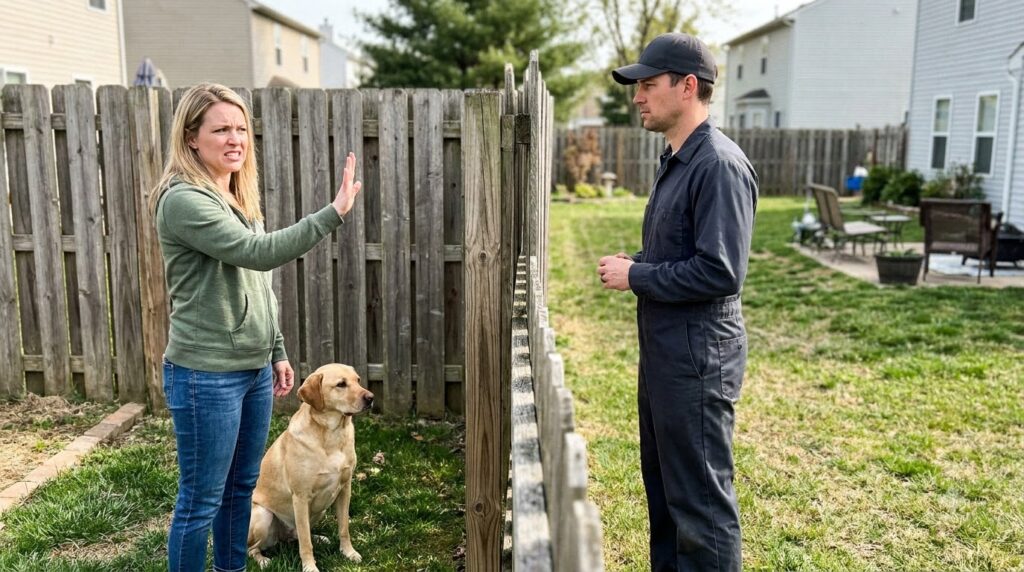
CHAPTER 5: THE STANDOFF AT THE BOUNDARY
“I told you the easement was valid, Arthur.”
Henderson’s voice drifted over the cedar pickets, smooth and dry as seasoned firewood. He stopped two feet behind the responder, his hands tucked neatly into the pockets of his beige cardigan. His leather loafers made a sharp, grinding noise against the alley gravel—a sound that sent a cold spike of adrenaline straight up Clara’s spine.
“It’s not your call to make, Henderson,” Clara said. She didn’t rise from her knees immediately. She stayed grounded, one dirt-caked glove resting flat against the cold top of the iron pin, holding her position like a soldier defending a breach. “You don’t work for Code Enforcement.”
“No, but I pay county taxes on three adjoining parcels,” Henderson replied, leaning slightly to peer over the responder’s shoulder. His eyes flicked down to the exposed pin, then to the yellow triplicate form on the clipboard. “And when a property owner obstructs a designated regional drainage corridor, it creates an actionable nuisance for the entire block. Inspector Miller knows the administrative code.”
The responder looked between Henderson and Miller, clearly relieved to have a prominent local resident backing his initial assessment. “Inspector, if the eighty-four reservation stamp is active on the master file, protocol requires an immediate preliminary halt-work and fence removal order for the encumbered corridor.”
Clara stood up slowly, wiping her clay-stained glove down the thigh of her jeans. Her chest felt tight, the air cold and thin in her lungs. The decoy record—that eighty-four stamp—had trapped her. The survey in her hands was a certified boundary map, but it didn’t automatically strike a legacy municipal reservation off the county’s central ledger.
“Look at the pagination,” Clara said, her voice cutting through the rising wind.
Inspector Miller paused, her fingers hovering over the heavy leather binder resting on her hip. “What did you say, Miss Vance?”
“Look at the bottom corner of the master record in your binder,” Clara said, stepping directly to the fence rail, her green hoodie pressing against the cedar pickets. “The yellow sheet on his clipboard has the eighty-four stamp. But your archival ledger has page numbers in the bottom right corner. What page is that yellow sheet copied from?”
Miller frowned, unclipping her magnifying loupe again. She reached out and pulled the responder’s clipboard toward her, turning the yellow sheet over to examine the bottom edge where the paper had been fed through a high-volume scanner.
Across the alley, Henderson’s hands slid out of his cardigan pockets. His left thumb twitched against his knuckle.
“The copy on the clipboard is listed as Page Three of File Eighty-Four-C,” Miller murmured, her eyebrows knitting together under the brim of her work hat. She flipped open her leather-bound master ledger, her gloved thumb running rapidly through thick, yellowed sheets of archival vellum. “Page one… page two… page three…”
She stopped. Her thumb froze against the edge of a crisp, white page that had been inserted into the book with a heavy plastic hinge.
“Page three in my master ledger isn’t a drainage reservation,” Miller said, her voice dropping into a flat, deadly quiet. “Page three is a municipal vacation certificate.”
The responder blinked, looking bewildered. “A what?”
“A deed vacation,” Clara said, the pieces snapping together in her mind with the force of a slammed trap. She looked past the responder’s shoulder, her eyes locking onto Henderson’s tight, pale face. “A vacation order means the county formally abandoned the drainage corridor forty years ago when they rerouted the storm culvert down Main Street.”
“That… that copy was pulled directly from the public portal this morning,” the responder stammered, pointing a shaking finger at the yellow sheet. “The file was uploaded as an active exhibit under File Eighty-Four-C.”
“Uploaded by whom?” Miller asked, turning her head slowly to look at Henderson.
The wind rustled through the cedar pickets, carrying the faint, bitter smell of exhaust from the idling white SUV. Nobody spoke. Two neighbors across the lane stepped out onto their back porch steps, watching the huddle at the fence line in complete silence.
Henderson didn’t flinch, but his jaw set into a hard, rigid line. “The public portal accepts certified record submissions from affected property owners. If there’s a discrepancy between the legacy files and the digitized archive, that’s an administrative error for the county recorder to clear up—not a reason to allow an unpermitted fence to block historical water flow.”
“It’s not a discrepancy,” Clara said, her voice ringing out crisp and clear over the cedar posts. “It’s a redacted record. You submitted Page Three from the nineteen-eighty-four draft file and left out the two-thousand-two vacation certificate that cleared my deed.”
She raised her hand in a final, unyielding boundary gesture, her gloved fingers pointing directly at the gate latch.
“Inspector Miller,” Clara said. “Check the county digital GIS log right now. See whose user account uploaded that redacted PDF to my property file last Tuesday.”








