CHAPTER 2: THE PAPERWORK AT THE FENCE
Clara didn’t reach across the top rail to touch the paper. She leaned in just enough to smell the fresh toner on the yellow triplicate sheet—industrial, metallic, still crisp from an office laser printer.
“That’s a photostat,” she said. Her voice stayed low, under the whisper of the wind through the cedar pickets. “The county seal at the top is grayed out, but that red line was drawn with a fresh marker.”
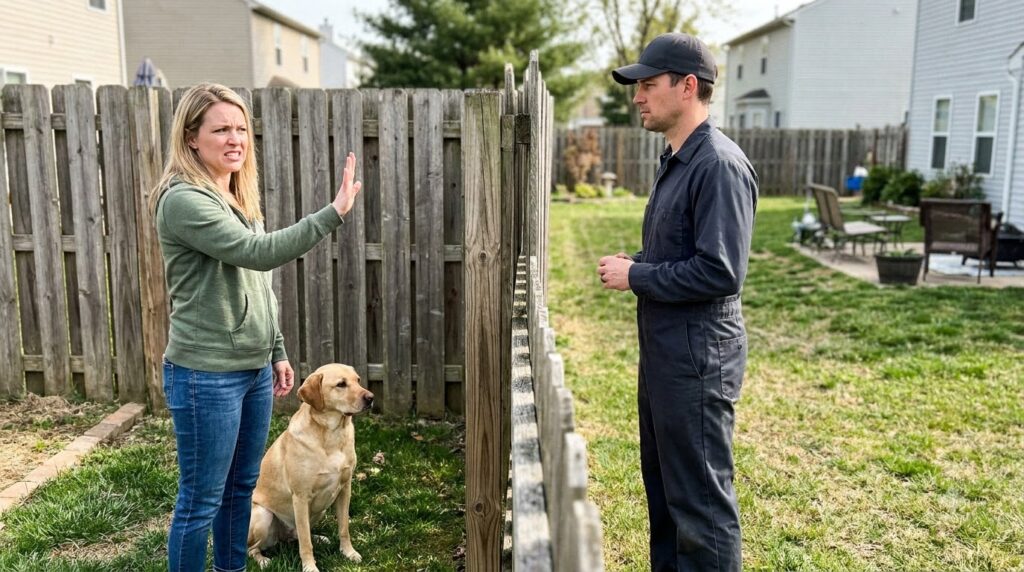
The responder’s eyes narrowed under the bill of his dark cap. He pulled the clipboard back an inch, a subconscious defensive pull that told Clara more than any ordinance code could.
“It’s a dispatch map printed straight from the municipal GIS terminal thirty minutes ago,” he replied, though his voice had lost its flat, practiced edge. “Code Enforcement doesn’t draw on these by hand.”
“Then someone did it before it went into your queue,” Clara said. She turned her gaze past his shoulder, down the gravel alley where a silver sedan sat idling near the corner. The driver’s side window was down two inches, just far enough for a glint of sunlight to bounce off a pair of dark tortoiseshell sunglasses. Henderson’s wife wasn’t even pretending to weed her hydrangeas today.
Barnaby let out a low, vibration-only growl deep in his chest. Clara laid two fingers flat against the dog’s ribcage, feeling the steady, warm rhythm of his breathing.
“I’m going to my porch,” Clara said, stepping backward without turning her spine to the fence line. “I’m getting my weather folder. You stay on that side of the cedar posts.”
“If you lock yourself inside, I’ll have to call for dispatch backup,” the responder called after her, his boots scraping against the loose gravel as he shifted his stance to maintain eyes on her. “Standard protocol for uncooperative entry.”
“Call them,” Clara said over her shoulder. “Tell them to bring the chief inspector while they’re at it.”
She didn’t run. Running gave authority figures something to pursue. She walked at a measured pace across the damp lawn, her boots leaving shallow depressions in the rye grass. The air carried the heavy, iron-rich scent of the turned garden soil, mixed with the faint sulfur smell of the old municipal well line two streets over.
The back porch steps were raw fir, grayed by five winters of Oregon rain. Under the second step sat a dark, heavy-gauge vinyl folder—waterproof, zipper-sealed, and hidden behind a stack of terracotta pots. She had kept it there since March, ever since the first anonymous notice about her compost bin had appeared tucked under her windshield wiper.
Clara unzipped the folder with a sharp, dry rasp. Inside lay three sheets of heavy vellum, protected by clear plastic sleeves. She didn’t grab the top sheet—the basic property description everyone gets when the title company clears escrow. She slid her fingers down to the second tier, pulling the folded, triple-stamped county survey map from April of three years ago.
Attached to the corner of the survey was a small, plastic evidence bag. Inside it sat a single chip of flaked orange paint, recovered from the grass three weeks after she moved in, right where a sledgehammer had struck the original iron corner pin.
She turned back toward the yard just as the responder raised a heavy black radio to his shoulder.
“Control, this is Unit Four,” the responder said, his voice carrying clearly over the fence rail. “I have a refusal at the rear access point on Elm Lane. Subject is non-compliant, claiming boundary variance. Requesting secondary verification on file number 84-C.”
Clara stopped at the edge of her garden bed, five feet from the fence line. She held the vinyl folder against her chest like a shield made of thick paper and dry ink.
“File 84-C?” Clara asked, her eyes fixing on his badge clip. “You’re running this off an eighty-four series file?”
The responder lowered the radio, a flicker of hesitation crossing his face before he smoothed it over with a hard set of his jaw. “File eighty-four-C is the primary drainage corridor easement for this block.”
“File eighty-four-C,” Clara said, her voice dropping into a dangerous, quiet precision, “was opened forty years ago when the county tried to put a storm culvert through this lot. It was never executed.”
“The system shows an active flag,” he insisted, though his fingers tapped nervously against the edge of his clipboard.
“The system shows whatever someone uploaded to the online portal during the public review window last Tuesday,” Clara countered. She unzipped the plastic sleeve and pulled out the survey map, unfolding it with a crisp, dry snap. “This is a certified land survey signed by a licensed county surveyor fourteen months ago. The iron pin sits eighteen inches below the sod right under your left boot.”
The responder looked down involuntarily at his boots, shifting his heel away from the base of the cedar post.
“You want to inspect a setback?” Clara continued, stepping directly up to the fence line until only six inches of air separated her hoodie from the wooden pickets. “Get a shovel. Dig four inches down right where you’re standing. If you hit concrete or a pipe, you can break my latch. But if you hit an iron pin with orange chalk on the cap, you’re standing on private land without a permit—and every second you stay there is recorded on the lens right behind my eaves.”
She pointed up toward the shadow of the roofline, where the small glass eye of her security camera reflected the gray sky, its red status LED pulsing silently once every three seconds.
Across the alley, the silver sedan’s engine revved once, then went dead silent.