
CHAPTER 4: THE IRON UNDER THE SOD
The driver’s side door of the white county SUV opened with a heavy, pressurized thunk.
A woman stepped out onto the gravel lane. She didn’t wear a dark cap or a utility shirt; she wore a high-visibility orange vest over a canvas barn jacket, a brass-rimmed magnifying loupe dangling around her neck by a leather cord. She pulled a worn leather binder from the passenger seat, resting it against her hip as she took in the scene with a quick, practiced sweep of her eyes.
The responder turned sharply toward her, his posture snapping into a rigid, defensive straightness. “Inspector Miller. I was just conducting the preliminary access check on dispatch file 84-C.”
“I heard the dispatch radio call,” Miller said. Her voice was dry, raspy, conditioned by thirty years of breathing dust in county archive basements and road-crew trenches. She didn’t look at the responder. Her eyes drifted over the top of the cedar pickets, landing directly on Clara, then shifting down to the waterproof vinyl folder held firmly against Clara’s ribs. “You called for secondary verification.”
“The resident is refusing entry,” the responder said, gesturing toward the gate. “She’s disputing the active drainage easement.”
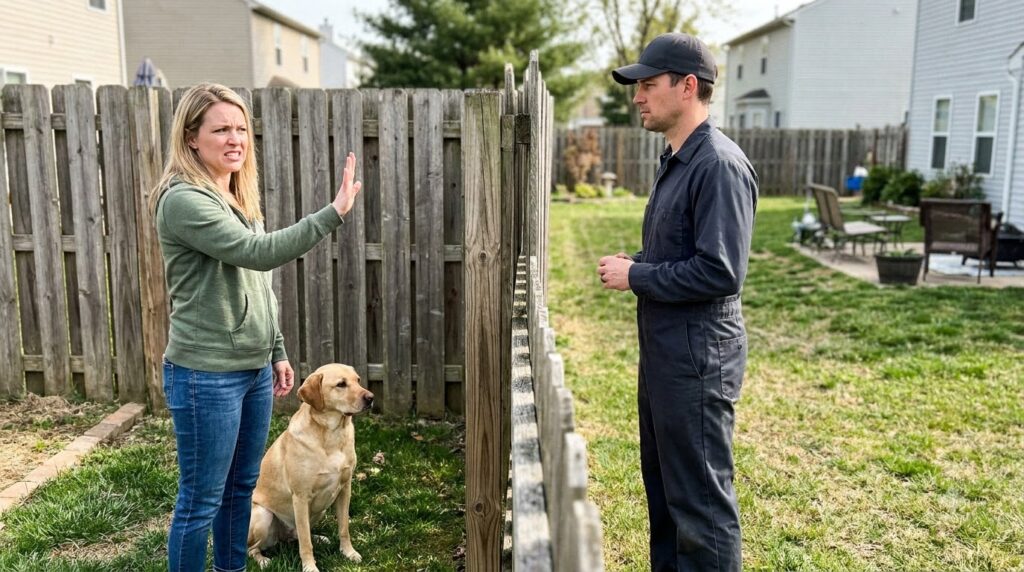
Clara didn’t wait for Miller to ask. She dropped to one knee right in the damp rye grass, five inches inside her fence line. The cold soil soaked through the knees of her denim jeans instantly, but she didn’t care. She reached into her hoodie pocket, pulled out the flat-head trowel, and sliced a neat, six-inch square into the turf directly below the cedar post.
“What are you doing?” the responder demanded, taking a half-step toward the fence rail.
“Exposing the record,” Clara said without looking up.
She levered the trowel under the sod. The grass roots groaned as they parted from the clay beneath, peeling back in a clean, square flap. Underneath lay four inches of dark, undisturbed topsoil mixed with crushed river stone. Clara dug her gloved fingers straight into the dirt, clawing through the cold silt until her nails struck something dense, unyielding, and metallic.
Clink.
The sound was sharp, resonant—the unambiguous ring of heavy forged steel buried deep in the earth.
Clara scraped the loose dirt away from the top of the object. A round iron cap, roughly the size of a silver dollar and heavily encrusted with flaked orange surveyor’s chalk, sat flush against the clay strata. Across its face, stamped deep into the steel forty years ago, were four raised numbers: 1984-PIN.
“There’s your 1984 boundary anchor,” Clara said, her breath fogging slightly in the cool air as she stood up, her palm covered in red-clay mud. She pointed down through the fence pickets at the exposed iron head. “Eighteen inches inside the alley gravel. Three inches outside my cedar post. Your 84-C file isn’t an open corridor—it’s an easement reservation that was tied to the old county storm culvert project.”
Inspector Miller stepped closer to the fence, her heavy work boots crunching deliberately over the loose gravel. She reached down, unhooked the magnifying loupe around her neck, and bent over the top rail to peer down into the small square hole Clara had cut into the turf.
“Let me see that folder, Miss Vance,” Miller said softly.
Clara unzipped the clear plastic sleeve and held the county-stamped 2021 survey map over the top rail. She didn’t let go of the paper; she held it flat so Miller could read the raised embossed seal at the bottom right corner.
Miller examined the seal, then reached out with one gloved finger and flipped back the top yellow triplicate sheet on the responder’s clipboard, exposing the full document underneath.
There, stamped in faded, eighty-four blue archival ink along the bottom margin of the original municipal record, was the physical evidence Clara had been hunting for: a recorded reservation clause granting the county a twenty-foot wide drainage corridor running directly across the rear third of the parcel.
The responder leaned in, a triumphant glint returning to his eyes. “There it is,” he said, pointing at the blue stamp. “Eighty-four easement clause. Right there on the master deed record. That corridor covers this entire lawn, six feet deep.”
Clara felt a cold knot tighten in the pit of her stomach. The survey in her hands showed clean boundaries, but the document on the responder’s board—the actual 1984 county master record—contained an active, un-cancelled drainage reservation stamp that she had never seen before. Her 2021 survey had cleared the title based on local boundary pins, but it hadn’t erased the underlying archival easement reservation sitting quietly in the county’s legacy system.
Miller didn’t declare victory for either side. She drew a slow breath, her thumb tracing the edge of her leather binder.
“The 1984 easement reservation is real, Miss Vance,” Miller said, her voice dropping into a grave, heavy register that carried across the quiet yard. “It’s stamped right here on the master parcel map. As far as this clipboard is concerned, this entire fence sits inside a restricted county drainage zone.”
Across the alley, the driver’s door of the silver sedan clicked open. Henderson stepped out onto the gravel, a thin, satisfied smile playing across his lips as he straightened his sweater vest and began walking toward the fence line.








