
CHAPTER 3: THE CODE OF EXHAUSTION
“You think the lens changes the code, ma’am?”
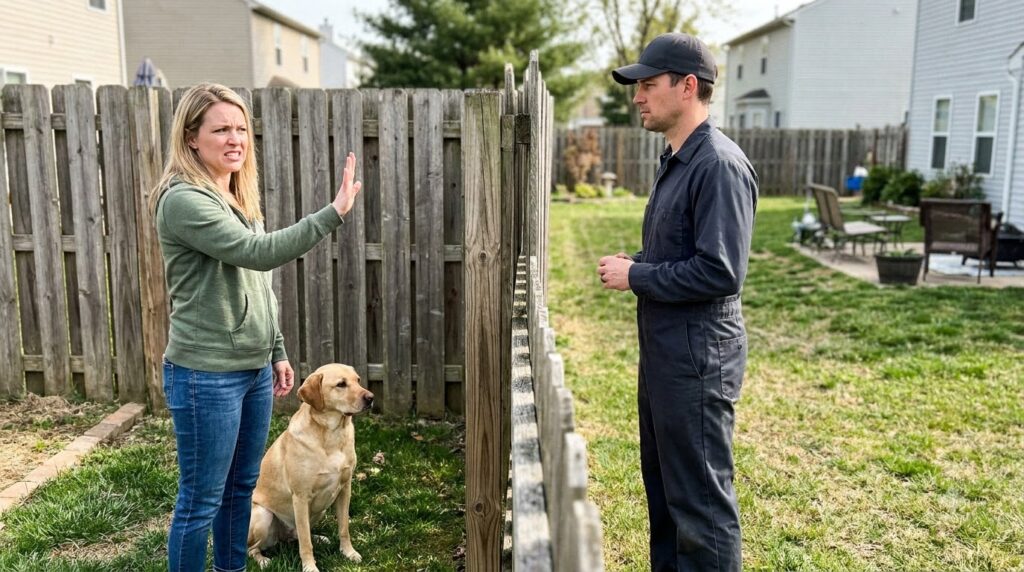
The responder’s voice was lower now, raspier, the thin glaze of customer-service composure cracking down the center. He didn’t look up at the black dome mounted under Clara’s eaves, but his shoulders hitched higher under his charcoal uniform shirt. He tapped the edge of his clipboard against the top cedar rail—clack, clack, clack—a dry, rhythmic strike that made Barnaby’s ears swivel backward.
“The lens records the trespass,” Clara said. She didn’t retreat an inch from the fence line. Her boots stayed planted in the damp grass, three inches inside her property line. “And it records the fact that you haven’t produced an entry warrant, a signed access order, or a verified utility emergency dispatch.”
“I have an administrative dispatch ticket,” he said, turning the clipboard slightly so the white glare of the afternoon sky bounced off the laminated surface. “File 84-C isn’t an internet upload. It’s a recorded municipal easement corridor for the entire east side of Elm Lane. You don’t get to opt out of the town storm-water management grid just because you put up six-foot cedar pickets.”
“File 84-C is forty years old,” Clara repeated, watching his eyes. “And if it was an active easement, your department wouldn’t have issued a building permit for this fence when the previous owner put it up in ninety-eight.”
The responder hesitated, his thumb scraping along the metal spring clip at the top of his board. In that fraction of a second, Clara caught a detail she hadn’t seen when he was holding the papers at his waist: tucked behind the top yellow sheet was a pink index slip—the kind used exclusively for private intake complaints at the front counter of the county building, not digital dispatches sent to field units. Across the top margin of the pink paper, written in tight, slanted blue ink, was a parcel number that didn’t belong to her lot.
It belonged to the 1.2-acre parcel directly behind her—the house with the silver sedan and the manicured, weed-free hydrangeas.
“The ninety-eight permit was issued under prior county parcel maps,” the responder said, stepping closer until his dark belt buckle pressed against the outside pickets. He leaned over the top rail, bringing his face within two feet of hers. “Maps that didn’t account for the nineteen-eighty-four storm runoff declaration. I’m not here to argue title law with you on a Friday afternoon, Miss Vance. I’m here because if there’s an obstruction in this easement when the spring rain hits, the water backs up into three basements down the line. That makes it a public hazard.”
“There is no pipe under this lawn,” Clara said, her voice dropping into a flat, unyielding register. “There is no culvert. There is no public drain. There is four inches of topsoil, eight inches of river rock, and three feet of tight clay. If Henderson has water in his basement, it’s because his downspouts dump directly onto his own patio foundation instead of the alley gutter.”
The responder’s jaw muscles tightened. He reached down to his utility belt, unclipping a heavy, rubberized flashlight—not to illuminate anything in the bright afternoon sun, but to hold something heavy and solid in his hand.
“I’m giving you a formal verbal directive,” he said, leaning his weight forward so the top rail groaned under the pressure. “Unlock the rear gate. Allow me five minutes to conduct a surface visual assessment of the easement corridor, or I mark this file as an active physical obstruction. That triggers an automatic enforcement lien and a mandatory hearing before the county magistrate in twenty-one days.”
“Do it,” Clara said.
The word hung between them, hard and cold as an iron stake.
The responder blinked, his hand freezing on the body of the flashlight. “What?”
“Mark it,” Clara said, stepping forward until her hoodie brushed the inner face of the cedar posts. “Mark it as an active obstruction. Put your name on the signature line at the bottom of that yellow sheet. Write down that you inspected the site, verified the 84-C easement, and refused to review the 2021 certified survey presented by the property owner on site.”
She pointed a gloved finger straight at the pink slip peeking out from under his clipboard stack.
“And make sure you attach that private intake slip from Henderson,” she added, her voice chilling the warm spring air. “The one with his parcel ID written in the margin. Because when I file the counter-affidavit for harassment under Section Twelve of the Civil Standards Act, the magistrate isn’t going to look at your storm-water map. He’s going to ask why a field inspector executed an emergency entry protocol based on an unverified complaint from a neighbor who tried to buy this three-foot strip from the bank during my foreclosure proceeding three years ago.”
The responder’s posture went instantly rigid. His eyes darted down to the pink slip, then back to Clara’s face, the institutional confidence draining out of him like water through a cracked pipe.
Behind him, the gravel in the alley crunched under a second set of heavy tires. A white county SUV with a high-mounted light bar pulled up behind his parked service sedan, its engine humming with a low, deep idle that shook the cedar fence posts.








