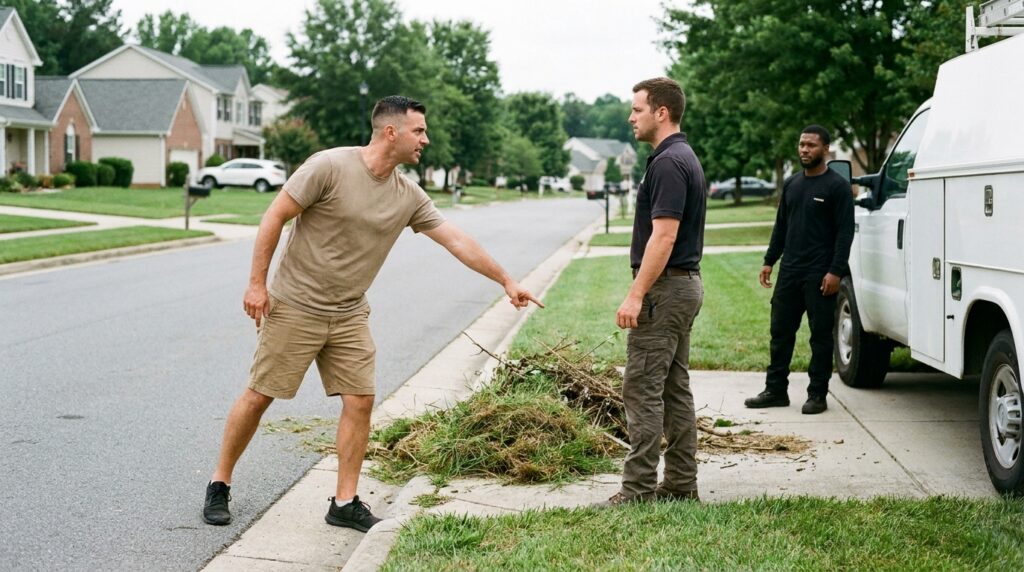
The Bitter Geometry of a Suburban Curb Where Two Men Fight for Dirt and Local Rule
CHAPTER 1: THE DUSTY BOUNDARY
The crunch of dry oak branches under a heavy work boot was the only warning before the man in the tan t-shirt crossed the dead grass strip, his thumb already hooking into his waistband like a deputy looking for an excuse.
Jesse didn’t look up immediately. He kept his weight centered, his boots biting into the gray asphalt of the cul-de-sac while he hoisted a second bundle of debris. The heat was rising from the suburban road in thick, desaturated waves, carrying the bitter scent of sheared pine and parched dirt. Behind him, the six-ton municipal truck idled with a heavy, metallic vibration, its amber roof-lights cutting rhythmic slashes of orange across the manicured lawns.
“You’re structural ballast on the wrong side of the line,” the man said. His voice was too tight, vibrating with a rehearsed authority that belonged in a courtroom, not a ditch. He had a brand-new clipboard clutched against his ribs, the zinc clip gleaming under the harsh midday sun. “This is private frontage. HOA handles the drainage maintenance here. Dump that pile back in your bed and move the rig.”
Jesse let the bundle drop. It hit the curb with a dry, hollow thud, sending up a small cloud of pulverized gray soil. He didn’t wipe the sweat from his forehead. Instead, his eyes went straight to the corner of the curb, where the faded yellow paint of a municipal easement marker had long since flaked into the gravel. There was a scratch there—a fresh, deep score mark in the concrete that hadn’t been made by a tire. Someone had been measuring the dirt with a steel tape before the sun came up.
“The work order says the bypass channel runs sixty inches from the center of the asphalt,” Jesse said. His voice was flat, dry as the road. He kept his hands low, thumbs hooking into the pockets of his dark work pants. He wasn’t looking for a fight; he was looking at the wear on the man’s expensive running shoes. “We’re forty-eight inches in.”
“I don’t care about your paperwork,” the man snapped, stepping closer until the shadow of his sunglasses fell over Jesse’s boots. He pointed a rigid index finger straight down at the pile of branches, his knuckles turning a dry, chalky white. “Stop stepping into my role and making my calls. Respect the boundary, you handle yours, I’ll handle mine.”
In the cab of the idling truck, Miller paused, his hand resting on the heavy black folder on the dashboard. He didn’t open the door. He just watched through the tinted glass, his reflection cutting through the heat shimmer.
Jesse felt the silence of the street settling over his neck. Across the cul-de-sac, a white window blind twitched behind a pristine pane of glass. A dog barked once inside a garage, its throat muffled by insulation. The neighbor wasn’t just talking to him; he was playing to the houses. He wanted the dirt to move. He wanted the truck gone before the county inspector’s car turned the corner at two o’clock.
Jesse shifted his weight, his eyes tracking a tiny glint of brass buried near the root ball of the oak pile—a surveyor’s pin, completely uncoupled from the official county maps.
“Alright,” Jesse said, his face settling into the dusty gray lines of a man who worked for time, not pride. He gave a single, slow nod that cost him nothing. “I hear you.”

CHAPTER 2: THE PAPER LAUNCH
“You hear me, but you aren’t moving the rig,” the man said, his thumb tapping the edge of the zinc clip. The metal gave off a thin, metallic tink that caught the low hum of the truck’s diesel engine.
Jesse didn’t shift his gaze from the scratch on the concrete curb. The sun was directly overhead now, baking the asphalt until the smell of hot tar and old iron rose into the back of his throat. He reached down slowly, grabbed the handles of his rusted shears, and tossed them into the back of the flatbed. They landed with a heavy, discordant clang against the steel floorboards, right next to a pile of frayed nylon tie-downs.
“The truck stays until the pile is down to the dirt,” Jesse said. His voice didn’t rise. It had the flat, unhurried cadence of a machine that had been running all morning in the dust. “That’s the contract with the township. If you want the lane clear, you talk to the county yard in Westlake.”
The man in the tan t-shirt let out a dry, short laugh that didn’t reach his eyes. He took half a step backward, his expensive running shoes kicking up a spray of gray gravel from the edge of the lawn strip. He unclipped the top sheet of paper from his board, holding it out by the corner. The white stock was thick, uncreased, and bore a heavy, raised corporate seal that looked too crisp for a standard municipal notice.
“This is a formal cease-and-desist from the Oak Ridge Homeowners Association,” the man said, his voice dropping into a register meant to carry toward the nearest porch. “Section 4, Paragraph B. Unauthorized staging of commercial waste on common frontage. You’ve got five minutes before the heavy-duty tow from Miller’s Express gets called to clear this lane. I’ve already signed the authorization form.”
Jesse looked at the paper. He didn’t take it. The shadow of the sheet fell across the rusted iron hinge of the truck’s tailgate. In the lower margin, under the blue ink signature of the board president, there was a small, smudged fingerprint—not ink, but a greasy residue that smelled faintly of hydraulic fluid and recycled oil. It was the same grade of lubricant Jesse used on his own hydraulic lifts every three months.
From the cab, the passenger side door finally groaned open. Miller climbed down, his heavy work boots hitting the blacktop with a solid, fleshy impact that made the truck’s leaf springs squeak. He wasn’t carrying his tools. His hands were stuffed deep into the pockets of his grease-stained black canvas vest, his eyes squinting through the glare of the noon light.
“Jesse,” Miller said softly, his voice low enough to slide under the rumble of the exhaust. “Look at the planter behind him. The brick one with the dead ivy.”
Jesse didn’t turn his head, but his peripheral vision tracked the line of Miller’s shoulder. At the entrance of the subdivision, about ten yards back, a massive brick planter held the weathered cedar sign for Oak Ridge Estates. The mortar between the bottom two rows of brick had crumbled away, leaving a dark, jagged gap about three inches wide. Taped just inside that shadow, completely hidden from the street but visible from the high vantage of the truck’s cab, was a small black plastic box with a flexible wire antenna pointing straight down into the weeds. It was a commercial GPS transponder, its power light blinking a faint, regular red against the dark stone.
“You guys like to monitor the curb pretty close around here,” Jesse said, his tone casual, almost conversational, though his mind was already running the geometry of the street.
“We protect the infrastructure,” the Confronter replied, his clipboard snapping shut with a sharp crack. He stepped in line with the brick planter, his posture stiffening as if he were physically blocking the view of the mortar gap. “Every square inch of this development is accounted for. If you aren’t out of this cul-de-sac by twelve-fifteen, the fine hits your company registration before you reach the interstate.”
Jesse took a slow breath, the dry, alkaline dust of the roadside settling into his lungs. The weight of the morning’s labor was a dull ache across his shoulder blades, but his movements remained deliberate. He walked past the man, his shoulder brushing within an inch of the tan t-shirt, and stopped at the side of the truck bed. He reached over the rail, pulled the heavy black vinyl folder off the dashboard through the open window, and laid it flat against the hot metal of the hood.
The iron of the truck was hot enough to sting through his calluses. He flipped the cover open, revealing three years of laminated county easement maps, each one cross-referenced with the state’s agricultural drainage grid. The pages were yellowed at the margins, marked with grease pencil and the faint, circular stains of old coffee cups.
“This lane isn’t common frontage,” Jesse murmured, his finger tracing a thick, hatched line that bypasses the subdivision’s legal boundaries entirely. He looked back over his shoulder at the Confronter, whose fingers were now twitching against the edge of his clipboard. “The county laid this pipe in eighty-four. Before these houses were even staked out. This dirt doesn’t belong to your board, mister. It doesn’t even belong to the township.”
A curtain across the street snapped shut with a distinct plastic click. The dog in the garage had stopped barking, replaced by the faint, distant whine of an approaching diesel engine from the main highway—but it wasn’t the sound of a standard county inspector’s sedan. It was heavier. The deep, twin-axle growl of a commercial wrecker.
Jesse closed the folder, the magnetic clasp snapping home with a heavy thud. He didn’t look at the road. He looked straight at the Confronter’s sunglasses, watching his own reflection—dusty, sweat-streaked, and entirely unmoving—stare back at him from the dark lenses.
“Miller,” Jesse said, his voice dropping into the quiet center of the heat. “Get the chains out of the toolbox. We’re going to be here a while.”
CHAPTER 3: THE RUSTED RAMPART
The heavy iron links didn’t slide out of the steel toolbox so much as they spilled, a coarse, rust-flaked heap crashing onto the bed of the truck with a sound like iron filings hitting a shovel.
Jesse wrapped his fingers around the cold metal, feeling the gritty scale grind into the calluses of his palm. He didn’t look back at the street corner where the flatbed tow truck had just cut its engine, its hydraulic arm already starting to hiss as it tilted the flat steel deck down toward the asphalt. The odor of cheap hydraulic fluid from the wrecker drifted across the hot curb, thick and sour, matching the smudged fingerprint on the paper the Confronter was still holding like a weapon.
“You’re making a five-hundred-dollar mistake,” the man in the tan t-shirt said. He didn’t come closer than the edge of the dead grass strip now, his expensive shoes staying clear of the loose gravel where Miller was working. He tapped the clipboard with his pen, a sharp, rhythmic click that timed out the approach of the tow driver. “That deck is rated for twelve tons. Your rig will be sitting in the impound yard by two o’clock, and the HOA board doesn’t approve releases on weekends.”
Jesse ignored the click. He hauled twenty feet of graded transport chain over the steel tailgate, the iron links trailing across the blacktop with a dry, screeching slide. He looped the tail end directly through the heavy-duty tie-down ring welded to the truck’s frame, then dropped the massive drop-forged hook through the link until it bit with a dull, grease-chilled clunk.
“Miller,” Jesse muttered, his voice barely lifting over the rhythmic clatter of their own idling diesel engine. “Take the short lead. Secure the front axle to the municipal storm grate. The one with the unpainted iron frame.”
Miller didn’t answer with words. He just reached into the toolbox, grabbed a smaller four-foot binder chain, and dropped to his knees on the gritty edge of the road. His boots kicked the loose pine needles out of the way as he slid beneath the front bumper, the back of his dark canvas vest catching on the rusted leaf springs. Within seconds, the sound of iron clinking against the thick cast-iron slots of the county drainage grate echoed through the cul-de-sac.
The tow driver—a stocky man wearing a faded neon vest over an old grease-spotted shirt—walked up from the rear of his flatbed, a heavy steel J-hook dangling from his thick leather gloves. He looked at Miller under the bumper, then looked down at the twenty-foot span of chain Jesse had just stretched tight between the truck bed and the massive root ball of the oak debris pile.
“Hey, pal,” the driver said, his voice husky from tobacco and road dust. He stopped five feet short of Jesse, his eyes tracking the line of the chain. “I can pull the truck, but if you’ve got it tethered to the timber and the storm masonry, I’m going to rip the rear differential right out of the housing. My boss didn’t sign up for property damage on a standard HOA sweep.”
“The paper says common frontage,” the Confronter interrupted, his voice rising an octave as he stepped forward, thrusting the clipboard toward the driver’s chest. “I’m the authorized agent for Oak Ridge Estates. The contract covers obstruction removal. Pull the rig.”
Jesse stood by the rear tire, his hand resting on the hot, salt-crusted fender of his truck. He could smell the heat radiating from the tires, the dry rot of old rubber cooking under the mid-summer sun. He reached down to his pocket, pulled out a small wire brush he used for cleaning spark plugs, and began scraping at a spot on the truck’s chassis where a legal plate was riveted into the metal.
“The driver’s right,” Jesse said, his tone flat, entirely devoid of anger. He didn’t look at the Confronter. He looked at the tow operator’s worn gloves. “You pull this rig while it’s locked to the municipal easement infrastructure, and you’re damaging county drainage assets. That’s a Class three misdemeanor. The fine doesn’t go to the HOA. It goes straight to the operator’s license.”
The tow driver froze, his J-hook swinging like a pendulum against his thigh. He looked at the heavy cast-iron storm grate beneath Miller’s boots, then looked back at the paper clutched in the Confronter’s hand.
Jesse didn’t give them time to recalculate the margins. He leaned over the hood of his truck, his thumb tracing the blue ink lines of the old county map he’d left spread across the hot steel. The map showed three things the clipboard didn’t: a county-ordered drainage clearway, a twenty-foot municipal right-of-way from the center of the asphalt, and the distinct, hand-drawn initials of a state engineer from 1984.
But it was something else that caught Jesse’s eye in the lower corner of the page. There was a tiny handwritten ledger entry from three months ago, noted in red grease pencil by the county water district inspector. It detailed a maintenance permit variance issued to an independent contractor named Vance Contracting LLC—an entity Jesse had never heard of, but the address listed for the firm matched the exact house number of the driveway where the Confronter’s tan t-shirt had first appeared.
Jesse felt the rough texture of the paper under his skin, the oil from his hands smudging the edge of the grid. The piece of paper the Confronter was holding wasn’t an official legal order from a community board. It was a shield.
Across the street, the front door of a gray ranch-style house opened with a loud, dry scraping sound as the screen door unlatched. A woman in a faded canvas apron stepped onto the concrete porch, her eyes locked onto the three men gathered around the rusted chains. She didn’t yell; she just pulled a black smartphone from her pocket and pointed the lens directly at the tow truck’s license plate.
“The wind’s shifting,” Miller said, his head popping out from beneath the front bumper, his face streaked with black road grime. He wiped his nose with his sleeve, his eyes fixed on the main entrance road where a second set of headlights was just appearing through the dust of the outer highway.
Jesse didn’t turn around. He just reached down and tightened the nut on the chain binder until the iron links hummed with tension under his palm.
CHAPTER 4: THE ZONE OF OCCUPATION
“Get your boots off the gravel line,” the Confronter said, his stride shortening as he cut off the remaining distance between his shins and the debris pile. His shoulder pitched forward, his shadow completely blotting out the yellowed corner of Jesse’s laminated county maps. “You’re trespassing on private drainage layout now. This whole staging perimeter is closed.”
Jesse didn’t pull the maps back. He held his weight steady against the fender, the heat of the iron plate soaking through his heavy trousers. He could feel the fine, dry grit of the cul-de-sac crunching beneath the man’s sneakers as the Confronter planted himself directly between the truck bed and the root balls of the cleared timber. It was a calculated, blocking stance—the posture of an inspector who knew that a laborer wouldn’t risk physical contact while a tow rig was idling twenty feet away.
“The clearway doesn’t close until the sun goes down,” Jesse said, his tone dry as the parched soil beneath his boots. He reached out with one blunt finger, pointing directly past the man’s hip toward the thick oak branches that jutted into the asphalt. “We’re clearing the channel blockage. If I leave these trunks in the easement strip, the first four-inch rainstorm fills your crawlspaces with mud. You want to sign for that liability on that clipboard of yours?”
“The HOA doesn’t take operational notes from independent haulers,” the man snapped. He tilted the clipboard up, using the flat plastic edge to physically push away Jesse’s extended finger without making direct skin contact. He was close enough now that the sour smell of his chemical sunscreen mixed with the sharp stench of the truck’s exhaust. “The board has its own contractor for the structural spillways. Vance Contracting handle the layout here. Your work order is an unvetted intrusion on our internal grid.”
Jesse didn’t flinch from the plastic edge. His eyes remained locked on the lower corner of the clipboard where a small, clear window label had been peeled away, leaving a sticky square of grey lint. Underneath the residue, the faint, stamped logo of the county water district was still visible in the grain of the plastic—this wasn’t standard corporate stationaries bought at an office supply store. It was salvaged municipal property.
Miller stood up from the front wheel well, a heavy steel ratchet binder dangling from his gloved right hand. The tool gave off a greasy, rhythmic clack-clack-clack as he set the gear, the sound flat and hollow against the wide, sun-bleached facades of the houses across the street.
“Jesse,” Miller said, his boots scraping against the asphalt as he shifted his stance to parallel the tow driver. “The wrecker’s air lines are pressurized. He’s backing the hook up to the front stabilizer bar.”
The tow driver didn’t move the winch line yet. He stood by his hydraulic control cluster, his hand resting loosely on the chrome lever while his eyes bounced from Jesse’s rusted transport chains to the official county water district emblem stamped into the front bumper of the flatbed. He was evaluating the geometry of the tie-downs, tracing the steel path that linked his own twelve-ton winch straight to the cast-iron core of the municipal storm grate.
“Look, mister,” the driver muttered, looking at the Confronter’s tan t-shirt. “The truck’s dead-locked. He’s bypassed my primary lift bracket with those safety loops. If I drop the stinger now, I’m pulling against four thousand pounds of wet oak and sixty feet of buried drainage pipe. I need an indemnification stamp from the county surveyor before I engage the PTO.”
“I told you, I am the authority on this curb,” the Confronter shouted, his face darkening as he turned on his heel to face the driver. He shoved the white cease-and-desist paper within three inches of the driver’s sunglasses. “The township signed the subdivision plat in ninety-two. The common area extends to the center line of the gutter. Pull the frame or I’m calling your dispatcher to report an unexecuted recovery order.”
Jesse didn’t join the shouting match. He leaned over the hood, his thumb pressing down on the red grease-pencil notation at the bottom of his map sheet. The numbers listed under Vance Contracting LLC weren’t just a corporate registration; they were linked to an old municipal equipment lease line that had been flagged for non-payment two cycles ago.
He looked over at the brick planter ten yards back, where the small black GPS box was still blinking its regular, secret red light against the crumbling mortar. The device wasn’t tracking the truck to see when it left; it was a beacon, timing the arrival of a completely different set of assets.
Across the asphalt, the screen door of the gray ranch house creaked again. The woman in the canvas apron hadn’t moved from her porch, but she was no longer holding her phone up. She was looking past the idling tow truck toward the outer throat of the subdivision, where the high, squared-off silhouette of a white utility van was slowly turning into the lane, its side panels caked in gray highway dust.
Jesse closed his black vinyl folder, the magnetic clasp hitting the hot steel with a definitive, metallic click. He stepped away from the fender, his heavy work boots carrying him into the small two-foot gap between the Confronter and the debris pile, his bulk effectively cutting off the man’s line of sight to the approaching vehicle.
“The road’s getting narrow,” Jesse murmured, his voice dropping below the rattle of the diesel injectors. “Let’s see whose name is on the registration when that van hits the line.”
CHAPTER 5: THE ANCHOR INCIDENT
“Alright,” Jesse said, his face settling into the dusty gray lines of a man who worked for time, not pride. He gave a single, slow nod that cost him nothing. “I hear you.”

The Confronter’s jaw tightened, his hand dropping three inches until the corporate cease-and-desist paper brushed against his knee. The silence that followed was heavy, broken only by the rhythmic, mechanical heartbeat of the six-ton truck’s diesel engine and the faint, high-frequency hiss of the tow deck’s hydraulic fluid cooling in the sun. He had expected a shouting match, an explosive blue-collar refusal that he could log into his phone as an active threat to community safety. Instead, the flat compliance of Jesse’s voice left him standing on the edge of the parched lawn strip, his arm still rigidly extended over a pile of dead oak limbs.
“If you hear me, tell your man to unhook the frame,” the Confronter said, his voice dropping into a register that sounded like a dry file dragging across sheet iron. He didn’t look at the white utility van that had just coasted to a halt fifty feet behind the tow rig, its rusted muffler giving off a single, metallic tink as the engine cut out. “We’re already twenty minutes past the standard clearance window. Every quarter-hour this lane is blocked costs the association three hundred dollars in contractor delays.”
Jesse didn’t move from his position by the fender. He reached down slowly, his rough fingers tracing the coarse edge of the transport chain where it looped through the cast-iron storm grate. The links were already hot enough to blister skin, coated in a fine layer of pulverized limestone dust that had settled from the passing cement trucks on the state highway.
“The delay isn’t mine,” Jesse murmured. He leaned in slightly, his voice dropping below the rattle of the truck’s fuel injectors, carrying only far enough to hit the Confronter’s sunglasses. “The map on my hood has a public utility seal from eighty-four, mister. But the ledger entry from March has a private tax identification number. It’s registered to an office park off Route 9, listed under Vance Contracting. You want to tell me why an HOA board helper is running city infrastructure through an unbonded family shell company?”
The man in the tan t-shirt took half a step back, his heel catching on a thick surveyor’s string that had been pegged into the parched soil behind the grass line. The crisp white paper on his clipboard rattled, the zinc clip vibrating against the plastic board with a tiny, frantic chatter. He shifted his weight, his eyes darting toward the white van where the driver’s side door was now swinging open, revealing a man in an unbuttoned high-visibility vest that bore no county logo.
“The board handles its internal allocations through vetted subsidiaries,” the Confronter said, his voice rising as his shoulder pitched forward to block Jesse’s view of the van. “It’s entirely within the township’s development guidelines. Section 9 allows for private mitigation when municipal crews fail to clear the channel lines.”
“Section 9 requires a certified structural engineer’s signature and an open public bidding log,” Jesse said. He didn’t raise his voice, but he stepped forward, his bulk closing the gap until his sweat-streaked shoulder was less than twelve inches from the man’s clipboard. “Your brother-in-law doesn’t have an engineering stamp, friend. He has a three-ton dump truck with a leaking transmission and an expired county vendor license. You didn’t call the heavy tow to protect the drainage. You called it because our truck is sitting right on top of the silt trap his crew was paid five thousand dollars to excavate three weeks ago—the one that’s still choked with four feet of river gravel.”
Behind them, Miller let out a short, rhythmic grunt as he pulled the lever on the primary ratchet binder, the iron teeth clicking into place with a sound like a rifle bolt snapping home. The chain between the truck frame and the buried storm masonry hummed under the sudden mechanical load, the iron links aligning themselves into a straight, unyielding bar of gray metal across the asphalt.
The tow driver stepped away from his control panel entirely, his thick leather gloves dropping to his sides. He looked at the white van, then looked at the red grease-pencil notation Jesse had exposed on the truck’s hood. His face had gone hard, the professional indifference of a road worker replaced by the cold, transactional calculation of a man who knew exactly who paid for the fuel in his tank.
“This isn’t an obstruction sweep,” the driver muttered, his eyes locking onto the Confronter’s sunglasses. “This is a private boundary dispute. You told my dispatcher this was an abandoned commercial rig on common frontage. If I pull against a county drainage marker for a private sub-contractor, the sheriff’s department takes my rig before I reach the county line.”
“I signed the authorization!” the Confronter shouted, his face turning a dark, blotchy red under his chemical tan. He turned on the driver, his finger pointing wildly down at the concrete curb line. “The plat is filed! The association owns the easement down to the raw dirt!”
“The association owns the grass,” Jesse said, his hand dropping flat onto the blistered iron of his tailgate. “The state owns the flow. And right now, you’re standing in the middle of a federal clearway with a handful of forged corporate notices.”
The woman on the porch across the street didn’t move, but the smartphone in her hand stayed level, the glass lens catching the glare of the noon sun like a tiny, unblinking eye. From the back of the white van, the side panel door slid open with a loud, corrugated scrape, but the man who stepped out wasn’t carrying a shovel. He was holding a handheld radio, his face pale as he looked past the tow truck toward the outer throat of the cul-de-sac, where the distinctive, low-pitched whine of a county supervisor’s diesel wagon was just beginning to echo through the subdivision entrance.
Jesse didn’t turn to look at the highway. He kept his eyes on the Confronter, watching the man’s fingers slowly unlock from the zinc clip until the white paper began to flutter in the hot, dust-laden breeze coming off the asphalt.
CHAPTER 6: THE MAP ON THE HOOD
The white county engineering maps didn’t move when the heavy door of the supervisor’s wagon slammed shut down the block, but the sudden compression of air caused the yellowed corners to flap against the hot steel of Jesse’s truck.
Jesse didn’t smooth the paper down. He placed his open palm over the thickest cluster of blue topographical lines, feeling the radiator’s iron heat radiating through the linen sheets and into his calluses. The sun had baked the vehicle’s hood until the salt crust from the spring roads was blistering into small, grey bubbles. Across the street, the tow driver was already back inside his cab, his low-pressure air lines hissing as he retracted the heavy J-hooks from the front stabilizer bar. He wasn’t waiting for an explanation from the board; he was moving his asset before the county plates cleared the intersection.
“The file on your hood doesn’t alter the township plat,” the Confronter said, though his boots didn’t hold their ground on the grass line. He took two steps back toward his own concrete driveway, his zinc clip held low against his thigh as if he were trying to hide the grey lint square where the water district sticker had been scraped off. “The easement records at the county clerk’s office show a clear private assignment. If your crew damages that retaining structure while you’re pulling those trunks, the recovery costs hit your bond before five o’clock.”
“The county clerk didn’t map this clearway,” Jesse said, his voice flat, retaining the dry, unhurried weight of the dust coat on his clothes. He didn’t look at the white utility van that was now idling by the curb, its rear tires kicking up small plumes of parched soil as the driver tried to find a gear that didn’t grind. “The state hydraulic office drew these grids after the valley flood of eighty-four. If you look at the lower margin on this sheet, under the blue boundary seal, there’s a handwritten cross-reference code: M-B-Four-Zero-Nine.”
The man in the tan t-shirt didn’t offer a reply. His eyes shifted past Jesse’s shoulder toward the white wagon that had stopped right at the throat of the cul-de-sac, its amber lights rotating with a silent, heavy sweep that turned the white ranch houses across the street a regular, pale orange. A man in a clean khaki uniform with a state environmental division badge on his belt stepped onto the asphalt, his fingers already unbuckling a leather map cylinder from his shoulder strap.
“Jesse,” Miller said, leaning his bulk over the passenger side rail of the flatbed. He had a pair of rusted iron calipers in his gloved hand, the tips caked in the wet, grey silt he’d scraped from the storm grate’s lower frame. “The van crew’s dumping their tracking gear. The guy in the passenger seat just kicked a plastic casing under the box elder tree behind the sign.”
Jesse didn’t turn around to check the grass line. He reached down to the black vinyl folder, flipping the heavy plastic leaves until he found the third-tier drainage layout—the one that wasn’t stamped by the local township developers. The grid lines here didn’t stop at the property lines of Oak Ridge Estates. They cut straight through the center of the cul-de-sac, through the brick planters, and directly under the basement foundations of the three houses sitting on the low side of the ridge.
“This layout isn’t an HOA drainage lateral,” Jesse said softly, his voice dropping into the small space between the truck’s rattling grill and the Confronter’s sunglasses. “This whole strip of dirt is a registered flood mitigation bypass channel. It’s tied to the state reservoir system. Your brother-in-law’s company didn’t just fail to clean the silt trap, mister. They filled the back-end of the weir with five hundred yards of unpermitted construction fill from the shopping center excavation last winter. You’ve been using this easement as a private dump site to save his hauling permits.”
The Confronter’s face didn’t pale; it hardened into the rigid, grey lines of a man whose legal leverage had just dissolved into raw, civil infrastructure violations. He thrust the clipboard into his armpit, his hand dipping into his pocket for his phone, his thumb tapping the screen with a dry, frantic cadence.
“The filling was part of a foundation stabilization project,” the man muttered, his boots finally leaving the gravel strip entirely as he backed into the mouth of his driveway. “The board approved the grade modification. It’s all documented in the annual infrastructure report.”
“The board can’t modify a federal spillway line,” Jesse said, his hand closing over the black folder. He lifted the maps off the hood, the paper dry and stiff against his shirt as he turned to face the state inspector who had just reached the rear tire of the tow rig.
The tow truck’s transmission engaged with a heavy, mechanical clunk that shook the entire flatbed deck, its tires biting into the loose gravel as it began to back out of the lane without its prize. The driver didn’t look through his side mirror at the man in the tan t-shirt; he kept his eyes locked on the state vehicle blocking the middle of the road.
The inspector didn’t call out to anyone. He stopped five feet from Jesse’s truck, his boots white with limestone dust, his eyes tracking the long line of transport chains that still connected the contractor’s chassis straight to the cast-iron storm grate. He looked at the iron links, then looked down at the fresh, unpainted score mark in the concrete curb where the tapes had been run before dawn.
“Who ran the boundary string on this easement?” the inspector asked. His voice was old, worn thin by thirty years of county enforcement work, carrying the sharp, chemical tang of state-issue insect repellent.
Jesse looked at the Confronter, who had stopped ten yards up his own concrete driveway, his cell phone held tight against his ear while he watched the white van try to back out through the narrow gap between the state wagon and the curb.
“He did,” Jesse said, pointing his brush toward the tan t-shirt. “He wanted to make sure we didn’t touch the dirt under the roots.”
The inspector didn’t open his leather cylinder yet. He just looked across the parched grass strip at the brick planter, where the little black GPS transponder was still throwing its tiny, regular red blinks into the weeds.
“Miller,” Jesse said, his voice level and cold as the iron links under his feet. “Get the long crowbar out of the cab. We’re going to need to look at the silt trap ourselves before the county clerk pulls the original plat.”
CHAPTER 7: THE UNCOVERED FLUID
The heavy hexagonal socket of the long iron crowbar didn’t slide smoothly onto the silt trap nut; it bit with a jagged, metallic screech that sheared away twenty years of layered rust and dried alkaline mud.
Jesse threw his weight into the shaft. The steel bar groaned, flexed under his palms, and then let go with a loud, hollow bang that echoed off the corrugated metal undercarriage of the idling utility van. A sour pool of stale, iron-choked drainage water seeped immediately out of the cast-iron seam, running down the gray asphalt until it hit the dry dirt of the lawn edge. It smelled of sulfur, spent transmission fluid, and old silt—the distinct chemical footprint of a shortcut hidden under the sub-base of a street.
“You don’t have authorization to breach that utility lid,” the Confronter shouted, though his voice was thin now, fighting the deep, rhythmic rattle of the state inspector’s diesel wagon. He didn’t come down his concrete driveway. He stood by his mailbox, his fingers white where they clamped around his clipboard, his phone still held flat against his collarbone like a radio transmitter. “The drainage grid is under an exclusive engineering easement. If you alter the chamber pressure, you’re violating municipal safety codes.”
Jesse didn’t give him a glance. He reset the point of the crowbar, leveraging the wedge until the twelve-inch round inspection cap began to heave.
“The safety code left the lane when the unpermitted construction fill came in,” Jesse said. He wiped his palms on his dark canvas pants, leaving two greasy black streaks near the pockets. He looked at the state inspector, whose thick leather map cylinder was now resting flat against the hood of Jesse’s own truck. “Take a look at the neck of this bypass channel, sir. That’s not river gravel coming up. That’s crushed masonry from the commercial site off the highway.”
The state inspector stepped into the wet zone, his heavy boots crunching through the loose limestone gravel that Miller had shoveled into a heap beside the tire. He didn’t use a clipboard. He pulled an old, steel-edged rule from his khaki shirt pocket and dropped it straight down into the black water of the open silt trap. The metal rule went down eighteen inches before hitting a solid, grinding stop that sounded like stone hitting concrete.
“The record sheet says this sump runs five feet deep to the primary siphon pipe,” the inspector muttered, his eyes narrowing through his sun-bleached eyebrows. He pulled the rule back up, its zinc plating covered in a slick, blue-grey mud that left an oily iridescent rainbow on the surface of the puddle. “This isn’t silt accumulation. Someone has dumped a low-grade grout base straight into the state clearway. Who gave the authorization to alter the flow profile of this weir line?”
The man in the tan t-shirt looked toward the white van, but the passenger had already pulled his high-visibility vest off, throwing it across the dashboard to hide the corporate logo of Vance Contracting LLC. The van’s transmission clicked into reverse, its tires spinning once against the oil-streaked gravel strip before it backed down the throat of the cul-de-sac, leaving a dark trail of unburned fuel in the hot midday air.
“The board approved a soil stabilization remedy,” the Confronter said, his voice crackling with a rehearsed legal defensiveness that had no weight left on the asphalt. “The contractor provided a full indemnity bond to the clerk’s office. It’s an internal neighborhood matter.”
“An internal matter doesn’t alter a state reservoir bypass,” the inspector said. He didn’t look at the paper on the clipboard. He unbuckled his leather cylinder, pulling out a set of thick canvas-backed charts that had been printed before the subdivision was even cleared of timber. He laid them flat over Jesse’s laminated sheets, the two sets of paper overlapping until the true geometry of the cul-de-sac appeared under the noon sun.
The lines on the inspector’s chart didn’t match the HOA plat. They showed that the entire road strip—every square foot of asphalt the truck was sitting on—was part of a non-negotiable public floodway. It wasn’t an easement for the neighborhood’s benefit; the neighborhood had been built by developers who had systematically lied about the width of the state clearway to squeeze three extra houses into the low side of the cul-de-sac.
Jesse looked down into the black water of the trap. A small, floating piece of plastic caught the glare of the rotating orange safety lights—it was an old county water district tag, cut clean through the center by a heavy-duty bolt cutter. It had been dumped down the shaft to hide the original serial number of the municipal valve.
“Miller,” Jesse said, his tone dry and level, matching the unyielding weight of the iron bar in his hand. “Go back to the toolbox. Grab the long steel sounding rod and the digital field kit. We aren’t just clearing a debris pile today. We’re going to map the whole fraud down to the bedrock before the surveyor’s office unseals the grand jury files.”
The woman across the street had stepped off her porch now, her canvas apron flapping around her knees as she walked toward the curb, her smartphone still recording every micro-second of the confrontation. The Confronter didn’t try to stop her. He looked down at his own expensive running shoes, which were now stained with the blue-grey muck that had bubbled up from the state’s hidden bypass.
“The line goes all the way under your garage, mister,” Jesse murmured, his voice flat as he pointed the crowbar toward the man’s driveway. “Let’s see if your board’s insurance covers a federal obstruction citation when the back-water hits your kitchen floor.”
CHAPTER 8: THE COLD CLEARANCE
“The truck stays until the dirt is showing,” Jesse said.
His voice was barely louder than the low, double-stroke rattle of the state supervisor’s idling wagon, but it carried across the entire width of the concrete gutter strip. He didn’t look at the Confronter, whose fingers had finally uncoiled from the zinc clip of the clipboard. The paper had begun to flutter, its crisp corporate edges catching the dusty wind that was blowing in off the state highway, completely detached from the false authority it had held twenty minutes ago.
Jesse took three slow paces toward the rear tire of the flatbed. He reached into the steel side box, his palms grazing the cold, notched gears of the primary winch until his fingers closed around the handle of the long steel sounding rod. The metal was caked in dried grease and fine river silt, the scent of parched earth and iron slag sharp in his nostrils. When he swung the rod down against the exposed rim of the siphon cap, it produced a heavy, solid clack that sounded like an old rail spike hitting a tie.
“The state maps don’t terminate at your driveway line, mister,” the inspector said, his voice level and flat as he unrolled the historical hydrological charts directly over the truck’s blistered hood. His thumb pressed into a large, red-hatched perimeter that covered the lower three properties of the cul-de-sac. “This isn’t a county road lateral. This is an active floodway easement under state jurisdiction. Any unauthorized alteration or placement of grout-base fill inside this weir ring is a structural felony.”
The man in the tan t-shirt didn’t step back onto the parched grass. He stood by his mailbox, his shoulders tightened until his collarbone showed through the fabric of his shirt. He looked down the length of the road where the white utility van was already disappearing over the crest of the hill, its transmission screeching as the driver pushed it through the outer gate without waiting for his partner.
“The board didn’t execute the filling to block the flow,” the Confronter muttered, his thumb tapping the cold glass of his phone screen with a short, regular rhythm that had no code left to run. “It was an emergency stabilization project. The water table was rising into the foundation piers.”
“The water table was rising because your brother-in-law dumped five hundred tons of highway scrap into the siphon basin to avoid the commercial landfill fees,” Jesse said. He didn’t lift his eyes from the open trap. He shoved the steel sounding rod four feet down into the dark, bubbling water until it struck a jagged piece of reinforced concrete that had been wedged across the intake valve. “You didn’t call the tow truck to clear an obstruction. You called it because you knew that if a county crew dropped an inspection camera down this shaft, the state would be digging up your entire front yard by Monday morning.”
Across the street, the woman in the canvas apron walked right out into the middle of the road, her smartphone held steady, the glass lens reflecting the slow, rhythmic rotation of the inspector’s orange safety lights. She stopped three feet from the Confronter’s mailbox, her face expressionless as she tracked the line of the gray water seeping down the concrete gutter.
“The whole street’s on the ledger, Gary,” she said, her voice small but sharp enough to cut through the hum of the truck’s diesel injectors. “The board’s been collecting the drainage assessment from every house on this ridge for four years. Where’s the county receipt folder?”
The Confronter didn’t answer her. He let the clipboard slide out from beneath his arm, the plastic board hitting the parched earth with a dull, hollow thud that sent up a small circle of gray limestone dust. He turned on his heel, his expensive running shoes dragging through the loose gravel as he began the slow, heavy walk back up his pristine concrete driveway toward the shadow of his double garage.
Jesse didn’t track his retreat. He reached down to the winch assembly, his hands moving with the deliberate, rhythmic discipline of a man who measured his life by the weight of the material in his bed. He gripped the iron clutch lever, pulling it backward until the heavy transport chain hummed with mechanical tension, lifting the final root ball of the oak debris clear of the cast-iron storm grate.
The pile came up with a dry, splintering crackle, revealing the raw, unpainted concrete of the municipal rim underneath. The water in the channel was already starting to drop, draining out through the opened siphon cap with a deep, gurgling rattle that shook the iron plate beneath Jesse’s boots.
“Miller,” Jesse said, his voice dropping into the quiet center of the fading afternoon heat. “Get the shovel from the cab. We’ve got twenty minutes of clearing before the county surveyor closes the office ledger.”
He leaned his weight against the side rail, his fingers tracing the rusted edge of the steel box where his tools were locked. The cul-de-sac was silent now, the houses on the low side of the ridge sitting quiet beneath the wide, desaturated blue of the suburban sky, their foundations resting on lines that had been drawn forty years before the first brick was laid. Jesse pulled his wire brush from his pocket and began to clean the limestone grit from his shears, his face settled into the gray lines of a man who knew exactly how much labor it took to keep a boundary straight.