The Weight of the Line: A Story of Property, Asphalt, and the Heavy Cost of Grounded Realism
CHAPTER 1: THE DUST ON THE RUNG
“You take one more bite out of that cedar with your spurs, boy, and I’m calling the county marshal,” Evelyn said. Her voice didn’t carry the high, frantic pitch of a nervous woman; it had the dry, rhythmic rattle of gravel sliding down a chute.
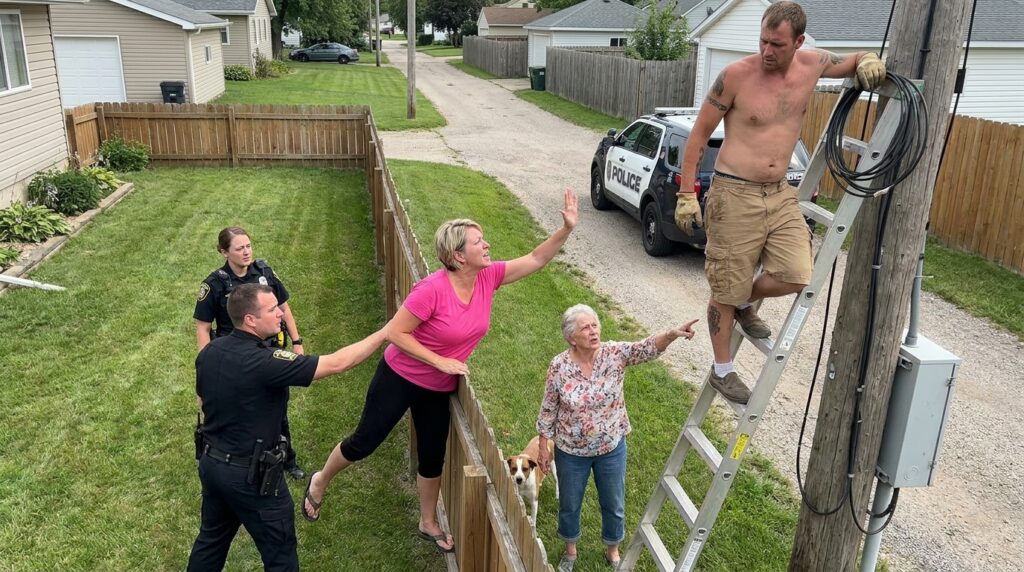
Mark didn’t look down. He couldn’t. His boots were locked into the narrow third rung of the aluminum extension ladder, his heels wedged against the metal edges until the thin soles of his work boots hummed with the vibration of the utility pole. The mid-July heat didn’t rise from the ground—it pressed down from the sky like a wet wool blanket left out on the blacktop. Sweat ran down the ink on his shoulder blades, tracing the black lines of the old piston tattoo until it pooled at the waistline of his tan cargo shorts.
“It’s a county easement, ma’am,” Mark said. He kept his teeth together, his breath shallow as he used a pair of heavy leather gloves to peel back the split rubber casing of the main distribution trunk. The copper inside was already green with oxidation, furred like old cheese. “The line’s dead from here to the corner of Tenth. If I don’t drop the new box in before the three o’clock shift change, your AC isn’t going to do anything but hum.”
“I don’t care if the whole valley goes dark,” she snapped.
Through the green-tinted lenses of his safety glasses, Evelyn looked like a bright, bleeding spot against the dry rye grass of her yard. Her pink T-shirt was pristine, ironed flat across her narrow shoulders, and her short blonde hair didn’t have a single strand out of place despite the humidity. She stood exactly three inches behind the rusted chain-link fence, her fingers curled through the wire links like she was trying to hold the metal together by sheer force of will. In her left hand, a heavy blue folder with a gold HOA seal was tucked under her arm like a weapon.
“This is private platting,” she said, her finger coming up to point straight at the aluminum foot of his ladder. The metal shoe was dug deep into the narrow strip of packed dirt between her grass and the oil-stained gravel of the rear alleyway. “The surveyor’s stake from ninety-two is six inches to the left of that pole. You’re sitting on my dirt, and you’re doing it without a shirt.”
Mark let out a slow, hot breath through his nose. He reached back to his belt, his fingers finding the familiar, greasy handle of his lineman’s wrench. Every house in this development was the same—built in the late seventies with cheap brick and narrower lot lines than the county map actually allowed. They all thought the world ended at their property markers.
He gripped the wrench, the iron cold against his palm despite the heat, and turned his face slightly down toward her. From twelve feet up, he could see the gray roots showing through her blonde dye job.
“The city signed the work order at eight this morning, Evelyn,” he said, using her first name because the badge pinned to his tool belt said Contractor #402 and he didn’t owe her the politeness of a mister. “If you want to argue about six inches of dirt, you call the municipal clerk. But until then, I’ve got sixty pounds of dead copper to pull out of this housing.”
He turned back to the box, his knuckles scraping against the rough, sun-baked cedar of the pole. But as his fingers brushed the lower hinge of the steel casing, he froze. The factory-grade padlock wasn’t broken—it had been sheared cleanly through with a pair of professional-grade bolt cutters, the metal bright and unoxidized beneath a thin layer of fresh alley dust.

CHAPTER 2: THE WEIGHT OF LABOR
The bright, silver bite on the lower hinge hummed against the dead gray of the galvanized casing. It wasn’t the dull, chalky white of iron that had sweated through five Indiana winters; it was raw zinc, clean enough to leave a grey smudge on Mark’s gloved thumb if he ran it along the edge. Someone had put a pair of twenty-four-inch shears through the master link within the last forty-eight hours, and they hadn’t done it to steal four dollars worth of scrap copper. They had done it to look inside.
“Mark!” Evelyn’s voice came up through the rungs, stiffer now, the gravel in her throat dry enough to spark. “I’m not talking to the back of your neck. I have the certified plat map from the ninety-two subdivision filing right here. Section four clearly marks this alley as an unmaintained private access lane, not a municipal thoroughfare. You’re trespassing on an unrecorded utility easement without a county permit.”
Mark didn’t shift his boots. He let his weight settle back into the leather harness, the thick webbing creaking where the iron D-rings bit into the canvas of his tool belt. He took a short, deliberate breath, letting the smell of creosote and baking dust fill his nose before he answered. Down in the alley, the small brown-and-white floppy-eared dog belonging to Mabel drifted through the chicory weeds, its nose down, totally indifferent to the property lines but intensely interested in the grease on Mark’s discarded work truck tires.
“Evelyn,” Mark said, his voice dropping into the low, flat register he used for city inspectors who tried to short his crew on gravel tonnage. “The ninety-two filing was overridden when the county ran the fiber trunk through here in June of last year. This pole belongs to the district grid. If someone’s been clip-cleaning the locks on a three-phase distribution trunk, that’s not an HOA issue. That’s a federal utility violation.”
He reached out with his left hand, his heavy leather glove catching the lip of the steel box. The hinges didn’t screech—they had been oiled recently, another wrong detail that made the grease in his palms feel cold despite the midday glare. When the heavy door swung clear, the internal wiring layout didn’t look like a standard residential drop. Three separate eight-gauge copper leads had been stripped back, their black insulation sliced clean with a razor blade, and bypassed directly into a secondary conduit that plunged straight down the back of the cedar pole, disappearing into the dark earth right at the base of Evelyn’s chain-link fence.
Below, the latch on Evelyn’s gate clicked. The sound was sharp, metallic, and close.
Mark leaned his hip against the pole, looking over his shoulder. Evelyn hadn’t just stayed behind her wire line; she had stepped through the gap where the gate hung loose from the post. Her white-soled tennis shoes crunched into the gravel of the alley, her forward-leaning build throwing a short, sharp shadow toward the base of his ladder. She held the blue folder like a shield against her ribs, but her eyes weren’t on him anymore—they were fixed on the black conduit running into the dirt.
“You have no right to touch that lower housing,” she said, her voice dropping into a tight, rapid whisper that didn’t reach past the truck. “That’s secondary loop equipment. It’s under the jurisdiction of the property owner for maintenance.”
“This is forty-eighty volt primary transmission, ma’am,” Mark said, his knuckles tightening around his lineman’s wrench until the scaling iron bit through his glove. “Nobody maintains this but a card-carrying city crew. And whoever put these shears through the core lock knew exactly which leg was dead when they did it.”
From two houses down, the screen door on Mabel’s porch slapped shut. The old woman stepped onto her top step, her sleeveless floral blouse a spot of faded color against the grey clapboard of her kitchen wall. She raised one hand to shade her eyes, her short gray hair caught in the dry breeze that rattled through the alleyway weeds. She didn’t call out yet, but her head was tilted, her attention locked entirely on the way Evelyn’s white shoes were encroaching onto the narrow strip of public dirt where the aluminum ladder stood.
Mark looked back inside the box. His thumb brushed a small piece of debris caught in the lower gutter of the housing—a tiny, bright orange plastic shaving from a heavy-duty wire-cutter handle. The color was identical to the industrial tools the county road crews used, but the thickness was wrong. It was thin, cheap, the kind of plastic found on the discount racks of hardware stores three miles outside the city limit.
He took his wrench and tapped the side of the transformer casing. The metal gave off a dull, hollow thud that vibrated through the ladder and straight into his shinbones. The box wasn’t pulling juice for the neighborhood; it was humming at three times the cycle it should have been, the heat radiating off the grey enamel finish enough to singe the hairs on his forearm.
“Evelyn,” Mark said, looking down into the silver lenses of her sunglasses. “Who’s been working on your central breaker since the storm last Tuesday?”
She didn’t answer. She took one step closer, her hand coming up to rest on the third rung of his ladder, her knuckles white against the aluminum.
CHAPTER 3: THE PAPER GRIDLOCK
The weight of her palm against the aluminum vibrated straight up through the soles of Mark’s boots. It wasn’t a loose touch; she clamped her fingers around the side rail with a deliberate, calculated leverage, her polished nails clicking against the cold metal. Her knuckles were dead white under the glare of the noon sun. Up on his perch, Mark shifted his hips three inches to the right, his leather tool belt scraping against the dry cedar grain of the pole as he balanced the weight of his iron wrench.
“Take your hand off the rail, Evelyn,” he said. He didn’t raise his voice, but he dropped the words with the heavy, flat finality of a spade striking clay. “The safety manual says nobody stands inside the fall perimeter while the housing is unbolted. If this transformer slips its bracket, sixty pounds of iron and PCB oil will drop straight through your collarbone.”
Evelyn didn’t move her arm. Instead, she leaned her torso forward, her rigid blonde silhouette cutting across the gravel lane like an iron wedge. With her left hand, she brought the blue folder up, smacking the heavy linen stock against the lower upright of the ladder. The gold-leaf HOA seal caught the light, casting a tiny, jagged yellow reflection across the greasy toe of Mark’s left work boot.
“This is an immediate, binding administrative cease-and-desist,” she said. Her speech had slowed down, tightening into the practiced, bureaucratic cadence of someone who spent her Tuesday nights citing neighbors for using the wrong shade of mulch. “Paragraph three of the subdivision bylaws explicitly reserves the right of architectural review for all visible infrastructure attachments within thirty feet of a primary residential facade. Look at the signature line, contractor.”
Mark tilted his chin down, his green safety lenses tracking the paper sheet she was thrusting toward his knees. The document looked expensive—thick, eighty-pound cream stock, complete with a neatly typed legal description of the Elm Street plat and an official-looking corporate stamp at the footer. But Mark spent forty hours a week reading municipal blueprints and easement filings. He knew what real county seals looked like. The stamp on her paper didn’t have the raised, embossed edge of the county recorder’s press; it was a flat, purple ink-jet imitation, the edges slightly feathered where the ink had bled into the cheap cotton fiber of the page.
More importantly, the legal description was missing the standard northwest section marker. Someone had manually adjusted the coordinate links, shifting the public utility easement boundary exactly twenty-four inches to the east—just enough to push the entire wooden pole out of the city’s right-of-way and onto Evelyn’s private lawn plot.
“This text didn’t come from the courthouse clerk,” Mark said, his voice dropping into the gravelly rumble of an idling truck engine. He tapped the shaft of his wrench against the top rung, the ring of the steel cutting through the dense, humid air. “You typed this out yourself, Evelyn. You used the old ninety-two boundary layout before the county widened the alleyway for the fire lane.”
Evelyn’s chin jerked up. Her oversized sunglasses flashed, hiding her eyes behind twin circles of polished dark acrylic, but the muscle right below her jawline twitched twice, her lips drawing back into a thin, bloodless line.
“The Board signed that document at seven o’clock last night,” she said, her voice rising just enough to carry across the low wire fence into the neighboring yard. “We don’t recognize the county’s right to re-zone the back-alley easements without a unanimous vote from the property owners. My husband paid thirty-two thousand dollars for this lot extension in ninety-five. We own the ground, we own the fence, and we own the structural support lines that run across this grass.”
“You don’t own the wire, ma’am,” Mark said. He didn’t look down at her document again. Instead, his fingers went back to his belt, unhooking the worn leather pouch that held his official city permit book. He flipped it open with one hand, the grease-stained carbon sheets rattling in the hot draft. “This is a Department of Public Works work order, number seven-dash-four-four-alpha. It’s got the city engineer’s stamp and a direct signature from the regional grid administrator. If your board wants to contest it, you’ll have to do it in the municipal civil court on Monday morning. But until three o’clock, I’m the one with the wire-cutters.”
Down in the chicory weeds, Mabel’s dog stopped its sniffing. The animal’s head went up, its floppy ears lifting as it turned its gaze toward the far end of the alleyway. A low, dull vibration was beginning to rumble through the packed gravel—the heavy, rhythmic throb of a standard six-cylinder diesel engine shifting down into second gear as it turned off the main avenue.
Evelyn didn’t turn around to look at the alley entrance. She kept her weight pressed hard against the aluminum rail, her fingers digging deeper into the metal as if she could keep the ladder anchored by her own determination.
“I don’t care about your carbon paper, boy,” she whispered, her voice dropping into a razor-thin hiss that didn’t carry past the ladder base. “You take that splice box apart, and you’ll find out exactly what this neighborhood does to contractors who think a city badge means they can touch a private system.”
Mark didn’t answer her. He let his gaze drift past her shoulder toward the cedar pole’s connection line. Right where the black conduit plunged into the dry dirt near her fence, the earth was slightly discolored—darker, wetter than the surrounding gravel, as if someone had been digging around the primary ground rod within the last twelve hours.
CHAPTER 4: THE WIRECUTTER DISCREPANCY
The wet patch of clay at the fence line stayed in the corner of Mark’s eye as he pulled his gaze back into the dark interior of the enclosure. The heat coming off the components wasn’t a standard electrical hum; it was greasy, thick with the smell of scorched synthetic oil and frying dust that made the skin across his cheekbones itch. He took his small inspection light from his pocket, clicked the rubber tail switch between his teeth, and pointed the narrow white beam into the back corner of the iron sleeve.
The three stripped copper leads didn’t look like they had been modified by a professional lineman. The jagged scars in the black plastic insulation were rough, torn back with an uneven pressure that left silver scores in the metal beneath. But it was the secondary alignment block that made him stop. The steel bracket had been pried open with a common pry bar—the zinc coating was gouged down to the raw iron, leaving a tiny pile of metallic dust on the bottom ledge that hadn’t even had time to rust in the humid air.
He leaned closer, the bill of his gray work cap catching on the edge of the outer door. Right behind the main bus bar, the clean, silver shear marks he had noticed on the outer lock were repeated. Someone had used a heavy-duty cutter to trim away the safety grounding strip. He looked down through the rungs of the ladder at Evelyn’s yard. The door to her small, weathered cedar tool shed sat unlatched, swinging three inches in the hot breeze. On the bottom shelf of the workbench inside, half-hidden by a green plastic garden hose, the long, red handles of a pair of heavy-duty bolt cutters caught the glare of the noon sun. The plastic on those handles was worn, split at the butt, but the jaws were bright, unrusted, and exactly twenty-four inches long.
“You’re done looking in there,” Evelyn said. Her voice didn’t rise, but it had a thin, dry hardness that sounded like a shovel blade dragging across concrete. Her fingers didn’t leave the aluminum rail. Instead, her knuckles shifted, her thumb pressing flat against the metal side piece to steady her weight as she tilted her chin upward. “I’ve already contacted the county commissioner’s office. If you don’t drop those tools and clear this alley before the deputy gets here, I’m filing a formal complaint for property destruction and harassment.”
“The box is running hot, Evelyn,” Mark said. He didn’t drop the light from his teeth. He used his socket wrench to loosen the upper mounting bolt, the iron threads screaming as they turned through thirty years of dry cedar rot. A small shower of red wood dust fell through the air, settling on the shoulders of her pink T-shirt like dried rust. “It’s pulling three times the residential load it’s rated for. Someone bypassed the main commercial meter on the south side of the block and tied the line directly into your secondary panel. Every kilowatt this entire lane is using for their air conditioners is running straight through your private house line first.”
Evelyn didn’t blink behind her dark lenses. The shadow of her forward-leaning posture didn’t shift an inch.
“The neighborhood associations handle their own distribution agreements,” she said. She brought the blue folder down, smacking the stiff linen pages against her thigh with a dull thwack. “We don’t owe the city an explanation for how this block is wired. We paid for the infrastructure when the original contractor went bankrupt in eighty-eight. If the county didn’t update their records, that’s a clerical error, not a trespass.”
Mark let out a short, sharp whistle through his teeth, the light dropping into his gloved hand. He knew the history of this subdivision. The developer had walked away before the final paving was dry, leaving forty families with unbonded roads and an unfinished utility grid. The city had taken over the lines by default five years later, but they had never dug up the underground feeds.
He reached into the housing, his fingers tracing the thick, bypassed cable down toward the base of the pole. The line didn’t split toward the other houses. It went straight down into the damp earth, disappearing under the bottom rail of Evelyn’s chain-link fence like a black root. The logic of it clicked into place with a heavy, cold weight—she wasn’t trying to protect her privacy. She was trying to keep him from pulling the main fuse that would show the entire district why her household utility bill had been four times higher than anyone else’s for the last ten years. She had been paying the county for the entire block’s line loss, and she had done it because she thought it gave her the legal right to control the physical wire.
“You’ve been paying the billing drop for the whole cul-de-sac, haven’t you?” Mark said, his voice flat, completely stripped of any professional politeness. He looked down at her, his boots locking harder into the metal rungs. “You thought if you carried the meter cost, the easement belonged to you. That’s why you cut the master lock.”
Evelyn’s mouth opened, her lips twitching back into a tight circle, but before she could drop her line, the heavy throb of the diesel engine at the end of the alley cut out. A white police SUV with a black steel brush guard slid through the chicory weeds, its tires crunching into the dry gravel exactly ten feet behind her. The blue and red lights on the roof didn’t flash, but the reflection of the midday sun across the unbranded door panels was bright enough to make Mabel turn her face away from the porch.
The driver’s door swung open with a heavy, mechanical click. Officer Miller stepped out into the dust, his stocky frame pulling the black fabric of his uniform tight across his chest as his boots found the packed gravel. He didn’t look at Mark on the ladder. He looked straight at Evelyn’s hand, which was still clamped hard around the third aluminum rung, her knuckles shaking with an uneven, white-hot tension.
“Ma’am,” Miller said, his voice low and practiced, the tone of a man who spent his days separating neighbors over broken fence panels. “Step away from the work zone right now.”
CHAPTER 5: THE CRITICAL KINETIC LUNGE
The dust kicked up by the white SUV’s tires hung thick in the heavy air, sticking to the grease on Mark’s forearms. He kept his grip on the cedar pole, his boots tensing against the narrow rungs as the mechanical low-end rumble of Officer Miller’s voice vibrated through the alley.
Evelyn didn’t let go of the ladder. Her hand remained clamped like an iron vise around the third aluminum bar, her fingers rigid. She spun her head back toward the cruiser, her neck muscles corded like frayed rope below her short blonde hair. The silver frames of her oversized sunglasses caught the raw reflection of the black steel brush guard on the incoming vehicle.
“Officer, thank God,” she yelled. Her voice lost its flat, bureaucratic precision, snapping into a high, commanding tone that scraped across the quiet of the alleyway. “This individual is completely unauthorized. He’s deliberately destroying neighborhood association equipment and trespassing across an unrecorded private boundary line. Look at what he’s done to the central casing!”
“Get down, you don’t touch those wires!” she screamed, her head snapping upward toward Mark again, her free left hand jabbing violently into the air just beneath his boots.
Mark didn’t move. He kept his hip anchored against the pole, his arms bracing his torso clear of the open housing. He could feel the irregular, hot throb of the transformer box leaking through his leather work gloves. The machine was rattling at a pitch that meant the internal coils were beginning to char their paper insulation.
“Ma’am,” Officer Miller said again. His boots hit the dry chicory weeds with a rhythmic, heavy crunch. He didn’t unholster his duty weapon, but his right hand came to rest flat against the utility belt near his hip, his stocky build leaning forward into the workspace. “I told you to clear the lane. Step back behind the wire fence now.”
“I am the president of this development’s management board!” Evelyn’s torso lurched closer to the ladder. Her body weight surged forward, her bright pink T-shirt brushing against the cold aluminum frame. Her hand hooked into the side rail and she gave it an aggressive, desperate tug, trying to yank the base away from the cedar pole to force Mark to descend.
The sudden shift in the metal center caused the top rungs to slam two inches across the weathered bark. Mark’s right boot slipped from the platform, his heavy leather harness groaning as the canvas webbing took the full weight of his hip against the iron D-rings. A sharp splinter of sun-baked cedar bit into his bare ribs, drawing a thin line of red that mixed with the sweat on his spine.
“Evelyn, stop!” Mabel screamed from her top porch step. She ran toward the low chain-link property line, her sleeveless floral blouse flapping in the draft. Her face was gray with fear as she pointed a trembling hand toward the top of the utility pole. “You’re going to kill him! Mark, don’t move!”
Before Evelyn could give the aluminum frame a second pull, the stocky form of Officer Miller crossed the distance. His black unbranded uniform cut through the glare of the noon sun. He didn’t hesitate or monologue; he used his bulk to crowd Evelyn’s shoulder, his large, gloved hand reaching out to wrap firmly around her upper arm right below the pink sleeve. With a short, practiced backward pull, he broke her grip on the side rail and dragged her three feet back into the dry rye grass of her own yard.
“Back from the ladder, hands down now!” Miller barked. His voice was clipped, professional, and entirely unyielding to the paper folder she was still trying to brandish.
Evelyn shrieks in disbelief, her white tennis shoes losing their traction on the grass as she was forced back from the lane. The blue folder slipped from her arm, the thick linen pages scattering across the dirt, showing the purple ink-jet imitation seals to the open alleyway. Behind the vehicle, Officer Davis exited the passenger side, her athletic build alert as she took up a position near the rear gate to secure the perimeter.
Mark stabilized his footing, his heart hammering a steady, heavy cadence against his ribs as he forced his boot back onto the rung. His hands were shaking with the adrenaline of the slip, but his mind remained cold, fixed entirely on the greasy black conduit that ran out of the broken transformer box and straight into the earth beneath Evelyn’s feet. The decoy of her association paperwork was gone, destroyed by the simple physics of a police officer’s grip, but the deeper heat inside the machine was still humming.
“Sir,” Officer Davis called up, her eyes tracking the sweat on Mark’s chest before she looked down at the official municipal clipboard lying near his truck tires. “Step down and wait here. Let’s look at that work order.”
Mark slowly unhooked his safety lanyard from the cedar pole, his knuckles white against the iron snaps. As his boots began their descent toward the gravel, he noticed a tiny stream of dark, viscous oil starting to ooze from the lower seam of the distribution box. The fluid didn’t look like standard city oil—it was black, burnt, and smelled like zinc that had been cooked over a high flame.
CHAPTER 6: THE RUSTED SETTLEMENT
The work boots hit the alleyway blacktop with a solid, leaden thud that sent a small shudder through Mark’s calves. The gravel beneath his soles was hot, saturated with decades of leaked crankcase oil and the grey dust of limestone base. The air down here smelled different than it did twelve feet up; it was thick with the scent of roasted insulation and the sharp, chemical tang of the black dielectric fluid leaking from the split seam of the distribution housing.
He didn’t drop his wrench. His leather-gloved fingers stayed clamped around the iron handle, his skin slick with sweat where the tool’s industrial cross-hatching pressed into his palm.
“Let’s look at that work order,” Officer Davis said again. She didn’t move toward Evelyn. Her posture remained squared toward the alleyway lane, her fingers hooked loosely into the top of her tactical vest, her boots spaced to give her leverage if the situation reset itself into violence.
Mark reached into the worn leather pouch hanging from his side, his fingers brushing past the cold metal of his wire-strippers until they found the coarse, thumbed edges of the city permit book. The yellow carbon sheets were warped from the humidity, the purple indelible ink slightly smudged along the margins where his greasy thumb had pinned the page. He pulled the document free, the paper crisp and noisy in the sudden silence of the backyard boundary.
Officer Davis took the book, her eyes scanning the municipal registration code—7-44-A—and the embossed seal of the Department of Public Works. She didn’t look at Evelyn while she read. She tracked the legal description of the grid coordinates down to the bottom line, then raised her chin to glance at the wooden pole where the dark, bubbling line of transformer oil was collecting in the dry rye grass.
“It’s a clean drop,” Davis said, her voice carrying the flat, monotone weight of a person reading a serial number off a engine block. She handed the book back to Mark, her leather gloves clicking against the carbon paper. “The city owns the radius up to four feet from the centerline of the lane ditch. The pole sits exactly thirty-two inches inside the public zone.”
Behind them, Evelyn was still held by Officer Miller’s stocky arm. Her bright pink T-shirt was rumpled, the shoulder seam pulled tight against her collarbone where the officer’s fingers kept her anchored to the grass. Her oversized sunglasses had slipped a quarter-inch down her nose, revealing her eyes—small, pale blue, and bloodshot around the rims, blinking rapidly against the unshaded glare of the July sun. The fake HOA folder lay three feet away in the dirt, its gold seal covered by a fine layer of grey blacktop grit.
“The billing is wrong,” Evelyn said. Her voice didn’t have the loud, sharp bark left in it; it had dropped back into that low, rattling hiss, her chest heaving underneath the thin cotton fabric. “You don’t understand the ledger. The county clerk has been routing the entire sector three line loss through meter box forty-two since the substation upgrade in January. I’ve paid seven hundred and forty dollars every month since the freeze. If he pulls those fuses, the whole block goes dark, but my circuit stays live. I paid for the extra transformer capacity. It’s on my bill!”
Mark stopped his hand midway to his belt. He looked from her face down to the fresh, wet clay where the black conduit disappeared under her chain-link fence line. The truth didn’t arrive with a dramatic reveal; it came with the greasy, industrial reality of a municipal accounting failure. The city hadn’t re-routed the cables when they took over the bankrupt subdivision’s grid. They had simply left the old, irregular private transformer active, letting the primary meter run inside Evelyn’s house while forty other homes pulled their air conditioning load directly through her private transformer’s secondary bypass leg. She wasn’t an autocrat trying to steal public access—she was a broke woman who had been systematically drained by a bureaucratic glitch for ten years, and she had cut the city’s master lock because she believed that paying the bill made the iron hers to keep.
“Evelyn,” Mark said, his voice flat, the pragmatism of a field mechanic overriding the anger from his slipped footing. “The city isn’t billing you for the line loss because they think you own the pole. They’re billing you because the old developer tied your residential service panel directly into the primary distribution bus forty years ago. Every time Mabel turns on her stove, your dial spins. Cutting my lock didn’t fix the loop; it just kept the engineer from seeing the line error.”
Evelyn’s mouth stayed open, her lower lip trembling slightly against her teeth. She looked at the wooden pole, then down at the scattered linen stock of her fraudulent injunction, her shoulders dropping two inches as the rigid, forward-leaning tension left her silhouette.
Officer Miller slowly released his grip on her upper arm. He didn’t pull his handcuffs from his belt, but he kept his stocky frame between her and the aluminum ladder.
“Ma’am,” Miller said, his hand gesturing toward the parked white SUV. “We’re going to step back to the cruiser. You’re getting a citation for interfering with a public utility tech, and we’re going to have the county clerk verify those billing records. But you need to stay out of the alley lane while the lineman finishes the splice.”
Evelyn didn’t shriek. She didn’t pick up her blue folder. She walked deliberately toward the vehicle, her white-soled tennis shoes dragging through the dry chicory weeds, her eyes fixed entirely on the gravel at her feet as Officer Miller followed her flank.
Mark turned back to his truck. He reached into the bed, his gloves sliding over the scaling zinc plating of a fresh, unweathered three-phase isolation switch. He had a job to finish before three o’clock, and the block was still drawing juice through a burnt core. He looked over at Mabel, who was still standing by her fence line, her sleeveless blouse damp with sweat as she watched the cruiser’s doors click shut.
“Is the power coming back on, Mark?” she asked.
“It’ll be on in twenty minutes, Mabel,” Mark said, lifting the heavy iron replacement unit onto his shoulder. “And the city’s going to owe your neighbor a lot of money.”