
The Weight of Faded Iron and the Cold Bureaucracy of Suburban Dirt

CHAPTER 1: THE ACCUMULATION OF DUST

The thick yellow paper did not pull away cleanly from the glass. It tore along the wet line where the frost had begun to melt against the cracked rubber of the wiper blade. I didn’t use a knife; I used the edge of my thumb, scraping the pulp until my nail ran cold against the windshield of my father’s blue F-150. The bold print at the top didn’t vary by a single character from the three that had come before it: NOTICE OF NON-COMPLIANCE – OAKRIDGE HOMEOWNERS ASSOCIATION. Below it, the fine had grown by another seventy-five dollars, typed out in the clean, dry font of an office printer that didn’t care about the sound the engine made when it turned over in the morning.

I rolled the wet scrap into a hard gray pill and dropped it into my pocket, right beside the heavy brass ignition key. The key was cold. The metal had been worn smooth by his thumbs over twenty years of hauling gravel, back before the township had laid the uniform sod and called the fields an estate. Through the kitchen window, the silhouette was already there, perfectly still behind the steering wheel of a silver sedan parked exactly six inches clear of our mailbox post. Brenda didn’t have her lights on. She didn’t need them. She had a legal pad propped against the wheel and the low, gray light of six-thirty in the morning.

“Don’t look out there,” my mother said from the stove. Her voice had that thin, flat quality it always took on when the bills sat on the table for more than two days. She didn’t turn around to look at me. She just kept the wooden spoon moving in the oats, the wood clicking against the seasoned cast iron with a rhythmic, mechanical scratch. “She’s just waiting for you to walk down the driveway. Just get in the truck and go to the store.”

“The truck isn’t leaking,” I said. My boots felt heavy on the linoleum, the soles worn down to the foam at the heels from the concrete floor of Lane 4. “I checked the pan twice. It’s dry dirt underneath.”

“It doesn’t matter if it’s dry, Leo. It matters what she writes down.” She set the spoon down on the counter with a soft, wet thud. She looked at her hands, the skin dry from forty years of Michigan winters and cheap dish soap. “The lawyer from the bank called again while you were on the night shift. He said three more outstanding liens from the association will trigger the acceleration clause. They can do it. They have the papers.”

I didn’t answer. I reached down and touched the brass key through the denim of my jeans. The edge of it dug into my skin, sharp and functional. Every house in Oakridge had the same grey cedar siding, the same mandatory three-foot perimeter of red mulch, the same lack of shadows under the streetlights. If you lived here long enough, you learned that the ground didn’t belong to you; it belonged to the code.

When I pulled the truck out onto the asphalt, the silver sedan shifted gears without a sound. It followed three car lengths back, the reflection of Brenda’s short, gray hair visible in my side mirror whenever we hit the turn by the retention pond. She didn’t look left or right. She kept her chin high, her hands locked at ten and two on the leather-wrapped wheel, her stocky silhouette dark against the pale gray of the subdivision entrance. She stayed behind me all the way to the state route, turning off only when the blue neon sign of the supermarket came into view against the power lines.

The store smelled of old wax and plastic wrap. I pulled the blue polyester polo over my head in the breakroom, the fabric stiff and smelling of the industrial laundry. The plastic name badge pinned slightly crooked across the left pocket. When I took my place behind Checkout Lane 4, the register scanner gave its first short, metallic ping of the morning. My hands stayed flat on the stainless steel counter, cold and still, waiting for the conveyor to move.

The belt ran with a low, continuous groan. A box of crackers, a plastic gallon of milk, a small bag of frozen corn. I scanned them by habit, the red laser line cutting across the barcodes like a stitch. Then the line went wide and flat against a piece of yellow paper that had been laid down between a jar of sauce and a heavy bag of flour.

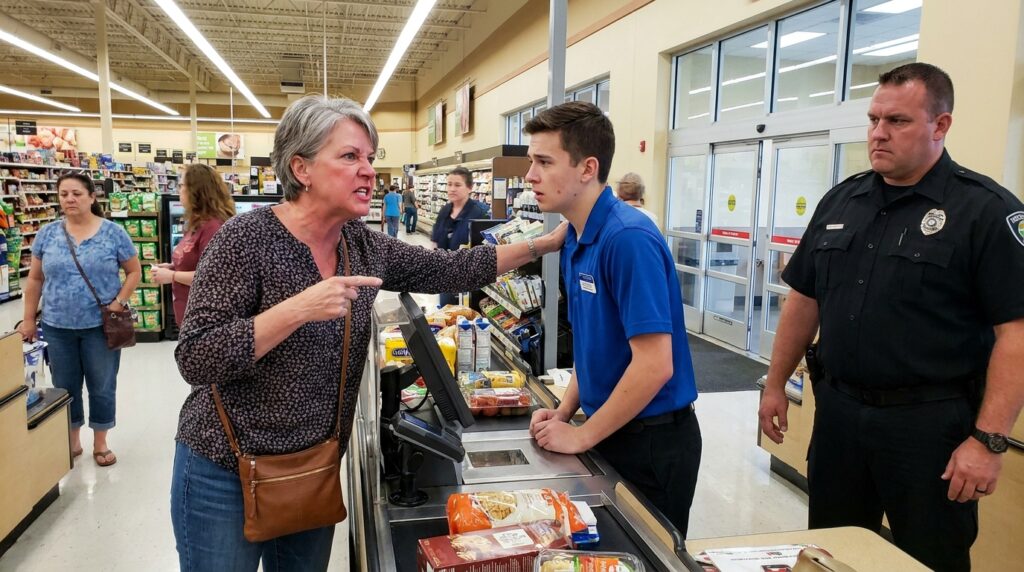
I looked up. The stocky build, the dark patterned blouse, the brown leather strap of the cross-body bag cutting deep into the fabric of her shoulder. Brenda wasn’t looking at the groceries. Her eyes were fixed directly on the plastic edge of my name badge, her jaw tight and flushed beneath her styled hair.

“You skipped the citation on the porch, Leo,” she said, her voice dropping below the hum of the freezer cases. “The board doesn’t accept silence as an appeal.”

CHAPTER 2: THE COST OF STANDING WATER

“You skipped the citation on the porch, Leo,” she said, her voice dropping below the hum of the freezer cases. “The board doesn’t accept silence as an appeal.”

My fingers stayed anchored to the metallic rim of the grocery scanner. The steel was cold, scratched by thousands of tin cans and brass rivets, coated in the fine, dry dust of unbleached flour that had leaked from some previous customer’s bag. I didn’t look at the paper she had laid on the black rubber conveyor belt. I looked at the edge of her collar—the stiff, starched crease of her dark floral blouse where a stray thread hung loose near the button.

“Ma’am, I am on the clock,” I said, keeping my breath steady, the words flat and even, exactly the way the store manager trained us to handle the people who brought their personal miseries to the register. “I cannot discuss the subdivision here. Your total is fourteen dollars and sixty-two cents.”

Brenda didn’t reach for her wallet. Her stocky build leaned further over the divider, her forceful forward posture cutting off the space between my lane and Checkout Lane 3. The leather strap of her brown cross-body purse creaked as she shifted her weight, pressing her hip against the plastic carousel where the plastic bags hung empty. She pointed a short, thick finger at the yellow sheet.

“Look at the margin, Leo. Look at the date.”

Against the grain of my own judgment, my eyes tracked down to the paper. The print was standard, but near the bottom, right above the signature line, a sequence of digits had been scrawled in a peculiar, dark purple ink—an obsolete shade of aniline ink that didn’t match the cheap blue ballpoint the association usually attached to the clipboard at the gate. The date wasn’t from this morning. It was backdated three weeks, right to the night the storm had filled the retention ditch at the edge of our gravel driveway until the red mulch floated away like blood across the asphalt.

“The culvert isn’t yours,” she murmured, her face flushing a deep, dark crimson that started at her throat and crept toward her ears. “The survey didn’t stop at your fence line, no matter what your father told you before he died. The standing water on that gravel strip belongs to the community now. We’re putting the concrete drainage pipe through by the end of the month.”

The conveyor belt beneath her groceries gave a short, metallic shudder as I toggled the foot switch. The jar of sauce rolled an inch forward, its glass bottom clicking against the metal track with the dry, hollow sound of an empty bin. The implication didn’t make sense—our driveway had been clear for thirty years, the deed signed in the old township office before the developers had even drawn the blueprint for the Oakridge gatehouse. But Brenda’s hand remained steady on the counter, her fingertips leaving short, oily smudges on the clean stainless steel.

Behind her, a man in a gray fleece vest let out a short, loud sigh, dropping a basket filled with charcoal and ribeyes onto the belt of Lane 3. The ambient noise of the supermarket—the rhythmic, mechanical ping of the other registers, the low rumble of the ventilation system, the squeak of a loose wheel on a shopping cart—seemed to recede into a dry, static hiss.

“Fourteen sixty-two, Brenda,” I repeated, my voice dropping an octave, my hand moving to the register keys without looking at them. The plastic caps of the keys were slick under my fingertips, worn down by hours of repetitive labor. “The store doesn’t permit third-party business in the lanes. If you aren’t paying, I have to clear the belt.”

“Clear it,” she said, her smile small, rigid, and devoid of teeth. She didn’t blink. She stood her ground, her body blocking the narrow passage to the exit doors, an absolute wall of suburban authority that expected the world to bend to the rules she carried in her folder. “But when the county truck backs over your dad’s old garden box on Monday morning, don’t say the notice wasn’t served.”

She turned, the heavy brown purse swinging hard against her thigh as she walked away toward the automatic double doors, leaving the yellow paper lying flat across the scanner’s glass eye, blocking the red laser from reaching the next item.

CHAPTER 3: THE STRIP OF DISPUTED DIRT

The grease from the truck’s steering box had worked its way under my fingernails during the drive home, leaving ten dark crescents that wouldn’t scrub out with the rough orange soap by the sink. I stood on the small gravel strip between our porch and the chain-link boundary fence, the heels of my boots sinking into the loose stones my father had hauled from the quarry five summers ago. The ground here smelled of wet lime and iron-rich well water, a heavy, domestic scent that always settled in the low spots when the humidity rolled off the county drainage ditch.

“They dropped these while you were at the terminal,” my mother said. She was kneeling by the edge of the old timber garden box, her calloused fingers turning over the loose black loam. She didn’t look up when the F-150’s manifold gave its long, ticking cool-down hiss. Beside her boots lay four wooden surveyor’s stakes, each one painted a sharp, violent orange at the tip, connected by a length of cheap nylon string that had already collected the grey dust of the road.

I walked down to the property marker, the leather of my work boots stiff against the weeds. The string was pulled tight, cutting straight through the middle of the wild blackberry bushes my father had planted to keep the road dust from hitting the porch windows. It didn’t follow the old iron pipe driven into the corner of the lot—the one the township surveyor had stamped back in ninety-four. It sat three feet inside our grass, a clean, mechanical division that claimed the gravel parking strip for the association’s utility easement.

“Brenda brought a man with a transit tool around noon,” my mother continued, her voice small against the rumble of a lawnmower three houses down. She stood up slowly, her hand resting on the small of her back where the labor always left a dull, constant ache. “He didn’t speak to me. He just wore an orange vest with the Oakridge logo on the pocket and hammered the stakes into the sod. When I asked him for the county permit, Brenda pulled a blue folder out of her shoulder bag and told me the township board had already vacated the right-of-way.”

I reached down and picked up one of the spare stakes lying in the weeds. The pine was fresh, splintering against my calloused palm, the bright orange paint still clean enough to smell of petroleum solvent. On the flat side of the wood, the same dark purple aniline ink I had seen on the supermarket register notice was used to mark a sequence of grid numbers: E-104-DRAIN. The handwriting was small, sharp, and perfectly uniform, the ink biting deep into the grain of the soft wood.

“The township didn’t vacate anything,” I said, my thumb scraping against the rough edge of the pine. “The county road commission handles the culverts. I checked the public ledger on my break at the store. The county hasn’t updated the drainage maps since the subdivision loop was paved.”

“She has papers, Leo,” she whispered, her eyes tracking back to the silver sedan that had just turned the corner by the entry gate, its clean panels reflecting the low, desaturated orange of the setting sun. “She has the seal from the board. If we pull those stakes, the notice says it’s a five-hundred-dollar fine for willful destruction of community property. We don’t have the five hundred. The bank won’t wait if the escrow account drops again.”

I didn’t answer. I walked the length of the string, the nylon line humming slightly in the evening breeze like a wire under tension. Every house on our side of the loop had the same mandatory three-foot strip of red cedar mulch, but our lot was different—it was the only one that still had the old gravel driveway, the only one that hadn’t been dug up and re-graded to feed the concrete storm sewers that ran toward the main road.

Underneath the counter at the store, buried beneath the stacks of plastic bags and the logs of expired coupons, I had found an old, faded copy of the regional drainage blueprint left behind by the night maintenance crew. The blue ink was water-damaged, the paper smelling of damp basement concrete, but the red lines drawn across the Oakridge perimeter didn’t look like an infrastructure upgrade. They looked like a boundary shift. The drainage pipe Brenda was threatening to lay didn’t connect to the main township culvert; it stopped exactly at the edge of our foundation, turning our lower gravel lot into a catch-basin for the entire eastern tier of the development.

I stuck the orange stake back into the loose gravel at my feet, the stones grinding against the wood with a dry, heavy crunch. The silver sedan didn’t park. It crept past at five miles an hour, the window rolling down just enough for the dark frame of Brenda’s sunglasses to show against the shadow of the interior. She didn’t drop a notice this time. She just held a grey folder against the glass, her stocky arm steady against the door panel, her posture cutting the space between the road and our dirt like a fence.

“Get inside,” I told my mother, my hand closing around the brass key in my pocket until the metal left a deep, cold impression in my palm. “The wind is turning. The dust from the ditch is going to hit the porch.”

CHAPTER 4: THE PREEMPTIVE EMULSION

The high-pitched hum of automated conveyor belts had a way of embedding itself in the bone behind my ears after four continuous hours on the floor. The store was thick with the scent of cheap pine floor sealant and the heavy, damp air that blew in from the loading docks whenever the big rolling garage doors were left unsecured. It was five past four on a humid Tuesday afternoon, and my hands were slick from scanning plastic milk jugs covered in cold condensation, the skin of my thumbs raw where the coarse blue cotton of the uniform sleeves rubbed against my wrists.

I didn’t look at the clock on the wall, but I could feel the rhythm of the town shifting through the weight of the carts. The after-school rush was bleeding straight into the factory shift change, bringing a steady, unyielding line of tired faces toward Checkout Lane 4. I kept my boots planted flat on the ribbed rubber fatigue mat behind the counter, my spine locked upright. In my left pocket, the old brass ignition key pressed hard against my thigh—a heavy, cold reminder of the truck sitting in the gravel lot outside, its rusted bed filled with the four orange stakes I had yanked from our lawn before the sun had even cleared the rooflines.

“Next,” I said, my voice dry.

A plastic basket hit the belt with a heavy, hollow thud. I reached for the first item without looking up, my fingers finding the familiar cold glass of a commercial sauce jar. But the conveyor didn’t move forward. The light beam at the end of the scanner track was broken, blocked by the rigid corner of a grey plastic clipboard that had been jammed deliberately between the metal guide rails.

“You didn’t leave the stakes where they belonged, Leo,” Brenda said. Her voice wasn’t a yell yet, but it carried that sharp, high-pitched clip she used when she was reading code violations from the neighborhood handbook.

She had positioned her cart directly across the mouth of the lane, entirely blocking the passage for a woman behind her who was holding two small children by the hands. Brenda’s stocky build was shoved forward against the silver divider bar, her dark patterned blouse stretched tight across her shoulders. The brown leather cross-body bag hung low against her hip, the thick strap digging visible creases into her collar. She didn’t have groceries in her cart; she had three folders of identical grey cardstock, each one stamped with the blue embossed emblem of the Oakridge Homeowners Association.

“Ma’am, I am on the clock,” I said, my voice dropping into that flat, transactional stillness I had used two days ago. I kept my palms pressed flat against the stainless steel scanning table, the cold metal drawing the heat out of my skin. “I cannot discuss the subdivision here. If you aren’t purchasing items, I need you to clear the lane for the customers behind you.”

“The board doesn’t wait for your shift to end,” she said, her face flushing that dark, immediate crimson that always signalized her refusal to be managed by a service worker. She reached into her cross-body bag, her hand emerging with a fresh, crisp sheet of the yellow paper. She didn’t lay it down this time; she held it six inches from my face, her short, grey-haired head tilting down so her sunglasses slipped down the bridge of her nose. “This is a formal notice of non-compliance with the easement directive. Your mother refused service at noon, so it’s logged as a secondary evasion. The fine doubles at midnight.”

“Ma’am,” I repeated, the word coming out through my teeth like gravel grinding in a chute. “Clear the lane.”

“You think this store protects you?” Her voice rose, the pitch cracking against the high, open steel beams of the supermarket ceiling. The rhythmic clicking of the adjacent registers seemed to drop away all at once, replaced by the sudden, heavy silence of the customers in the next lane turning to look. “Your father built that driveway on common dirt, Leo. He knew it, and you know it. You sign this acknowledgment right now, or the county sheriff accompanies the grading crew on Monday morning.”

She reached across the metal bar, her stocky arm extending until the edge of the clipboard scraped against the plastic casing of my register terminal. She didn’t care about the corporate rules of the store; she was carrying the absolute weight of her neighborhood authority into the grid of my employment, confident that the uniform I wore made me small enough to break.

Behind her, a man in a delivery vest dropped his basket with a loud clatter of aluminum cans, his mouth opening to speak, but Brenda didn’t turn around. She leaned further over the conveyor belt, her stocky frame jostling the display of small battery packs near the register, her breath smelling faintly of black coffee and dry paper as she waited for the submission she believed she had already bought and paid for with thirty years of neighborhood code.

CHAPTER 5: THE IMPACT ACROSS THE REGISTER

“You think this store protects you?” Her voice rose, the pitch cracking against the high, open steel beams of the supermarket ceiling. The rhythmic clicking of the adjacent registers seemed to drop away all at once, replaced by the sudden, heavy silence of the customers in the next lane turning to look. “Your father built that driveway on common dirt, Leo. He knew it, and you know it. You sign this acknowledgment right now, or the county sheriff accompanies the grading crew on Monday morning.”

My hands stayed flat on the stainless steel counter, the cold metal drawing out the sweat of my palms until my skin left dark, dull smears against the polished track. I didn’t reach for the yellow paper. I didn’t reach for the pen she was forcing toward my face. The stiff polyester collar of my blue uniform shirt felt tight against my throat, rubbing against the raw skin where the fabric had begun to fray from daily wear.

“Ma’am, I am on the clock,” I said again, the words mechanical, dragged up from the bottom of my throat like iron chain through a rusty pipe. “Move the cart out of the lane.”

Brenda didn’t move. Her stocky build lunged forward across the black rubber conveyor belt, her hips catching the edge of the candy rack and sending three small boxes of batteries tumbling into the plastic grocery bags with a sharp, plastic rattle. The heavy leather strap of her brown cross-body purse cut deep into the floral pattern of her blouse as her hands snapped forward. Her fingers didn’t grab for the paper; they reached straight across the scanner’s glass eye and clamped into the fabric of my polo shirt, right above the plastic name badge.

The force of the grab yanked me an inch forward, my belt buckle striking the hard metal rim of the cash drawer with a hollow, metallic clink. Her face was dark crimson now, the skin around her eyes tight and wet with an old, predatory rage that had nothing to do with code enforcement or property lines. Her breath smelled of stale coffee and paper dust, hot against my chin.

“You don’t get to treat me like this, fix it now!” she screamed.

The store went completely silent. The hum of the freezer units seemed to drop an octave, leaving only the dry, electronic drone of the register’s error tone as the glass eye remained blocked by her arm. I didn’t strike back. My father had taught me how to hold a twenty-ton load on a ten-percent grade with nothing but grease-stained brake drums; he had taught me that when the weight starts to push you down the hill, you don’t panic—you lock your heels and wait for the friction to take hold. I kept my elbows tucked against my ribs, my fingers curled tight around the brass ignition key inside my pocket until the teeth of the metal cut deep into my skin.

Then the shadow fell over the lane.

Marcus didn’t move with the frantic hurry of a retail clerk. His large build came from the exit threshold with a slow, heavy stride that carried the absolute physics of institutional weight. The black fabric of his uniform was stiff, the tactical belt creaking slightly as he stepped between the counter and Brenda’s shopping cart. He didn’t unholster anything. He didn’t use a strike or a punishment blow. He simply placed one large, calloused hand firmly on the corner of the grey plastic clipboard Brenda was brandishing and used his weight to reset the distance.

“You walk out calmly now, or I escort you,” Marcus said. His voice was flat, clipped, and completely unconcerned with the rules of the Oakridge Homeowners Association.

Brenda’s head snapped back, her short, styled gray hair shaking as she looked up at the badge on his chest. For a second, her fingers stayed knotted in the blue cotton of my shirt, her jaw working silently as if searching for a regulation that could override the security guard standing in her way. When Marcus took one small, deliberate step forward, his boot grinding against a scattered battery box on the floor, her grip broke away with a dry tear of the seams.

“This is private business,” she hissed, her voice shaking as she stumbled backward out of the lane. “He owes the association seven hundred dollars. He’s using public employment to evade service.”

“This is corporate property,” Marcus said, his large arm extended to guide her toward the automatic exit doors, his posture form-locking the path so she had no choice but to follow the vector of his retreat. “The employee is on duty. You need to leave the premises immediately.”

Brenda twisted violently against his direction of travel as they reached the rubber entry mat near the double glass doors. Her foot caught the edge of the metal threshold bar, the heavy brown purse swinging hard against her hip like a counterweight. She lost her footing, her stocky frame collapsing onto her side with a dull, wet slap against the grey rubber mat. Her grey folders flew wide, the contents scattering across the floor—including a blue folder that burst open to reveal a map stamped not with the township seal, but with the private corporate logo of an industrial development group based out of Detroit.

Marcus stopped instantly. He didn’t touch her again. He took one deliberate step back, his hand rising with the palm held flat toward the shoppers who had begun to crowd the adjacent checkout lanes with their phones held high. He looked down at the neighborhood tyrant lying defeated among her own paper trails, her sunglasses crooked on her face, her jaw trembling in shocked defiance.

“Ma’am, stay still while I call for help,” Marcus said, his voice dropping into the quiet, professional tone of a man documenting a corporate liability.

The glass exit doors hummed as they slid open, letting in the damp, heavy air of the parking lot and the distant, low rattle of my father’s truck idling in the gravel tier below.

CHAPTER 6: THE QUIET OF THE GRAVEL DRIFT

The automatic glass doors slid shut behind me, cutting off the high-pitched drone of the checkout lane and replacing it with the low, heavy thrum of the F-150’s tailpipe. The engine was cold, the iron manifold ticking against the evening dampness as I turned the truck down the final loop of Oakridge Drive. The four orange stakes still rolled across the steel floor of the truck bed with every corner, their split pine ends scraping the dry rust with a small, hollow scratch.

The silver sedan wasn’t in its spot by the retention ditch. The street was empty, the uniform rows of gray cedar siding looking desaturated under the pale amber glow of the automated streetlamps. My mother stood on the small porch, her hands tucked deep into the pockets of her worn canvas apron, her eyes fixed on the white envelope jammed between the doorframe.

I didn’t turn off the ignition. I left the truck idling in the gravel drift, the heavy vibrations shaking the steering wheel against my palms. I took the stairs two at a time, my boots leaving gray streaks of damp limestone dust on the clean cedar planks. I pulled the paper out of the door. It wasn’t yellow, and it didn’t bear the standard printed header of the association. It was a single, high-grade sheet of white bond, typed in the clean, unyielding layout of a commercial real estate firm out of Detroit.

“A man in a dark suit dropped it twenty minutes ago,” my mother said, her voice dropping into a flat, level rhythm that carried no dynamic range. She didn’t look at the paper. She looked past my shoulder at the old iron survey pipe driven into the corner of the lot. “He didn’t check the lawn length. He just asked if the owner’s son was back from the store.”

My eyes ran down the clean margins. The document wasn’t a fine, and it wasn’t a citation for the truck. It was an Option to Purchase Real Estate, backdated three months, referencing an unrecorded municipal lien that had been executed by the HOA president himself—not for the subdivision’s drainage system, but for a private commercial buffer zone designed to connect the state route directly to the newly cleared commercial acreage behind the perimeter fence. The name at the bottom of the signature line wasn’t Brenda’s. It was the president’s, written in the same dark purple aniline ink that had marked the yellow notices, her personal crusade nothing but a useful friction to run us off the plot before the zoning board published the expansion.

“They’re taking the fence down on Monday,” she whispered.

I turned the paper over. On the back, a small grid map had been photocopied, showing our split-level home enclosed within a thick black rectangle labeled Retention Zone Phase 4 (Zoned Commercial B). The gravel strip where my father had parked his work rigs for three decades was marked with an arrowhead pointing toward the main road. The drainage pipe Brenda had tried to enforce wasn’t designed to protect the suburban lawns from standing water; it was designed to carry the runoff from a three-acre asphalt parking lot that hadn’t even been poured yet.

The key in my pocket felt cold, the heavy brass digging into the skin of my thumb as my hand closed around it. Brenda’s unhinged overreach across the register hadn’t been an isolated piece of madness—it was the machine working exactly as it was built to work, using her rigid obsession with regulations to clear the dirt for an enterprise that didn’t care about grey cedar siding or property lines.

I walked down the steps, the stones grinding under the thick heels of my boots. I reached into the truck bed and pulled out the four split pine stakes, their orange tips dull against the grey gravel. I didn’t hammer them back into the sod. I walked to the edge of the ditch where the wild blackberry bushes grew thick against the chain-link wire and dropped them one by one into the stagnant well water at the bottom of the culvert.

The F-150’s exhaust left a thin, blue shadow against the white paint of the porch. The old blue truck stayed exactly where it belonged, its weight anchored to the limestone foundation my father had laid by hand, while the town’s text chains and smartphone videos finished the work we couldn’t afford to buy with a lawyer. The oil stains on the dirt stayed dark and dry, the iron scent of the ground remaining exactly where it had always been, clear of the code and the men who wrote it.

Similar Posts

Leave a Reply

Your email address will not be published. Required fields are marked *





