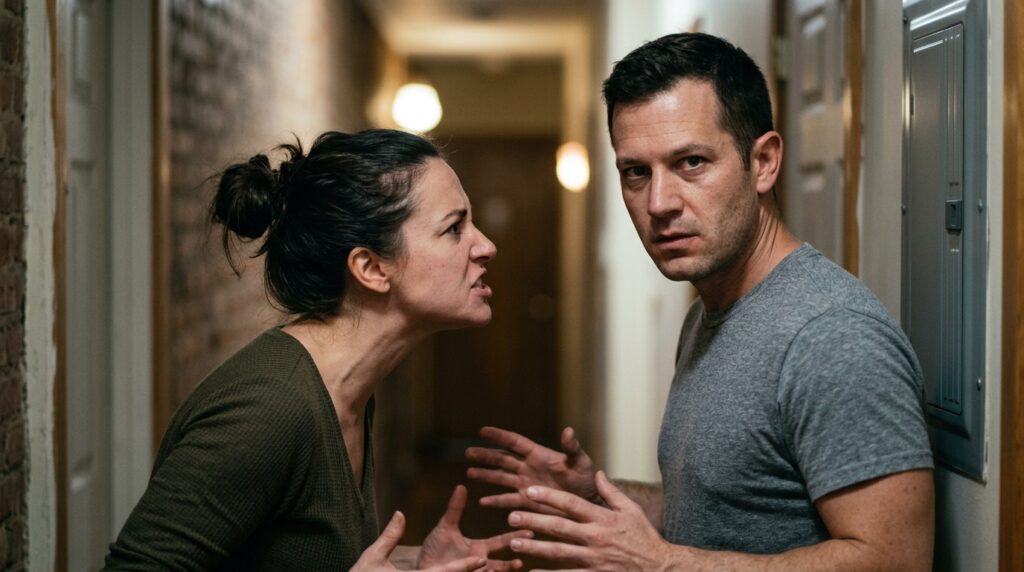
The Frozen Line Where the Concrete Ends and the Sovereign Border Begins
CHAPTER 1: THE TIGHTENING STRAP
The laminated card stock didn’t flutter. It was heavy enough to slap rhythmically against the black iron gate every time the wind swept off the eastern drainage canal, pinned beneath a thick industrial zip-tie that had bitten deep into the powder coating.
David stood on the gravel apron of his driveway, the cold air from the valley settling inside his collar. The print on the violation notice was laser-printed, waterproof, and marked with a sharp, crimson stamp from the Architectural Review Committee: NON-COMPLIANT USE OF EASEMENT BOUNDARY—DAILY ACCRUAL FORFEITURE.
He didn’t pull it down. To pull it down was to acknowledge a delivery, and the three industrial security cameras hidden under the eaves of his garage were already recording the exact angle of the card. Instead, he pulled the small, brass surveyor’s tack from his pocket, turning its cold, pointed head between his thumb and forefinger. The earth didn’t care about committees. The earth was anchored by iron rods driven six feet into the subsoil, documented by county seals that outlived subdivisions.
He checked his watch. 7:42 AM. The neighborhood clubhouse opened its glass-paneled double doors at eight, its administrative office running on a strict, automated lock system controlled by a remote server in the county seat. Every morning for fourteen days, the notices had arrived between midnight and two—stealth enforcement, designed to build a ledger of unappealed infractions before the county clerk’s office could process his seasonal drainage clearance.
“You’re wasting the daylight,” a voice called from across the asphalt lane.
David didn’t shift his feet. He turned his chin an inch to the left, tracking the silhouette of his neighbor through the low, manicured hedge row. The woman stood near her driveway line, a clipboard tucked flat under her arm like a weapon she had spent the night polishing. Her dark hair was pulled into a severe, functional knot that left her jawline completely exposed to the gray morning light. Her casual, dark athletic jacket was zipped to the throat, neutral and disciplined. She didn’t look like a fanatic; she looked like an auditor whose only remaining joy was the clean math of a penalty grid.
“The county maps were updated on Tuesday,” David said, his voice flat, retaining its even weight.
“The county handles roads, David,” she replied, taking two slow, deliberate steps toward the curb line. The clipboard stayed flat against her ribs. Her gaze was locked, wide and unblinking, mapping his posture for any sign of hesitation. “The association handles the look of things. And right now, your drainage access looks like an infrastructure breach. The board is meeting at nine. I suggest you clean your gate before the fines lock into the portal.”
She didn’t wait for his counter. She turned on her heel, her sneakers making a sharp, scratching sound on the dry aggregate of her driveway as she walked back toward her garage door.
David watched her shadow retreat past her kitchen window. He felt the brass tack in his palm, its point pressing into the line of his skin. This wasn’t an argument about aesthetics or drainage tiles. The woman wasn’t working alone; she had a master log, and the signature on his midnight citation matched the administrative assistant’s handwriting inside the clubhouse central file.
He stepped back into his truck, the diesel engine turning over with a heavy, mechanical shudder that vibrated through the steering column. He laid the folder of certified blue-line maps on the passenger seat, the official gold seals cold against the vinyl. He was going to the clubhouse.

CHAPTER 2: THE ROAD TO THE GATEHOUSE
The diesel engine didn’t so much shut off as click into a metallic, cooling silence beneath the low-slung branches of the perimeter oaks. David sat for three seconds, his palm flat against the vinyl passenger seat where the blue-line county maps lay unrolled. Through the tinted windshield, the community clubhouse loomed—a heavy, faux-craftsman structure of stone veneer and slate tiles that cost forty thousand dollars a year just to power. It was designed to look old, to look rooted, but to David, it had the clinical chill of a regional bank branch.
He stepped out, the door hinge throwing a sharp, dry crack across the empty parking lot.
At the entrance, the glass door clicked before he could touch the handle. The digital magnetic striker released with a sound like a small caliber pistol clearing its chamber. Inside, the air conditioning was set to a crisp sixty-eight degrees, smelling of lemon-scented floor wax and damp commercial carpeting.
“The office doesn’t accept cash drop-offs on Wednesdays, David.”
The voice came from behind the low, dry-stacked stone counter that divided the mailroom corridor from the administrative suite. The neighborhood helper didn’t look up from her screen. Her dark hair was still pinned in that severe, functional knot, but under the fluorescent tubes of the lobby, her skin looked translucent, nearly gray. Her fingers moved across a mechanical keyboard with a rhythmic, heavy snap-snap-snap that sounded like an industrial stitcher.
David adjusted the folder under his left arm. He didn’t close the distance immediately; he stayed three feet back, mapping the width of the lane. To his right, the heavy oak door leading to the board’s private conference room was pulled shut, but the brass latch hadn’t caught. A sliver of yellow light cut across the gray carpet.
“I’m not dropping off a check, Sarah,” David said, his voice level, stripped of the morning’s raw cold but retaining its hardness. He laid the first map on the stone ledger. The heavy bond paper rolled back against itself, its blue ink sharp against the limestone. “I’m dropping off an injunction. The daily accrual fine on my easement gate was logged through the portal at 1:14 AM. The portal user-ID belongs to this terminal.”
The stitching sound of the keyboard stopped.
Sarah’s hand didn’t drop from the mouse. She tilted her chin up, her gaze locking onto his with an unblinking, analytical focus. There was no heat in her eyes—only the cold, structural assessment of an administrative barrier that had encountered an unmapped obstacle.
“The automated system handles the time-stamps,” she said. Her voice was thin, balanced, and intentionally sparse. She leaned slightly forward, her elbows resting on the stone surface, shortening the space between them until David could smell the stale chicory coffee in her mug. “If your contractor left the trailer tongue projecting six inches past the shared utility curb, the sensor flags it. I don’t write the script, David. I just verify the logs.”
“The contractor wasn’t here last night,” David said. He pointed a single finger at the lower corner of the map, where the county notary’s gold foil seal was pressed into the linen backing. “The county completed the culvert clearout at three on Monday afternoon. They pulled the orange cones. They signed the clearance. Look at the initials on the midnight portal log, Sarah. They aren’t automated. Someone typed in an override to manually re-open the violation window.”
A small, rhythmic ticking began behind the stone wall—the clubhouse master clock adjusting its gears for the eight o’clock synchronization.
Sarah didn’t look down at the blue lines. She kept her eyes fixed on the bridge of his nose, her posture tightening until her shoulders looked straight, almost mechanical under her dark top. “The board doesn’t review county field notes during public hours. If you want to challenge the metric, you submit an appeal through the portal. It takes twenty-one business days for a compliance officer to audit the coordinate.”
“I don’t have twenty-one days,” David said. His fingers adjusted on the edge of the folder, his thumb finding the loose surveyor’s tack in his pocket. He could feel the cold iron of its head. “The daily accrual triggers a property lien at fifteen days. You know that. The committee changed the bylaws in October without a community quorum.”
“A quorum isn’t required for an infrastructure emergency,” she shot back, her tone dropping an octave, becoming sharp, transactional, probing. She didn’t deny the override. Instead, she reached under the counter, her arm moving with a deliberate, smooth economy of motion, and brought up a thick, black-bound ledger. The corner of the book hit the stone table with a heavy, dull thud that echoed down the narrow office lane. “Section four, paragraph nine. The association retains sovereign enforcement if a resident’s border maintenance threatens the structural integrity of the common drainage basin.”
She flipped the ledger open. The pages were heavy, cream-colored paper covered in precise, small columns of handwriting.
David’s eyes tracked the lines. He didn’t look at the text she was pointing to; his gaze drifted down to the bottom margin of the active page, where a series of small, pencil-drawn numbers were scribbled next to his lot number. They weren’t enforcement codes. They were decimal coordinates—four sets of longitudinal markers that didn’t match the subdivision plot. They matched the public access road that lay three hundred yards behind his barn, right where the old county timber line met the new commercial blacktop.
“Who logged those numbers, Sarah?” David asked, his voice dropping into a low, deliberate cadence.
Sarah’s hand went flat over the page, her palms covering the pencil marks with a sudden, rigid snap. Her fingers were white where they pressed into the paper. For the first time since he had entered the room, her gaze flicked toward the heavy oak door to her left, her pupils dilating as she listened to the muffled sound of a chair scraping against the floor inside the executive suite.
“Those are internal administrative references,” she whispered, her voice clipped, setting an immediate, defensive boundary. “You don’t have authorization to audit the ledger. Leave the maps on the counter and clear the lane, David. The director arrives at eight-thirty, and he doesn’t tolerate residents tracking mud onto the workspace carpet.”
She didn’t close the book. She held her hand over the secret like a soldier guarding a breach, her chin tilted up in a final, defiant challenge that signaled she had no intention of letting him see the next line.
David didn’t move his hand from the map. He could hear the low, distinct murmur of a second voice inside the locked office—a deep, resonant rumble that didn’t belong to any of the five elderly board members who lived on the circle. It was the voice of a man used to speaking over the roar of heavy machinery, and it was coming from the private office behind her chair.
CHAPTER 3: THE GATHERING CORRIDOR
The deep voice through the oak door frame didn’t stop. It carried a dry, unhurried cadence, the sound of a man reading structural specifications from an open binder. David did not break eye contact with Sarah. His hand remained flat on the blue-line county map, his thumb lightly pressing the linen edge against the cold limestone counter. He could feel the fine ridge of the paper’s margin—a sharp, straight line cut by an industrial blade.
Sarah’s fingers remained rigid over the ledger page, covering the penciled coordinate numbers. Her shoulder alignment had shifted; her right elbow was pinned tighter to her ribs, an involuntary bracing mechanism designed to shield the desk blotter beneath her arm.
“The office lane is closed to non-administrative personnel after eight,” she repeated. Her voice had lost its smooth, transactional rhythm, dropping into a clipped cadence that clipped the vowels short. “I’ve given you the filing timeline, David. If you stand here, you’re interfering with daily standard operations.”
“The standard operations include public logs,” David said. He didn’t raise his voice. He kept his tone leveled at the exact volume of her whisper, a calculated frequency that forced her to lean an inch closer to hear him over the hum of the central air ventilation. “The association registry is open for member inspection under state corporate statute four-twelve. I don’t need the director’s clearance to look at the sign-in sheet for the executive session.”
Behind him, the heavy glass double doors of the clubhouse main entrance hummed, the magnetic latch clicking back into place. Two residents from the third tier of the subdivision walked in—older men wearing identical nylon windbreakers, their soft-soled shoes leaving damp, faint prints on the commercial matting. They stopped four feet back from the stone partition, their conversation dying mid-sentence as they registered the absolute lack of motion between David and the helper. The silence in the lobby grew thick, localized, and sharp.
Sarah didn’t look at the newcomers. Her gaze was a fixed laser line on David’s throat. “The registry is digital this quarter. The hard copy is restricted.”
“Then why is the binder out?” David asked.
His eyes flicked down to the corner of the black leather book where her palm wasn’t fully covering the edge. Beneath her thumb, a fresh ink impression had bled into the gray desk blotter—a circular violet stamp that hadn’t fully dried. It wasn’t the standard hexagonal emblem of the Architectural Review Committee. It had a clean, triangular core with three distinct alphanumeric sub-codes running along the lower radius: ARC-E-Z3.
David recognized the notation style. It wasn’t an internal HOA marker; it was the specific zoning taxonomy used by the regional infrastructure planning board when tracking private properties for municipal condemnation or utility right-of-way re-assignments.
The door to the executive suite swung back another two inches. The gap was narrow, but it allowed a clear view of the interior office wall—a stark expanse of white drywall where a giant, gridded map of the entire valley development had been pinned with heavy steel tacks. Red wax lines had been drawn directly across three specific parcels along the western fence line. One of those parcels had a small, handwritten notation beside the septic junction: LOT 44—DAVIDSON.
“Sarah,” the voice called from inside the office. The tone was sharp, flat, and entirely devoid of local accent. “Bring the corporate log. The surveyor needs the secondary signature on the drainage easement release before the board goes into the closed session.”
Sarah’s posture fractured. Her hand left the cream-colored page, snapping the black ledger shut with an intentional, heavy crack that drew a sharp look from the two men waiting by the mailboxes. She pulled the book off the stone counter, tucking it beneath her arm with a rapid, defensive twist of her torso.
“You need to step back into the main seating area, David,” she said, her voice turning into a thin, impenetrable shield. She stepped out from behind the limestone counter, her sneakers squeaking on the vinyl flooring behind the security gate. She adjusted her casual top, her shoulders squaring as she blocked the entrance to the inner corridor with her entire frame. “The board is in a private workshop. No exceptions.”
David didn’t step back. He took half a step to the left, positioning his body at a forty-five-degree angle to the security latch on the swing-gate. From this stance, his field of vision bypassed her shoulder, tracking the movement inside the light-filled office. A man in a high-quality, tailored flannel shirt was rolling up a set of construction blueprints, his movements methodical and fast. Beside his briefcase on the oak table sat a heavy, industrial-grade ink pad, its lid open, revealing a deep violet reservoir.
The puzzle was assembling itself with cold, calculated precision. The fines on his driveway weren’t designed to force compliance; they were designed to create a documented record of unresolved property disputes. Under the community’s revised covenants, any lot with an outstanding title dispute for more than fourteen consecutive days was automatically barred from voting on corporate structural alterations—including the sale of peripheral common acreage.
“I’m staying until the director logs the map,” David said clearly. He adjusted his grip on the folder of county surveys under his arm, the crisp paper rustling against his ribs. He looked past her, directly at the open seam of the office door. “And I want to know why the infrastructure planning board is validating a foreclosure audit on a private drainage culvert.”
The man inside the office stopped rolling the blueprints. His hands went perfectly still on the paper, his head tilting toward the corridor as he measured the volume of David’s voice. The two neighbors by the mailroom turned fully around now, their phone screens dimming as they picked up the word foreclosure hanging in the sterile, air-conditioned vault of the clubhouse.
Sarah didn’t look back at the office. She took one step forward, her chest almost touching the security gate, her eyes narrowing until they were two hard, dark slits. “You’re crossing a line you don’t understand, David. Get out of the corridor.”
CHAPTER 4: THE CLOSERANGE CHESS MATCH
The space between them was less than an arm’s length. Inside the compressed lane of the clubhouse corridor, the hum of the climate control seemed to drop an octave, swallowed by the dense commercial carpeting and the heavy stone masonry of the partition counter. Sarah leaned in sharply, her torso angling forward with a rigid, calculated velocity that pushed her deep into his personal space. Her shoulders were braced, her dark top taut against her collarbones. Her chin was slightly raised, her jaw fixed like a latch driven into a slot.
She locked direct eye contact, her pupils dark and unyielding beneath the harsh fluorescent lights.
“You can’t just walk in here and act like you understand everything,” she delivered. The challenge was quiet, clipped, and razor-sharp, aimed straight at the space between them to prevent her words from carrying out into the wider lobby where the neighbors stood.
David stiffened. Every muscle in his frame locked into an upright resistance, absorbing the psychological weight of her posture without giving an inch of ground. The gray t-shirt across his chest didn’t move. He lifted his right hand half an inch between them, his fingers curled loosely around the folder of county surveys, a restrained, frustratingly calm gesture that acted as a silent physical dam against her forward lean.
“I’m not pretending, Sarah,” David said. His voice was low, flat, and clinical, utilizing the enclosed depth of the lane to anchor his position. “I’m trying to help but you keep shutting me out.”
“Then listen instead of assuming things,” she countered instantly. Her command was a cold snap, her eyes wide and dry, refusing to blink. Her posture tightened further, her elbows pinning the thick black ledger against her ribs like armor plating. She used the physical boundaries of the narrow corridor to simulate an unshakeable institutional power, entirely focused on driving him back past the swing-gate before the locked door behind her could open any further.
David didn’t break focus. His mind tracked the spatial geometry of the space—the raw physics of her stance, the subtle forward weight she was using to mask the vulnerability of the desk blotter behind her. She was performing authority because she didn’t possess the legal title to enforce it. The strategic pursuit required absolute stillness. He noticed the slight white pressure marks on her knuckles where her fingers gripped the leather binding of the book; she wasn’t calm, she was overextended.
“The board’s registry log doesn’t list an infrastructure workshop for eight-fifteen,” David said, his voice dropping into a rhythmic, transactional cadence that chipped away at her defense. “It lists a property asset reconciliation. And the initials on the signature block aren’t local board members, Sarah. They belong to a general partner at Apex Utility Holdings.”
A short, muffled rustle of paper came from the semi-open office behind her chair. The man in the flannel shirt had stepped closer to the door frame, the heavy roll of construction blueprints gripped under his arm like a blunt instrument. Through the two-inch gap, the giant valley development map was clearly visible, its red wax lines cutting across the drainage boundaries with surgical precision.
Sarah’s gaze flicked toward the shadow behind her, her unblinking eyes showing the first micro-second of real panic. Her fingers slipped slightly against the leather cover of the book, revealing a wider glimpse of the fresh violet ink impression on the gray blotter—the ARC-E-Z3 designation, the state planning commission’s specific classification for a distressed, un-vetted utility easement prone to rapid municipal foreclosure.
“The registry is an internal corporate file,” she whispered, her voice tightening into an impenetrable barrier. Her lean grew more aggressive, her shoulder line cutting off his view of the wall map. “You don’t have the status to query it. You have five seconds to clear this lane before I log a non-resident disruption code into the sheriff’s dispatch portal.”
“Log it,” David said. He took a single, deliberate breath, his grip tightening on the brass surveyor’s tack loose in his left pocket, its cold point a physical reminder of the six-foot iron rods anchoring his actual plot lines outside. “The sheriff uses county mapping grids, not association ledgers. When the deputy arrives, we can compare the coordinate lines on this digital survey with the pencil markings you’re hiding under your palm.”
Behind them, the low murmur of voices in the lobby suddenly went dead. The two neighbors by the mailboxes had stopped scrolling on their phones, their screens dropping toward their pockets as they turned their heads to watch the intense, silent compression of the corridor. The atmosphere in the room had shifted from a generic administrative dispute into a localized, cold-range siege, the spatial dominance of the clubhouse beginning to fracture under the weight of the legal documents gripped in David’s hand.
Sarah’s mouth remained shut, her jaw locked tight as she held her ground, her rigid frame absorbing the pressure of his refusal without stepping back an inch, while the shadow inside the executive suite grew completely stationary.
CHAPTER 5: THE FREEZING OF THE CORRIDOR
The magnetic lock on the inner corridor partition didn’t just click; it let out a heavy, pneumatic sigh that vibrated straight through the limestone face of the counter. Sarah’s rigid posture didn’t collapse—it locked completely solid, her spine shifting into an unnatural, military straightness as the shadow from the executive door finally broke past the frame.
The man who stepped into the narrow office lane did not wear the corporate polo shirt of the subdivision committee. He was older, his hair a cropped thatch of silver that matched the dull, unpolished steel of the digital tablet gripped in his left hand. His tailored charcoal jacket was open, revealing a heavy brass key ring clipped to his belt loop that clinked softly against a plastic entry fob.
This was the institutional weight David had been tracking through the ledger lines: Arthur Vance, the regional director of property management.
Vance didn’t look at Sarah. He didn’t look at David. He stopped three inches behind the swing-gate, his polished leather shoes coming down on the thin commercial carpet with a muted, dead thud. He pulled a pair of wire-rimmed reading glasses from his breast pocket, his eyes remaining fixed on the digital display of his tablet as his thumb scrolled through an automated server queue.
“The server logged an un-vetted manual fee injection at 1:14 AM from this terminal, Sarah,” Vance said. His voice was flat, dry, and carried the slow, clinical resonance of a state auditor clearing a ledger line. He did not raise his volume, but the low frequency filled the tight corridor, turning the air instantly cold. “The committee’s administrative token was used to override a cleared county drainage ticket on Lot forty-four. I want the physical ledger on the stone. Right now.”
Sarah’s fingers tightened so hard against the black leather binding under her arm that the heavy grain of the hide groaned. Her jaw remained clamped, her dark hair casting a sharp, angular shadow across the limestone counter as she held the book against her ribs like a piece of structural shrapnel.
“The board authorized an emergency infrastructure review under section four,” she said, her voice dropping into a thin, desperate register that scraped against the silence of the room. She didn’t look back at the executive door. She kept her unblinking focus fixed on the bridge of David’s nose, trying to preserve the defensive boundary she had spent fourteen days constructing. “The resident’s driveway modification threatens the common drainage basin. The log is an active workshop file.”
“The board doesn’t possess the technical token to override a county clerk’s clearance,” Vance replied. He finally looked up from his screen, his gaze moving across the space between them like a industrial blade measuring an structural seam. He extended his right hand, his palm flat, waiting. “The ledger, Sarah. The master copy. Not the committee notebook.”
David watched the movement of her shoulder. He didn’t speak. He stayed perfectly still in his forty-five-degree stance, his left hand remaining loose in his pocket around the sharp edge of the surveyor’s tack. The strategic pursuit had reached its pivot point. The neighbors in the lobby had moved two feet closer to the partition, their breathing audible through the open frame of the corridor door. The space was too small for her lie to survive the transition.
Sarah’s chest rose and fell in a single, shallow sequence. With a slow, jerky economy of movement, she pulled the black binder from her side and laid it flat on the stone ledger. The corner of the book hit the limestone with a dry, hollow slap that made the two older men by the mailboxes shift their weight.
Vance didn’t open the pages. He laid his digital tablet directly on top of her hand, his thumb striking the glass screen once. A bright, blue-white barcode scanner cut across the leather cover, tracking the small, gold-embossed crest at the base of the spine.
“This isn’t the management ledger,” Vance said, his voice dropping another octave into a clinical chill that caused Sarah’s chin to drop an inch. He tilted the book up, his fingers tracing a small, circular violet stamp impression that had bled through the lower margin of the flyleaf—the exact ARC-E-Z3 taxonomic marker David had spotted on the desk blotter. “This is an un-indexed utility registry from the regional infrastructure planning board. Why is an un-vetted commercial easement tracker inside a private residential office corridor?”
The door to the inner suite didn’t just swing open; it was pushed from within. The man in the flannel shirt stepped out into the light, his heavy roll of construction blueprints tucked tightly under his arm like a shield. He didn’t look at David or Sarah. He walked straight toward the main lobby exit, his leather work boots leaving a gray trail of dry aggregate dust across the freshly vacuumed carpet.
“The workshop is adjourned,” the technician said to the empty air as he cleared the glass outer doors, the magnetic striker snapping back into its iron housing with a sharp, final report.
David felt the cold air from the doorway hit his neck. He looked at Vance, then down at the blue lines of his own county map still spread across the stone. The decoy secret had fractured—the idea that this was an internal neighborhood squabble over gate placement or drainage tiles was gone. But the deeper reality, the handwritten decimal coordinates scribbled next to his lot number, remained locked beneath the Director’s tablet. The victory was a false flag; the real threat hadn’t left the property line.
“The county maps are still active on my gate, Mr. Vance,” David said, his voice retaining its hard, even weight.
Vance didn’t answer immediately. He picked up his tablet, his eyes tracking a new column of automated alert codes flashing across his display—notifying him of an unmapped infrastructure query that had just been logged against the subdivision’s western perimeter fence.
CHAPTER 6: THE CLINICAL DECONSTRUCTION
Director Arthur Vance didn’t look up from the screen as the outer glass door rattled back into its frame. His index finger tracked a vertical column of data fields, the blue light from the matrix reflecting off the crisp edges of his silver hair.
“The system has locked the account, Sarah,” Vance said. His cadence remained rhythmically flat, maintaining its clinical weight while the silence in the corridor turned razor-thin. “Every manually injected code entered from this workstation since the twelfth of the month has been quarantined. The corporate ledger shows no corresponding billing approval from the regional board. Your entry token has been revoked for thirty days pending an external data audit.”
Sarah’s shoulders dropped exactly half an inch. The intense posture she had held for twenty minutes—the aggressive forward tilt that had compressed the air in the management lane—fractured. Her right hand slipped from the leather binding of the un-indexed ledger, her fingers dragging across the limestone surface with a soft, scraping sound that drew a collective exhalation from the neighbors waiting by the mailboxes.
She didn’t apologize. Her jaw remained tight, a single muscle twitching along her cheekbone as she looked down at the stone ledger. “The documentation came from the infrastructure advisory team. They validated the coordinate overlap.”
“The infrastructure team handles common easements, Sarah. They don’t track private lot numbers for individual property liens,” Vance said. He closed the digital folder on his screen with a sharp tap, then slid the black leather binder across the partition. The edge of the cover caught the blueprint folder under David’s arm, stopping cleanly against his sleeve. “The association’s structural liability ends where the county survey stake is driven. You issued fourteen separate compliance fines for a section of asphalt that sits four feet outside our corporate jurisdiction.”
David turned his chin down, his gaze tracking the precise alignment of the binder on the limestone. The status reversal was clear to every person standing in the lobby. The two older men in the nylon windbreakers had lowered their chins, their eyes moving between Sarah’s white face and the official screen in the Director’s hands. The public witness pressure had inverted; the block bully had been deconstructed within her own perimeter lane.
“The fines are wiped from the resident portal, David,” Vance said, his voice dropping into a professional monotone as he turned his attention to the blue-line maps. “The daily accrual clock has been reset to zero. The association has no active claim against your gate or your drainage culvert.”
It was a clean administrative victory. By any standard structural metric, the confrontation was resolved, the homeowner’s title secured. But David didn’t move his hand from his pocket. The brass surveyor’s tack was still tucked tight against his palm, its cold, metallic point pressing against his skin. His strategic lens didn’t track the cleared ledger lines; it tracked the lingering anomaly.
“The files under her hand weren’t neighborhood violations, Mr. Vance,” David said. His tone remained level, stripped of heat, operating on the same calculation he had used since dawn. He tapped the lower margin of the un-indexed ledger where the circular violet stamp sat. “The ARC-E-Z3 designation belongs to a regional utility tracker. The board helpers don’t have access to planning commission codes unless an external developer is downloading the subdivision’s lot registry.”
Vance’s thumb froze on the edge of his tablet. His reading glasses slipped a millimeter down the bridge of his nose as his eyes narrowed, tracking the specific alphanumeric sub-codes running along the bottom radius of the stamp. He didn’t look at Sarah, but his entire torso became perfectly rigid.
“The planning commission hasn’t run a utility corridor audit in this district since nineteen-ninety-two,” Vance muttered, his voice losing its automated clarity, dropping into a low, gravelly frequency that didn’t carry past the gate.
“They’re running one now,” David said. He slid his county map over the stone, aligning the notary’s gold foil seal with the penciled longitudinal numbers Sarah had tried to cover. “Look at the coordinates she logged next to my lot. Those aren’t shared utility markers. They match the commercial rail terminus behind the timber line. Someone isn’t trying to fix a drainage culvert, Vance. They’re mapping the foreclosure timeline for the entire western boundary.”
The terminal in the center of the desk let out a sharp, multi-tonal chime—the automatic alert system flagging a secondary administrative query. A yellow dialogue box opened across the portal interface, its header flashing with a direct data request from an unlisted corporate domain: APEX UTILITY HOLDINGS—LIEN ACCESS GRANTED.
Sarah didn’t look up to meet their eyes. She stepped back three feet from the gate, her sneakers squeaking softly on the carpet as she retreated into the dim shadow of the back suite, her arms folded tightly across her chest like an empty frame. She had lost the micro-authority of the lane, but the electronic ledger on the desk was still pulling information from the fence line. The paradigm had shifted; the local gatekeeper was just a lens for a deeper, unvetted pressure system that had already bypassed the clubhouse doors.
Vance watched the yellow box flash against the screen, his fingers remaining motionless over the glass as the true scale of the tracking software began to unravel in the silent office corridor.
CHAPTER 7: THE SOVEREIGN LINE WHERE THE CONCRETE ENDS
The steady, amber flash of the central terminal did not stop. It painted the crisp, sharp corners of Director Arthur Vance’s silver hair in rhythmic intervals, a silent electronic pulse that seemed to pull the remaining warmth from the narrow administrative lane. On the display, the yellow dialogue box from Apex Utility Holdings remained locked over the frozen residential portal, its automated data extraction meters filling block by block with clinical precision.
“They’re not auditing the community compliance codes, David,” Vance said. His voice had lost its formal corporate clarity, sinking into a dry, hollow rattle that barely carried past the stone ledger. He did not look at Sarah, who stood frozen in the deep shadow of the back filing bay, her arms crossed tight against her ribs like a cracked structural column. “The backend interface isn’t pulling from our local servers. It’s executing a direct, cross-referenced title query on every deed that touches the western perimeter timber line.”
David pulled the rolled county maps toward his chest, the heavy linen paper rustling sharply against the cotton of his gray t-shirt. He didn’t drop his chin. His left hand came out of his pocket, his thumb leaving the small brass surveyor’s tack he had carried since dawn. He laid the sharp, cold point directly onto the glass screen, pinning the exact coordinate row flashing next to his lot number.
“The infrastructure planning board never closed the seasonal drainage file,” David said. His cadence was low, even, and deliberately calculated, slicing through the quiet space of the corridor. “They left it open so Sarah could inject the manual overrides under an active corporate token. If the association logs an unappealed title dispute for fourteen consecutive days, the boundary becomes legally classified as an un-vetted utility risk. Apex doesn’t have to buy the land from the homeowners. They just have to claim the sovereign easement right-of-way from the county clerk.”
The two neighbors who had been watching from the mailroom corridor stepped entirely into the office entry frame. Their shoes made no sound on the commercial carpet, but their shadows cut long, dark angles across the limestone floor. The public pressure had completely inverted; the quiet fear of an arbitrary association citation had evaporated, replaced by the heavy, silent realization that the ground beneath their concrete driveways was being systematically remapped by an invisible buyer.
Vance reached out, his leather-trimmed digital tablet slipping an inch against the stone as his index finger struck the terminal’s physical master switch. The screen didn’t fade; it died instantly, the blue light snapping into a dark, glossy reflection that showed David’s squared shoulders and Sarah’s distant, rigid silhouette.
“The management contract for this subdivision is frozen as of eight-thirty,” Vance said, his tone dry and final, stripped of its automated regulatory armor. He pulled his reading glasses from his face, tucking them into his charcoal jacket with a single, economic movement. “I’m locking the central database terminal from the county seat before the next sync window opens at noon. Sarah, pack your personal files. The regional board will receive the data-manipulation logs before the clerk’s office opens tomorrow morning.”
Sarah didn’t answer. Her jaw remained clamped, a hard, geometric line tracking the floorboards as she took two slow, backward steps into the dark administrative vault, her presence fading into the gray cabinetry without a single word of explanation or defense.
David picked up his blue-line maps. He smoothed the folded edges with the side of his hand, his touch precise, focusing on the unyielding weight of the official gold notary seals. The tactical chess match inside the clubhouse corridor had concluded, but the strategic pursuit was just moving to the real perimeter outside. The false flag of the neighborhood warning card had been dismantled on-screen, but the six-foot iron survey rods driven deep into his gravel apron were still the only true boundaries that mattered.
He turned on his heel, his movements clean and unhurried. As he cleared the glass double doors, the morning light hit his eyes with a cold, blinding glare that reflected off the hood of his diesel truck. The valley air smelled of dry dust and iron, the distant hum of heavy machinery from behind the timber line carrying across the blacktop like a challenge. He climbed into the cab, laying the maps across the passenger seat, his fingers finding the loose surveyor’s tack in his palm one last time. The county lines were drawn, the sovereign boundary was set, and he was ready for whatever came down the access road next.