
The Heavy Line of Earth: A Tale of Property, Pride, and the Iron Beneath the Clay
CHAPTER 1: THE WEIGHT OF THE SOIL
The iron bucket of the mini-excavator slammed into the damp Pennsylvania clay with a dull, teeth-rattling thud that vibrated straight through the soles of Helen’s heels.
From the top step of her back porch, the three-foot trench looked like a raw, bleeding wound cut parallel to her concrete driveway. The air smelled of diesel exhaust, turned earth, and the faint, bitter scent of stagnant water that had been rotting against her basement wall for three straight months. Marcus Rivera sat high in the open cab of the orange rig, his gloved hands working the dual joysticks with practiced, rhythmic precision. Clay scraped against steel, a wet, heavy sound that seemed to pull the silence right out of the neighborhood.
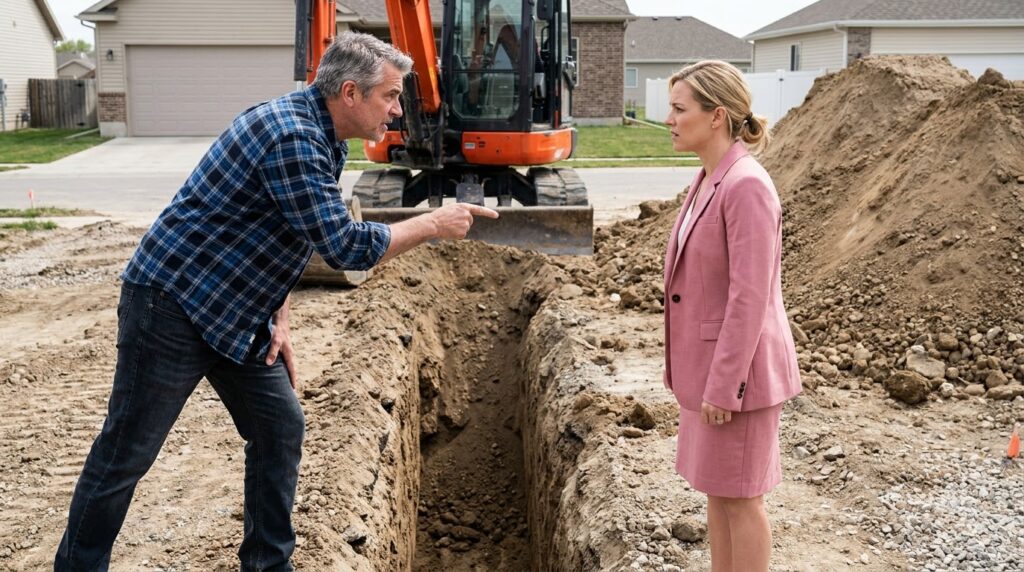
Helen smoothed the lapel of her pink blazer. She had left her second-period chemistry class under the care of a substitute, driving fifteen minutes across town with her blue plastic file folder resting on the passenger seat like a loaded sidearm. Inside were three documents: her deed, the stamped town permit, and the structural engineer’s report detailing the nine-millimeter shear fracture creeping across her western foundation wall.
She didn’t want the noise. She didn’t want the dirt. But three weeks of spring rain had turned her mother’s basement into a sump pit, and the house was settling toward Arthur Pendelton’s lot by fractions of an inch every week.
Across the lawn, a screen door slammed shut with a sharp, metallic crack.
Arthur didn’t walk across the grass; he marched. He wore a heavy blue-and-black plaid flannel shirt despite the mid-morning heat, his dark jeans stiff and stained at the knees, his broad shoulders squared like an infantry sergeant inspecting a compromised perimeter. His short salt-and-pepper hair bristled in the humidity, and his gray beard was trimmed into a tight, aggressive line along his jaw. In his left hand, he held a clipboard clamped thick with white paper.
“Hey!” Arthur shouted over the low, throbbing idle of the excavator engine. He didn’t look at Helen. He aimed his voice straight at the cab, stepping hard onto the fresh dirt mound beside the driveway. “Cut the rig, son! Shut it down right now!”
Marcus didn’t touch the throttle. He let the bucket hover two inches above the open trench, the hydraulic lines humming under tension, his eyes shifting beneath the brim of his dusty ballcap to take in the broad-shouldered man standing beside his machine.
“Arthur,” Helen said, stepping off the porch. Her voice was flat, level, cleared of any tremor. “He works for me.”
Arthur turned on his heel, his boot sliding three inches down the loose slope of the dirt mound, spraying red clay across her driveway. He planted his right foot directly on the crumbly lip of the trench, leaning his upper body across the three-foot chasm until he was staring straight down into the wet clay. His face was flushed red, the veins along his neck swollen against his collar.
“You don’t dig this trench and ignore me, Helen!” Arthur stabbed a thick, calloused index finger straight down toward the exposed concrete footing of her garage. His voice rattled off the vinyl siding of the house. “You think you can just drop heavy machinery on a lot line without board review? Nobody moves another shovel until this is settled!”
Helen stopped two feet back from the trench edge. She didn’t raise her voice. She didn’t shift her weight. She held the blue plastic folder against her ribs and looked at the wide, wet footprint Arthur’s work boot had left in the private soil of her yard. Underneath his heel, exposed in the raw wall of the pit, a thick curve of black plastic pipe protruded from the dirt—crushed, leaking, and leading straight back toward Arthur’s property line.

CHAPTER 2: THE LINE IN THE CLAY
“You don’t get to stand on my dirt and issue orders, Arthur.”
Helen’s voice didn’t carry the raw, rasping strain of Arthur’s roar, but it cut through the diesel thrum of the excavator all the same. She took one step closer to the edge, her low heels sinking half an inch into the soft turf. Her eyes stayed locked on the broad-shouldered man, taking in the white-knuckle grip he had on his wooden clipboard, the faint tremble in his thick wrist, and the furious, dark flush spreading upward from his flannel collar.
“This isn’t your dirt,” Arthur spat, his boot shifting again on the crumbling lip of the trench. Loose pebbles and wet red clay sloughed off beneath his heel, raining down onto the exposed concrete footing of Helen’s garage. “This whole strip—six feet from your driveway edge to my fence line—is a recorded drainage easement. Approved by the township board in ’98. You’re altering communal flow, Helen. You’re destroying neighborhood infrastructure!”
Marcus cut the engine of the mini-excavator.
The abrupt silence hit the driveway like a physical weight, replacing the roar of the diesel with the soft, steady drip of groundwater trickling out from the raw trench wall. High above, a hawk circled in the gray humidity, but nobody looked up. Marcus unlatched the heavy cab door, stepped out onto the steel tread, and casually pulled a dark smartphone from his back pocket. He didn’t say a word. He just angled the camera lens straight at Arthur’s planted boot, his thumb tapping the screen to start recording.
Arthur’s eyes darted to the phone, a flicker of dark, instinctual annoyance passing over his features before his posture hardened again.
“Put that away, kid,” Arthur growled, waving his clipboard toward Marcus like a weapon. “You’re operating heavy machinery on an illegal job site. If you drop that bucket one more time, I’m calling the township code enforcement, I’m calling the state police, and I’m having your rig towed off this street on a flatbed!”
“He’s not turning off the machine, Arthur,” Helen said evenly.
She held the blue plastic folder loose against her side, her thumb resting on the cold plastic clasp. She looked past Arthur’s shoulder toward the neighboring houses. Across the cul-de-sac, Mrs. Gable was standing behind her screen door, a white dish towel clutched in her hand, watching the driveway through the mesh. Two houses down, old Mr. Henderson had stopped pushing his mower, resting his hands on the handlebar as he stared across his manicured lawn.
Arthur wanted the audience. He had always wanted the audience. For three years, ever since Helen’s mother had passed and left her the deed to the yellow split-level, Arthur had used the sidewalk as his personal courtroom. A missed lawn mowing by two days meant a brightly colored violation notice tucked under her wiper blade. An extra trash bin left out past seven on a Tuesday morning brought a three-paragraph email citing HOA Bylaw 4-B.
“You think you can hide behind that quiet teacher routine, don’t you?” Arthur leaned further across the three-foot gap, his chest heaving under the plaid flannel. The smell of stale coffee and damp wool radiated off him. “Your mother knew the rules, Helen. She respected the boundary. The moment she’s gone, you bring in contractors, you tear up the yard, you throw mud all over the street—”
“My mother paid three thousand dollars six years ago to patch the basement wall you flooded,” Helen said, her tone dropping an octave, flat and chillingly precise. “And she was too soft-spoken to ask you why your downspouts were pointed at her foundation.”
Arthur’s jaw tightened so hard the muscles along his cheek turned pale. “That’s a lie.”
“It’s on the structural report,” Helen replied. She unclipped the blue folder with a crisp, dry snapping sound that seemed to ring across the quiet yard. She pulled out a single sheet of paper—the engineer’s official blue-lined schematic—and held it out. “The wall is bowing because water is being forced under hydrostatic pressure straight against the cinderblock. Three hundred gallons every time it rains more than an inch.”
“I don’t care what some paid-off contractor wrote on a piece of paper!” Arthur snapped, thrusting his clipboard forward so fast the papers rattled under the metal clip. Clamped to the front was a faded, laminated document stamped with a faded red seal. “Look at the map, Helen! 1998 storm-drain overlay! This land right beneath my boot is dedicated township property. You have zero right to dig here. Zero!”
Helen didn’t reach for the clipboard. Instead, her eyes traveled down.
Down past the laminated map, past Arthur’s stiff blue jeans, to the exact spot where his heavy work boot was crushing the edge of the pit. Two inches below his leather sole, protruding from the dark, sheared clay of the trench wall, was a jagged section of four-inch black PVC pipe. It was cracked, choked with mud, and dripping a thin, continuous stream of gray water directly onto the exposed concrete footing of her house.
The pipe didn’t run parallel to the street. It didn’t head toward the storm drain at the corner. It ran at a sharp, right angle, leading straight out from under Arthur’s side lawn.
Helen looked up from the pipe, her gaze settling back on Arthur’s face.
“What is that, Arthur?” she asked quietly.
Arthur’s eyes flashed, dropping for a fraction of a second to the black plastic sticking out of the mud beneath his shoe. A sharp, ugly twitch caught the corner of his trimmed beard.
“It’s old agricultural tile,” Arthur said instantly, his voice rising in pitch, dropping its booming authority for something sharper, more defensive. “Township put it in decades ago. It’s got nothing to do with this.”
“It’s fresh PVC,” Marcus called out from the side of his excavator, his phone still raised, capturing the pipe, the trench, and Arthur’s boot in one clean frame. “And it’s not township. That’s home-depot schedule-forty pipe, buddy. Still got the barcode sticker on the side.”
Arthur turned on Marcus, his face darkening to the color of a bruised plum. “Shut your mouth! You’re trespassing on a contested easement!”
“He’s not trespassing,” Helen said. She pulled a second document from her blue folder—a thick, yellowed piece of parchment folded into thirds, bearing the official embossed seal of the Allegheny County Recorder of Deeds. She didn’t hand it to him. She just unfolded the top third so the red surveyor’s stamp was visible in the bright morning light. “And this isn’t an easement, Arthur.”
Arthur froze. His hand, still holding the clipboard high, faltered slightly.
“I called the township building office at eight o’clock this morning,” Helen said, her voice steady, cool, and implacable as the iron bucket resting in the dirt. “I asked them to pull the 1998 storm-drain overlay. Do you know what the clerk told me?”
Arthur stared at her, his lips pressed into a thin, white line, his chest rising and falling in quick, shallow breaths.
“She told me there is no 1998 easement,” Helen continued, stepping directly up to the edge of the trench, her eyes locked onto his. “She said the board rejected your petition twenty-eight years ago. This line is private deeded property. My property. All the way to the iron survey pin buried under your lawn.”
Across the street, a white municipal pickup truck turned the corner of the cul-de-sac, its yellow roof beacon flashing silently against the gray sky.
CHAPTER 3: THE TURNING WHEELS
The yellow strobe of the municipal truck cast a pulsing amber glare across the wet lawn, reflecting in sharp, rhythmic sweeps off the laminated map Arthur held in his shaking hands.
Arthur didn’t pull his boot back from the trench edge, but the rigidity in his shoulders fractured. His head jerked toward the curb where the white Ford F-150 pulled to a smooth stop behind Helen’s sedan. The driver-side door swung open, and the heavy leather soles of Inspector David Miller’s work boots hit the asphalt with a dull, deliberate thud.
Miller was a man shaped like an iron fence post—lean, weathered by thirty years of county enforcement, wearing a tan municipal uniform with a brass badge pinned above his left pocket. In his right hand, he carried a heavy steel clipboard; tucked under his arm was a leather-bound folio containing the township’s official master plat books.
“Afternoon,” Miller said, his voice a dry, gravelly drawl that carried easily over the low idle of the excavator. He didn’t rush his stride. He walked up the incline of the driveway, his sharp eyes taking in the scene in a single, practiced sweep: the parked orange rig, the fresh dirt mound, the raw three-foot trench, Marcus holding up his recording phone, and Arthur standing rigid over the open pit in his flannel shirt.
“Inspector,” Helen said, making room for him on the concrete pad. She kept her blue folder held firm against her ribs. “Thank you for making it out so quickly.”
“Got your call at eight-fifteen, Miss Vance,” Miller replied, stopping a yard back from the pit. He looked down at the dark, turned earth, then turned his gaze slowly toward Arthur. “Arthur. You’re looking hot for a Tuesday.”
“Dave,” Arthur barked, stepping forward so fast his boot dislodged another chunk of dry turf into the trench. He thrust his laminated document toward Miller’s chest. “I’m glad you’re here. You need to shut this site down right now. I’ve issued a formal HOA stop-work order under the ’98 drainage overlay. She’s cutting straight through the neighborhood easement!”
Miller didn’t take the laminated paper. He reached into his breast pocket, pulled out a pair of wire-rimmed reading glasses, and hooked them slowly behind his ears. Then he unclasped his plat folio, laying it flat across the hood of Helen’s sedan.
“Let’s look at what the county says before we start throwing around stop-work orders, Arthur,” Miller said mildly.
“I have the map right here!” Arthur insisted, his voice climbing an octave, the gravelly authority he usually carried cracking under the strain. He pointed a thick, calloused thumb at the laminated paper. “It was signed off by the board! The whole drainage corridor belongs to the association!”
Marcus leaned out from the cab of the excavator, his arm still extended with the phone. “Inspector, make sure you get a look at the pipe sticking out beneath his boot. Four-inch black schedule-forty. It’s dripping straight onto the foundation footing.”
Arthur turned his torso sharply, his jaw clenched so hard his gray beard twitched. “You stay out of this, operator! You’re a hired contractor on a contested property line!”
“He’s operating under a valid township permit, Arthur,” Miller said, not looking up from his plat book. His heavy index finger traced a blue-lined parcel grid across the yellowed paper. “Permit number 2026-0414, issued to Helen Vance for emergency foundation stabilization and drainage remediation. Approved by my office yesterday afternoon.”
“Then your office made a mistake!” Arthur declared, taking a half-step closer to Miller’s shoulder, trying to crowd the inspector’s sightline. “You didn’t check the ’98 master plan! The easement runs six feet south of her driveway edge. That puts this entire trench on communal land!”
Helen watched Arthur’s posture—the way his chest heaved against his flannel, the way his knuckles turned white where he gripped his wooden clipboard. He was fighting for every inch, over-explaining, flooding the space with noise just like he had done for three years whenever she questioned a notice or asked about her mother’s water damage.
“Arthur,” Miller said softly, his finger stopping at a sharp red ink line on the parcel map. He lifted his head, his eyes cool behind his wire rims. “The 1998 petition you’re talking about? The board never ratified it. The county rejected the dedication because your association failed to provide an engineering survey.”
The silence returned to the driveway, heavier this time. Across the street, Mr. Henderson took off his cap and wiped his brow, still watching from his lawnmower.
Arthur blinked, his lips parting slightly. “What?”
“It’s not an easement,” Miller said, turning the plat book so the red ink line faced Arthur. “This property line is straight deeded private land belonging to Lot 14—Miss Vance. Her line goes all the way to the curb iron. Your lot starts two inches north of that fence line.”
“No,” Arthur muttered, shaking his head, his eyes darting across the official map. “No, that’s… that’s a misprint. I have the signed copy right here!” He held up his laminated sheet, pressing it toward Miller’s face.
Miller didn’t look at the plastic. He looked directly into Arthur’s eyes. “Where did you get that document, Arthur?”
Arthur hesitated for a fraction of a second, his boots shifting on the dirt. “It’s from the association archives. It’s been in the locker since ’98.”
“Because if that’s what you’ve been showing the board,” Miller continued, his voice dropping into a cold, dangerous register, “you’ve been enforcing an unrecorded document on private land. And that brings us to what’s inside the trench.”
Miller turned away from the car, stepping directly up to the edge of the pit where Arthur stood. He leaned over, looking down into the raw cut where the crushed black PVC pipe protruded from the clay, slowly dripping dark water onto the exposed concrete footing of Helen’s house.
Miller pulled a metal laser measure from his belt, clicked it on, and pointed the red dot straight down at the pipe.
“Marcus,” Miller called out to the excavator operator. “Take the bucket down six inches right beneath that black line. Let’s see where that pipe connects.”
Arthur’s face drained of color, the red flush vanishing to leave a mottled, greyish pale. He stepped out of Miller’s way, but he didn’t leave the edge. “You can’t just tear up the ground based on an unverified line! I’m calling the association lawyer!”
“Call whoever you want, Arthur,” Helen said quietly, her blue folder held firm against her waist. “The machine is staying in the dirt.”
CHAPTER 4: THE EDGE OF THE CUT
Marcus didn’t hesitate. His boots hit the steel cab floor, his hands wrapping around the twin joysticks as the excavator’s diesel engine roared back to life, its blue exhaust puffing into the humid suburban air. The heavy iron bucket rose three feet, pivoted with a metallic screech, and slammed straight down into the damp red clay two inches below the protruding black pipe.
“Wait! Hold on!” Arthur’s voice cracked, losing every drop of its practiced, booming authority. He stepped forward, his boot sliding violently down the crumbly lip of the trench. A cascade of loose stones and dry topsoil rattled off the iron bucket as it bit deep into the earth.
Inspector Miller didn’t move an inch. He stood at the edge of the driveway, his arms folded across his chest, his wire-rimmed glasses catching the harsh glare of the mid-morning sun. “Let him dig, Arthur. If that pipe is township tile like you claimed, it’ll run parallel to the street right into the storm main.”
Helen stepped up beside Miller, her pink blazer held tight against the damp breeze kicking off the excavator’s radiator fan. Her eyes were locked on Arthur’s hands. He was clutching his wooden clipboard so hard the knuckles under his calloused skin were stark, bloodless white. In his panic, his thumb had slipped under the metal clamp, peeling back the laminated 1998 easement map just enough to expose the reverse side.
There, stamped in faded, flaking red ink across the back of the heavy bond paper, was an official county seal—and a bold, hand-lettered annotation in black ink: VOID – UNRATIFIED PETITION #98-112B. RETURN TO APPLICANT.
Helen’s pulse spiked, a cold, sharp clarity settling behind her ribs.
Arthur hadn’t just brought out an old document to argue his point. He had laminatingly sealed a rejected, voided petition thirty years ago, using the official-looking red seal on the front to intimidate her mother—and then her—into believing the driveway belonged to the neighborhood. He had weaponized an official rejection to build an empire of fake jurisdiction.
“Arthur,” Helen said, her voice dropping into a razor-thin quiet that cut clean through the engine noise. “Flip that paper over.”
Arthur froze. His eyes darted from Helen’s face down to his own hands. In an instant, his fingers tightened, snapping the laminated paper flat against the wooden board, trying to press the red stamp out of sight against the masonite.
“You knew,” Helen said. It wasn’t a question. “The county rejected your petition in 1998. The board told you that you couldn’t establish a communal easement on this lot. But you kept the map anyway.”
“It was a procedural misunderstanding!” Arthur shouted, his face turning an unhealthy, mottled purple as he took a step back toward his own lawn. He raised his voice toward the sidewalk where Mrs. Gable and Mr. Henderson were now standing side-by-side, watching every movement. “The intent of the board was clear! We needed a drainage corridor for the whole upper street! I was protecting the neighborhood’s water table!”
“You weren’t protecting the neighborhood, Arthur,” Marcus called down from the cab, his left joystick pulling back with a hydraulic hiss.
The excavator’s steel teeth scraped against something hard beneath the mud. A sickening CRACK echoed out of the trench—the sound of brittle, aged PVC snapping under six tons of mechanical pressure.
The bucket lifted. Clung to its teeth was a three-foot section of black plastic pipe, torn directly out of the clay wall.
Behind the severed pipe, where the earth had been ripped away, a dark, hollow channel was revealed in the trench wall. It ran at a steep, forty-five-degree angle—not toward the street, not toward any town storm sewer, but straight up the slope of the lawn, tunneling directly underneath Arthur’s front porch step.
From the severed neck of the pipe, a thick, foul-smelling surge of stagnant water exploded outward, cascading down the clay bank and pooling around the concrete foundation footing of Helen’s garage.
Inspector Miller took one step forward, unhooked his flashlamp from his duty belt, and clicked the high-intensity beam down into the exposed channel.
The bright white light illuminated the interior of the pipe. It was packed with crushed gravel and roof-shingle grit, a homemade French drain system hastily buried without a permit, running straight from Arthur’s downspouts, under his fence line, and terminating directly against the cinderblock basement wall of Helen’s house.
Miller slowly lifted the beam, tracing the dark channel straight back to Arthur’s front porch.
“Well now,” Miller said softly, his voice carrying the dry weight of an impending conviction. “That doesn’t look like township infrastructure to me, Arthur. That looks like an unpermitted diversion line.”
Arthur stood on the edge of his manicured lawn, his arms limp at his sides, his laminated clipboard hanging from his fingers like a dead bird.
“It was… it was temporary,” Arthur stammered, his eyes darting wildly toward the street where two more neighbors had paused on the sidewalk, their cell phones held up to record the water flowing out of his pipe into Helen’s yard. “During the ’08 storms… the water was backing up into my basement… I had to divert it…”
“You diverted it onto my mother’s house eighteen years ago,” Helen said, her voice shaking with an anger she had kept locked behind her ribs for three long years. “And every time the basement leaked, every time the walls bowed, you walked across this driveway with your clipboard and told her it was her responsibility to fix her drainage.”
Miller pulled a heavy yellow citation pad from his rear pocket, unfastened his pen, and rested the paper on the hood of his truck.
“Interfering with a permitted utility repair,” Miller read aloud as his pen scratched against the paper, “unpermitted stormwater discharge onto an adjoining parcel, and presenting falsified documentation to a municipal inspector. That’s a minimum three-thousand-dollar civil penalty, Arthur. Plus the full cost of Miss Vance’s excavation and foundation repair.”
Arthur didn’t answer. He stared at the water pouring out of his pipe, his face completely drained of color, his chest rising and falling in shallow, ragged gasps.
“Marcus,” Helen said, turning her back on Arthur completely as she looked up at the cab of the excavator. “Keep digging.”
CHAPTER 5: THE PAPER TRAIL IN THE MUD
The iron bucket dropped again into the clay with a dull, wet impact that shook the driveway.
Arthur didn’t run for his house. Instead, he took two long, desperate strides along the grass verge toward Inspector Miller’s truck, his heavy work boots churning up clumps of dandelion and crabgrass. He held his clipboard high, the laminated map fluttering under the spring clip like a broken wing.
“Dave, listen to me for one second!” Arthur shouted, his voice cracking into a thin, rasping edge as he tried to insert himself between Miller and the truck hood where the citation pad lay open. “The petition was rejected on a technicality! I paid for that pipe out of my own pocket in 2008 because the township wouldn’t act! The HOA board knew about it—”
“Which board, Arthur?” Helen asked, stepping directly into his path before he could reach Miller.
She stood on the narrow ribbon of concrete between her garage door and the trench edge. The damp wind whipped her blonde hair across her face, pulling a few stray strands from her low ponytail, but her posture remained immovable. She unclipped her blue plastic folder, pulled out a thick stapled booklet with yellowed edges, and flipped directly to the back page.
“I went through my mother’s estate boxes last night,” Helen said, her voice cutting clean through the high-pitched idle of the excavator. “I have the official minutes from every Oakridge Estates HOA annual meeting from 2005 to 2018. You were president or vice president for twelve of those years.”
Arthur stopped short, his boots skidding on the grass. His chest heaved against the blue-and-black plaid flannel shirt, dark circles of sweat blooming under his arms despite the cool morning air. “That’s private association records! You have no right—”
“My mother was a dues-paying homeowner,” Helen interrupted, holding the booklet out so Miller could see the black-and-white print. “There isn’t a single vote recorded for a drainage extension. There isn’t a single motion for a stormwater easement on Lot 14. You never brought it to a vote because you knew the neighborhood would never fund a private line for your yard.”
Miller didn’t even look up from his citation pad as his pen scrawled across the duplicate carbon pages. “Presenting an unratified private document as a public municipal easement is a misdemeanor under County Code 104, Arthur. I suggest you stop talking before I call the deputy sheriff out here to take a statement.”
Across the ditch, Marcus let out a whistle. “Hey! Inspector! You better take a look at what’s sitting behind this pipe.”
The excavator engine throttled down to a low, rhythmic thrum. Marcus had maneuvered the bucket to clear away another two feet of heavy red soil along the trench wall, exposing the full trajectory of Arthur’s illegal installation.
Beneath the shattered black PVC line, half-buried in a bed of river gravel that had washed down from Arthur’s property, lay an ancient, heavily corroded galvanized steel box. It sat squarely on the boundary line, wedged between the concrete footing of Helen’s garage and an old, rusted iron pipe protruding from the earth.
Helen stepped closer to the edge, her gaze fixed on the box. The steel was flaking with dark red rust, its lid secured by two heavy hex bolts that were caked in dry clay.
“What is that?” Helen asked, looking from the metal box up to Inspector Miller.
Miller walked to the lip of the cut, taking his flashlight from his belt once more. He shone the intense white beam straight down onto the corroded box. The light glinted off a raised brass plate riveted to the steel cover.
Miller’s brow furrowed behind his wire-rimmed glasses. He leaned over the pit, squinting. “That’s an old municipal shut-off valve casing. That line hasn’t been active since the original farm tract was subdivided in ’72.”
“It’s not active,” Arthur blurted out, his voice suddenly jumping an octave higher, a fresh wave of panic breaking through his posture. He took a hasty step toward the trench, waving his hands as if he could physically shield the iron box from view. “It’s abandoned! It’s got nothing to do with any of this! Marcus, don’t touch that box!”
Marcus lowered his head from the cab window, looking at Arthur with cold amusement. “I’m not touching it, chief. But your PVC line wasn’t just draining onto the foundation. It was tied straight into the overflow port on that casing.”
Helen felt the air leave her lungs. She looked down at the dark, wet gap where the crushed black pipe met the corroded steel box.
It wasn’t just that Arthur had diverted his roof runoff onto her mother’s lot. He had actively tapped his illegal downspouts into an abandoned municipal junction box buried on her side of the property line—a box that had been slowly leaking concentrated groundwater into the structural cinderblocks of her basement for over fifteen years.
Every time Arthur had walked across her driveway with his clipboard, every time he had issued a notice about her mother’s lawn or scolded her for unwashed windows, he had known that the foundation beneath her feet was being systematically destroyed by his own covert plumbing.
Helen looked up from the trench. Arthur was backing away slowly now, his boots leaving dark smears on the grass as he retreated toward his own front porch steps, his laminated map tucked uselessly under his arm.
“Arthur,” Helen called out, her voice dangerously quiet.
He froze, his hand touching the wrought-iron railing of his porch steps, his gray beard twitching as he looked back over his shoulder.
“Don’t go inside,” Helen said, pointing toward the white municipal truck where Inspector Miller was tearing the top copy from his yellow citation pad. “We’re not done measuring.”
CHAPTER 6: THE IRON PIN IN THE DIRT
Arthur’s hand remained glued to his porch handrail, his knuckles white against the black wrought iron. He turned his head slowly, his jaw working back and forth as if trying to chew through a mouthful of sand.
“I’m going inside to call the association’s legal counsel, Miss Vance,” Arthur said, his voice flat, stripped of its loud, theatrical gravel. “You have no right to detain me on my own porch.”
“I’m not detaining you, Arthur,” Inspector Miller called out from the side of his truck, stepping around the open door with a heavy steel measuring tape reel resting in his palm. “I’m just advising you that if you walk inside while I’m establishing the official boundary mark, I’ll record it as a failure to cooperate with an active municipal investigation. That’s an additional five hundred dollars on the summons.”
Arthur didn’t take another step up the stairs. He slowly turned around, his flannel shirt hanging loose off his broad shoulders, and leaned his back against the railing. His eyes darted to the sidewalk, where three more neighbors had gathered near Mr. Henderson’s mower. Mrs. Gable was holding her phone up openly now, recording the flashing amber beacon of the municipal truck and Arthur standing trapped on his own porch.
Miller unhooked the end of the flexible steel tape and tossed the brass ring to Marcus. “Hold this flush against the concrete curb face at the lot line, son. Right where the yellow paint marks the original 1972 survey point.”
Marcus hopped down from the excavator’s tread, taking the brass ring and pressing it firmly into the curb corner. Miller walked backward across Arthur’s manicured front lawn, the steel tape unspooling with a bright, metallic zipping sound that seemed to slice through the humid air.
Helen followed Miller’s line, her heels sinking slightly into Arthur’s prized fescue turf. She kept her blue folder tucked under her arm, watching the red numbers on the steel tape roll past.
“Your deed calls out forty-five feet four inches from the corner pin to the boundary marker, Arthur,” Miller said, eyeing the tape as it reached the forty-five-foot mark. He stopped three feet onto the grass that Arthur had spent fifteen years treating as his personal property. “And look at that.”
Miller dropped to one knee on the sod. He pulled a folding trenching trowel from his belt, flipped open the sharp steel blade, and plunged it straight into the pristine green turf.
“Hey!” Arthur shouted, taking one involuntary jerk forward off his porch step. “That’s my lawn! You’re damaging private landscape!”
“I’m locating a recorded county boundary pin, Arthur,” Miller said without looking up.
He drove the trowel six inches deep into the soil and twisted the handle. A neat square of green sod lifted away, revealing dark, moist loam underneath. Miller scraped the blade across something hard buried beneath the roots.
CLANG.
The sound of steel striking heavy cast iron rang across the yard like a small bell.
Miller reached into the hole with his bare fingers, brushing away loose dirt and root fibers until a rusted, three-inch iron survey cap emerged from the soil. Plamped into the center of the iron top was a stamped county registration number: PARCEL 14-B / BOUNDARY PIN 04.
Miller pointed his flashlight straight into the hole, illuminating the rusted iron cap.
“The iron pin is right here,” Miller said calmly, looking up at Arthur. “Three feet inside what you’ve been calling your easement, Arthur. This entire strip of grass—your prize hydrangeas, your decorative stone border, and the ground where you buried that black pipe—sits on Miss Vance’s property line.”
Helen stood beside the hole, staring down at the rusted iron cap. The cold metal pin had been buried beneath Arthur’s sod for decades, silent and unyielding, waiting for someone to clear away the grass and read the numbers.
She turned her head to look at Arthur. The broad-shouldered man seemed to shrink against the wrought-iron railing of his porch. The laminated map in his hand swung loosely at his side, its fake red seal catching the dim morning light.
“You knew the pin was here,” Helen said softly, the realization settling into her chest with the weight of a stone. “When my mother wanted to build a garden fence seven years ago, you told her the county wouldn’t allow it because of the easement. You knew if she dug the post holes, she’d hit this iron cap.”
Arthur opened his mouth, but no sound came out. His chest rose and fell in shallow, uneven twitches.
“Miller,” Helen said, turning back to the inspector. “What happens to the pipe now?”
Miller stood up, wiping his muddy hands on a blue shop rag from his pocket. “He has forty-eight hours to disconnect his downspouts from that buried line and seal his foundation wall at his own expense. If he doesn’t, the township brings in a crew to cap it at the property line and bills his tax parcel.”
Miller unclipped the top copy of the yellow citation pad, walked across the grass, and slapped the paper directly onto the clip of Arthur’s wooden clipboard, right over the laminated 1998 map.
“Have a good afternoon, Arthur,” Miller said quietly.
Arthur didn’t take the paper. He didn’t look down at it. He stared straight ahead at the open, muddy trench beside Helen’s garage, where the black pipe stuck out of the clay like an exposed nerve, dripping its dirty water onto the ground he no longer controlled.
CHAPTER 7: THE UNCOVERED DRAIN
The yellow citation slip fluttered under Arthur’s hand, the carbon-copy ink dark and fresh against the worn masonite of his clipboard. Arthur stood motionless on his second porch step, his fingers twitching against the wrought-iron rail, watching Inspector Miller step back toward his truck.
“Marcus,” Helen said, her voice cutting through the idling drone of the excavator. “Take the bucket down another six inches. Let’s clear the clay off that steel junction box completely.”
Arthur’s head snapped up. “The citation is written! The inspector verified the line! There’s no need to tear up any more dirt!”
“I’m not leaving an unpermitted diversion pipe leaking into my foundation wall, Arthur,” Helen replied, without looking at him. She walked along the narrow strip of driveway asphalt, stopping right where the excavator bucket hung suspended over the pit. “We clear it out today so my crew can lay the gravel bed and waterproof the cinderblock.”
Marcus pulled back on his dual joysticks. The hydraulic cylinders hissed under high pressure, tilting the heavy iron bucket forward. Steel teeth bit into the soft, saturated red earth right beside the foundation wall, scooping away a heavy three-foot wad of clay.
CRUNCH.
The iron bucket scraped against the side of the corroded steel junction box, peeling away the remaining layer of mud.
Helen leaned over the edge, her hand gripping the cold vinyl folder tight against her hip. In the bright morning sunlight, the full structure of Arthur’s installation lay exposed in the pit.
The crushed four-inch black PVC pipe didn’t just rest beside the old 1972 municipal valve box; it had been forcibly sleeved into an adapter collar that Arthur had hand-fitted into the top port of the steel box. To keep the water from backing up onto his own lawn during heavy storms, he had packed the joint with fast-setting hydraulic cement—cement that had cracked under soil pressure years ago, channeling every gallon of his roof runoff straight through the rusted seam and into the soil abutting Helen’s basement wall.
Inspector Miller walked back over, leaning his hands on his knees as he peered into the trench. He pulled his flashlight from his belt and clicked the beam directly onto the cracked cement collar.
“Look at that,” Miller muttered, his voice cold and dry. “He didn’t just dump his downspout onto your grade. He tapped into an abandoned municipal junction box without a permit, plugged the downstream outlet, and turned the whole casing into a pressure-injector against your wall.”
Marcus looked out from the cab window, shaking his head. “That’s why her basement wall was bowing. Every time it rained, that steel box filled up like a pressure cooker and pumped water straight into the cinderblock seams.”
Helen looked up from the pit, her gaze sweeping across the lawn to where Arthur stood.
His face was completely hollowed out, the aggressive posture that had dominated the cul-de-sac for fifteen years entirely gone. He wasn’t looking at the neighbors gathered on the sidewalk. He wasn’t looking at Miller or Marcus. He was staring at the cracked cement collar at the bottom of the pit—the physical proof of a quiet, deliberate sabotage that had slowly rotted her mother’s house while he sent monthly HOA warning letters about weeds and trash cans.
“How long, Arthur?” Helen asked. Her voice wasn’t loud. It didn’t carry the rage she had felt in her chest an hour ago. It was flat, heavy, and absolute as the iron pin buried in the dirt. “How many years did you watch my mother pay contractors to patch that wall, knowing you had a cement collar pumping water into her foundation?”
Arthur opened his mouth, but his throat worked in silence. His shoulders slumped forward under his plaid flannel shirt. He pulled his eyes away from the pit, looking down at the yellow citation paper clutched in his hand.
“I… the water had nowhere else to go,” he whispered, his voice barely carrying over the low idle of the engine. “My basement floor was buckling in ’08. The board wouldn’t approve the municipal drain…”
“So you made it my mother’s problem,” Helen said. She looked down at the blue plastic folder in her hands, then turned toward Inspector Miller. “Inspector, I want every inch of that black pipe removed from my parcel today. And I want the municipal valve box capped according to town code.”
“Already on it, Miss Vance,” Miller said, taking out his notepad to draft the formal site remediation directive. “I’m issuing an immediate structural hazard abatement order. Arthur has twenty-four hours to produce a licensed contractor’s plan to disconnect his downspouts and restore your property line, or the town executes the work and places a priority tax lien on his deed.”
Marcus raised the excavator bucket, swinging the boom away from the trench and dropping a final load of cleared clay onto the spoil pile. The black PVC pipe lay severed and dead in the mud, its cracked cement collar exposed to the open air.
Arthur slowly turned, stepped up his porch stairs, and pushed open his front door without saying another word. The screen door shut behind him with a soft, dull click.
Helen stood on the clean asphalt of her driveway, watching the amber strobe on Miller’s truck flash rhythmically against her yellow house. For the first time in three years, the air smelled only of fresh clay and turned earth.
CHAPTER 8: THE RESTORED LINE
The heavy oak front door of Arthur’s house remained shut, its dark wood standing mute against the silent cul-de-sac.
Inspector Miller folded his citation pad, tucked his flashlight back into his belt holster, and handed Helen a carbon-copy pink sheet stamped with the municipal seal. “I’ve filed the immediate abatement order, Miss Vance. The township code office will serve him formal notice by certified mail tomorrow morning. He’s got twenty-four hours to produce a contractor’s plan, or we step in.”
“Thank you, Inspector,” Helen said, taking the paper and slipping it neatly behind her county deed inside the blue plastic folder.
Miller nodded once toward Marcus, gave Helen a brief tip of his cap, and walked back down the driveway. The white municipal truck’s engine turned over with a deep rumble, its yellow roof beacon shutting off as it pulled away from the curb and vanished down the street. Across the cul-de-sac, Mrs. Gable slowly stepped off her porch, making eye contact with Helen and offering a firm, silent nod of approval before turning back inside. Mr. Henderson restarted his lawnmower, the motor sputtering to life, the routine sounds of the suburban afternoon reclaiming the air.
Marcus throttled down the mini-excavator to a low, quiet idle. He unlatched the cab door, stepped down onto the driveway, and wiped his sweat-slicked brow with a navy shop rag.
“We’ve got the full length of the foundation cleared, Miss Vance,” Marcus said, gesturing toward the open trench. The dark, severed end of Arthur’s PVC pipe sat completely isolated, its cracked cement collar capped off with a heavy rubber test plug Marcus had driven into the metal casing. “The crushed stone bed is ready to go in. We can have the waterproofing membrane torched onto the cinderblock and the French drain backfilled before five o’clock.”
Helen walked to the edge of the pit, looking down into the raw earth. The water that had pooled against her foundation for three years was already draining away through the gravel channel Marcus’s crew had cut toward the street. The cinderblocks, though stained dark by years of trapped moisture, stood exposed to the dry spring air, finally able to breathe.
She walked three paces to her right, stopping directly above the small square of turf Inspector Miller had cut away.
There, buried six inches deep in the cool Pennsylvania clay, sat the rusted iron survey pin. The stamped numbers—PARCEL 14-B / BOUNDARY PIN 04—were clear and unmistakable in the sunlight. It didn’t move. It didn’t ask for consensus. It didn’t rely on laminated maps or raised voices. It simply held the ground it had been driven into fifty years ago.
Helen knelt beside the hole. She reached down, her fingers brushing past the damp roots of the grass until her fingertips touched the cold, pitted surface of the iron cap.
For three years, she had carried the silent weight of Arthur’s clipboard notices, the passive-aggressive emails, the implied shame that she was somehow failing her mother’s home by letting it decay. She had spent nights lying awake in her bedroom, listening to the creak of the settling floorboards, wondering if she was fighting a losing battle against a house that was simply too old to save.
The house hadn’t been failing. It had been under siege by a man who mistook loud overreach for authority.
Helen stood up, smoothing the front of her pink blazer. She picked up the neat square of sod Miller had cut, set it back over the iron pin, and pressed it firm with the heel of her shoe. The turf settled flush with the lawn, hiding the rusted iron once more, but the line was drawn. It was mapped, recorded, and witnessed.
Marcus hoisted a bag of washed river gravel over his shoulder, walking toward the trench to begin laying the new drainage bed. “He won’t be bothering you about this driveway again, Miss Vance.”
“No,” Helen said, closing the clasp on her blue plastic folder with a crisp, final click. She looked across the grass toward Arthur’s silent front porch, where the yellow municipal notice hung pinned under his knocker. “You spent three years trying to run this street, Arthur. Today you’re paying for the dirt you moved.”
She turned her back on his house, stepped onto her clean concrete driveway, and walked up her porch stairs into the quiet warmth of her home.







