CHAPTER 5: THE PAPER TRAIL IN THE MUD
The iron bucket dropped again into the clay with a dull, wet impact that shook the driveway.
Arthur didn’t run for his house. Instead, he took two long, desperate strides along the grass verge toward Inspector Miller’s truck, his heavy work boots churning up clumps of dandelion and crabgrass. He held his clipboard high, the laminated map fluttering under the spring clip like a broken wing.
“Dave, listen to me for one second!” Arthur shouted, his voice cracking into a thin, rasping edge as he tried to insert himself between Miller and the truck hood where the citation pad lay open. “The petition was rejected on a technicality! I paid for that pipe out of my own pocket in 2008 because the township wouldn’t act! The HOA board knew about it—”
“Which board, Arthur?” Helen asked, stepping directly into his path before he could reach Miller.
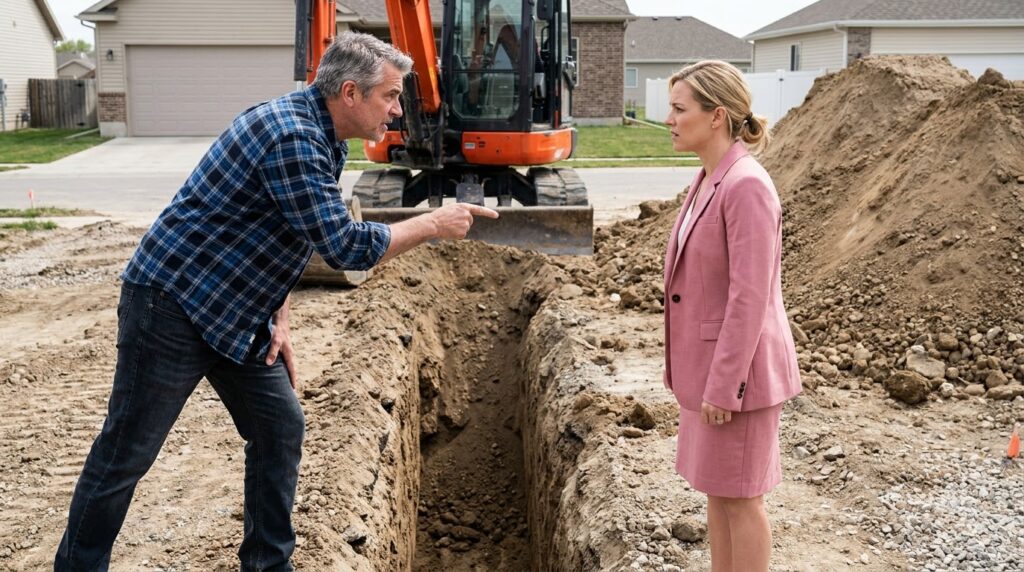
She stood on the narrow ribbon of concrete between her garage door and the trench edge. The damp wind whipped her blonde hair across her face, pulling a few stray strands from her low ponytail, but her posture remained immovable. She unclipped her blue plastic folder, pulled out a thick stapled booklet with yellowed edges, and flipped directly to the back page.
“I went through my mother’s estate boxes last night,” Helen said, her voice cutting clean through the high-pitched idle of the excavator. “I have the official minutes from every Oakridge Estates HOA annual meeting from 2005 to 2018. You were president or vice president for twelve of those years.”
Arthur stopped short, his boots skidding on the grass. His chest heaved against the blue-and-black plaid flannel shirt, dark circles of sweat blooming under his arms despite the cool morning air. “That’s private association records! You have no right—”
“My mother was a dues-paying homeowner,” Helen interrupted, holding the booklet out so Miller could see the black-and-white print. “There isn’t a single vote recorded for a drainage extension. There isn’t a single motion for a stormwater easement on Lot 14. You never brought it to a vote because you knew the neighborhood would never fund a private line for your yard.”
Miller didn’t even look up from his citation pad as his pen scrawled across the duplicate carbon pages. “Presenting an unratified private document as a public municipal easement is a misdemeanor under County Code 104, Arthur. I suggest you stop talking before I call the deputy sheriff out here to take a statement.”
Across the ditch, Marcus let out a whistle. “Hey! Inspector! You better take a look at what’s sitting behind this pipe.”
The excavator engine throttled down to a low, rhythmic thrum. Marcus had maneuvered the bucket to clear away another two feet of heavy red soil along the trench wall, exposing the full trajectory of Arthur’s illegal installation.
Beneath the shattered black PVC line, half-buried in a bed of river gravel that had washed down from Arthur’s property, lay an ancient, heavily corroded galvanized steel box. It sat squarely on the boundary line, wedged between the concrete footing of Helen’s garage and an old, rusted iron pipe protruding from the earth.
Helen stepped closer to the edge, her gaze fixed on the box. The steel was flaking with dark red rust, its lid secured by two heavy hex bolts that were caked in dry clay.
“What is that?” Helen asked, looking from the metal box up to Inspector Miller.
Miller walked to the lip of the cut, taking his flashlight from his belt once more. He shone the intense white beam straight down onto the corroded box. The light glinted off a raised brass plate riveted to the steel cover.
Miller’s brow furrowed behind his wire-rimmed glasses. He leaned over the pit, squinting. “That’s an old municipal shut-off valve casing. That line hasn’t been active since the original farm tract was subdivided in ’72.”
“It’s not active,” Arthur blurted out, his voice suddenly jumping an octave higher, a fresh wave of panic breaking through his posture. He took a hasty step toward the trench, waving his hands as if he could physically shield the iron box from view. “It’s abandoned! It’s got nothing to do with any of this! Marcus, don’t touch that box!”
Marcus lowered his head from the cab window, looking at Arthur with cold amusement. “I’m not touching it, chief. But your PVC line wasn’t just draining onto the foundation. It was tied straight into the overflow port on that casing.”
Helen felt the air leave her lungs. She looked down at the dark, wet gap where the crushed black pipe met the corroded steel box.
It wasn’t just that Arthur had diverted his roof runoff onto her mother’s lot. He had actively tapped his illegal downspouts into an abandoned municipal junction box buried on her side of the property line—a box that had been slowly leaking concentrated groundwater into the structural cinderblocks of her basement for over fifteen years.
Every time Arthur had walked across her driveway with his clipboard, every time he had issued a notice about her mother’s lawn or scolded her for unwashed windows, he had known that the foundation beneath her feet was being systematically destroyed by his own covert plumbing.
Helen looked up from the trench. Arthur was backing away slowly now, his boots leaving dark smears on the grass as he retreated toward his own front porch steps, his laminated map tucked uselessly under his arm.
“Arthur,” Helen called out, her voice dangerously quiet.
He froze, his hand touching the wrought-iron railing of his porch steps, his gray beard twitching as he looked back over his shoulder.
“Don’t go inside,” Helen said, pointing toward the white municipal truck where Inspector Miller was tearing the top copy from his yellow citation pad. “We’re not done measuring.”