
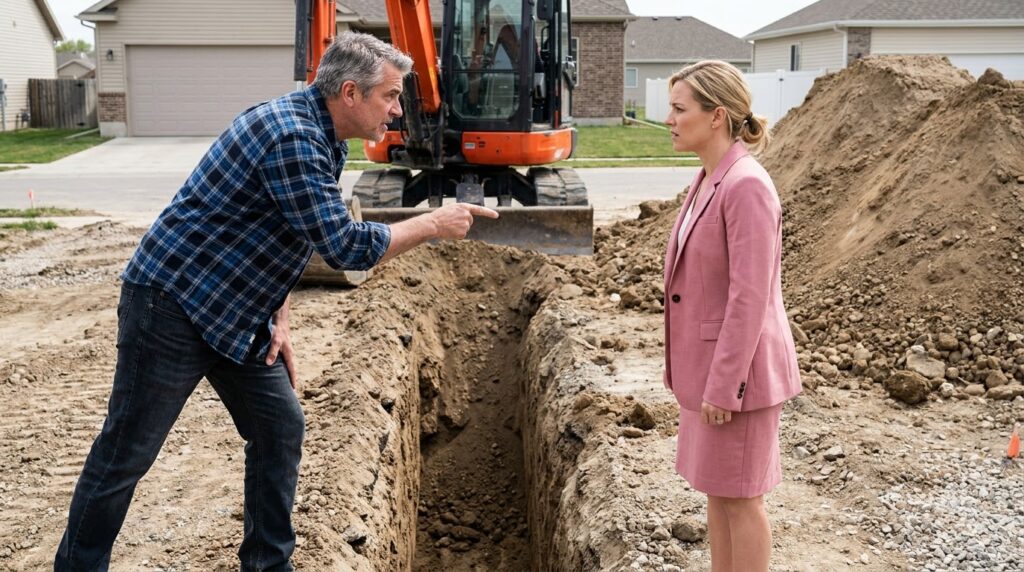
CHAPTER 2: THE LINE IN THE CLAY
“You don’t get to stand on my dirt and issue orders, Arthur.”
Helen’s voice didn’t carry the raw, rasping strain of Arthur’s roar, but it cut through the diesel thrum of the excavator all the same. She took one step closer to the edge, her low heels sinking half an inch into the soft turf. Her eyes stayed locked on the broad-shouldered man, taking in the white-knuckle grip he had on his wooden clipboard, the faint tremble in his thick wrist, and the furious, dark flush spreading upward from his flannel collar.
“This isn’t your dirt,” Arthur spat, his boot shifting again on the crumbling lip of the trench. Loose pebbles and wet red clay sloughed off beneath his heel, raining down onto the exposed concrete footing of Helen’s garage. “This whole strip—six feet from your driveway edge to my fence line—is a recorded drainage easement. Approved by the township board in ’98. You’re altering communal flow, Helen. You’re destroying neighborhood infrastructure!”
Marcus cut the engine of the mini-excavator.
The abrupt silence hit the driveway like a physical weight, replacing the roar of the diesel with the soft, steady drip of groundwater trickling out from the raw trench wall. High above, a hawk circled in the gray humidity, but nobody looked up. Marcus unlatched the heavy cab door, stepped out onto the steel tread, and casually pulled a dark smartphone from his back pocket. He didn’t say a word. He just angled the camera lens straight at Arthur’s planted boot, his thumb tapping the screen to start recording.
Arthur’s eyes darted to the phone, a flicker of dark, instinctual annoyance passing over his features before his posture hardened again.
“Put that away, kid,” Arthur growled, waving his clipboard toward Marcus like a weapon. “You’re operating heavy machinery on an illegal job site. If you drop that bucket one more time, I’m calling the township code enforcement, I’m calling the state police, and I’m having your rig towed off this street on a flatbed!”
“He’s not turning off the machine, Arthur,” Helen said evenly.
She held the blue plastic folder loose against her side, her thumb resting on the cold plastic clasp. She looked past Arthur’s shoulder toward the neighboring houses. Across the cul-de-sac, Mrs. Gable was standing behind her screen door, a white dish towel clutched in her hand, watching the driveway through the mesh. Two houses down, old Mr. Henderson had stopped pushing his mower, resting his hands on the handlebar as he stared across his manicured lawn.
Arthur wanted the audience. He had always wanted the audience. For three years, ever since Helen’s mother had passed and left her the deed to the yellow split-level, Arthur had used the sidewalk as his personal courtroom. A missed lawn mowing by two days meant a brightly colored violation notice tucked under her wiper blade. An extra trash bin left out past seven on a Tuesday morning brought a three-paragraph email citing HOA Bylaw 4-B.
“You think you can hide behind that quiet teacher routine, don’t you?” Arthur leaned further across the three-foot gap, his chest heaving under the plaid flannel. The smell of stale coffee and damp wool radiated off him. “Your mother knew the rules, Helen. She respected the boundary. The moment she’s gone, you bring in contractors, you tear up the yard, you throw mud all over the street—”
“My mother paid three thousand dollars six years ago to patch the basement wall you flooded,” Helen said, her tone dropping an octave, flat and chillingly precise. “And she was too soft-spoken to ask you why your downspouts were pointed at her foundation.”
Arthur’s jaw tightened so hard the muscles along his cheek turned pale. “That’s a lie.”
“It’s on the structural report,” Helen replied. She unclipped the blue folder with a crisp, dry snapping sound that seemed to ring across the quiet yard. She pulled out a single sheet of paper—the engineer’s official blue-lined schematic—and held it out. “The wall is bowing because water is being forced under hydrostatic pressure straight against the cinderblock. Three hundred gallons every time it rains more than an inch.”
“I don’t care what some paid-off contractor wrote on a piece of paper!” Arthur snapped, thrusting his clipboard forward so fast the papers rattled under the metal clip. Clamped to the front was a faded, laminated document stamped with a faded red seal. “Look at the map, Helen! 1998 storm-drain overlay! This land right beneath my boot is dedicated township property. You have zero right to dig here. Zero!”
Helen didn’t reach for the clipboard. Instead, her eyes traveled down.
Down past the laminated map, past Arthur’s stiff blue jeans, to the exact spot where his heavy work boot was crushing the edge of the pit. Two inches below his leather sole, protruding from the dark, sheared clay of the trench wall, was a jagged section of four-inch black PVC pipe. It was cracked, choked with mud, and dripping a thin, continuous stream of gray water directly onto the exposed concrete footing of her house.
The pipe didn’t run parallel to the street. It didn’t head toward the storm drain at the corner. It ran at a sharp, right angle, leading straight out from under Arthur’s side lawn.
Helen looked up from the pipe, her gaze settling back on Arthur’s face.
“What is that, Arthur?” she asked quietly.
Arthur’s eyes flashed, dropping for a fraction of a second to the black plastic sticking out of the mud beneath his shoe. A sharp, ugly twitch caught the corner of his trimmed beard.
“It’s old agricultural tile,” Arthur said instantly, his voice rising in pitch, dropping its booming authority for something sharper, more defensive. “Township put it in decades ago. It’s got nothing to do with this.”
“It’s fresh PVC,” Marcus called out from the side of his excavator, his phone still raised, capturing the pipe, the trench, and Arthur’s boot in one clean frame. “And it’s not township. That’s home-depot schedule-forty pipe, buddy. Still got the barcode sticker on the side.”
Arthur turned on Marcus, his face darkening to the color of a bruised plum. “Shut your mouth! You’re trespassing on a contested easement!”
“He’s not trespassing,” Helen said. She pulled a second document from her blue folder—a thick, yellowed piece of parchment folded into thirds, bearing the official embossed seal of the Allegheny County Recorder of Deeds. She didn’t hand it to him. She just unfolded the top third so the red surveyor’s stamp was visible in the bright morning light. “And this isn’t an easement, Arthur.”
Arthur froze. His hand, still holding the clipboard high, faltered slightly.
“I called the township building office at eight o’clock this morning,” Helen said, her voice steady, cool, and implacable as the iron bucket resting in the dirt. “I asked them to pull the 1998 storm-drain overlay. Do you know what the clerk told me?”
Arthur stared at her, his lips pressed into a thin, white line, his chest rising and falling in quick, shallow breaths.
“She told me there is no 1998 easement,” Helen continued, stepping directly up to the edge of the trench, her eyes locked onto his. “She said the board rejected your petition twenty-eight years ago. This line is private deeded property. My property. All the way to the iron survey pin buried under your lawn.”
Across the street, a white municipal pickup truck turned the corner of the cul-de-sac, its yellow roof beacon flashing silently against the gray sky.








