
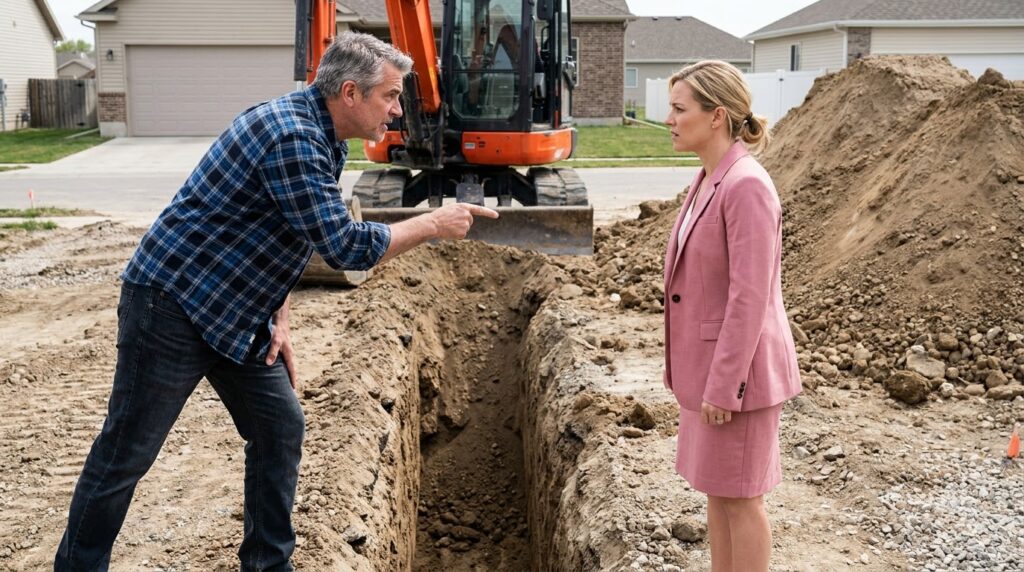
CHAPTER 7: THE UNCOVERED DRAIN
The yellow citation slip fluttered under Arthur’s hand, the carbon-copy ink dark and fresh against the worn masonite of his clipboard. Arthur stood motionless on his second porch step, his fingers twitching against the wrought-iron rail, watching Inspector Miller step back toward his truck.
“Marcus,” Helen said, her voice cutting through the idling drone of the excavator. “Take the bucket down another six inches. Let’s clear the clay off that steel junction box completely.”
Arthur’s head snapped up. “The citation is written! The inspector verified the line! There’s no need to tear up any more dirt!”
“I’m not leaving an unpermitted diversion pipe leaking into my foundation wall, Arthur,” Helen replied, without looking at him. She walked along the narrow strip of driveway asphalt, stopping right where the excavator bucket hung suspended over the pit. “We clear it out today so my crew can lay the gravel bed and waterproof the cinderblock.”
Marcus pulled back on his dual joysticks. The hydraulic cylinders hissed under high pressure, tilting the heavy iron bucket forward. Steel teeth bit into the soft, saturated red earth right beside the foundation wall, scooping away a heavy three-foot wad of clay.
CRUNCH.
The iron bucket scraped against the side of the corroded steel junction box, peeling away the remaining layer of mud.
Helen leaned over the edge, her hand gripping the cold vinyl folder tight against her hip. In the bright morning sunlight, the full structure of Arthur’s installation lay exposed in the pit.
The crushed four-inch black PVC pipe didn’t just rest beside the old 1972 municipal valve box; it had been forcibly sleeved into an adapter collar that Arthur had hand-fitted into the top port of the steel box. To keep the water from backing up onto his own lawn during heavy storms, he had packed the joint with fast-setting hydraulic cement—cement that had cracked under soil pressure years ago, channeling every gallon of his roof runoff straight through the rusted seam and into the soil abutting Helen’s basement wall.
Inspector Miller walked back over, leaning his hands on his knees as he peered into the trench. He pulled his flashlight from his belt and clicked the beam directly onto the cracked cement collar.
“Look at that,” Miller muttered, his voice cold and dry. “He didn’t just dump his downspout onto your grade. He tapped into an abandoned municipal junction box without a permit, plugged the downstream outlet, and turned the whole casing into a pressure-injector against your wall.”
Marcus looked out from the cab window, shaking his head. “That’s why her basement wall was bowing. Every time it rained, that steel box filled up like a pressure cooker and pumped water straight into the cinderblock seams.”
Helen looked up from the pit, her gaze sweeping across the lawn to where Arthur stood.
His face was completely hollowed out, the aggressive posture that had dominated the cul-de-sac for fifteen years entirely gone. He wasn’t looking at the neighbors gathered on the sidewalk. He wasn’t looking at Miller or Marcus. He was staring at the cracked cement collar at the bottom of the pit—the physical proof of a quiet, deliberate sabotage that had slowly rotted her mother’s house while he sent monthly HOA warning letters about weeds and trash cans.
“How long, Arthur?” Helen asked. Her voice wasn’t loud. It didn’t carry the rage she had felt in her chest an hour ago. It was flat, heavy, and absolute as the iron pin buried in the dirt. “How many years did you watch my mother pay contractors to patch that wall, knowing you had a cement collar pumping water into her foundation?”
Arthur opened his mouth, but his throat worked in silence. His shoulders slumped forward under his plaid flannel shirt. He pulled his eyes away from the pit, looking down at the yellow citation paper clutched in his hand.
“I… the water had nowhere else to go,” he whispered, his voice barely carrying over the low idle of the engine. “My basement floor was buckling in ’08. The board wouldn’t approve the municipal drain…”
“So you made it my mother’s problem,” Helen said. She looked down at the blue plastic folder in her hands, then turned toward Inspector Miller. “Inspector, I want every inch of that black pipe removed from my parcel today. And I want the municipal valve box capped according to town code.”
“Already on it, Miss Vance,” Miller said, taking out his notepad to draft the formal site remediation directive. “I’m issuing an immediate structural hazard abatement order. Arthur has twenty-four hours to produce a licensed contractor’s plan to disconnect his downspouts and restore your property line, or the town executes the work and places a priority tax lien on his deed.”
Marcus raised the excavator bucket, swinging the boom away from the trench and dropping a final load of cleared clay onto the spoil pile. The black PVC pipe lay severed and dead in the mud, its cracked cement collar exposed to the open air.
Arthur slowly turned, stepped up his porch stairs, and pushed open his front door without saying another word. The screen door shut behind him with a soft, dull click.
Helen stood on the clean asphalt of her driveway, watching the amber strobe on Miller’s truck flash rhythmically against her yellow house. For the first time in three years, the air smelled only of fresh clay and turned earth.








