
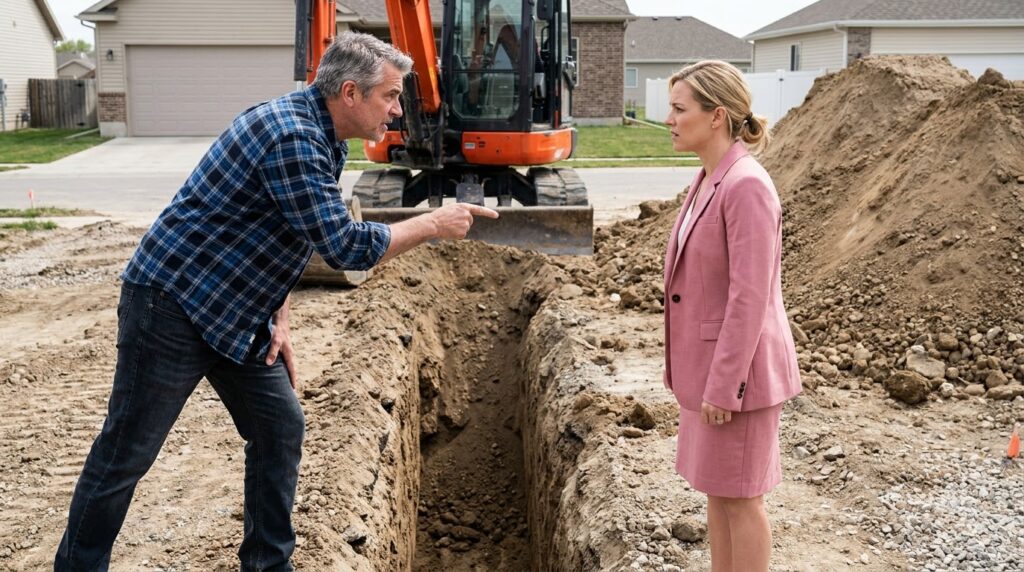
CHAPTER 6: THE IRON PIN IN THE DIRT
Arthur’s hand remained glued to his porch handrail, his knuckles white against the black wrought iron. He turned his head slowly, his jaw working back and forth as if trying to chew through a mouthful of sand.
“I’m going inside to call the association’s legal counsel, Miss Vance,” Arthur said, his voice flat, stripped of its loud, theatrical gravel. “You have no right to detain me on my own porch.”
“I’m not detaining you, Arthur,” Inspector Miller called out from the side of his truck, stepping around the open door with a heavy steel measuring tape reel resting in his palm. “I’m just advising you that if you walk inside while I’m establishing the official boundary mark, I’ll record it as a failure to cooperate with an active municipal investigation. That’s an additional five hundred dollars on the summons.”
Arthur didn’t take another step up the stairs. He slowly turned around, his flannel shirt hanging loose off his broad shoulders, and leaned his back against the railing. His eyes darted to the sidewalk, where three more neighbors had gathered near Mr. Henderson’s mower. Mrs. Gable was holding her phone up openly now, recording the flashing amber beacon of the municipal truck and Arthur standing trapped on his own porch.
Miller unhooked the end of the flexible steel tape and tossed the brass ring to Marcus. “Hold this flush against the concrete curb face at the lot line, son. Right where the yellow paint marks the original 1972 survey point.”
Marcus hopped down from the excavator’s tread, taking the brass ring and pressing it firmly into the curb corner. Miller walked backward across Arthur’s manicured front lawn, the steel tape unspooling with a bright, metallic zipping sound that seemed to slice through the humid air.
Helen followed Miller’s line, her heels sinking slightly into Arthur’s prized fescue turf. She kept her blue folder tucked under her arm, watching the red numbers on the steel tape roll past.
“Your deed calls out forty-five feet four inches from the corner pin to the boundary marker, Arthur,” Miller said, eyeing the tape as it reached the forty-five-foot mark. He stopped three feet onto the grass that Arthur had spent fifteen years treating as his personal property. “And look at that.”
Miller dropped to one knee on the sod. He pulled a folding trenching trowel from his belt, flipped open the sharp steel blade, and plunged it straight into the pristine green turf.
“Hey!” Arthur shouted, taking one involuntary jerk forward off his porch step. “That’s my lawn! You’re damaging private landscape!”
“I’m locating a recorded county boundary pin, Arthur,” Miller said without looking up.
He drove the trowel six inches deep into the soil and twisted the handle. A neat square of green sod lifted away, revealing dark, moist loam underneath. Miller scraped the blade across something hard buried beneath the roots.
CLANG.
The sound of steel striking heavy cast iron rang across the yard like a small bell.
Miller reached into the hole with his bare fingers, brushing away loose dirt and root fibers until a rusted, three-inch iron survey cap emerged from the soil. Plamped into the center of the iron top was a stamped county registration number: PARCEL 14-B / BOUNDARY PIN 04.
Miller pointed his flashlight straight into the hole, illuminating the rusted iron cap.
“The iron pin is right here,” Miller said calmly, looking up at Arthur. “Three feet inside what you’ve been calling your easement, Arthur. This entire strip of grass—your prize hydrangeas, your decorative stone border, and the ground where you buried that black pipe—sits on Miss Vance’s property line.”
Helen stood beside the hole, staring down at the rusted iron cap. The cold metal pin had been buried beneath Arthur’s sod for decades, silent and unyielding, waiting for someone to clear away the grass and read the numbers.
She turned her head to look at Arthur. The broad-shouldered man seemed to shrink against the wrought-iron railing of his porch. The laminated map in his hand swung loosely at his side, its fake red seal catching the dim morning light.
“You knew the pin was here,” Helen said softly, the realization settling into her chest with the weight of a stone. “When my mother wanted to build a garden fence seven years ago, you told her the county wouldn’t allow it because of the easement. You knew if she dug the post holes, she’d hit this iron cap.”
Arthur opened his mouth, but no sound came out. His chest rose and fell in shallow, uneven twitches.
“Miller,” Helen said, turning back to the inspector. “What happens to the pipe now?”
Miller stood up, wiping his muddy hands on a blue shop rag from his pocket. “He has forty-eight hours to disconnect his downspouts from that buried line and seal his foundation wall at his own expense. If he doesn’t, the township brings in a crew to cap it at the property line and bills his tax parcel.”
Miller unclipped the top copy of the yellow citation pad, walked across the grass, and slapped the paper directly onto the clip of Arthur’s wooden clipboard, right over the laminated 1998 map.
“Have a good afternoon, Arthur,” Miller said quietly.
Arthur didn’t take the paper. He didn’t look down at it. He stared straight ahead at the open, muddy trench beside Helen’s garage, where the black pipe stuck out of the clay like an exposed nerve, dripping its dirty water onto the ground he no longer controlled.








