CHAPTER 1: THE SCARRED EDGE
“You’re three inches over the utility margin, Vance,” the voice cut through the damp morning air before the latch on the driver’s side door could click shut.
Marcus Vance didn’t lift his head immediately. He kept his grip on the steering wheel of his work truck, letting the diesel engine rumble to a quiet halt. Through the desaturated tint of the side window, the suburban block looked like a row of identical teeth—clean, white, and sharp. The smell of cut fescue mixed with the heavy scent of unburned fuel. When he finally stepped down onto the asphalt, his boots hit the edge of the gray concrete curb with a solid, dull thud.
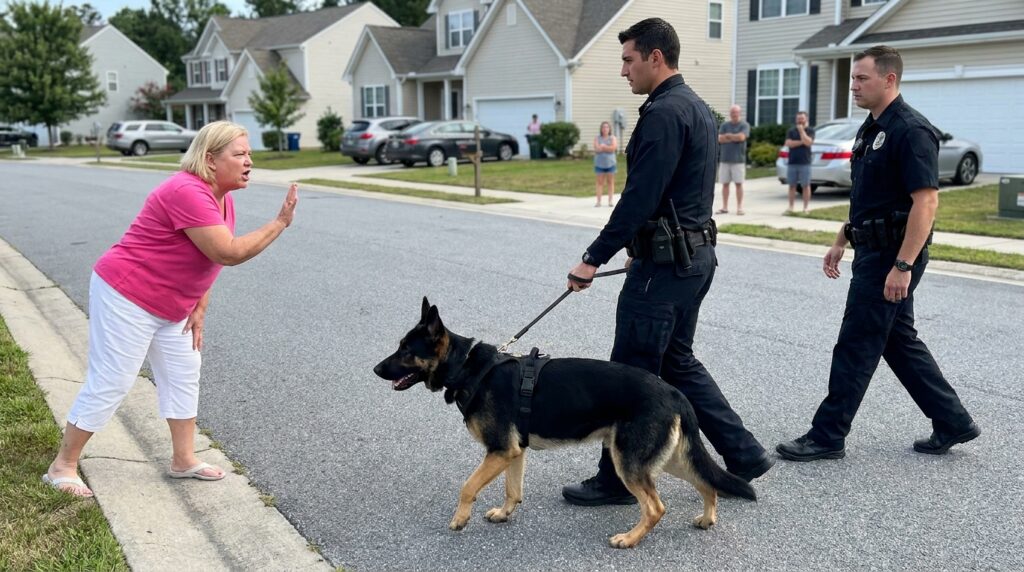
Brenda Vance stood precisely at the seam where his driveway met the public road. She was a stocky silhouette against the morning fog, wearing a bright pink short-sleeve top that looked garish against the desaturated gray of the early light. Her white cropped pants were immaculate, free of the mud that currently coated Marcus’s work boots. In her left hand, she held a thick plastic clipboard like a shield; her right index finger pointed directly at a fresh line of neon-green utility paint marking the turf.
“The board reviewed the layout at six this morning,” she said, her voice dry, carrying the high, nasal pitch of a person used to talking over municipal meetings. “You parked the trailer outside the allowable twelve-hour window for commercial offloading. The citation is already logged in the system.”
Marcus adjusted the brim of his faded dark baseball cap, his eyes tracking past her to the low retaining wall running along the side of his lot. The stone was scarred. Someone had taken a can of industrial aerosol paint to the masonry overnight, leaving a jagged, sloppy mark right over the boundary line. The paint was still tacky, catching the low angle of the morning sun. He didn’t check the masonry for structural damage; he looked at the ground, noticing where the turf had been freshly disturbed, the grass torn away in clumps near the spot where his metal surveyor stakes had been driven into the dirt the day before.
“The stakes are gone, Brenda,” Marcus said. His voice was flat, rhythmic, carrying the practiced restraint of a man who had spent a decade monitoring logistics lines under pressure.
“The wind carries things off out here,” Brenda replied, her lips tightening into a thin, pale line as she pushed her oversized dark sunglasses up into her short, rigid blonde hair. She didn’t look at the defaced stone wall. Her eyes were fixed on the phone clutched tightly in her other hand. “And if you place unapproved markers in the common easement zone again, the county will be the ones pulling them. We maintain visual uniformity on this street, Mr. Vance. It’s what keeps the values where they belong.”
Marcus took one step closer, his boots crunching against a small patch of gravel near the mailbox lane. He felt the familiar weight of the block’s silent observation—the subtle shift of white blinds in the kitchen window across the street, the slow rotation of a neighbor’s lawnmower halting fifty yards down the asphalt. The air smelled of iron and dry earth. He reached into his pocket, his fingers brushing the cool, metallic edge of the certified plot maps he carried. He didn’t pull them out. The conflict wasn’t about the paper; it was about the rusted pin buried six inches beneath the sod, a marker that had stayed quiet for forty years.
“The public street doesn’t belong to the board, Brenda,” he said softly.
Brenda’s posture stiffened, her heels catching the lip of the concrete as she took a half-step backward, her phone rising slightly as if to record the distance between them. Before she could answer, the distinct sound of a heavy utility door slamming shut echoed from the far end of the development, followed by the sharp, rhythmic click of iron tags on a heavy leather collar.