CHAPTER 6: THE IRON BOUNDARY
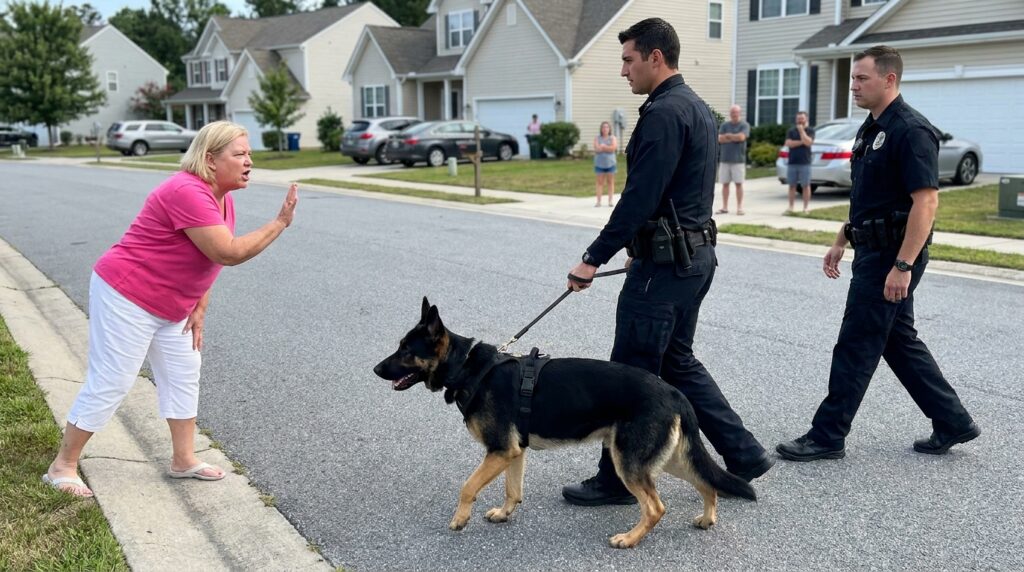
The German Shepherd went completely rigid, its front paws digging hard into the mulch at the base of Brenda’s privet hedge. A low, vibrating whine caught in the animal’s throat—not an aggressive challenge, but the definitive operational alert of a working dog tracking a buried disturbance.
Marcus stepped forward, his boots sinking into the loose, damp loam. The thick, plastic folder he had pulled from the drainage tile crinkled under his arm, its edges caked with dried mud. He didn’t wait for the officers to authorize the clearance. Reaching down, his hands tore past the tangled woody stems of the hedge, the rough bark scraping across his knuckles as he hauled back a thick layer of decorative limestone rocks.
“Mr. Vance, stay clear of the tracking zone,” the handler officer said, though he didn’t adjust his grip on the lead. He held the German Shepherd steady, his boots planted firmly on the edge of the asphalt.
Marcus ignored the warning, his fingers sinking deeper into the dirt until they struck something cold, square, and unyielding. With a heavy, upward heave that sent dry earth flying across the pristine white of Brenda’s cropped pants, he dragged the object out into the harsh daylight. It wasn’t just a survey stake. It was the complete bundle of Marcus’s missing zinc-plated property markers, bound together with heavy-gauge copper wire and wrapped in a copy of the unrecorded corporate infrastructure lease he had unearthed in the basement vault.
“The markers didn’t blow away, Brenda,” Marcus said, his voice flat and level as he dropped the heavy metal bundle onto the sunlit asphalt. The iron weights hit the pavement with a loud, metallic clang that vibrated through the quiet street.
Brenda stood entirely motionless on the shoulder, her smartphone drooping toward the ground, her face completely drained of its rehearsed fury. The laminated HOA papers under her arm slipped, scattering across the gravel like dead leaves. She looked at the bundle, then at the silent gallery of neighbors watching from their driveways. Her lips twitched, but no sound came out; the performance of absolute neighborhood authority had collapsed entirely under the weight of physical recovery.
The backup officer stepped into the dirt, his heavy tactical boots crunching over the remaining limestone rocks. He reached into his belt, pulling out a solid steel probing rod. He drove the tip straight down into the exact hole the dog had indicated, searching for the structural baseline. Three inches down, the rod struck something with a dull, heavy tink that sounded completely different from the loose stone.
“We have a primary marker contact,” the backup officer noted, kneeling down and using a small hand trowel to clear the remaining soil.
Time seemed to slow as the earth was scraped away, every movement heavy and deliberate. Marcus watched the rust-colored crust of a massive, ancient iron pin emerge from the ground. It wasn’t the shallow zinc stake Marcus had driven yesterday, nor was it the modern corporate footer. It was the original 1974 primary county surveyor pin—a thick, flaking spike driven directly into the bedrock before the subdivision had ever been named.
The backup officer cleared the lime residue from the top of the pin, revealing a deeply stamped numeric grid coordinate. He cross-referenced the numbers with the certified historical vellum map on Marcus’s phone screen, his pen tracking the old infrastructure lines.
“The original grid pins are active,” the officer said, standing up and dusting the gritty soil from his trousers. His eyes locked onto Brenda, then turned slowly toward Marcus, his expression completely devoid of neighborhood sentiment. “According to the 1974 county baseline, the primary utility easement doesn’t stop at the curb lane. The true county right-of-way extends exactly twelve feet inward from the asphalt seam.”
A heavy, absolute silence settled over the lot. Marcus stood perfectly still, his hand resting on the brim of his cap as the structural logic of the revelation settled into his mind. The line didn’t just strip Brenda of her jurisdiction over the street margins; it cut directly through the middle of his own retaining wall and took three feet of his own paved driveway. The true iron line stripped both sides of the property they had been fighting to control, leaving the entire dispute completely irrelevant under the grander authority of the county grid.
“Everyone saw it,” Marcus said softly, his eyes tracking from the flaking iron pin back to the stunned, silent neighbors. “The board doesn’t own the ground. Neither do we.”
The backup officer began clipping a series of formal county citations into his folder—tampering with public safety evidence, criminal mischief, and maintaining an illegal infrastructure obstruction on a county right-of-way. He stepped toward Brenda, his voice carrying the cold, final weight of institutional enforcement.
Marcus turned away from the curb, his work boots dragging through the loose gravel as he walked back toward his truck. The sun was beginning to drop, casting long, desaturated shadows across the identical houses. The battle for the easement was over, settled not by corporate rules or neighborhood pressure, but by the quiet, unyielding weight of the iron buried deep beneath the grass.