The Deep Blue Surface: A Story of Suburban Peace, Quiet Boundaries, and Unbroken Resilience
CHAPTER 1: THE WEIGHT OF STILL WATER
The heavy plastic wheels hit the patio pavers with the wet, grinding crack of stone meeting bone.
Behind the double-paned glass of the second-story bedroom, I didn’t move. My palm rested flat against the cool wall, feeling the faint vibration of the air conditioner humming in the attic above. Below, in the sharp white light of two o’clock, the side gate swung wide, its rusted latch hanging loose against the cedar fence.
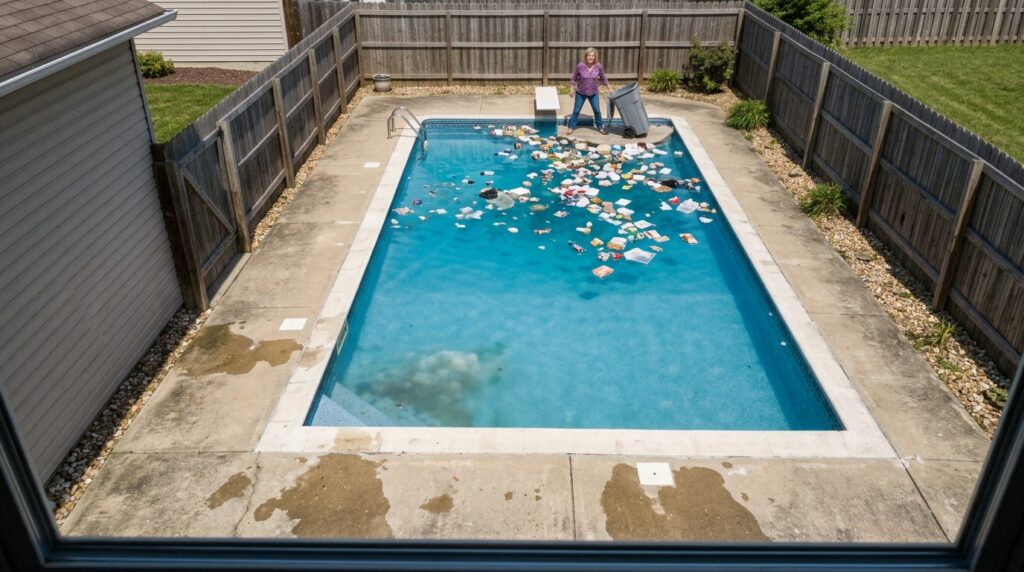
Evelyn didn’t look up. She moved with the rigid, braced momentum of someone who believed the ground beneath her feet had been laid for her exclusive use fifty years ago. Her blonde bob was hairsprayed stiff against the afternoon breeze, her patterned purple blouse clinging to her shoulders as she hauled the gray municipal bin across the concrete. The cart was overflowing—stale coffee grounds, damp cardboard, sour milk cartons spilling over the rim like an unmade bed.
She didn’t hesitate at the edge. Her tan flats planted wide on the wet coping stone, her knees locked, and with a short, guttural shove, she tipped the bin.
The sound wasn’t a splash; it was a heavy, suffocating thud. A thick wave of fouled water surged over the blue tile, carrying a dark, spreading cloud of grease and rotting paper outward across the pristine surface I’d spent three months hand-scrubbing. Floating plastic packaging bobbed in the wake, choking the skimmer intake within seconds.
Evelyn stepped back, her hands still curled in the air as if holding invisible reins. She lifted her chin toward my window, her chest heaving under the purple polyester, and opened her right palm in a mocking, wide-open gesture that offered no apology and demanded every inch of space.
“What are you going to do about it?” her voice drifted up through the glass, thin and sharp, like paper scraping against stone.
I didn’t open the latch. I didn’t scream. My thumb pressed the side button on my phone, locking the screen where four camera feeds glowed in crisp, high-definition gridlines. In the bottom-right quadrant, a tiny red dot flashed steadily next to the timestamp, capturing the curve of her spine, the tilt of her head, and the exact trajectory of the refuse as it settled into the deep end.
When I stepped away from the glass, my eyes caught a white slip of paper jammed tightly between the latch and the cedar post of the broken gate below—a folded sheet of yellowed notepad paper I hadn’t noticed when she forced her way inside.
CHAPTER 2: FADED INK AND CEDAR SPLINTERS
The latch on the wooden side gate was sheared completely through, the graying cedar splintered where the metal had finally given way under the weight of the trash cart. A thin trail of sun-warmed rust dust coated the latch plate, mixed with a faint smudge of purple dye from Evelyn’s sleeve.
I didn’t step onto the patio right away. I pulled open the screen door slowly, letting my boots rest on the bottom step of the porch while my eyes tracked the edges of the yard. The midday heat hung heavy over the grass, carrying the sharp, chemical stench of spoiled milk and rotting vegetable rind from the water. The pool sat still now, the initial swell of the impact having died down into a greasy, rainbow-tinted scum that clung to the white grout line.
I reached out and slipped the folded slip of paper from between the split cedar grain.
The paper was stiff, yellowed at the margins from exposure to sunlight, as if it had sat in a glove box or the bottom of an outdoor utility drawer for years before being brought into the light today. But when I unfolded it, the crease didn’t tear. The fiber was thick—heavy linen cardstock from an older era—and the ink across the middle was a pale, faded blue, soft around the edges where the moisture of the air had bled into the page over time.
Perpetual easement granted for runoff and utility maintenance along east fence line, the first line read, written in a loose, sweeping cursive that slanted heavily to the right. Agreed by verbal covenant upon boundary installation.
Below it, written in fresh, sharp ballpoint black ink that indented the paper so hard it nearly cut through to the back, was a single additions line: This access includes weekly waste clearing and gate clearance.
I stared at the two handwritings. The faded blue script belonged to someone who had signed documents forty years ago—perhaps the original owner who had built the cottage before the modern subdivision was platted. But the black ink below it was rigid, cramped, and breathless. It was Evelyn’s hand. She had taken a real piece of history—a faded relic from an era before surveys and county deeds—and tried to graft her own entitlement onto its bones.
A faint rustle came from the far side of the fence. A pair of tan flats shifted against the dry gravel of Evelyn’s driveway.
“You can look at that paper all afternoon!” her voice came through the cedar slats, stripped of its earlier theatrical screech, leaving only a dry, raspy tremor. “Doesn’t change what your house did to the natural flow! That line has been open since seventy-eight! You don’t get to build a concrete box in the ground and pretend the water has nowhere else to go!”
I didn’t answer her. I folded the yellowed sheet back along its original creases, keeping my fingers on the dry edges to avoid smudging the fresh black ink she had added.
“I know what you’re doing up there with your little camera!” she barked, her voice closer now, her face likely pressed near the narrow gap where the gate hinge had pulled free from the post. “You think a lens makes you right? You think some town hall clerk who hasn’t stepped foot on this street in twenty years knows where the water goes when the storm drains back up?”
I turned the paper over in my hand. In the bottom corner of the original faded script, barely visible beneath a thumb-sized stain of old oil, were three numbers: Sec. 14-B. It wasn’t an agreement between neighbors at all. It looked like an old county code reference number—a citation from an era when this entire slope was open pasture, before the retaining walls were poured.
“The police are already on their way, Evelyn,” I said quietly, my voice barely carrying over the slow drip of the fouled pool skimmer.
“Let them come!” she snapped, though her heels clicked once, hard, against the gravel as she stepped back from the fence line. “Let them look at the whole yard! Let them look at what you buried under that blue liner!”
She didn’t stay to hear more. Her back door slammed shut a second later, the heavy wooden frame rattling the glass panes in her kitchen.
I walked back up the porch steps, the worn paper held loosely in my left hand. In my right, the phone screen lit up again with an incoming text from the county non-emergency dispatcher confirming a unit was five minutes out. I looked down at the paper once more. If Evelyn had held onto this old slip of county script for decades, she hadn’t just brought it out today to justify a cart of trash. She had brought it out because she was terrified of what would happen when someone finally looked past the fence line and measured the ground for what it actually was.
CHAPTER 3: THE ARRIVAL OF THE TALLYMAN
The low, hydraulic sigh of a Ford Interceptor’s brakes echoed off the front brick facade before the engine was even turned off. Through the glass panels of the front door, the cruiser’s roof lights flickered in silent amber and blue, painting long, stretched bars of color across the entryway runner.
I opened the front door just as Officer Miller’s dark leather boots hit the asphalt. Behind his patrol car, a second vehicle—a white city-owned pickup with County Code Enforcement & Surveying stenciled across the door in sun-faded gray block letters—pulled up against the curb, its tires clipping the edge of the turf.
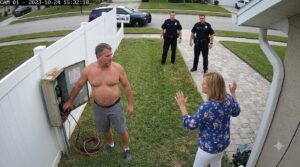
“Afternoon,” Miller said, resting his hand casually over his belt buckle as he walked up the porch steps. His face had the weathered, flat tolerance of a man who spent eight hours a day mediating suburban boundary wars over overhanging oak branches and unclipped hedges. “Dispatch said we had a trespass in progress with property damage?”
“It’s in the back,” I said, stepping aside to let him through the porch framework. “Side gate.”
From the adjacent lawn, Evelyn’s front screen door slammed open with a metallic rattle that made the officer’s eyes flick sideways. She didn’t wait for him to reach her driveway. She marched across the dry turf in her tan flats, her purple patterned blouse fluttering in the hot exhaust breeze of the idling county truck. In her right hand, she clutched a blue plastic folder, its corners frayed and dog-eared from years of being jammed into kitchen drawers.
“Officer! Officer, don’t let him frame this!” her voice pitched high and tight, cutting through the warm air like a dull saw. “I am the original deed holder on this sector! I have been maintaining the drainage right-of-way since 1994! He poured a concrete basin right over the natural spillway!”
The code inspector stepped out of the white pickup, a heavy aluminum clipboard clipped to his belt. He was an older man, his skin leathered from years under the open sky, wearing a faded khaki uniform shirt with a brass badge pinned crookedly over the pocket. His eyes didn’t fix on Evelyn, nor on me. They went straight to the ground, scanning the pitch of the driveway, the angle of the curb, and the small green plastic cover of the county water meter buried near the property line.
“Ma’am,” Miller said, holding up a single flat palm toward Evelyn as she crossed the property line onto my grass. “Stay on your side of the boundary line for right now. We’re going to take a look at the scene first.”
“I have the documentation!” she shouted, thrusting the blue folder toward his chest. “I have the historical right-of-way easement! My father signed the original drainage agreement with the county before these houses were even subdivided!”
The inspector, whose name tag read Vance, took a slow step toward the side gate. His eyes caught the splintered cedar post and the sheared metal latch hanging by a single screw. He reached out with a gloved finger and touched the fresh, unweathered wood fiber where the gate had been forced inward.
“She pushed through here ten minutes ago,” I said, keeping my voice level, stripped of any rising emotion. “She was wheeling a seventy-gallon municipal waste cart.”
“It was an emergency clearing!” Evelyn yelled from six feet away, her body vibrating with a defensive, rigid energy. “The water was backing up into my foundation! He trapped the runoff! I was clearing a blocked access path!”
Inspector Vance didn’t answer her. He pushed the broken gate open with the toe of his boot, the wood scraping harshly over the patio pavers. Miller followed him into the backyard, his eyes dropping immediately to the pool.
The scene had settled into a heavy, stagnant silence. The afternoon sun beat down directly onto the water, baking the floating debris into a thick, oily scum. Stale coffee grounds had drifted toward the shallow end, coating the white steps in a dark, gritty film. A half-dissolved cardboard box bobbed near the main drain intake, clogging the suction grid so severely that the pump in the pump house was beginning to emit a low, strained whine.
And right at the deep end, pinned sideways against the wet coping stone, sat the empty gray trash cart. Its wheels were still dripping dark, murky water onto the gray patio pavers.
Vance stood at the pool’s edge for a long time, his jaw working silently as he looked from the cart to the polluted water, then up toward the second-story bedroom window.
“That’s a five-thousand-gallon closed-loop circulation system,” Vance said quietly, his voice dry as dust. He turned his head slowly to look at Evelyn, who had stepped up to the edge of the broken gate, her fingers hooked tightly around the cedar fence posts. “Ma’am… did you dump a municipal waste container into a residential filtration system?”
“It’s not a residential system!” she cried, her knuckles turning white against the gray wood. “It’s an illegal obstruction of a county drainage basin! Look at the elevation! Look at how the ground falls from my garage to his fence!”
Miller pulled a small black notebook from his breast pocket, his pen hovering over the blank paper. “Evelyn, I’m going to need you to step back to your driveway right now. This isn’t a drainage dispute anymore. This is a scene inspection.”
“He has no right to trap the water!” she screamed, her voice cracking as she pointed a shaking finger at me. “Ask him about the survey! Ask him why he wouldn’t sign the joint boundary waiver last spring!”
I reached into my pocket and pulled out my phone, opening the video file that had finished processing five minutes before they arrived. I held the screen out toward Officer Miller.
“I don’t need to argue about the water, Officer,” I said quietly, the words falling flat and cold into the humid air. “You can watch the entry, the shove, and the taunt right here in four-K.”
Vance leaned over Miller’s shoulder, his eyes narrowing as the video began to play. On the small screen, the image was mercilessly clear: the side gate snapping open, Evelyn’s braced posture, the heavy shove of the trash cart, the violent splash of garbage hitting the pristine blue water, and then her face lifting toward the upper window, her mouth opening to deliver the single, sharp line.
As the audio played through the phone’s speaker—What are you going to do about it?—Evelyn’s voice cut off abruptly from the fence line. The high, shrill defiance that had sustained her all afternoon seemed to leak out of her all at once, leaving her standing against the splintered cedar gate with her mouth slightly open, her eyes wide, staring at the small glowing screen in the officer’s hands.
CHAPTER 4: THE PAPERWORK PARADOX
Officer Miller tapped the glass screen of my phone once, pausing the frame right where Evelyn’s hand hung open over the water. The silence that followed was heavy, broken only by the continuous, strained gurgle of the choked pool intake.
“I think we’ve seen enough of the footage for right now,” Miller said, his tone dropping an octave into something cold and procedural. He looked across the broken latch toward Evelyn. “Step back into the driveway, ma’am. Do not touch the fence again.”
Evelyn’s chest rose and fell in short, shallow hitches. Her face had drained of its ruddy color, leaving her skin pale against the stiff blonde bob. But instead of retreating, her fingers tightened around the blue plastic folder she carried.
“He’s omitting the context,” she whispered, her voice rasping as if her throat were filled with sand. She thrust the folder forward, offering it to Inspector Vance this time. “Read the covenant. Read the 1978 variance! The previous owner gave us the right to clear this walkway whenever the culvert choked!”
Vance didn’t reach for the folder. Instead, I pulled the folded yellowed sheet out of my back pocket—the one I had retrieved from the broken gate post—and extended it toward the inspector.
“She left this pinned in the gate before she tipped the bin,” I said. “Take a look at the second line.”
Vance pulled a pair of thin reading glasses from his shirt pocket, unfolding them with one hand as he took the page. He squinted at the soft, faded blue ink of the top paragraph, then his thumb moved down to the dark, fresh ballpoint line below it.
“This top part is an old agricultural runoff waiver from before the neighborhood was platted,” Vance said, his finger tracing the Sec. 14-B notation in the corner. “It applied to the open ditch that used to run two hundred feet east of here. It expired when the county installed the storm mains in eighty-two.” He looked up, his eyes locking onto Evelyn’s trembling hands. “And this bottom line about waste clearing… that ink isn’t a week old. The paper is indented so hard it almost tore through.”
A sharp, collective gasp came from the sidewalk behind us. Two neighbors—the retired couple from across the cul-de-sac—had stopped on the pavement, their hands raised to shield their eyes from the glare as they watched the inspector examine the document.
“She forged a drainage waiver?” Miller asked, looking from Vance to the paper.
“It’s not a forgery!” Evelyn shrilled, her voice cracking under the pressure as she took a frantic step forward. “It was an oral agreement! The old man told my father we could use this strip in perpetuity! He said as long as the fence stood, the path was shared!”
“An oral agreement from forty years ago doesn’t override a deeded parcel line, ma’am,” Miller said, pulling a pair of steel handcuffs from his utility belt with a metallic click that echoed off the patio concrete. “And it certainly doesn’t give you the right to destroy five thousand dollars worth of private property.”
I felt a surge of cold, quiet relief—the crisp satisfaction of a trap snapping shut exactly as planned. The evidence was ironclad. The video showed the trespass and the vandalism; the document proved premeditation and fraudulent intent. Every legal gear was turning in my favor.
“Officer,” I said, stepping toward the pool edge, “I’ll need an incident report number for the commercial cleaning service and the pump repair.”
“You’ll get one,” Miller said, turning toward Evelyn. “Ma’am, turn around and place your hands behind your back.”
Evelyn backed away, her tan flats skidding on the dry gravel of her driveway. “No! You’re looking at the wrong side! You think he’s the victim here? Look at her foundation!” She pointed wildly toward her own house, her finger shaking toward the base of her concrete garage wall. “Look at the water! If he drains that pool, where do you think it goes? Look at the retaining wall!”
Vance frowned, his gaze shifting past Evelyn’s shoulder toward the low, moss-covered stone wall that separated her property from mine. He stepped past the broken gate, his heavy boots crunching over the gravel as he approached the boundary line.
I followed him, confident that her ranting was nothing more than the final, desperate thrashing of someone who knew she was caught. But as Vance reached the base of her retaining wall, he stopped.
The soil at the foot of her stone wall wasn’t dry like the surrounding turf. A dark, thick seepage was creeping outward from the mortar joints near the ground—not clear pool water, and not fresh rainwater. It was a stagnant, iron-stained trickle that smelled faintly of damp clay and sulfur, oozing from deep beneath her garage foundation and pooling along the edge of my property line.
Vance knelt down, touching the damp soil with his gloved tip. When he pulled his hand back, the glove was stained with a dark, reddish-brown sludge that had nothing to do with my pool or her trash cart.
He looked up at the stone wall, then at the slope of her driveway, his eyes narrowing as he realized something that the forged paper and the video footage had completely obscured.
“Officer,” Vance said slowly, his voice dropping into a register that made both Miller and me freeze. “Hold off on the transport for a minute.”
Miller paused, one cuff dangling open. “What is it, Vance?”
Vance stood up, wiping his gloved fingers against a rag from his pocket, his eyes fixed on the weeping mortar of Evelyn’s wall. “This isn’t a surface runoff dispute. And that trash cart wasn’t about a blocked gate.” He turned to look at me, his expression grim. “We have a structural failure under her slab. And if this ground gets disturbed by a full property line survey… both of these yards are in deep trouble.”
CHAPTER 5: THE BOUNDARY MARKS
The word structural hung in the muggy air like exhaust fumes from the idling county truck.
Officer Miller lowered the open handcuff, his eyes darting between Vance’s mud-stained glove and the low retaining wall separating our properties. The moss along the mortar joints wasn’t just damp—it was bulging outward in a subtle, sickening curve, pushed from behind by decades of trapped subterranean weight.
“What do you mean, both yards?” I stepped closer to the wall, my boots sinking slightly into the soft, over-saturated turf along the boundary line. “My pool was engineered with three-foot concrete piers down to the bedrock.”
Vance didn’t answer right away. He stood up, wiping his palm on his trousers, then unclipped a metal surveyor’s tape from his belt. “Your piers are fine. It’s the lateral soil pressure. If her garage foundation is leaking clay into the subsurface drainage channel, the earth under this entire lot line is shifting. And when you call a county crew to pull a full boundary survey for a criminal property damage charge…” He paused, looking directly at me with eyes narrowed against the sun. “…they don’t just look at who owns the gate. They red-tag the entire slope until a civil engineer signs off.”
A small, choked sound came from the driveway. Evelyn had backed all the way up against her garage door. Her hands were no longer thrusting the blue folder; she had pulled it against her ribs, holding it like a shield.
“I told you,” she whispered, her voice stripped of every layer of performative rage, leaving only the thin, raw thread of panic underneath. “I told you to leave the drainage alone. You thought I was just trying to annoy you about the grass…”
I stared at her. The anger that had sustained me since two o’clock—the clean, sharp righteousness of a man who had caught his antagonist red-handed on high-definition video—began to twist into something far colder and far more complicated.
“You knew,” I said slowly, the realization dawning in my chest like ice water. “The forged paper… the complaint about the gate… the trash cart. You didn’t dump that bin into my pool because you wanted to hurt my yard.”
“She wanted a city crew on site,” Vance said softly, pulling a set of yellow-topped wooden survey stakes from the bed of his pickup truck. “She wanted an emergency sanitation response. If the city cleared the pool under an environmental nuisance order, the cost would get tagged to your property insurance—and nobody would look under her slab.”
Evelyn didn’t deny it. Her chin trembled, the stiff blonde bob shaking as her head dropped toward her chest. “Twenty years,” she murmured to the gravel at her feet. “Twenty years my husband kept that French drain clear with a hand auger every autumn. Then he passed… and the clay started backing up. If the city inspects the foundation, they’ll condemn the garage. They’ll force a fifty-thousand-dollar underpinning…”
The silence that followed was suffocating. Across the street, the retired couple watched from the curb, their faces pale as they realized the scale of the disaster unfolding across the lot line.
Officer Miller slowly returned his handcuffs to his belt. He looked at me, then at Vance, his pen hovering over his notepad. “So what are we doing here, Vance? Is this a criminal destruction case, or is this a civil emergency?”
“It’s both,” I said, my voice surprisingly steady as I looked at the dark, oily scum floating on the surface of my pool. The satisfaction of victory had evaporated, replaced by the grim weight of reality. “The trash in the pool is on video. The damage to my filter system is real, and she’s paying for the commercial restoration. That doesn’t change.”
I walked over to Vance, reaching out to take one of the yellow surveyor stakes from his hand. I stepped onto the grass, right where the certified county land map indicated my actual property marker sat buried beneath six inches of sod.
“Drive the stakes, Vance,” I said, my thumb pressing against the sharp pine wood. “Let’s mark the exact line. Whatever is under that wall… we’re going to see it in the light.”
Vance looked at me for a long moment, then nodded once. He unholstered a heavy rubber mallet from his truck bed and stepped onto the turf.
The first strike of the mallet against the wooden stake echoed across the cul-de-sac—a sharp, dull thpack that sounded like a gavel falling in a courtroom without a jury. Evelyn flinched at the sound, her shoulders slumping as the yellow stake sank four inches into the damp earth, marking the undisputed, permanent line between what was hers and what was mine.
CHAPTER 6: THE CLEAR REFLECTION
The thrumming vibration of the industrial sump pump hummed through the soles of my shoes, a steady, rhythmic heartbeat against the damp concrete patio.
Three days had passed since the yellow surveyor stakes were driven into the turf along the fence line. Three days of quiet, mechanical labor. The commercial remediation crew had worked in silence, running thick corrugated hoses from the deep end through the side gate, siphoning thirty-five hundred gallons of corrupted water out to the storm main on the street.
I stood by the edge, watching the last inch of dark, oily sludge slide down the sloping blue vinyl liner toward the main drain. The plastic trash cart was gone, taken into evidence by Officer Miller’s department along with the unedited 4K security file and the forged yellowed page. The floating cardboard, the coffee grounds, the sour milk cartons—all swept away into heavy biohazard drums.
Across the property line, the silence was absolute.
Evelyn’s garage door remained closed, its white paint chalky and peeling along the bottom panel. Along her retaining wall, where Vance had discovered the iron-stained clay seepage, two bright orange county notice tags hung taped against the stone, fluttering softly in the afternoon breeze. The structural order was official: an immediate mandate for professional underpinning and foundation repair, issued directly to her insurance carrier under strict civil code compliance. There would be no secret erosion, no shifted blame, and no forged covenants to mask the decay beneath her floor.
The head technician from the pool service stepped up beside me, pulling off his heavy rubber gloves with a dry snap.
“Liner washed down, sanitized, and sealed,” he said, wiping sweat from his forehead with a blue shop towel. “Pumps flushed out with fresh filters. We’re running the fill hose now. Give it about six hours, and you’ll be back to crystal clear.”
“Thank you,” I said, handing him the signed work order. The total on the invoice was steep—nearly four thousand dollars for emergency remediation, pump overhaul, and chemical balance—but the court restitution filing was already attached to Evelyn’s citation record. Every cent would be recovered through legal channels, backed by the undeniable weight of physical evidence.
As the technician walked back to his service van, I stepped over to the wooden side gate. A local contractor had repaired the frame yesterday morning, replacing the shattered cedar post with a solid four-by-four timber, bolted deep into the concrete footing with heavy galvanized steel bracketry. The new latch was thick, forged iron, dropping into place with a firm, decisive clack that echoed with absolute authority.
I pulled the gate closed and threw the deadbolt.
I walked slowly back toward the pool edge. The heavy blue fill hose was already churning out a steady, forceful stream of fresh, clean city water into the shallow end. It rippled outward in translucent blue circles, washing away the last lingering scent of damp garbage and stale grease, replacing it with the clean, crisp smell of fresh water hitting sun-warmed tile.
I looked up toward the second-story bedroom window. The glass reflected the pale afternoon sky, clear and unbroken.
There was no shouting match on the lawn, no lingering bitterness, no need for vengeance. The boundary had been drawn—not with anger or elevated voices, but with cold, unyielding facts, legal clarity, and the quiet dignity of a space reclaimed.
I sat down on the edge of the patio coping, dipping my bare feet into the cool, rising water. As the pool filled, the surface smoothed out into a mirror, reflecting the sky, the new gate, and the peaceful, unbroken solitude of a home restored.