
CHAPTER 4: THE PAPERWORK PARADOX
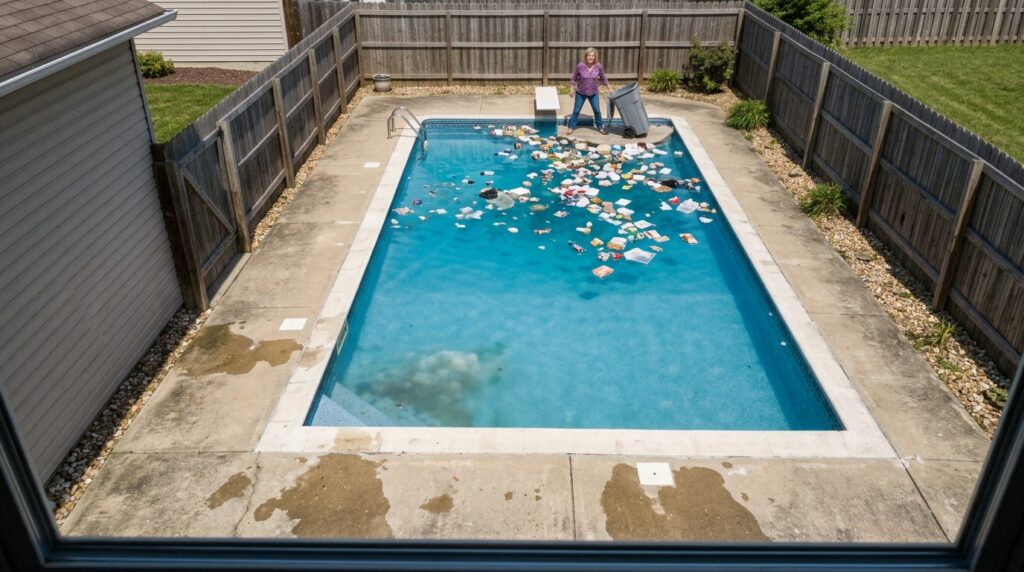
Officer Miller tapped the glass screen of my phone once, pausing the frame right where Evelyn’s hand hung open over the water. The silence that followed was heavy, broken only by the continuous, strained gurgle of the choked pool intake.
“I think we’ve seen enough of the footage for right now,” Miller said, his tone dropping an octave into something cold and procedural. He looked across the broken latch toward Evelyn. “Step back into the driveway, ma’am. Do not touch the fence again.”
Evelyn’s chest rose and fell in short, shallow hitches. Her face had drained of its ruddy color, leaving her skin pale against the stiff blonde bob. But instead of retreating, her fingers tightened around the blue plastic folder she carried.
“He’s omitting the context,” she whispered, her voice rasping as if her throat were filled with sand. She thrust the folder forward, offering it to Inspector Vance this time. “Read the covenant. Read the 1978 variance! The previous owner gave us the right to clear this walkway whenever the culvert choked!”
Vance didn’t reach for the folder. Instead, I pulled the folded yellowed sheet out of my back pocket—the one I had retrieved from the broken gate post—and extended it toward the inspector.
“She left this pinned in the gate before she tipped the bin,” I said. “Take a look at the second line.”
Vance pulled a pair of thin reading glasses from his shirt pocket, unfolding them with one hand as he took the page. He squinted at the soft, faded blue ink of the top paragraph, then his thumb moved down to the dark, fresh ballpoint line below it.
“This top part is an old agricultural runoff waiver from before the neighborhood was platted,” Vance said, his finger tracing the Sec. 14-B notation in the corner. “It applied to the open ditch that used to run two hundred feet east of here. It expired when the county installed the storm mains in eighty-two.” He looked up, his eyes locking onto Evelyn’s trembling hands. “And this bottom line about waste clearing… that ink isn’t a week old. The paper is indented so hard it almost tore through.”
A sharp, collective gasp came from the sidewalk behind us. Two neighbors—the retired couple from across the cul-de-sac—had stopped on the pavement, their hands raised to shield their eyes from the glare as they watched the inspector examine the document.
“She forged a drainage waiver?” Miller asked, looking from Vance to the paper.
“It’s not a forgery!” Evelyn shrilled, her voice cracking under the pressure as she took a frantic step forward. “It was an oral agreement! The old man told my father we could use this strip in perpetuity! He said as long as the fence stood, the path was shared!”
“An oral agreement from forty years ago doesn’t override a deeded parcel line, ma’am,” Miller said, pulling a pair of steel handcuffs from his utility belt with a metallic click that echoed off the patio concrete. “And it certainly doesn’t give you the right to destroy five thousand dollars worth of private property.”
I felt a surge of cold, quiet relief—the crisp satisfaction of a trap snapping shut exactly as planned. The evidence was ironclad. The video showed the trespass and the vandalism; the document proved premeditation and fraudulent intent. Every legal gear was turning in my favor.
“Officer,” I said, stepping toward the pool edge, “I’ll need an incident report number for the commercial cleaning service and the pump repair.”
“You’ll get one,” Miller said, turning toward Evelyn. “Ma’am, turn around and place your hands behind your back.”
Evelyn backed away, her tan flats skidding on the dry gravel of her driveway. “No! You’re looking at the wrong side! You think he’s the victim here? Look at her foundation!” She pointed wildly toward her own house, her finger shaking toward the base of her concrete garage wall. “Look at the water! If he drains that pool, where do you think it goes? Look at the retaining wall!”
Vance frowned, his gaze shifting past Evelyn’s shoulder toward the low, moss-covered stone wall that separated her property from mine. He stepped past the broken gate, his heavy boots crunching over the gravel as he approached the boundary line.
I followed him, confident that her ranting was nothing more than the final, desperate thrashing of someone who knew she was caught. But as Vance reached the base of her retaining wall, he stopped.
The soil at the foot of her stone wall wasn’t dry like the surrounding turf. A dark, thick seepage was creeping outward from the mortar joints near the ground—not clear pool water, and not fresh rainwater. It was a stagnant, iron-stained trickle that smelled faintly of damp clay and sulfur, oozing from deep beneath her garage foundation and pooling along the edge of my property line.
Vance knelt down, touching the damp soil with his gloved tip. When he pulled his hand back, the glove was stained with a dark, reddish-brown sludge that had nothing to do with my pool or her trash cart.
He looked up at the stone wall, then at the slope of her driveway, his eyes narrowing as he realized something that the forged paper and the video footage had completely obscured.
“Officer,” Vance said slowly, his voice dropping into a register that made both Miller and me freeze. “Hold off on the transport for a minute.”
Miller paused, one cuff dangling open. “What is it, Vance?”
Vance stood up, wiping his gloved fingers against a rag from his pocket, his eyes fixed on the weeping mortar of Evelyn’s wall. “This isn’t a surface runoff dispute. And that trash cart wasn’t about a blocked gate.” He turned to look at me, his expression grim. “We have a structural failure under her slab. And if this ground gets disturbed by a full property line survey… both of these yards are in deep trouble.”








