
CHAPTER 2: FADED INK AND CEDAR SPLINTERS
The latch on the wooden side gate was sheared completely through, the graying cedar splintered where the metal had finally given way under the weight of the trash cart. A thin trail of sun-warmed rust dust coated the latch plate, mixed with a faint smudge of purple dye from Evelyn’s sleeve.
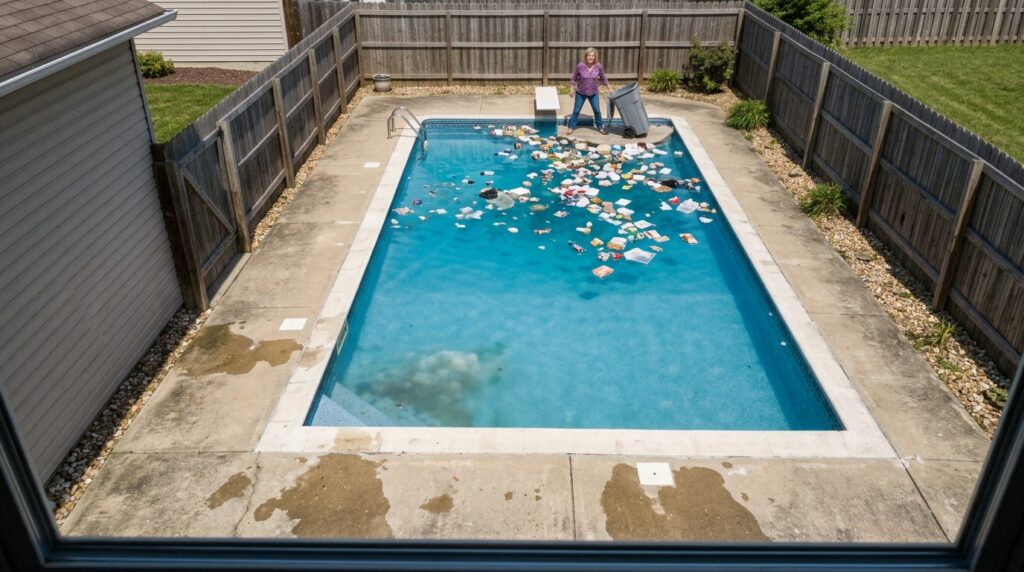
I didn’t step onto the patio right away. I pulled open the screen door slowly, letting my boots rest on the bottom step of the porch while my eyes tracked the edges of the yard. The midday heat hung heavy over the grass, carrying the sharp, chemical stench of spoiled milk and rotting vegetable rind from the water. The pool sat still now, the initial swell of the impact having died down into a greasy, rainbow-tinted scum that clung to the white grout line.
I reached out and slipped the folded slip of paper from between the split cedar grain.
The paper was stiff, yellowed at the margins from exposure to sunlight, as if it had sat in a glove box or the bottom of an outdoor utility drawer for years before being brought into the light today. But when I unfolded it, the crease didn’t tear. The fiber was thick—heavy linen cardstock from an older era—and the ink across the middle was a pale, faded blue, soft around the edges where the moisture of the air had bled into the page over time.
Perpetual easement granted for runoff and utility maintenance along east fence line, the first line read, written in a loose, sweeping cursive that slanted heavily to the right. Agreed by verbal covenant upon boundary installation.
Below it, written in fresh, sharp ballpoint black ink that indented the paper so hard it nearly cut through to the back, was a single additions line: This access includes weekly waste clearing and gate clearance.
I stared at the two handwritings. The faded blue script belonged to someone who had signed documents forty years ago—perhaps the original owner who had built the cottage before the modern subdivision was platted. But the black ink below it was rigid, cramped, and breathless. It was Evelyn’s hand. She had taken a real piece of history—a faded relic from an era before surveys and county deeds—and tried to graft her own entitlement onto its bones.
A faint rustle came from the far side of the fence. A pair of tan flats shifted against the dry gravel of Evelyn’s driveway.
“You can look at that paper all afternoon!” her voice came through the cedar slats, stripped of its earlier theatrical screech, leaving only a dry, raspy tremor. “Doesn’t change what your house did to the natural flow! That line has been open since seventy-eight! You don’t get to build a concrete box in the ground and pretend the water has nowhere else to go!”
I didn’t answer her. I folded the yellowed sheet back along its original creases, keeping my fingers on the dry edges to avoid smudging the fresh black ink she had added.
“I know what you’re doing up there with your little camera!” she barked, her voice closer now, her face likely pressed near the narrow gap where the gate hinge had pulled free from the post. “You think a lens makes you right? You think some town hall clerk who hasn’t stepped foot on this street in twenty years knows where the water goes when the storm drains back up?”
I turned the paper over in my hand. In the bottom corner of the original faded script, barely visible beneath a thumb-sized stain of old oil, were three numbers: Sec. 14-B. It wasn’t an agreement between neighbors at all. It looked like an old county code reference number—a citation from an era when this entire slope was open pasture, before the retaining walls were poured.
“The police are already on their way, Evelyn,” I said quietly, my voice barely carrying over the slow drip of the fouled pool skimmer.
“Let them come!” she snapped, though her heels clicked once, hard, against the gravel as she stepped back from the fence line. “Let them look at the whole yard! Let them look at what you buried under that blue liner!”
She didn’t stay to hear more. Her back door slammed shut a second later, the heavy wooden frame rattling the glass panes in her kitchen.
I walked back up the porch steps, the worn paper held loosely in my left hand. In my right, the phone screen lit up again with an incoming text from the county non-emergency dispatcher confirming a unit was five minutes out. I looked down at the paper once more. If Evelyn had held onto this old slip of county script for decades, she hadn’t just brought it out today to justify a cart of trash. She had brought it out because she was terrified of what would happen when someone finally looked past the fence line and measured the ground for what it actually was.








