
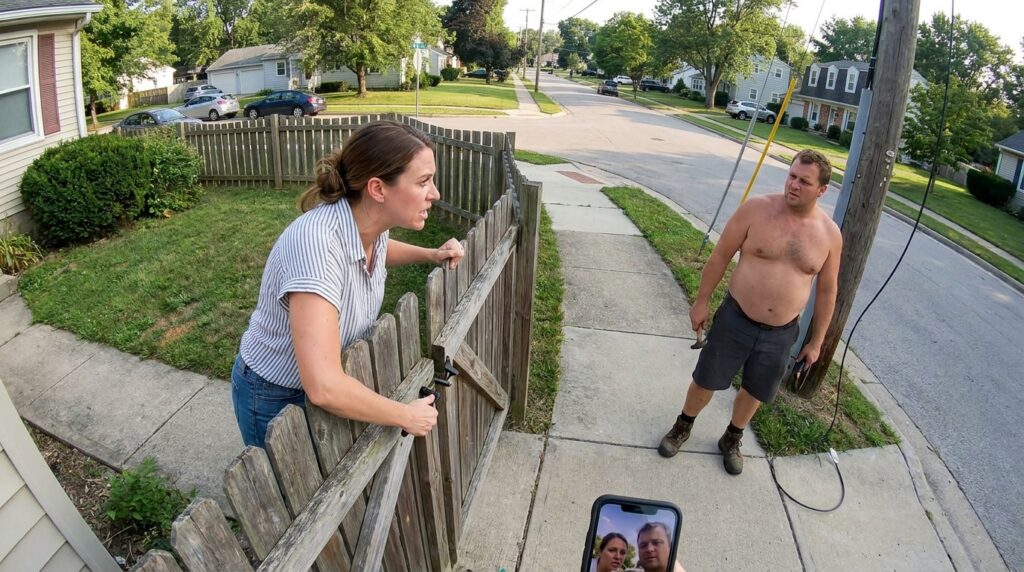
The Concrete Line Drawn in the Sun-Bleached Dust of an Unyielding American Suburb

CHAPTER 1: THE ORANGE INK ON THE POST

The heat came off the asphalt in visible, oily waves, distorting the neat lines of the opposite lawns until the colonial-style facades looked waterlogged. Sarah didn’t look at the houses across the street. Her focus was entirely on the mailbox post at the edge of her gravel driveway, where the wood had split along the grain from three seasons of unshaded July sun.

Brenda was already there. She didn’t look up when Sarah’s boots crunched against the dry transition where the yard met the public right-of-way. The older woman’s broad silhouette was framed against the desaturated gray of the neighbor’s retaining wall, her bright floral blouse a loud, artificial smear against the dusty weeds thriving along the curb. She held a thick plastic clipboard tucked against her ribs like a shield, her thumb pressing down on a stack of yellow carbon-copy sheets that rustled in the dry, hot breeze.

“You’re outside the municipal buffer, Brenda,” Sarah said. Her voice didn’t carry the weight of anger; it carried the dry, flat cadence of someone who had spent three weeks reading county tax codes in a room that smelled of old binders and damp toner.

Brenda adjusted her oversized tortoise-shell sunglasses, the lenses reflecting two tiny, warped versions of Sarah standing in the sun. She didn’t drop her hand from the mailbox post. Between her manicured fingers, a bright orange square of heavy cardstock was already pinned to the cedar, the staple gun still gripped in her left hand like a small iron jaw.

“The association code is very clear about unapproved property markers, Sarah,” Brenda said, her tone dripping with the performed, administrative pity she used for residents who didn’t attend the monthly board meetings. She tapped the clipboard with the nose of her ballpoint pen. “Section four, paragraph two. Any infrastructure adjustments visible from the primary access road must be vetted by the architectural committee. You know this. I left the preliminary notice last Tuesday.”

Sarah looked down at the orange card. The ink was fresh, bleeding slightly into the porous wood of her post. It wasn’t an official citation. It was a typed, unnumbered warning with the neighborhood association’s logo photocopied crookedly at the header. Beneath it, someone had written IMMEDIATE COMPLIANCE REQUIRED in thick, black permanent marker.

“Last Tuesday was a courtesy letter from an address that doesn’t exist on the county register,” Sarah said. She reached out, her fingers catching the corner of the orange cardstock. The paper was stiff, hot from the sun. She didn’t rip it; she pulled it slowly, letting the staple groan as it tore through the fiber until the notice came away in her hand.

Brenda’s posture stiffened, her shoulders squaring under the floral fabric. The clipboard shifted, the metal clip catching the glare of the noon sun and throwing a sharp blade of light across Sarah’s jeans. “That is corporate property you are defacing, Sarah. Everything from the curb to the five-foot setback line falls under our jurisdiction for aesthetic maintenance. If you refuse to clear the line before the utility truck arrives, the board will authorize the removal at your expense.”

Sarah didn’t answer immediately. She folded the orange card into a small, tight square, her thumb pressing the crease until her skin turned white. She felt the heavy weight of the old iron key ring in her pocket, the edges of the obsolete keys biting into her thigh through the denim. She looked past Brenda’s shoulder toward the concrete curb, noticing a small, dark grease stain where a surveyor’s vehicle had parked earlier that morning—a tiny discrepancy in the dust that Brenda’s sunglasses had completely missed.


CHAPTER 2: THE RECONSTRUCTION OF GRIT

“We don’t pull those ledger boxes from the deep vault unless there’s a formal title dispute filed with the state, ma’am.”

The clerk’s breath smelled faintly of stale chicory coffee and the iron tang of paperclips. He didn’t look up from his screen, his yellowed index finger rhythmically tapping a scarred spacebar that squeaked with every stroke. Behind him, the rows of green industrial shelving stretched into the dim rear profile of the county administration basement, catching only the gray, subterranean light filtering through the high, dirt-caked window wells.

“The dispute is current,” Sarah said. She placed her palms flat against the Formica counter. The surface was cold, micro-textured with decades of ground-in dust that left a faint gray residue on her skin. “And the utility right-of-way easement for Sector Four was established in 1974, before the subdivision was incorporated. It’s public record under the Homestead Expansion Act.”

The clerk paused, his finger hovering. He turned his head slowly, his eyes narrowing behind thick, smudge-streaked lenses that magnified the crow’s feet at the corners of his eyes. “Nineteen seventy-four was the year of the flood, you know. Half those plats have water damage. The ink turned to soup before they moved them down here.”

“Then let’s look at the soup,” Sarah said, her voice dropping into that flat, unyielding register she used when dealing with fence repairs. She pulled the folded orange cardstock notice from her pocket and laid it next to her hands, the thick black permanent marker lines—IMMEDIATE COMPLIANCE REQUIRED—glaring under the fluorescent bulb. “Because someone is trying to rewrite the margins with a staple gun.”

The clerk looked at the orange square, then at Sarah’s dust-stained denim jeans, and finally at the heavy iron key ring resting near her belt loop. The keys didn’t jingle; they were bound tight with a strip of cracked black electrical tape to keep the weight from shifting. With a low, rattling sigh that sounded like gravel sliding down a chute, he pushed himself back from the desk. His chair castors complained against the grit on the linoleum as he disappeared into the narrow aisle between rows twelve and thirteen.

Sarah waited, her fingers tracing the smooth, cold edge of the Formica. The air down here was thick with the scent of decomposing cellulose and oxidized staples—a sharp, vinegar-like sting that made the back of her throat itch. This was the foundation beneath the manicured lawns above. Up there, Brenda spent her mornings measuring grass blades with a plastic ruler; down here, the real world was recorded in heavy, iron-bound ledger books that nobody had opened since the Carter administration.

When the clerk returned ten minutes later, he wasn’t carrying a book. He was holding a gray archival box with reinforced brass corners, the cardboard lid bowed upward by the volume of unorganized paper inside. He dropped it onto the counter with a heavy, hollow thud that sent a small cloud of ancient paper dust swirling into the light.

“Box forty-two,” the clerk muttered, sliding a pair of cotton gloves across the counter toward her. “Don’t tear the edges. Most of these sheets are onion-skin.”

Sarah pulled the gloves on, the rough white fabric instantly deadening the sensitivity of her fingers. She lifted the lid. The interior of the box smelled distinct—not just old paper, but the unmistakable metallic reek of dried well water and iron deposits. She began sorting through the folders, her movements methodical, calculating risks with every flip of her wrist. There were tax assessments from deceased farmers, faded blue-line prints of drainage ditches that had long since been paved over, and handwritten logs of fence line disputes from when the county was mostly rock and timber.

Halfway through the third stack, her hand stopped.

It was a large, tri-folded sheet of heavy vellum, significantly thicker than the surrounding documents. The edges were frayed, turning a dark tobacco brown where the air had crept into the box over forty years. Sarah unfolded it carefully, the stiff material resisting her hands with a dry, sand-like rasp.

It was the original developer’s plat map for the development, dated six months before the first foundation was poured. But it wasn’t the clean, standardized layout filed in the HOA’s promotional binders. This map was covered in red grease-pencil corrections, whole blocks of land slashed through with aggressive, jagged lines.

Sarah leaned closer, her eyes scanning the tiny, hand-inked notations along the margins. The main utility corridor—the exact line where the cedar pole stood outside her front gate—was bordered by a series of dashed lines that didn’t align with the current property deeds. On the back of the vellum, almost invisible against the dark discoloration of the paper, was a faded blue-ink stamp from the State Bureau of Land Management.

The stamp was marked REJECTED – UNLAWFUL TAX SETBACK DEVIATION.

Beneath the stamp, a handwritten note in faded iron-gall ink read: Developer failed to establish common areas; easement remains under primary public deed until corporate remediation is finalized.

Sarah felt a cold stillness settle behind her ribs. The corporate remediation had never happened; the developer had gone bankrupt three months after filing the vellum. The HOA wasn’t just overreaching—their entire aesthetic charter was built on top of a legal void, an unratified map that gave them zero authority over the ground beneath the utility poles. She reached into her pocket, pulled out her phone, and lined up the camera lens over the blue stamp, ensuring the sharp angle of the overhead fluorescent light captured every cracked line of the ink.

“Find what you were looking for?” the clerk asked, his voice echoing flatly off the concrete wall.

Sarah didn’t look up as she clicked the shutter. “I found something better,” she said, her thumb already locking the image into an encrypted folder. “I found out who actually owns the dirt.”

She folded the vellum back into its original creases, the dry paper whispering against her gloved fingers like old silk, and slid it back into the box. As she walked out of the basement into the blinding glare of the afternoon parking lot, the heat hit her like a physical blow, the smell of hot tires and dry topsoil reminding her that the utility truck was scheduled to arrive in less than three hours.

CHAPTER 3: THE MIDDAY STANDOFF

The heat radiating off the gravel shoulder tasted like sulfur and old transmission fluid. By the time Sarah rounded the corner of her property line, the heavy, air-braked hiss of a utility box truck had already died, leaving only the uneven, industrial rattle of a diesel engine idling in the blistering July glare. The contractor had already dropped his safety cones—cracked, sun-faded orange plastic pyramids that cast short, sharp shadows on the baking asphalt.

Brenda had already occupied the pivot point. She stood exactly where the public sidewalk met Sarah’s gravel driveway transition, her broad silhouette planted with low-centered permanence. Her bright patterned floral blouse looked like a neon warning sign against the desaturated gray of the utility pole behind her. She held her rigid plastic clipboard high against her chest, using the edge of it to gesture sharply at a young, stocky worker who had just hoisted a heavy spool of black telecommunication cable onto his shoulder.

The utility worker was already slick with sweat, his bare torso glistening with an oily sheen of dust and engine grease under the harsh noon sun. He wore only dark, canvas work shorts and a heavy leather tool belt that sagged under the weight of rusted lineman’s pliers and iron wire-twisters. He stood completely frozen beside the weathered cedar pole, his hand hovering inches from the low-hanging tension wire, caught completely in the administrative crossfire.

“This line installation is a non-sanctioned easement modification under the current district declaration,” Brenda announced, her voice rising above the low vibration of the diesel engine. She didn’t drop her arm. Her pen tapped the top sheet of her clipboard with a rhythmic, mechanical click that sounded like an approaching grasshopper. “I have the setback log right here. If you pierce the ground with those stabilization stakes before the board reviews the aesthetic variance, I will file an immediate civil injunction for corporate property disruption.”

The technician wiped his forehead with the back of a calloused, grime-streaked forearm, leaving a dark smudge of grease across his brow. He looked at the clipboard, then at the heavy iron anchors protruding from the base of the cedar pole. His boots shifted on the hot gravel, the dry stones crunching with a hollow, brittle sound. He was a laborer paid by the linear foot, not a corporate lawyer, and the sheer weight of Brenda’s unyielding, paperwork-backed certainty had clearly stalled his momentum.

“Look, lady,” the worker muttered, his voice gravelly from the heat and the dust of the road. “My work order says the junction box on this pole feeds the three houses down the cul-de-sac. It’s marked as a primary municipal utility easement. I don’t deal with neighborhood committees.”

“The committee regulates the physical access strip,” Brenda countered instantly, her chin lifting as her tortoise-shell sunglasses caught the full glare of the sun, obscuring her eyes behind two blank, reflective discs. “The county might own the circuit, but the association regulates the structural appearance of the surface. You do not have an approved landscape clearance certificate.”

Sarah watched the interaction from three paces back, her boots planted on the dry topsoil of her own lawn. She felt the heavy, taped-together iron key ring pressing against her hip—a hard, solid reminder of the boundaries she had sworn to keep. Her hand was tucked inside her pocket, her thumb resting on the cold screen of her phone, where the digital image of the 1974 vellum map lay locked in the dark.

As she stood there, she noticed something Brenda’s manicured authority had completely ignored. A faint, low-frequency tremor was passing through the soles of her boots—not the rhythmic vibration of the idling utility truck, but a strange, hollow fluid dynamic clicking deep beneath the concrete curb where the public drainage main met the edge of Brenda’s property across the street. The ground here felt unstable, worn thin by forces nobody was looking at.

Brenda stepped six inches closer to the pole, effectively cutting off the technician’s line of sight to the lower wire harness. She held the clipboard forward like a legal barrier. “If you drop that cable line across this fence section without an authorized supervisor present, I am calling the county code enforcement line to report an illegal contractor encroachment. They will impound your truck before you finish the splice.”

The utility worker’s hand dropped away from the cable line entirely. His stocky shoulders slouched under the sudden weight of institutional intimidation. He looked back toward the open cab of his truck, his eyes scanning the empty street as if searching for an escape route from a dispute he had never asked to join. He was on the verge of pulling his cones and driving away, leaving Sarah’s house completely cut off from the primary network loop before the infrastructure could even touch the ground.

Sarah’s fingers tightened around the iron gate latch just behind her, her thumb pressing the silver metal until the rusty spring groaned against the wood. The time for researching in the dark basement was over; the friction had reached the edge of the dirt.

CHAPTER 4: THE THRESHOLD SHIFT

“You don’t get to decide that for me.”

The latch didn’t slip; it gave way with a dry, mechanical snap under Sarah’s thumb, the rusted iron bar pivoting out of its cedar slot with the dull scrape of old oxidized metal. The heavy picket gate swung outward three inches before the weathered pine bottom dragged against the parched gravel. Sarah didn’t step through the opening. She leaned her weight directly against the crossbeam, her shoulders squaring against the blistering midday heat that vibrated off the fence lines.

Brenda’s clipboard dropped two inches, exposing the aggressive set of her mouth below the tortoise-shell lenses. The yellow carbon copies rustled under the sudden intake of her breath, their edges crinkling like dry autumn leaves in the hot, stagnant draft from the asphalt. “Sarah, this is an active regulatory enforcement matter. The utility worker has already been notified of the setback violation. Step back inside your boundary.”

“My boundary is under my boots, Brenda,” Sarah said. Her voice stayed flat, matching the sun-bleached look of the road stones. She didn’t raise her phone yet, but her hand remained clamped around the plastic casing inside her denim pocket, the screen warm against her thigh. “And the man with the cable spool isn’t employed by the association. He doesn’t answer to a committee that doesn’t have a registered tax number at the courthouse.”

The stocky technician looked from Sarah’s gripped hand on the gate latch to the rigid clipboard in Brenda’s hands. Sweat ran in clean, pale tracks through the gray stone dust coating his bare shoulders. His leather tool belt shifted with a heavy, metallic clink as he adjusted his stance, his boots settling into the weeds beside the cedar pole. He looked less like a worker about to abandon a job now and more like an evaluator weighing the thickness of two different walls.

“Section four is very specific about common access easements,” Brenda said, her voice rising an octave, losing its tight, administrative cadence. She thrust the clipboard forward again, the plastic edge nearly touching the outer face of the wooden gate. “The county charter gives the board clear oversight regarding the installation of above-ground distribution boxes. If you interfere with the stop-work directive, I will have the neighborhood security officer document the trespass.”

“Call him,” Sarah said. She didn’t blink against the solar glare. Her gaze remained fixed on the warped reflection of her own gate in Brenda’s sunglasses. “Tell him to bring the county land registry map from nineteen seventy-four while he’s at it. The one where the developer failed to sign over the common parcel deeds before the bankruptcy filing. He can look at the bureau stamp right next to my mailbox.”

Brenda’s posture went entirely rigid. The tip of her ballpoint pen jerked, tearing a short, jagged line through the top sheet of her violation log. For a fraction of a second, her eyes shifted past Sarah’s shoulder toward the porch steps, where the heavy manila folder from the county archives lay weighted down by a red clay brick. She didn’t ask what was inside it; the mere mention of the year had caused the skin around her jaw to tighten into pale, unyielding knots.

The technician caught the change in momentum. He didn’t wait for Brenda to counter. He stepped around her broad silhouette, his heavy work boots grinding a sun-faded orange safety cone into the gravel as he reached up to catch the loose end of the telecommunication cable. The thick black jacket of the wire groaned against the iron bracket of the pole as he pulled it taut, completely ignoring the clipboard still held between his chest and the cedar structure.

“I don’t have time to wait for a security officer who isn’t on the municipal clock,” the worker said, his tone dry and dismissive. He reached for his rusted wire-twisters, his movements efficient and practiced. “The lady says the dirt isn’t yours. My order says the pole belongs to the county. That’s enough for the splice.”

Brenda turned on her heel, her floral blouse snapping against the humid air as she faced the street. “This isn’t resolved,” she said, her finger pointing sharply at the utility box truck. “The board will issue a formal property lien for every hour that line remains unvetted by the architectural committee. You will pay for the removal, Sarah. Down to the last anchor bolt.”

Sarah didn’t look back as she turned her shoulder away from the sidewalk, her weight shifting inward toward the dry grass of her yard. The heat was still rising, but the space behind her gate felt clear, the hard line of the vellum map finally setting the scale of the cul-de-sac.

“I’m the one dealing with it, you need to get that,” Sarah said, her voice dropping into the quiet space between the fence posts as she let the gate drag shut behind her.

Behind her on the asphalt, a strange, low gurgle sounded from the storm drain directly beneath Brenda’s curb line—a heavy, subterranean pocket of air shifting through wet gravel that made the concrete seam vibrate ever so slightly under the midday sun. Sarah paused, her boot hovering over the dry lawn, realizing the ground wasn’t just old; it was hollow.

CHAPTER 5: THE ACKNOWLEDGEMENT OF THE dirt

“Alright, I hear you.”

The worker’s voice carried lightly across the sun-bleached yard, flat and raspy with the dry grit of the afternoon heatwave. He didn’t look at Brenda. His calloused hand, stained black from old hardware grime, lowered from the cable harness, dropping the heavy lineman’s pliers back into their worn leather loop with a solid, metallic thud. His stocky silhouette shifted, turning his bare, sweat-slicked back completely on the clipboard-wielding neighbor as he focused entirely on Sarah’s position inside the gate line.

Brenda stood perfectly still on the public concrete strip, her broad shoulders pinned rigidly against the desaturated grey of the retaining wall. Her sunglasses caught the direct, blinding glare of the three-o’clock sun, turning her eyes into two identical, white-hot mirrors that masked whatever shock was tightening the corners of her eyelids. The pen in her hand remained pressed against the yellow carbon paper, but her fingers had gone pale from the force of her grip, the tip tearing a small, frayed hole through the artificial architecture of her log sheet.

“This is an unauthorized alignment,” Brenda said, though the words lacked their previous bureaucratic rhythm, sounding instead like dry gravel sliding down a plastic chute. She didn’t drop the clipboard. “The technician is acting outside his designated work permit. I am recording the company unit number right now.”

The worker didn’t bother to answer. He reached into his tool belt, pulled out a heavy steel tension clamp, and drove it directly into the side of the cedar utility pole. The iron bit into the dry, cracked wood with a sharp, echoing crack that reverberated down the block, a physical statement that effectively neutralized the unverified HOA setback rules. He began threading the black bundled line through the loop, his movements steady, measured, and entirely indifferent to the woman with the paperwork.

Sarah kept her hand on the cold silver gate latch, her thumb pressing the worn metal until she felt the vibration of every hammer blow against the pole. She looked past Brenda’s shoulder toward the street gutter. The low-frequency gurgle she had heard minutes before was no longer just an auditory anomaly; a tiny, hairline fissure had crept out from beneath the concrete curb exactly opposite her driveway, its jagged edge exposing a dry, hollow void where the topsoil had quietly migrated down into the municipal drainage main. The road itself was giving way under the weight of the suburb.

Across the asphalt, two separate porch doors clicked open. The sidewalk witness layer was shifting. Old man Miller stood on his top step, his arms crossed over a faded blue work shirt, his eyes locked on the clipboard in Brenda’s hands with the silent, analytical neutrality of a retired mechanic watching an engine fail. On the adjacent lawn, a younger woman paused with her phone lowered against her hip, the screen dark but the lens still pointed at the curb line, waiting to see if the performance of authority would hold or shatter entirely.

Brenda noticed the audience. Her head snapped toward Miller’s porch, the tortoise-shell lenses catching the gray reflection of his garage door before swinging back to Sarah. “This doesn’t invalidate the board’s structural easement claim, Sarah. Even if the utility company bypasses the setback today, the landscaping guidelines require the immediate removal of any non-standard markers. Those stakes will be pulled by code enforcement before the weekend.”

“The surveyor’s stakes are set in legal granite, Brenda,” Sarah said, her voice dropping into that flat, quiet cadence that carried further than a shout. She pointed her free hand toward the base of the picket fence, where the freshly driven wooden pegs with their bright neon-pink caps stood out like iron surveyor pins against the dead weeds. “And the code enforcement office doesn’t take orders from an unratified committee that hasn’t filed a corporate resolution since the township was redrawn. If you touch the stakes, it’s not a covenant issue. It’s criminal property destruction on recorded video.”

The technician pulled the cable taut, the thick black wire groaning against the iron clamp with a heavy, mechanical hum that signaled the system was officially live. He turned back toward the cab of his truck, wiping his oily brow with the side of his hand, completely closing the loop on the confrontation. The authority had flipped; the dirt had been claimed, and the paperwork Brenda held was nothing more than yellow ink on cardboard.

The heat remained thick, choking the air with the smell of scorched weeds and hot asphalt, but the line between the houses had been cast in concrete. Brenda’s clipboard slowly lowered to her side, the metal clip scraping against the floral fabric of her dress with a dull, dry rustle as she looked down at the physical crack expanding across the concrete at her feet.

CHAPTER 6: THE GRIT OF THE RETREAT

“This strip isn’t yours to mark.”

Brenda’s final defense came out dry, a rasp of stale hot air that died instantly against the industrial rattle of the utility truck’s hydraulic lift. She didn’t raise the clipboard again. The rigid plastic rectangle hung loosely against her thigh, the yellow carbon sheets fluttering wildly in the sudden, hot draft coming up from the expanding fissure along the concrete curb.

Sarah didn’t step past the weathered cedar gate post. Her fingers remained wrapped tightly around the cold, oxidized silver iron latch, her weight braced hard against the dry wood crossbeam. She watched the tortoise-shell sunglasses shift, tracking a sharp, crystalline splintering sound that didn’t come from the utility pole, but from the center of the asphalt street between them.

The technician threw the final switch on his box unit. The heavy iron door clicked shut with a sharp, metallic ring that echoed flatly down the line of sun-bleached houses. He didn’t check his work order, didn’t request a signature from the neighborhood association coordinator, and didn’t acknowledge the folder of unverified aesthetic guidelines still dangling from Brenda’s hand. He simply hoisted his heavy tool belt, the rusted lineman’s pliers clinking in their leather sheath, and stepped onto the metal running board of his cab, leaving the physical wire humming with new infrastructure current.

Brenda took one step backward, her heavy work shoes grinding into the loose topsoil at the edge of the cul-de-sac. The bright floral pattern of her blouse looked thin and artificial under the direct solar glare, no longer projecting the weight of community policy. As her heel struck the concrete strip opposite Sarah’s driveway, a hollow, shifting thud rumbled from the storm drain main beneath her feet.

The hairline crack in the pavement didn’t stop at the curb. It widened, a dark, jagged mouth opening two inches across the desaturated gray asphalt, tracking straight toward the foundation line of Brenda’s own property across the street. The subtext of her months of frantic gatekeeping suddenly laid itself bare in the dust. The frantic obsession with property lines, the constant monitoring of utility access, the aggressive warnings pinned to mailboxes—it hadn’t been an architectural committee rule. It had been a desperate shield to keep municipal surveyors and heavy county excavation equipment away from the street line before the shifting drainage main completely undermined the weight of her own slab.

Across the block, old man Miller lowered his arms from his faded shirt, his boots stepping off the porch onto the dry turf. The younger woman with the phone didn’t stop recording; she stepped closer, her lens shifting from the live cable pole down to the physical void opening beneath the neighborhood’s master plan. The public witness layer had stopped reading from the association manual; they were looking at the structural truth of the ground.

“The county surveyors will be out here by Monday morning, Brenda,” Sarah said, her voice dropping into that flat, unyielding register that matched the iron pins driven deep into her yard. She didn’t reach for her phone. She simply pointed her thumb toward the brick-weighted folder sitting on her porch steps. “They’re not checking the height of my fence. They’re checking the hollow space under your garage floor.”

Brenda’s jaw tightened until the skin around her lips went dead white. She didn’t drop her sunglasses, but her head tilted downward, her blank, mirrored lenses staring at the black space widening inside the curb line. The clipboard slipped another inch, the metal clip catching a dry weed as she turned her broad silhouette back toward the shadow of her own house. Her retreat was slow, heavy, and entirely silent, her performative authority completely drained before she even reached her own boundary line.

Sarah let go of the silver iron latch. The picket gate didn’t swing; it settled firmly into the gravel, its weathered wood holding the exact margin it had been built to defend. The heat was still rising off the cul-de-sac, thick with the smell of parched earth and iron filings, but the line had been drawn, the void was open to the daylight, and the dirt was finally quiet.

Similar Posts

Leave a Reply

Your email address will not be published. Required fields are marked *






