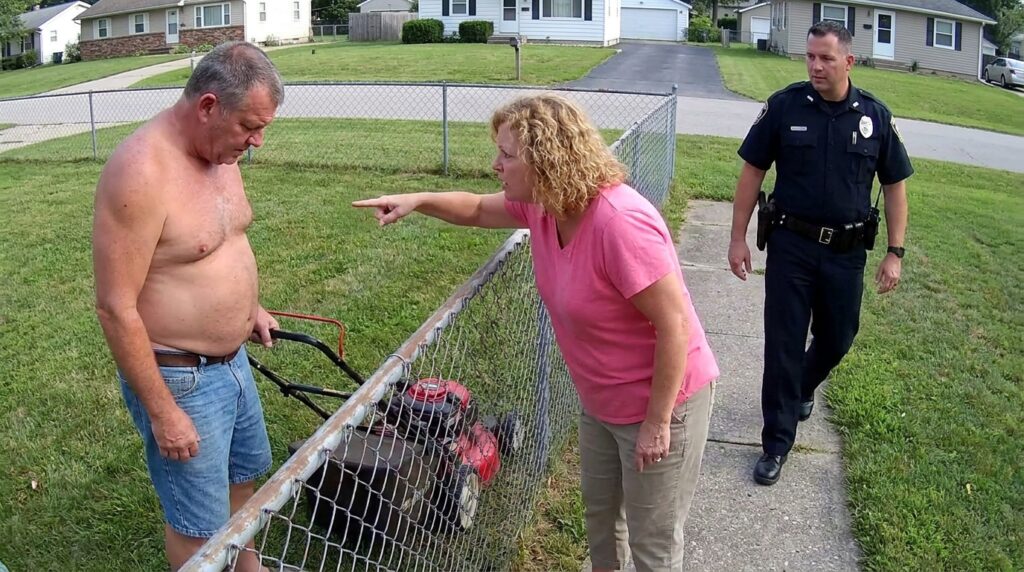
The Iron Tolerances of a Sun-Baked Frontier Where the Fences Never Blink
CHAPTER 1: THE ACCUMULATION OF SURFACE RUST
The yellow paper didn’t tear; it pulled right through the head of the rusted roofing nail Brenda had driven into the bark of his pin oak. Arthur Vance didn’t look across the driveway toward her porch. He didn’t have to. The sun was at three o’clock, baking the grease on his fingers into a dark, protective lacquer as he rolled a pair of worn steel calipers between his palm and thumb. In his line of work, tolerances were everything—half a thousandth of an inch meant a hydraulic seal held or it sprayed fluid until the pump ran dry.
He folded the notice. The graphite pencil text was written with a heavy, tremor-heavy hand: Property value degradation via unmanaged arboreal encroachment. Code 41-B enforcement pending.
He stepped inside the dark garage, where the smell of oil stone and old iron hung thick in the rafters. The heat here was dry, rattling the aluminum skin of his storage sheds with every passing semi-truck on the state route half a mile out. Arthur sat on his stool, his stocky frame sinking into the cracked vinyl seat. He picked up a piece of structural survey map from 1982, its corners eaten by silverfish, its fold lines grey with dust.
Outside, the dry rhythmic scrape of a plastic rake against parched grass began. Brenda was working her perimeter. She moved with a stiff, forward-pitched weight, her pink shirt a loud, unnatural scar against the pale, unwatered lawns of the block. Through the low window of the garage door, Arthur watched her index finger rise, pointing at a single dead branch hanging over the chain-link mesh.
He didn’t move. He reached into his pocket, his calloused thumb finding the small, coarse sharpening stone he’d carried since his first year at the plant. He ground his nail against the edge until the bone-white dust settled into the grease on his knuckles. The street was too quiet. It was the kind of midwestern silence where every screen door slam sounded like a starter pistol, and every neighbor watched through the slant of a vinyl blind. They were all waiting for him to break, to yell back, to match her volume. But Arthur knew how metal behaved under pressure. If you heated it too fast, it cracked. If you let it sit in the damp, it grew its own orange hide. You just had to know which part of the iron was still solid.
He checked his watch. The high-angle lens on his porch was already humming, recording the gray-scale pavement and the long, thin shadow of the fence. He reached down, gripped the pull-cord of the old Briggs & Stratton engine on his mower, and gave it one steady, calculated pull. The exhaust coughed a black plume of unburned fuel into the heavy afternoon air, and through the vibration in the rubber handle, Arthur felt the line lock into place.
But as the engine settled into its flat, mechanical roar, he noticed something at the base of the oak—a small, fresh patch of orange utility paint where no gas line had ever been marked.

CHAPTER 2: THE ANGLE OF REPOSE
The heavy iron deck of the push mower rattled against Arthur’s shins, vibrating through the thin soles of his work boots as he guided the machine along the tire-tracked edge of the curb. The air was thick with the scent of pulverized crabgrass and the bitter, metallic tang of hot engine oil. He kept his eyes down, watching the left wheel tracking exactly three inches inside the rusted silver chain-link mesh. Then, the dry screech of a locking brake assembly tore through the mechanical hum.
Brenda’s faded gray sedan didn’t just park; it drifted onto the gravel shoulder, its front bumper coming to rest three inches from the steel wheels of Arthur’s mower. The driver’s door swung wide, the rusted hinges groaning under the sudden weight as Brenda stepped out onto the asphalt. Her khaki pants were stiff, coated in a fine layer of dry lime dust from her garden beds, and her oversized designer sunglasses caught the glare of the midday sun like two black mirrors. Behind her, the white chassis of an official county survey truck slowed to a crawl at the edge of the cul-de-sac, its amber light bar rotating silently in the heat haze.
“Turn it off, Arthur,” Brenda said. Her voice didn’t carry the high pitch of fear; it had the flat, practiced drone of a county bureaucrat enforcing a lien. She didn’t drop her hand to her side. She kept her arm locked, pointing a manicured finger toward the yellowed grass beneath her bumper. “You don’t move that deck another foot down this curb. This shoulder isn’t public access, and that truck doesn’t have an easement to back into my drive.”
Arthur pulled the throttle lever back until the Briggs & Stratton sputtered and died, the sudden silence of the street settling over them like heavy dust. He didn’t let go of the rubber grip. His knuckles, grayed with graphite grease from the garage workbench, remained locked.
“The county sent a notice three weeks back, Brenda,” Arthur said, his voice low, matching the steady cadence of the idling survey truck fifty feet away. “They’re checking the culvert drainage. The markers go on the line.”
“The markers are fraudulent,” she snapped, stepping closer until her shoulder pitched forward against the corner of the chain-link posts. She reached into her pocket, pulling out a laminated folder bound with a black heavy-duty rubber band. She didn’t open it. She held it against her chest like an armor plate. “The original 1982 subdivision plat doesn’t account for the retaining wall shift. If that truck sets its outriggers on this gravel, it’s a civil trespass. I’ve already logged the plates with code enforcement.”
From the cab of the county truck, a young technician in an orange high-visibility vest leaned out the window, his clipboard resting against the side mirror. He looked at Arthur, then at Brenda’s sedan blocking the narrow right-of-way, his engine idling with a wet, heavy diesel chug. The driver wasn’t putting the vehicle in park; he was keeping his foot on the brake, the red tail-lights glowing through the exhaust smoke.
Arthur took a slow step forward, his boot heel grinding into a patch of spalling concrete where the curb met the fence anchor. His thumb rubbed the small sharpening stone in his pocket, calculating the distance. Brenda wasn’t looking at the surveyor. Her eyes were fixed on the base of Arthur’s fence line, her jaw locked into a tight, defensive grin. She was standing exactly over the fresh orange utility paint he’d noticed minutes before—but her left boot was intentionally covering something else.
He looked down. A small, notched steel masonry spike was driven flush into the asphalt right where the concrete curb had cracked away from the dirt. It wasn’t a standard county marker. It was old, the head of the spike pitted with deep, orange scale rust, and it sat precisely eight inches inside Arthur’s side of the chain-link line.
“You should move the car, Brenda,” Arthur said, his eyes narrowing as he traced the line of the spike toward the foundation of her detached garage twenty feet back.
“I’m not moving a single tire,” she said, her voice dropping into a sharp, transactional whisper that didn’t reach the surveyor’s truck. She stepped down harder, her heel grinding over the rusted spike, hiding it from view. “And if that boy in the vest tries to drop a pin in this dirt, he’ll be talking to the municipal attorney before his shift ends. Go back to your garage, Arthur. You’re out of your depth on this one.”
Arthur didn’t answer. He watched the county truck begin to back up, its reverse beeper starting its monotonous, high-pitched chime as the driver gave up on the blocked shoulder. But as Arthur looked up at Brenda’s garage, he noticed the bottom row of concrete blocks didn’t align with the newer gravel path she had laid down. The wall bulged outward, its mortar joints gray and crumbling, leaning toward his property like a slow-moving wedge of stone.
CHAPTER 3: THE PERIMETER GLOW
The blue light from the monitor didn’t warm the garage; it just pulled the gray out of the concrete floor panels. Arthur sat with his forearms flat on the oil-stained plywood of his workbench, his eyes tracking a single cluster of pixelated shadows on the upper left quadrant of the terminal screen. The localized camera feed from his front porch was fixed at an eleven-foot elevation, casting its digital eye down across the sharp, diagonal slant of the silver chain-link fence. It was twelve minutes past two in the morning. Outside, the steady drone of cicadas was occasionally cut by the dry hiss of wind through the dry oak leaves, but inside the monitor’s frame, the world was reduced to sixteen shades of charcoal and a persistent, high-frequency raster hum.
He zoomed in on the property line. The fence mesh looked like a gray spiderweb under the infrared illumination, its galvanized steel posts casting thin, dark lances across the unwatered patch of grass that Brenda claimed as her absolute territory. For twenty minutes, nothing had moved but a stray plastic bag caught on a low wire. Then, a vertical slip of light appeared on Brenda’s side of the yard.
The heavy solid-core side door of her garage swung open exactly six inches.
Arthur leaned forward, his calloused thumb mechanically rubbing the edge of the pocket sharpening stone he’d placed beside his keyboard. He didn’t blink. Through the narrow gap in the doorway, a shape materialized. It was Brenda, but she wasn’t wearing the loud, authoritative pink polyester shirt from the afternoon standoff. She was wrapped in a heavy, oversized canvas coat that obscured her outline, her curly blonde hair pinned tight under a dark knit cap. In her right hand, she wasn’t carrying her smartphone or a laminated county zoning folder. She was dragging a long, heavy iron pry-bar, its chisel tip making a dull, metallic scrape against her gravel path.
She stepped onto the grass, moving with a deliberate, rhythmic hesitation that reminded Arthur of a machinist checking a lathe alignment before dropping the cutter head. She didn’t look up toward his house. She knew where his old floodlights were aimed, but she didn’t seem to realize he had moved the wide-angle doorbell fixture three feet higher on the cedar pillar the previous Tuesday.
Brenda knelt at the base of the chain-link anchor post—the exact spot where the notched steel masonry spike remained driven into the cracked concrete curb.
Arthur watched her set the tip of the iron bar against the dirt. Through the pixelated gray rendering of the camera feed, he saw her lean her full weight onto the lever. The ground didn’t give way easily; the parched Midwestern clay was packed hard as firebrick, but she wasn’t digging. She was probing. She struck the buried concrete footing of the fence post once, twice, a faint, rhythmic thunk vibrating through the structural frame of Arthur’s workshop walls before the sound even reached his ears through the digital audio line.
“What are you measuring, Brenda?” Arthur muttered to the empty room, his hand tightening on the plastic casing of his monitor.
On screen, Brenda paused, her head tilting toward the dark silhouette of his house. She stayed frozen for nearly thirty seconds, her posture rigid, a living extension of the iron tool she gripped. When she satisfied herself that the dark windows remained blind, she reached into her coat pocket and pulled out a small, metallic cylinder. Under the infrared glare, the object didn’t shine; it absorbed the light, casting a distinct, flat reflection that Arthur recognized instantly from his thirty years at the assembly plant.
It was an antique brass surveyor’s plumb bob, its steel tip notched with three parallel grooves.
She dropped the weighted cord directly over the old masonry spike. But she wasn’t checking the fence line’s vertical true. She was using the line to mark a distance back toward her own garage wall. She pulled a yellow fiber tape measure from her waistband, stretched it across the eight-inch gap between the iron spike and the bottom row of her crumbling foundation blocks, and held it there.
Arthur tapped his fingers against the workbench, his mind running the calculations. An eight-inch gap. If her foundation sat exactly eight inches behind that rusty marker, then her entire roof drainage system, her concrete footings, and the heavy structural timber of her side wall didn’t just align with the boundary—they crossed it beneath the dirt. Her garage was sitting on his easement, supported by a hidden wedge of unreinforced masonry that had been sliding toward his lawn since the county last graded the drainage culvert in 1982.
Suddenly, the screen flickered. A violent horizontal distortion line tore through the gray pixels of the camera feed, the time stamp at the bottom corner leaping forward by three seconds. The infrared light bar on the porch unit died for a microsecond, then snapped back into alignment.
When the image cleared, Brenda was gone. The side door of her garage was shut tight, the iron bar was missing from the gravel path, and the chain-link fence sat empty under the pale moonlight. But at the bottom edge of the frame, right where the notched steel spike was embedded, the orange utility paint had been cleanly scraped away, replaced by a fresh, deep white gouge that ran straight through the concrete like a fresh surveyor’s line.
Arthur didn’t pull his eyes away from the glass. He reached down and rewound the digital archive to the exact moment of the distortion. When he froze the frame at two-fourteen, he saw that the static hadn’t been caused by a loose connection or a drop in line voltage. A dark, secondary shadow had crossed the edge of the lens from the opposite side of the street—a tall, unmoving silhouette standing right beside the neighborhood’s main electrical transformer box, holding an electronic device that glowed with a faint green interface.
CHAPTER 4: THE MIDDAY CROSSING
The starter rope ripped backward against Arthur’s palm with a wet, heavy crack, the vibration transferring straight down the steel tubing of the handle into the small of his back. The Briggs & Stratton engine didn’t just catch; it detonated into a flat, deafening roar that swallowed the dry rattle of the cicadas whole. The sun was dead center in the pale Midwestern sky, baking the gray dirt along the chain-link boundary until the heat rose in visible, oily waves from the galvanized mesh. Arthur gripped the black rubber sleeves of the handle, his shirtless chest coated in a fine, gritty layer of pulverized limestone and dried sweat. He pushed the deck forward.
He didn’t get five feet before the pink shirt cut through the glare.
Brenda didn’t walk down her porch steps; she plunged down them, her khaki trousers stiff with dried mud at the cuffs, her leather sandals slapping against the cracked concrete of her walkway with the rhythmic velocity of a machine tool. Her oversized designer sunglasses reflected two distorted, miniature versions of Arthur’s house as she slammed her body flat against her side of the chain-link fence. Her right arm came through the mesh, her index finger extended like a rusted spike, pointing directly at the front left wheel of the push mower.
“Shut it down! Shut it down right now, Arthur!” Her voice tore through the mechanical roar, dry and jagged, stripped of its usual bureaucratic pretense. She was leaning so hard against the wire that the links groaned, the metal diamonds biting into the flesh of her forearm. “You are tracking across the line! I have the police on the line! They’re coming out code-three, you stubborn old bastard!”
Arthur didn’t pull back. He kept his feet planted in the parched crabgrass, his boots resting on the exact edge of the concrete curb where the ancient masonry pin was driven. He didn’t drop the throttle lever to idle. He kept the engine running at full speed, the heat from the cooling fins blasting against his shins, the blue exhaust smoke hanging in the stagnant air between them.
“The wheel is three inches inside the post, Brenda,” Arthur said. He didn’t raise his voice; he simply adjusted his stance, leaning his weight into the machine to keep the vibration from tearing it from his calloused palms. “I’m cutting what’s mine.”
“It isn’t yours!” she screamed, her hand jerking violently through the fence, her nails catching on a loose strand of wire. She shoved a glossy, white-framed smartphone against the mesh, its screen displaying a blinking emergency dispatch map. “They know about the harassment. They know you’ve been monitoring my garage. Look at the curb, Arthur! Look at what you did to the survey paint!”
Through the gray dust rising from the dry turf, the high-pitched, warbling yelp of a municipal siren cut through the block from the north intersection. Within seconds, a dark blue cruiser swung into the cul-de-sac, its tires throwing up a loose spray of gravel as it braked hard against the curb behind Brenda’s gray sedan. The red-and-blue strobe lights didn’t just flash; they cut through the blistering midday sun, throwing sharp, artificial shadows across the parched front yards.
The driver’s door opened with a heavy, pressurized click, and Officer Miller stepped into the dispute lane. He didn’t pull his holster clip down, but his upright, rigid posture immediately locked the space between the two properties. His dark hair was clipped short, his uniform shirt stiff with starch, his face a neutral mask of state authority. He didn’t look at Brenda; he looked at the machine pinned against the fence line.
“Both of you stay right where you are,” Miller said, his voice flat, carrying the practiced weight of a man who had spent fifteen years separating neighbors over six inches of dirt. He stopped three feet from the fence, his attention split, his eyes tracking the physical orientation of the mower deck. “Sir, kill the engine.”
Arthur reached down with his left hand, his thumb catching the kill switch on the block. The motor choked, sputtered once, and died, the sudden silence of the street feeling heavy, thick with the smell of unburned gasoline and scorched grass.
“Officer, look at him,” Brenda hissed, her voice dropping into a frantic, shaking whisper as she leaned around the fence post, her khaki sleeve touching the officer’s arm. “He’s been out here since noon. He’s deliberately destroying the boundary markers. He’s tracking his equipment over my structural footings, and he’s got a camera pointed directly at my bedroom window from that pillar.”
Miller didn’t move toward her. He took a slow step toward the mower, his black leather boots crunching against the dry clay. He knelt down, his uniform trousers tightening against his knees, his eyes narrowing as he peered beneath the rusted steel deck.
Arthur stood perfectly still, his hands remaining on the rubber grip. But as his fingers tightened on the metal tubing, his thumb brushed against a cold, sharp metal ridge he hadn’t noticed before—a deeply grooved serial code stamped into the inner barrel of the handle itself, matching the exact format of the municipal numbers he had seen on the county surveyor’s truck that morning. It wasn’t an aftermarket addition. The mower itself was an old municipal asset, stamped by the city engineering department three decades ago, and the line it was tracking wasn’t a private property boundary at all.
Miller reached down, his gloved hand moving toward the notched steel masonry pin beneath the grass, his face going completely rigid as his fingers touched the scraped concrete.
CHAPTER 5: THE WEIGHT OF THE LINE
“Step back from the deck, Brenda,” Officer Miller said. He didn’t look up from his crouch, but his gloved fingers remained firmly pressed against the scraped concrete patch flanking the old chain-link anchor post. The red and blue strobes from his cruiser rolled across his sweat-sheened forehead, casting regular, rhythmic flashes of purple light over the dust-coated grass.
Brenda didn’t move her foot. Her sandal heel remained ground into the clay, right over the edge of the notched masonry pin she had tried to measure with her plumb bob the night before. “He ruined the grading, Officer. Look at the wheel tracks. He’s deliberately undercutting the lateral support for my garage foundation. If that wall shifts any further, it’s a total structural failure due to unmitigated water diversion.”
Arthur didn’t let go of the mower handles. The engine block was already clicking as it cooled in the parched air, releasing a sharp, sulfurous stink of over-torqued iron. He pulled his smartphone from his denim pocket with his left hand, his thumb resting against the smudged glass screen. He didn’t offer a defense; he waited for the law to find its own level.
“I asked you to step back,” Miller repeated. This time, he stood up, his knee joints making a dry, popping sound that was instantly swallowed by the constant hum of the cruiser’s electrical inverter. He adjusted his duty belt with a short, heavy tug, his gaze shifting directly to Brenda’s face. The polarized lenses of his sunglasses hid his eyes, but his mouth was pulled into a hard, professional line that left no room for neighborhood negotiation. “You’re crowding the workspace, and you’re standing over the primary monument marker.”
Brenda took a half-step backward, her shoulder pitching downward as she pulled her arms tight against her khaki-covered waist. Her phone was still clutched in her fist, its screen dark now, catching the harsh reflection of Arthur’s porch roof. “The monument is misplaced. The subdivision was re-platted after the 1982 freeze. I have the files right here.”
Arthur tapped his screen twice, bringing up the localized camera archive from two-fourteen that morning. He turned the device toward Miller, the bright white interface showing the pixelated gray rendering of Brenda’s canvas coat and the distinctive silhouette of the iron pry-bar cutting into the hard-packed clay.
“The post hasn’t moved, Officer,” Arthur said, his voice flat, retaining the heavy, rhythmic cadence of an old plant operator who knew exactly how much load a frame could take before the welds split. “But someone spent twenty minutes last night trying to see how deep the concrete footing went under my side of the fence.”
Miller took the phone from Arthur’s grease-stained hand. His leather glove made a faint, sticky stick-slip sound against the casing as he tilted the screen to block the blinding midday glare. For forty seconds, the street went entirely quiet. Two houses down, an aluminum screen door creaked open, an elderly neighbor leaning out past her porch railing to watch the flashing lights, her face half-hidden behind a plastic sunshade.
Brenda’s jaw worked silently. Her hand went to the collar of her pink shirt, her fingers twitching against the synthetic fabric as she watched Miller trace the frame-by-frame progression of the digital video. “That’s an unverified recording from an unregistered residential surveillance fixture. It doesn’t hold any evidentiary weight in a property line dispute.”
“It shows an active attempt to alter a physical marker,” Miller said, his voice dropping into a register that made Brenda’s chin jerk upward. He handed the phone back to Arthur, then pulled a heavy aluminum clipboard from the side pocket of his cruiser door. As he turned it over to clamp a blank incident report sheet, Arthur’s eyes locked onto a small, blue-and-white metal tag riveted to the back of the aluminum board. It bore the exact same five-digit municipal asset code as the stamp on his own push mower handle.
Arthur’s thumb tightened against his sharpening stone. The police officer wasn’t using a standard county-issued ledger. The equipment belonged to the regional highway extension authority.
“The survey pin shows your garage foundation is eight inches inside the active utility easement, Ms. Giddings,” Miller said, his pen drawing a clean, unyielding black line across the official grid paper. He didn’t look up at her. “The video shows you were aware of the encroachment before you made the dispatch call this afternoon.”
“The easement was abandoned by the county commissioners twenty years ago!” Brenda’s voice cracked, the high, frantic edge finally breaking through her calm veneer as she pointed her finger past Miller’s shoulder toward the street. “They can’t claim an encroachment on a structure that has its own tax assessment line!”
“The easement wasn’t abandoned,” Miller said, finally lifting his head to look past her toward the crumbling bottom row of her concrete blocks. “It was transferred to the state transit corridor. And right now, your garage is the only thing blocking the drainage clearing for the widening project.”
Arthur took a slow step back, the weight of the old iron mower handles suddenly feeling different under his palms. He looked down the length of the street, noticing for the first time that every house on the western edge of the cul-de-sac had a small, matching orange paint slash near their curbs—except for Brenda’s. The conflict wasn’t a petty neighbor war over six inches of crabgrass. Brenda wasn’t trying to steal two feet of his lawn to expand her garden; she was desperately trying to shift the legal line of the entire block to save her garage from a state demolition order.
But before Arthur could state the connection aloud, Miller turned the clipboard around, revealing a red, stamped municipal seal at the bottom of the report form that didn’t say Code Enforcement. It said Department of Eminent Domain.
CHAPTER 6: THE DISMANTLED REIGN
The aluminum clipboard snapped shut with a hollow, metallic crack that seemed to echo through the stagnant noon air of the cul-de-sac. Officer Miller didn’t return the board to his side pocket; he held it vertically against his hip, a rigid plate of gray metal that caught the white glare of the sun. The red-and-blue strobe lights continued their silent, rhythmic sweep across the property line, turning the dry blades of grass into brief, artificial flashes of color.
Brenda stood perfectly still, her hand frozen on the collar of her pink shirt. The sunglasses hid her eyes, but the sudden slackness in her jaw revealed the collapse of her internal math. The smartphone in her hand trembled slightly, its screen catching a greasy thumbprint over the dark display. The old garage behind her—the structure she had spent three years defending with city codes, fake notices, and midnight measurements—seemed to lean even further over the cracked concrete path, its crumbling mortar joints shedding a fine gray powder onto the dirt.
“Sign the acknowledgment line, Ms. Giddings,” Miller said. His voice was no longer that of a mediator resolving a civil disturbance; it had the cold, rhythmic precision of a stamp press at the assembly plant. He extended a black ink pen, its plastic barrel wet from the heat of his hand. “The state authority issued the condemnation easement registry in October. Your signatures on the preliminary certified letters are already logged with the district clerk.”
Brenda didn’t take the pen. Her extended finger, the one she had jabbed through the chain-link fence for twenty minutes to assert dominance over Arthur’s lawn mower, slowly curled back into her fist. “The letters didn’t specify the garage line. They said the right-of-way expansion was limited to the drainage ditch at the curb. This is an administrative overreach.”
“The right-of-way extends twenty-four feet from the center line of the existing asphalt,” Miller said, his boots grinding against the spalling concrete as he shifted his weight. He didn’t point toward her yard; he pointed toward the small, notched steel masonry spike embedded in the dirt. “That pin isn’t an arbitrary boundary. It’s the original 1974 municipal datum point. Everything within eight feet of it belongs to the state transit corridor. That includes your side wall, your roof drainage, and your gravel drive.”
Arthur slowly let go of the black rubber grips on the push mower handles. His hands were numb from the engine’s long vibration, the skin on his palms grayed with a mixture of carbon grease and dry dust. He stood up straight, his bare chest glistening under the heat haze. For three years, he had adjusted his internal tolerances to endure her micro-campaigns—the late-night city code reports, the handwritten citations pinned to his oak tree, the constant, voyeuristic glare from her front window. He had assumed she was simply a petty tyrant hungry for a sliver of land.
Now, looking at the red, stamped seal of the Department of Eminent Domain on the form beneath Miller’s thumb, the full scope of the trap became transparent. Brenda wasn’t trying to steal two feet of his grass out of greed; she had been trying to force the legal property line west, using his quiet nature as leverage, hoping to establish a historical usage boundary that would push the state’s excavation crews away from her illegal foundation.
“The fence can come down whenever the state brings the equipment through, Officer,” Arthur said, his voice low, steady, carrying the flat unyielding tone of an old machinist who had spent his life dealing with fixed dimensions. “I won’t be blocking the crews.”
Brenda turned her head toward him, her lips pulling back into a tight, desperate sneer that couldn’t mask the panic rising in her throat. “You think you’ve won something here, Arthur? If they clear this easement, they’re widening the state route into a four-lane connector. Your house sits on the exact same 1974 right-of-way plat. When the grading machines start rolling, they aren’t stopping at the chain-link. They’re taking your front porch too.”
The silence that followed her words didn’t belong to the neighborhood; it was the heavy, dead quiet of a factory floor after the main breakers were pulled. Two houses down, the elderly neighbor slowly stepped back inside her screen door, the plastic sunshade clicking against the frame as she closed it. The street was empty, the bright pink shirt and the polished blue uniform looking like small, temporary markers against the vast, cracked asphalt of the cul-de-sac.
Arthur looked down at his boots, then at the single push mower parked tight against the wire. He reached into his denim pocket, his thumb finding the coarse surface of his sharpening stone, running over its edge with a slow, calculated stroke. He didn’t look at Brenda’s leaning wall, nor did he look at the rotating amber lights of the distant county truck that had paused at the corner, waiting for the legal dispute to clear.
“I know where the line is, Brenda,” Arthur said, his gaze shifting back to the iron pin in the concrete curb. “I’ve always known where it is. Difference is, I didn’t try to build a lie on top of it.”
Officer Miller didn’t wait for a response. He clipped the signed form to the back of the ledger, turned his back on Brenda’s sedan, and walked back toward his cruiser, his heavy boots making a regular, rhythmic crunch on the gravel. Brenda stood alone on her side yard, her sunglasses reflecting nothing but the parched, unwatered expanse of the street, her fake authority stripped away down to the bare, non-compliant stone.
Arthur turned his mower around, his calloused hands taking the grip as he guided the heavy machine back toward the dark, cool safety of his garage, leaving the boundary lines exactly where they had been written fifty years before.