The Iron Perimeter: A Novel of Unyielding Lines, Rain-Slicked Asphalt, and the Heavy Cost of Professional Restraint

CHAPTER 1: THE GATHERING AT THE CORDON

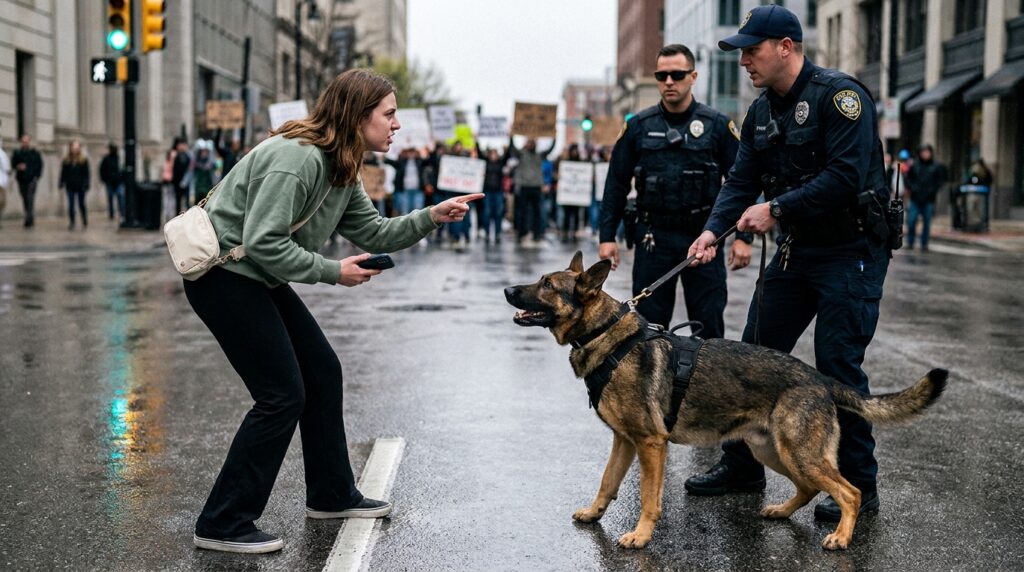
“Get those dogs out of my face, we’re allowed here!”

The words didn’t cut through the rain so much as they scraped against it. Officer Marcus Vance didn’t blink. The water running down the stiff brim of his navy cap dripped in a steady, rhythmic cadence onto the matte-black shell of the body camera anchored to his chest. Beneath his thick leather gloves, the braided nylon of the dual K9 leashes felt wet, heavy, and concrete. He could feel the slight, vibrational micro-tremors through the line—Rex’s hindquarters shifting, the dog’s pads searching for traction on the slick, oil-filmed asphalt. Rex wasn’t breaking stance. The shepherd held his ears high, pointed, catching the spray of passing city utility trucks two blocks over.

To Marcus, the street smelled of iron, desaturated exhaust, and the damp, sour wool of three dozen soaked coats. The crowd was a collection of blurred faces behind a row of neon-bright placards, their slogans running together under the downpour like cheap ink. They didn’t matter. Only the girl in the sage-green sweatshirt mattered. She was too close. Her gray sneakers were less than two inches from the reflective white paint strip that designated the municipal boundary lane. In her right hand, the smartphone stayed low, its lens angled upward to capture the tactical vest, the badge number he hadn’t covered, the clean-shaven line of his jaw.

Her left hand jabbed forward, a silver-plated ring catching the amber flash of a nearby construction barricade. Marcus calculated the distance: forty-two centimeters between her index finger and Rex’s snout. A fraction of a second if the dog decided to interpret the motion as an offensive strike. Behind Marcus, Officer Miller stood like an iron post, his sunglasses opaque despite the grey afternoon light, his gloved hand resting lightly on the trailing line of the second shepherd, Astro. They were a wall of dark blue and wet fur.

Marcus kept his posture wide, hips dropped, locking his center of gravity against the greasy surface of the road. He didn’t look at her phone. He looked at the flushed, erratic pulse visibly throbbing in her throat. She was leaning her torso forward, using her crossbody bag as a buffer against the physical space she was invading. She wanted the flinch. She needed the uniform to move, to swear, to show the raw edge of irritation that would validate whatever narrative was currently buffering on her screen.

Instead, Marcus let the silence stretch between them. It was a tactical silence, heavy and heavy with the smell of wet street scuffs. He could see his own reflection in the dark glass of her phone—a desaturated silhouette of authority holding two hundred pounds of trained muscle on a short string. The girl’s jaw tightened, her breath coming in short, white plumes against the damp air. She took a half-inch step closer, her toe breaking the clean edge of the reflective line.

Then, the small green light on the top of her smartphone flickered from steady recording to an erratic, rapid red flash. It wasn’t an application error. A single, encrypted string of text scrolled across the top of her dark screen—a sequence of numbers that Marcus recognized instantly as the internal logistics access code for the emergency containment vault directly behind him.


CHAPTER 2: THE LOGIC OF THE PHONE

The red strobe from the glass screen caught the wet texture of Marcus’s black leather glove. It wasn’t the soft, continuous glow of a standard recording application; it was an erratic, high-frequency pulse that indicated a terminal bypass handshake. On the slick surface of the display, beneath the smear of grease and rain, seven digits punched through the interface in a stark, unformatted terminal font: 04-E-CRIT.

Marcus didn’t lean forward. To the crowd, he remained an unblinking pillar of municipal authority, his boots anchored into the cold, pitted asphalt where the white paint had worn down to grey gravel. But internally, the calculation shifted instantly. That specific alphanumeric string wasn’t public data. It was the legacy access path for the internal electrical substations running directly beneath the primary security cordon—a system supposedly isolated from the civilian grid since the late nineties. The casing of the girl’s smartphone was scuffed, its corners showing the raw, green-tinted oxidation of cheap copper plating beneath a worn faux-metallic finish. She wasn’t holding a standard consumer device. She was holding a modified hardware receiver, and she was mapping the perimeter’s proximity tolerances in real time.

Elena’s eyes darted from the screen back to Marcus’s face. The performative outrage in her features flattened for a fraction of a second, replaced by the cold, transactional focus of an operator measuring a gap. Her thumb hovered over the lower edge of the glass, pulsing in sync with the red indicator.

“You know what this is,” she muttered, her voice dropping below the register of the shouting crowd behind her. The anger she had been projecting for the placards seemed to peel away like wet paper, exposing a hard, pragmatist core that matched the desaturated grit of the street. “You know exactly what’s behind this fence, officer. You aren’t keeping us out. You’re holding the lid down.”

Marcus maintained his broad command stance. His right hand remained low on the braided nylon lead, feeling the steady, rhythmic breathing of Rex against his left calf. The German Shepherd’s ears flattened slightly, sensing the shift in the air—the sudden drop in the girl’s vocal volume that carried more genuine threat than her previous screaming. Beside him, Officer Miller shifted his weight, his heavy tactical boots crunching against a fragment of broken glass on the curb. The sound was sharp, metallic, a tiny warning in the humid air.

“Step back behind the white line, ma’am,” Marcus said. His voice was flat, devoid of anger or theatricality, engineered to carry only the weight of institutional momentum. He didn’t acknowledge the screen. He didn’t acknowledge the code. Under the strict rules of the Sovereign Protector framework, any validation of her intel would be an operational failure. He treated her purely as a spatial anomaly, a physical obstruction that needed to be pushed back into the designated civilian sector.

Elena let out a short, dry laugh that sounded like gravel shifting in a pan. “The city council signed the decommissioning order six months ago. Section four. They’re stripping the foundation out from under the old ward, and they didn’t tell the neighborhood because the soil under the substation is full of mercury. That’s why you’ve got the dogs out here on a Tuesday afternoon. To keep people from looking down the drainage vents.”

She was testing his micro-expressions. Marcus knew the archetype; she was using a classic asymmetric interrogation technique disguised as a civil disturbance. She wanted him to glance toward the heavy iron gates fifty yards behind him, or to tighten his grip on the leashes, or to call for a supervisor over his shoulder-mounted radio. If he did any of those things, her device would log the physiological delay, mapping his reaction against the spatial coordinate she had just anchored with her phone.

Marcus kept his eyes locked on the bridge of her nose. The rain was picking up, the heavy drops striking the rusted chain-link fence behind the police line with a sound like distant small-arms fire. The desaturated green of her sweatshirt was turning almost black where the water soaked through the shoulders. She was shivering, but her hand remained remarkably steady as she raised the phone again, angling the lens not at his face this time, but at the heavy iron utility cover set into the asphalt directly between them.

The utility cover was solid cast iron, its radial grip pattern clogged with decades of city dirt and dried oil stains. Etched into its center was the faded insignia of the Department of Public Works, surrounded by a ring of heavy hex-head security bolts that had turned the dark, deep red of stabilized rust. The red light on Elena’s phone pulsed once more, a single, sharp flash that reflected off the wet iron plate.

“The signal is bouncing from the sub-level,” she whispered, her thumb jabbing down on the glass. “It’s already broadcasting. You can’t stop the file transfer by standing there.”

Behind her, the crowd surged slightly, a wave of wet nylon and bright placards pressing against her back. A man with a megaphone stepped up to her left, his voice exploding into an amplified screech that distorted against the brick facades of the surrounding buildings. The raw noise tore through the lane, but Marcus didn’t break focus. He saw the subtle tension in Elena’s wrist—the way she braced her weight not to move forward into the protest’s momentum, but to slide laterally along the white line, her gray sneakers seeking the exact point where the utility cover’s underground conduit intersected with the fence line.

Marcus felt Rex’s shoulder muscles tighten against his leg. The dog wasn’t growling; he was waiting for the verbal release or the physical cue. The braided leash in Marcus’s gloved hand felt like an extension of his own spine—rigid, heavy, and unyielding. The girl thought she was playing a game of administrative exposure, using a stolen logistics key to force a bureaucrat’s hand. She didn’t realize that the line she was standing on wasn’t drawn by city hall or the department of public works. It was drawn by the immediate, kinetic requirements of the perimeter.

“Miller,” Marcus said into his collar mic, his voice dropping into the low, encrypted channel. “Watch her left flank. She’s trying to ground a hardware bridge on the utility plate.”

Miller didn’t answer with words, but the second shepherd, Astro, stood up from his seated position, his large paws planting firmly on the wet asphalt, his dark eyes fixing instantly on the cream crossbody bag that hung across Elena’s chest. The bag was sagging under a specific weight that didn’t match the shape of a wallet or a set of keys. It had a hard, right-angled corner that pressed against the fabric—the unmistakable silhouette of a commercial grade signal repeater.

Elena noticed Astro’s shift. Her jaw tightened, the silver ring on her finger clicking sharply against the side of her phone as her grip slipped on the wet casing. She looked down at the reflective white line between them, then back up at Marcus, her eyes widening as she realized that the officer wasn’t reacting to her accusations because the accusations themselves were completely irrelevant to the physical reality of the cordon.

“You’re really going to let them bury it,” she said, her voice turning hard, all trace of the performative demonstrator gone. “You live in this city too, Vance. Your kid goes to the school four blocks down from the runoff.”

Marcus didn’t reply. He took a single, slow breath, tasting the iron and the ozone in the air. The green light on her phone died completely, replaced by a solid, unblinking red bar that stretched across the interface. The transfer was complete, or the bypass had failed. Before she could look down to verify the status, Marcus took a half-step forward, his heavy boot coming down directly on the edge of the white paint strip, the wet asphalt spraying a fine mist across the toe of her sneaker as he prepared to execute the spatial correction.

CHAPTER 3: THE FRICTION POINT

The heavy rubber edge of Marcus’s tactical boot sliced through the thin layer of standing water, flattening a patch of grease directly onto the fading white line. The sudden displacement produced a sharp, wet hiss that was immediately swallowed by the low, mechanical rattle of a city bus shifting gears three blocks north. Elena did not step backward immediately. Her weight remained balanced on the balls of her feet, her gray sneakers locking into the small indentations of the asphalt where the aggregate had begun to disintegrate from decades of heavy salt exposure.

Marcus kept his posture low, his center of gravity distributed evenly across his thick soles. Beneath his right calf, Rex’s flank went rigid. The shepherd’s coat was a rough, saturated mass of black and tan fur that smelled intensely of cedar chips and wet nylon. Through the short lead, Marcus monitored the dog’s internal metric—the sudden cessation of his rhythmic panting, the tightening of the muscles around the shoulders, the subtle drop of the skull by two centimeters. Rex wasn’t looking at Elena’s face; his black muzzle was aimed directly at the rusted iron circumference of the utility cover between their boots.

The ground was vibrating. It wasn’t the high-frequency rattle caused by the protest’s megaphone or the rhythmic thud of civilian footsteps along the sidewalk. It was a deep, subterranean thrum that worked its way up through the thick soles of Marcus’s boots, a mechanical drag that felt like a massive pump operating well past its duty cycle. The six hex-head security bolts securing the iron plate were caked in a dark, dry crust that looked like oxidized iron but tasted slightly sweet in the humid downpour—a chemical residue that shouldn’t have been present in standard municipal storm runoff.

Elena’s hand remained raised, the phone held between them like a small pane of smoked glass. The solid red bar across her screen cast a dull, crimson light onto her fingers, highlighting the raw skin around her knuckles and the deep scratches along the copper-plated bezel of the device.

“You can’t mask the draw, Vance,” she said, her voice dropping into a flat, strained cadence that barely carried across the two feet of wet air between them. Her shoulder-length brown hair was plastered to her cheeks in dark, wet arcs, drawing a hard line down the side of her jaw. “The substation isn’t pulling power from the grid. It’s pushing. They’re running the secondary extraction wells at triple capacity right now. Look at the water in the gutter. It’s not pooling; it’s being pulled down the secondary sleeve.”

Marcus did not turn his head to look at the curb. Under the strict parameters of his assignment, the physical environment was a closed matrix. Every utility line, every iron plate, and every square foot of slick asphalt was a fixed spatial anchor. To acknowledge a variance in the municipal drainage system was to admit a vulnerability in the line he had been ordered to hold. He let his gloved hand slide down the lead, shortening the distance between his wrist and Rex’s harness until the metal clip clinked against the D-ring. The sound was small, cold, and transactional.

“You’re crowding the dogs, ma’am,” Marcus said. His tone was level, stripped of any conversational color, tailored specifically for the body camera anchored to his chest. “The boundary is non-negotiable. If your sneakers cross the white strip, the space is compromised. Step back.”

Behind her, the front edge of the protest demonstration surged again, a collective mass of heavy winter jackets and rain-soaked cardboard signs that pressed against the back of her sage-green sweatshirt. A woman three feet away was screaming into a smartphone mounted on a plastic stabilizer, her eyes wide and performative, her mouth shaping words that Marcus’s ears systematically filtered out as background noise. The pressure from the crowd was physical, a slow, hydraulic shove that threatened to force Elena across the paint strip by simple mass alone.

Yet, Elena resisted the forward momentum. She wedged her left elbow against her side, using the strap of her cream crossbody bag to anchor herself against the crowd’s weight. She was looking at the small green utility flags planted in the narrow strip of soil between the sidewalk and the chain-link fence—flags that had been placed three days ago by a private surveying firm whose corporate logo had been neatly scraped off the plastic markers with a razor blade.

“Miller,” Marcus said into his throat mic, the tiny speaker behind his ear clicking with static. “Keep your eyes on the utility plate’s eastern seam. The seal’s been broken. The rust isn’t uniform.”

Through his peripheral vision, Marcus saw Miller’s hand adjust the strap of his heavy tactical vest, his sunglasses remaining locked on the crowd’s second tier. Astro, the second shepherd, dropped his hips into a low, coiled sit, his large black paws pressing into the wet gravel near the curb. The dog’s ears were twitching, catching a sound from beneath the iron grating—a wet, sucking gurgle that repeated every four seconds like a dying valve trying to clear a block.

Elena heard it too. Her eyes widened slightly, her thumb tapping the side of the copper-plated phone casing twice, a mechanical code that caused the screen to shift from the solid red bar to a sequence of scrolling numbers. The text was unformatted, listing core temperature readouts and volumetric flow rates that didn’t correspond to a standard electrical substation.

“That’s not mercury,” she whispered, her voice tightening as she looked past Marcus toward the grey, concrete facade of the municipal building fifty yards behind the fence. The building was windowless, its ventilation hoods covered in heavy plastic sheeting that had been taped down with industrial adhesive. “Mercury doesn’t vaporize at forty degrees. They aren’t cleaning the soil. They’re cooling it.”

Marcus didn’t move an inch. His boot remained locked on the white paint line, the iron perimeter holding firm against the rain and the noise. The girl’s intellect was sharp, her technical deduction precise, but she was still treating the confrontation as an argument that could be won with facts. She didn’t understand that the uniform didn’t operate on truth; it operated on mass.

“Final warning, ma’am,” Marcus said, his gloved finger pointing down at the reflective asphalt strip. “Back away from the line.”

CHAPTER 4: THE ANCHOR INCIDENT AT THE LINE

“Get those dogs out of my face, we’re allowed here!”

Elena’s voice didn’t just carry; it pushed hard into the narrow spatial corridor between them, her jaw tightening as she shoved her torso forward over the wet white stripe. The performative mask was back on, thick and aggressive, tailored perfectly for the perimeter crowd behind her. Her left hand stabbed forward, the cheap silver-plated ring flashing an oily orange under the flare of the construction lights. Marcus stood ground. His heavy tactical vest remained rigid, the matte-black body camera on his chest tracking the erratic trajectory of her phone.

Beneath his palm, the braided nylon lines were stiff with rainwater. Rex didn’t back off. The shepherd’s front paws remained planted right on the interior margin of the reflective paint, his tan-black chest tight, his pointed ears locked forward to absorb the direct blast of her shouting. The crowd behind her surged in a chaotic wave of heavy winter jackets and unreadable placards, their shouts rising into a localized roar that beat against the grey brick walls of the municipal compound.

Elena was less than ten centimeters from the canine line. Her smartphone stayed low in her right hand, the camera lens tilted upward to record Marcus’s eyes beneath the brim of his navy cap. The red indicator bar on her screen was still cycling, its dull light reflecting off the wet asphalt between their boots.

“Back up from the dogs and stay behind that line!”

Marcus didn’t yell, but the command came out with the absolute weight of the institution behind it, a short, sharp vocal projection that cut cleanly through the noise of the megaphone to his left. At the same micro-second, his gloved right arm snapped upward, his index finger extending straight into the boundary lane, pointing directly at the center of her chest.

The physical projection of authority was absolute. Elena recoiled, her gray sneakers slipping a fraction of a centimeter on the oil-filmed asphalt as she pulled her upper body back from his hand. The performative outrage in her eyes cracked, replaced by a sudden, frustrated panic as her spatial dominance was instantly neutralized. She threw a broad, clumsy gesture with her left hand, her phone wobbling in her grip as her weight shifted toward the camera edge.

“Keep backing up, ma’am,” Marcus said, his voice dropping back into that level, transactional register that left no room for negotiation. His extended arm remained locked in place, an unyielding iron post defining the exact limit of the civilian sector.

The crowd behind her felt the shift. The constant, rhythmic swaying of the bright placards slowed down, the noise dropping into a heavy, uncomfortable silence as the onlookers watched the girl lose her momentum. A man holding a heavy cardboard sign lowered it by a few inches, his eyes shifting from Elena’s phone to the unblinking, focused gaze of the two German Shepherds holding the line. The small, wet gurgle from the utility grating between their feet continued its four-second cycle, but nobody was listening to the water anymore; they were listening to the silence of the cordon.

Elena’s jaw remained set, but her gray sneakers took a deliberate, heavy step backward, clearing the reflective paint strip entirely. Her phone screen flickered once, the scrolling logistics data vanishing behind a dark system reset window, but her thumb remained anchored to the lower corner of the oxidized copper casing. She wasn’t looking at Marcus now; she was looking at the small space between his boots where the water was pooling over the rusted hex bolts of the cover.

Behind them, Officer Miller maintained his upright support stance, his sunglasses reflecting the grey, desaturated afternoon sky, his gloved hand keeping Astro perfectly stable in the rear tier. The white boundary line lay between them again, clean and uncrossed, a sharp division between the chaotic pressure of the neighborhood and the silent, heavy discipline of the perimeter.

Elena took a second step back, her cream crossbody bag swinging against her hip as she began to turn away toward the sidewalk edge. Her performative run was over, but the small hardware repeater inside her bag was still humming against her side, its low-frequency vibration clicking faintly against the metal buckle of her strap. Marcus didn’t lower his arm until her feet had cleared the secondary utility margin, his eyes remaining locked on the crowd until the placards began to drift back into the grey rain.

CHAPTER 5: THE SILENT RECOIL

The leather of Marcus’s glove creaked as he slowly lowered his right arm, his index finger dropping from the cold space that had separated him from Elena’s chest. He didn’t drop his stance. The white paint strip beneath his boot soles remained a rigid line of demarcation, its chemical reflective flakes catching the amber sweep of a city transport truck grinding past the outer intersection. Elena was three steps back now, her gray sneakers clearing the edge of the utility lane entirely, her weight shifted onto the rough concrete of the public sidewalk.

The crowd’s performative rhythm did not immediately recover. The loud, amplified rattle from the megaphone to her left sputtered, a sharp spike of feedback whining against the wet brick walls before the operator lowered the plastic horn. The bright, unreadable placards hung motionless in the downpour, their cardboard edges softening under the weight of the rain until the black ink began to bleed into the grey pulp. The onlookers remained frozen, their collective focus locked onto the unblinking, dark eyes of Rex and Astro, who held the physical boundary with the heavy, stationary discipline of concrete pillars.

Beneath Marcus’s boots, the low-frequency thrumming from the utility cover didn’t cease, but the character of the vibration evolved. It was no longer the steady, mechanical drag of a standard cooling pump; it had turned into a wet, rhythmic shudder that repeated every two seconds, sending a distinct shudder through the grease-filmed iron plate. A faint, heavy smell began to rise through the radial drainage slots—a dense, chemical vapor that smelled faintly of sweet almonds and oxidized copper, thickening the cold downpour until the air tasted metallic.

Elena stood on the curb, her sage-green sweatshirt completely saturated, the fabric clinging to her shoulders in dark, heavy folds. Her smartphone was clutched in her right hand, but the screen remained dark, its copper-plated bezel showing a thin smear of grey grease from her glove. Her thumb tapped the edge of the casing in a rapid, three-stroke sequence, but the hardware repeater inside her cream crossbody bag didn’t flash its red interface bar. The connection was dead.

“You’re holding the line for a ghost, Vance,” she said, her voice dropping below the steady hiss of the rain on the asphalt. She didn’t look at the crowd behind her; her eyes were locked on the small space between Marcus’s boots where the water was pooling over the rusted hex bolts of the plate. “The data didn’t stay on the local loop. The logistics file has three separate routing nodes outside the municipal zone. Even if your comms bridge is active, the council can’t pull the decommissioning order back.”

Marcus kept his face locked forward, his jaw tight under the chin strap of his cap. He didn’t look down at the utility cover, nor did he check the small digital interface mounted to the inner wrist of his left glove.

“Clear the sidewalk, ma’am,” Marcus said, his voice flat and transactional, providing the body camera with the required regulatory sequence. “The cordon extends twenty feet from the primary fence line during a localized public disturbance. You are obstructing the service access route.”

Elena didn’t throw another gesture. Her performative anger had completely evaporated, leaving behind a cold, pragmatic exhaustion that mirrored the desaturated grey of the street. She looked past his shoulder toward the windowless concrete facade of the facility behind the chain-link fence, her eyes narrowing as she noticed the heavy plastic sheeting on the ventilation hoods beginning to billow outward, the industrial tape straining against the pressure of an internal exhaust sequence.

“Miller,” Marcus said into his throat mic, his voice dropping into the encrypted, low-frequency channel. “The internal pressure is rising. The hoods are venting from the lower vault, not the main stack. Check the air monitor on the vest.”

A small, high-pitched click sounded in Marcus’s ear—the automated warning from Miller’s tactical sensor package. The digital readout on his own sleeve didn’t register a standard mercury spike; it registered a sharp, vertical climb in volatile organic compounds that didn’t correspond to an old electrical substation infrastructure. The decoy secret she had pulled from the logistics file—the hidden decommissioning order for a contaminated soil site—was already cracking under the physical evidence of the environment.

Elena caught the small movement of Marcus’s left wrist. A faint, bitter smile touched the corner of her mouth, her jaw tightening as she stepped back into the first tier of the silent crowd.

“They didn’t even give you the right filters for those vests, did they?” she whispered, her voice barely carrying over the sudden, sharp clatter of a loose piece of sheet metal vibrating on the facility roof.

She turned away, her gray sneakers splashing through a shallow puddle on the curb as she disappeared into the mass of wet winter jackets and lowering signs. The crowd began to fragment behind her, the demonstrators drifting toward the relative shelter of the store awnings across the street, leaving the dark asphalt lane wide, wet, and empty. Marcus remained planted on the white line, his hand holding the short, braided lead as Rex let out a long, low exhalation, his dark muzzle still aimed at the iron seam where the sweet-smelling vapor was slowly dissipating into the grey rain.

CHAPTER 6: THE DECOY UNCOVERED

The copper-plated edge of the smartphone didn’t bounce when it hit the curb; it slid three inches through a shallow skim of muddy water before catching against the rough, grit-pitted flank of a concrete drainage basin. Elena’s departure had been quick, her silhouette swallowed by the wet nylon mass of the dispersing demonstrators, but the physical artifact remained. The small green indicator on its side was completely dead, but a secondary, amber diagnostic light deep within the unbranded casing began to pulse, casting a tiny, mechanical rhythm onto the oil-stained pavement.

Marcus didn’t break posture. His boots remained anchored to the interior edge of the fading white line, his gloved fingers maintaining the steady, uniform tension on Rex’s braided lead. To the scattered onlookers across the street, he was still an unmoving extension of the municipal wall. But his eyes tracked the object. A man in an oversized yellow oilskin coat—one of the marshals who had been managing the protest’s secondary flank—stepped out from beneath a store awning, his heavy rubber boots sloshing toward the curb.

The marshal didn’t look at Marcus. He bent his thick torso, his wet hand reaching down to scoop the phone out of the gutter. As his fingers wrapped around the oxidized copper casing, his thumb accidentally cleared the grease-smothered proximity sensor on the lower bezel.

The display didn’t launch a standard commercial operating system. It flickered into an unformatted administrative directory, the text rendering in a stark, bright white that was easily readable through the dark rain. It wasn’t an online stream or a social media feed. The top header block displayed an official municipal seal, below which ran three thousand lines of decrypted logistical scheduling data marked PROJECT COBALT STRIP: PHASE 4.

“Hey,” the marshal muttered, his voice gravelly and thick with the damp cold. He took a step back from the line, his left hand shifting the heavy cardboard placard he was carrying so he could tilt the glass toward his face. “This isn’t a live feed. This is… this is the engineering schedule for the entire southern sector infrastructure.”

Marcus stayed silent, his chin strap pulled tight against his jaw. Through his collar mic, he could hear the rhythmic, electronic clicks from Miller’s air monitoring pack accelerating into a steady, unbroken tone. The volatile organic compound count was climbing again, but the data on the dropped screen offered a completely different explanation to the man holding it. To the marshal, the scrolling files were concrete proof of an administrative deception—a hidden, six-month-old city council directive to dismantle the sub-levels of the facility and abandon the neighborhood’s primary utility grid without public notice.

“They’re shutting down the whole ward,” the marshal shouted toward the remaining cluster of protesters under the awnings, his voice rising above the steady hiss of the downpour. He held the phone up, the white light of the logistics file reflecting off his wet yellow sleeve. “The decommissioning order is right here. Signed in October. They aren’t running a security detail; they’re clearing out the records before the county inspectors arrive on Friday.”

The remaining crowd turned back toward the perimeter, a low, angry murmur rippling through the small group. The placards rose again, but the anger was no longer performative or directed at Marcus’s stance; it had found a physical anchor in the file layout on the glass screen. They believed they had found the core truth—the hidden corporate layout that explained the presence of the K9 cordon.

Marcus let his right hand settle back onto the handle of the lead, the braided nylon digging into the thick leather of his glove. The marshal’s deduction was a perfect fit for the data he possessed. The logistics file logically covered every environmental anomaly they had witnessed: the private surveyor flags, the windowless concrete walls, the increased power draw from the secondary wells. It was a complete, self-contained answer that satisfied the crowd’s search for a culprit.

But the digital interface on Marcus’s inner wrist was telling a far colder story. The volatile organic index wasn’t stabilizing at the levels associated with abandoned municipal soil; it was breaking through the emergency containment thresholds. The sweet, almond-like scent rising from the radial drainage slots was growing heavier, a greasy film beginning to separate the puddles on the dark asphalt into iridescent, yellow rings. The cordon wasn’t protecting an administrative secret from a neighborhood group; it was a physical quarantine, holding a perimeter against a leaking sub-surface chemical vault while the city administration used the decommissioning file as a deliberate, structural decoy to keep the public from realizing the air they were breathing was already toxic.

“Miller,” Marcus said into his throat mic, his voice dropping into the lowest register of the encrypted frequency. “The crowd is locking onto the logistics decoy. They’re going to push the outer gates at the intersection if they think it’s just an administrative cover-up.”

“Understood,” Miller’s voice came back, flat and completely dry through the static. “The county response unit is still forty minutes out. Hold the asphalt strip. Do not let them touch the utility plate.”

The marshal with the phone took a step toward the white paint line, his face tight with the sudden authority of a man carrying a revelation. He pointed a thick finger at the facility behind the chain-link fence, the copper-plated device trembling slightly in his wet grip.

“You knew about the October sign-off, didn’t you, Vance?” he demanded, his voice pitching high for the returning demonstrators. “You’re just the cleanup crew.”

Marcus didn’t move an inch. He kept his eyes locked on the bridge of the man’s nose, his boots frozen on the edge of the reflective white marking, his silence absolute as the rain continued to wash the chemical residue down the long, dark gutters of the empty lane.

CHAPTER 7: THE LINGERING COORDON

“You’re just the cleanup crew,” the marshal repeated, his voice dropping into the damp, desaturated space between them. The phone screen in his thick grip remained bright, its white light cutting a clean line across the yellow oilskin of his sleeve, casting a pale glare onto the cold asphalt strip.

Marcus did not give him an answer. He didn’t shift his boots by a single millimeter from the white paint, though the standing water surrounding his soles had begun to thicken, turning into a heavy, iridescent yellow sludge that resisted the natural slope of the concrete gutter. The sensory profile of the lane had changed completely; the sweet, almond-like scent of volatile organic compounds was no longer a faint trace rising through the radial slots of the utility plate. It was a dense, heavy layer that sat low to the ground, stinging the membranes of his nose and throat with a cold, chemical burn that his tactical mask filter was failing to catch.

Through his left glove, the digital interface on his wrist pulsed a slow, continuous violet—the maximum threshold alert for systemic toxicological exposure. The decoy secret Elena had pulled from the administrative database had done its work perfectly. The marshal and the remaining demonstrators huddled under the store awnings across the street were fully locked into their victory, convinced they had uncovered an illicit infrastructure decommissioning project. They were treating the line as a political boundary, an administrative barrier they could expose with a stolen logistics file. They didn’t understand that the line was the only thing keeping them alive.

Marcus pulled the braided nylon lead tighter against his thigh, feeling the tight, mechanical vibration of Rex’s breathing. The dog’s tan-black coat was flat with grease and rain, his muzzle lowered to within three inches of the utility cover’s edge. Rex wasn’t growling anymore; his ribcage was working in short, shallow strokes, his system processing the same chemical weight that was currently expanding through the perimeter’s sub-floor.

“Vance,” Miller’s voice came through the throat mic, dry, hollow, and laced with a slight, mechanical tremor from his own physical exhaustion. “The secondary seals on the containment vault just dropped pressure by another forty percent. The exhaust hoods on the roof are venting pure gas now. If that crowd moves five feet closer to the chain-link, they’ll catch the core plume.”

“Hold the line, Miller,” Marcus said. His voice was a flat, low-frequency hum that didn’t travel past the brim of his navy cap. He looked directly at the marshal in the yellow coat, his eyes cold and unblinking under the grey downpour. “The perimeter stays locked.”

The marshal took a step back, the phone screen flickering as a new wave of rain struck the glass. The authority he had felt when holding up the logistics document seemed to falter against the total, administrative silence of the uniform. He looked at Marcus’s broad, command stance, then down at the yellow rings spreading across the water between their feet, his jaw tightening as his internal calculation encountered a variable the file hadn’t predicted. The chemical film was eating through the edges of the white paint strip, the reflective flakes dissolving into a grey, oily froth.

“Something’s wrong with the drainage,” the marshal muttered, his voice losing its theatrical pitch, his eyes tracking a thick line of yellow scum that was bubbling out from the utility cover’s rusted hex bolts. He wiped a mix of rain and grease from his forehead with his glove, then looked at his fingers, noticing a dull, red rash already forming where the water had touched his skin.

Across the street, the demonstrators began to lower their placards entirely. The neon signs were heavy, waterlogged pieces of pulp that sagged toward the pavement. One by one, the people under the store awnings turned their backs on the municipal compound, their gray winter jackets disappearing into the desaturated fog of the outer neighborhood blocks. They had their story; they had the file. They were leaving the intersection because they believed the conflict had been resolved by the data on the screen.

The marshal hesitated for three seconds, his boots sloshing through the muddy margin of the curb, before he turned and followed them, the copper-plated phone staying dark in his hand as he retreated into the grey rain.

Marcus remained on the asphalt, his boots frozen on the dissolved edge of the white paint strip. The desaturated evening was closing in, stripping the street of what little color remained until the entire lane looked like a faded photograph. The facility behind the fence was silent, the windowless concrete walls bleeding black water down into the foundation, while the heavy plastic sheeting on the ventilation hoods billowed out one last time before deflating against the corrugated steel.

The county response unit hadn’t arrived. The line didn’t move. Marcus kept his hand locked on the short lead, his eyes fixed on the empty intersection where the rain was washing the last traces of the neighborhood’s footprints into the dark, toxic gut of the city.

Similar Posts

Leave a Reply

Your email address will not be published. Required fields are marked *