The Concrete Line: A Novel of Weaponized Bureaucracy, Broken Fences, and the Hard Truth of Municipal Boundaries

CHAPTER 1: THE WARN LINE

“One more call about their trailer, Brenda, and the county clerk processes the harassment filing. It’s signed, it’s stamped, and it stays on your record.”

Deputy Miller didn’t look up from his clipboard. His thumb, calloused from fifteen years of handling steering wheels and report clip hinges, pressed against the yellow carbon copy sheet. The air between them smelled of dry fescue grass and hot asphalt, typical for a late July afternoon in the Oakridge Estates cul-de-sac.

Brenda didn’t step back from the property line. Her red sneakers were planted exactly two inches inside her own sod, her stocky frame leaning forward so hard the heavy cream cotton of her oversized hoodie bunched around her throat. She gripped a blue plastic folder against her ribs like a piece of light ballistic plating. Inside were three distinct highlightings of the municipal code regarding commercial vehicle storage in low-density residential zones.

“It’s an open obstruction of the easement, Miller,” Brenda said, her voice dropping into the flat, granular register she used when citing ordinances to people who didn’t want to hear them. “The wrapped logo on the side constitutes an unpermitted billboard under Section Four. The town can’t just look the other way because they have kids.”

“The trailer is legal,” Miller said. He finally raised his head, his sunglasses reflecting the glare off Brenda’s white garage door. The plastic lenses showed two distorted, miniature versions of her flushed face. “The tires are behind the curb line. The hitch doesn’t extend into the asphalt path. The landscape crew has a valid business tax receipt from the hall. We’re done checking it.”

Behind him, thirty yards down the pavement, the young family’s utility trailer sat under the shade of a silver maple. Its green and white vinyl wrap—Oakridge Professional Turf Solutions—looked clean, clean enough to pass any health or safety inspection the county could throw at it. A small red plastic tricycle lay on its side near the trailer’s rear double axle, a silent marker of occupancy that Brenda had already logged in her morning memo as a ‘secondary public hazard.’

“The town will look at the video,” Brenda muttered, her thumb tracing the plastic edge of her folder. “The internet doesn’t care about the precinct’s relationship with local contractors.”

Miller didn’t argue. He tore the carbon sheet off his pad with a single, sharp snap of his wrist. The sound was dry, like a dead branch breaking in the heat. He didn’t hand it to her. He walked past her toward his cruiser, the heavy leather of his utility belt groaning under the weight of his radio, handcuffs, and sidearm. “Go inside, Brenda,” he said over his shoulder. “Before you write a check your house can’t cash.”

She watched the cruiser’s exhaust pipe sputter as the engine caught, the smell of burning oil mixing with the dust raised by the tires. As the car rounded the corner past the subdivision gate, Brenda looked down at her feet. Right there, half-buried under the encroaching weeds at the edge of the asphalt, was the rusted iron surveyor’s pin. It was cold despite the midday sun, a rigid piece of iron that defined where her safety ended and the public world began. Her phone buzzed inside her crossbody bag—a notification from the neighborhood forum showing zero replies to her last post. They were ignoring her.

Turning on her heel, she headed toward the garage, her mind already shifting the line from the curb to the civic plaza downtown. If the local precinct wouldn’t hold the line, she would force them to do it under the lights.


CHAPTER 2: ARCHIVE ARCHITECTURE

“The town record room isn’t a library, Brenda. You can’t just browse the dead files because your neighbor’s lawn isn’t straight.”

The memory of the county clerk’s voice, flat and dry like old parchment, scraped against Brenda’s mind as she pulled the light chain in her basement. The bulb flickered once, hummed with a low electrical buzz, and settled into a dull yellow glow that barely reached the corners of the concrete foundation. The air down here was thick with the smell of damp mortar, iron water pipes, and thirty years of slowly decaying paper. It was the smell of the town’s history, or at least the parts of it people wanted to forget.

Miller thought a harassment warning would lock her inside. He thought the threat of a legal stamp would make her sit quietly in her living room, watching the turf trailers roll past her window like a conquered resident. He didn’t understand the nature of a line. Once a boundary was crossed, it didn’t reset itself; you either pushed back or you ceded the territory entirely.

Brenda’s red sneakers left faint, oval tracks in the gray dust coating the floorboards as she moved toward the back wall. Here, behind the deactivated oil tank, sat three green steel filing cabinets she had purchased at the municipal surplus auction five years ago. They were heavy, industrial monsters with rusted drawers that required a hard, physical yank to open—the metal-on-metal friction screeching through the empty basement like a complaint.

She gripped the handle of the bottom drawer, her fingers catching on a flake of bubbling green paint. The steel felt cold and rough, coated in a fine layer of grit that transferred to her skin. She pulled. The drawer resisted, its internal tracks clogged with rust and dried grease, before it finally gave way with a violent shudder that shook the entire cabinet. Inside, packed so tightly the tabs were bent flat, were the subdivision maps of Oakridge Estates from before the developers even poured the first curb.

Her hands moved with practiced efficiency, flipping past tax assessments, utility line revisions, and drainage reports from the late eighties. She wasn’t looking for the official county ledger—Miller had already closed that route. She was looking for the gaps, the unratified changes, the pieces of paper that were drafted but never legally executed because someone forgot to pay the filing fee or a clerk retired early.

Her fingers stopped against a thick, watermarked manila envelope. The paper was stiff, yellowed at the edges by decades of subterranean humidity, and sealed with a faded red wax imprint of the town clerk’s office. It bore no modern barcode, no digital indexing number. Written across the front in a scratching, fountain-pen hand were the words: Proposed Subdivision Re-Zoning & Emergency Access Easement – Block 4, Lots 12-18 (Draft Only, 1994).

Brenda hauled the envelope out, the heavy paper crinkling loudly in the silence of the basement. She laid it across the dusty top of the cabinet, her palm flattening the cardboard as she broke the brittle wax seal with the edge of her thumb. A small cloud of grey dust rose into the yellow light, settling into the lines of her face.

Inside were four oversized blueprint sheets and a twelve-page typed addendum. The ink on the blueprints was a faded indigo, the lines showing the cul-de-sac before the silver maples were planted, back when the entire area was just scraped clay and surveyor’s string. Brenda traced the line of the curb with a dirt-smudged finger. There, marked in hatched red lines that ran directly through the apron of the landscaping family’s current driveway, was a designated fifteen-foot strip labeled Emergency Public Fire Path.

She opened the typed addendum. The pages were held together by a rusted steel paperclip that had left a dark orange stain across the top margin. Her eyes scanned the legal jargon, her pulse jumping as she hit the crucial clause: In the event of subdivision completion prior to county assumption of public roads, said easement shall remain under municipal oversight, permitting any resident within Block 4 to report and request clearance of visual or physical obstructions.

The document was unsigned. The signature lines for the town council president and the developer were completely blank, nothing but empty black ink lines waiting for an authority that had never arrived.

Brenda’s chest tightened under her cream hoodie. To Miller, this was nothing but a dead draft, a piece of archival trash that had never crossed the threshold of legality. But Brenda didn’t see an unsigned contract. She saw leverage. She saw a physical document with an official town watermark that proved the intent of the space was public, an unfiled boundary that she could project onto the plaza stairs. The internet wouldn’t check the signature line; they would see the red hatched lines and the official seal, and they would see a department refusing to protect a municipal fire path from commercial exploitation.

She folded the blueprints back into the envelope, the sharp creases clicking under her fingers. As she lifted the pack, a small, secondary slip of paper fell from between the blueprints, fluttering down to the concrete floor near her sneaker.

Brenda reached down, her fingers brushing the cold, rough concrete of the foundation wall. She picked up the slip. It was a single sheet of surveyor’s field notes from the same year, but the lot number at the top wasn’t the landscaper’s. It was hers. Written in the margin next to her property coordinates was a single, heavily underlined handwritten note in red ink: Discrepancy noted at eastern boundary pin. Variance unapproved by county board. Foundation pour initiated regardless.

Brenda froze, the scrap of paper trembling slightly between her thumb and forefinger. The text didn’t explain the discrepancy, nor did it state which way the variance fell, but the word unapproved stared back at her like an open threat. She quickly shoved the slip deep into the pocket of her sweatpants, her heart drumming against her ribs as she reached up and yanked the light chain, plunging the basement into absolute blackness.

CHAPTER 3: THE PLAZA GRID

Three hundred and forty-two paces from the gravel perimeter of the municipal parking lot to the bottom tier of the city hall steps. Brenda did not drop her gaze as her red sneakers scuffed the transition line between asphalt and the smooth, sun-bleached concrete tiles of the civic plaza. Her fingers pressed through the thick pocket of her gray sweatpants, pinning the folded surveyor’s note against her thigh. The scratch of the old paper felt hot, an uncorrected weight that she had quarantined beneath the urgent business of the afternoon.

The heat in the open square didn’t behave like the heat in the cul-de-sac. Here, it radiated from the vertical faces of limestone columns and government glass, dry and metallic, carrying the distant drone of commercial truck traffic from the regional bypass. Brenda held the manila envelope flat against her chest with both hands, the heavy weight of the 1994 easement blueprint serving as a rigid shield between her oversized hoodie and the few pedestrians eating lunch on the concrete benches.

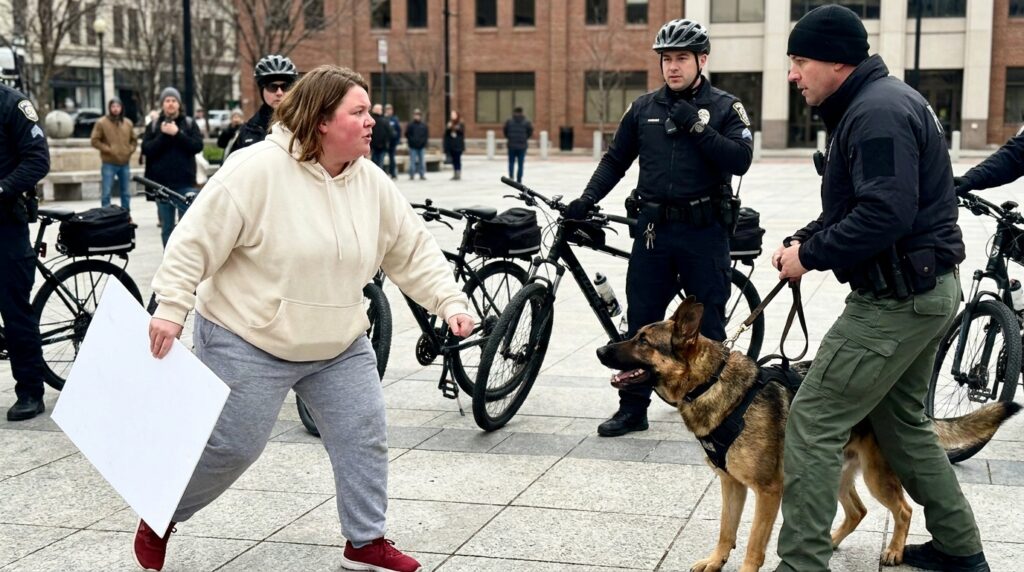
She stopped at the intersection of two expansion joints. To her left sat the municipal court building; to her right, the low, brick bunker of the precinct precinct headquarters. In the center depth, positioned near the broad granite steps where the city hall flags hung limp in the high July air, a row of dark utility bicycles formed a neat, static line.

Brenda raised her phone. Her thumb tapped the screen, opening the local neighborhood network app. The interface remained cold—no fresh alerts, no responses to her warnings about the turf trailer. Her fingers split the camera frame, zooming in until the grid lines on her screen aligned perfectly with the stone columns of the precinct portico. She wasn’t looking at the architecture. She was looking at the security perimeter.

Beneath the shade of the portico roof stood the K9 handler. Even from forty yards away, his silhouette read with a distinct, institutional weight: the black knit cap pulled tight above a short, dark beard; the matte black tactical vest over a dark windbreaker; the dull sheen of brass clips on the single nylon leash trailing down to his heel. Beside him, the German Shepherd sat upright, its tan-and-black head perfectly steady, its jaw slightly open in a relaxed pant that showed the pink line of its tongue.

They were the absolute anchor of the plaza’s public space. They were what the town used to define the boundary between general access and restricted municipal operations.

Brenda lowered the phone, her thumb sliding down to the plastic edge of her blue folder. She didn’t see a security detail; she saw a visual coordinate. If she stood exactly twelve feet from the bicycle line, right where the expansion joint cut toward the courthouse fountain, the camera lens would capture the dog’s head, the handler’s vest, and the unyielding brick facade of the precinct in a single vertical frame.

She walked toward the spot, her sneakers clicking in a slow, metered rhythm against the stone. She stopped. She turned the blank side of her protest placard toward her chest, the raw cardboard texture catching the rough fabric of her cream hoodie.

A young clerk in a short-sleeved blue shirt walked past her, his leather shoes making a light, hollow sound on the concrete tiles. He glanced at the blank sign, then at Brenda’s flushed face, his pace hitching for a fraction of a second before he looked down at his watch and accelerated toward the municipal court doors. The silence of the plaza closed in behind him, heavy and unmoving.

Brenda adjusted her grip on the wooden stake of the placard. The wood was rough, un-sanded pine that left tiny, dry splinters in the palm of her hand. She didn’t look down to pick them out. Her eyes were fixed on the K9 handler’s hands. He hadn’t shifted his posture. His fingers remained looped through the nylon handle of the leash, his knuckles still and grey in the shade.

She checked the digital grid on her screen one more time. The spacing was exact. The K9 lane—the open six-foot corridor between the bicycle line and the granite steps—was clear. The public was entirely absent from that narrow strip of stone. It was an artificial boundary, an unfiled restriction maintained by nothing but habit and the presence of the dog.

She tucked the folder tighter under her arm, her shoulder blades locking as she took a deep breath of the hot, exhaust-tainted air. The surveyor’s note in her pocket felt like a cold stone against her leg, but the paper in her hands—the watermarked 1994 draft—was what she needed right now. She would bring the cul-de-sac to the plaza. She would make them draw the line where everyone could see it.

CHAPTER 4: THE INTRUSION COGNITION

The phone screen went dark as Brenda slipped it into the front pocket of her cream hoodie. Her fingers immediately dropped back to the raw, un-sanded pine stake of the placard, her knuckles locking tight against the grain. Her red sneakers gripped the stone expansion joint for one final micro-second before she drove half a step forward, crossing the invisible vector she had calculated between the courthouse fountain and the security line.

She entered the K9 lane with her body crouched in a stocky forward lean, her shoulders drawn high and tense to absorb the public exposure. Her round face flushed hot, a dark crimson rash creeping up from the collar of her hoodie as her breathing turned thin and jagged. She held the heavy, blank white cardboard placard low, letting it swing near her thigh like an un-slung tool, its white surface completely clear of text—a pristine visual vacuum waiting to be filled by the lens of anyone recording the square.

“Keep that dog back, you don’t get to threaten us!”

Her voice erupted into the midday room tone of the plaza, a strained, echoing yell that carried the gritty rasp of dry basement dust. The sound hit the vertical limestone columns of the precinct portico and bounced back, sharp and thin.

The K9 Handler didn’t advance. His tactical boots remained perfectly flat against the concrete tiles, his tall, solid frame anchoring the corner of the municipal step line. But his gloved right hand moved with deliberate, mechanical precision, gathering a single loop of the heavy nylon leash and pulling it taut against his hip. The movement shortened the line by six inches, locking the German Shepherd strictly to his heel. The dog remained in an upright, attentive stance, its tan-and-black head level, its ears pointing forward like small steel wedges. Its mouth stayed open in a relaxed pant, completely unresponsive to the high-frequency vibration of her shout.

Brenda didn’t stop her forward momentum. She felt the heavy envelope in her crossbody bag press hard against her ribs—the 1994 unfiled draft serving as her internal justification for the intrusion. To her, this six-foot corridor wasn’t law enforcement territory; it was an obstruction of a public right-of-way, an unratified restriction identical to the landscaping trailer back in the cul-de-sac.

“Everyone sees it!” she screamed, snapping her face sideways toward a pair of office workers who had stopped near a concrete planter, their forks hovering mid-air above their plastic salad containers. She thrust her left hand toward the sky, her index finger pointing directly at the lintel of the precinct door as if indexing a formal violation for an online audience. “You’re using that dog to scare us!”

The handler remained entirely silent. His bearded jaw didn’t shift, and his eyes, shadowed beneath the brim of his black knit cap, stayed fixed on the upper edge of her blank cardboard sign. He didn’t offer a counter-argument; he didn’t give her a monologue to record. The only sound between them was the dry rustle of Brenda’s sweatpants and the faint, metallic click of the leash swivel rotating against the dog’s black harness as the animal adjusted its weight by a fraction of an inch.

Out of the corner of her eye, Brenda saw the midground shift. The static line of dark utility bicycles wasn’t vacant anymore. A seasoned officer, his grey hair visible beneath the rim of his white helmet, had stepped away from the handlebars. His glasses caught the full glare of the midday sun, turning his eyes into two blank discs of light as he began a steady, unhurried advance toward her left flank.

She tightened her grip on the pine stake, preparing to swing the placard up into the center of the frame to lock in the shot. The unfiled draft in her bag felt heavier now, a physical anchor that she believed gave her the right to stand on this stone, regardless of the uniform in front of her. But the officer wasn’t looking at her folder. He was tracking the position of her red sneakers as they drifted another inch into the restricted lane.

CHAPTER 5: THE INTERVENTION BARRIER

The sun-bleached concrete tiles beneath Brenda’s red sneakers felt utterly unyielding as the shadow of the bicycle officer dropped across her left flank. Her arm was already tightening to lift the pine stake, her shoulder drawing back to angle the blank white placard directly into the camera vector she had mapped out. But the frame didn’t lock. The visual path she was trying to force into existence was instantly severed by a thick sleeve of heavy black utility fabric.

The Bicycle Officer stepped into the midground with a flat, unhurried precision that completely ignored the high-frequency register of her screaming. He didn’t reach for his belt. He didn’t offer a dramatic display of force for the nearby phones. With the slow, deliberate momentum of a heavy weight shifting into place, he extended one long, rigid arm straight out between Brenda’s chest and the designated K9 lane.

His hand was flat, his fingers locked together, creating a hard physical barrier just four inches from the thick cream cotton of her hoodie. His face remained entirely composed behind his glasses, the glare from the open plaza sky turning the lenses into cold silver discs that gave Brenda nothing to read—no irritation, no professional hesitation, no opening for an argument.

“Keep moving back, ma’am, behind the line.”

The command was clipped, delivered in a low, flat frequency that carried the absolute, unyielding density of municipal law. It wasn’t an explanation; it wasn’t a debate about Section Four or zoning codes. The words hit Brenda mid-breath, their mechanical weight cutting off her public pressure shout before she could project the second half of her phrase toward the plaza benches.

Brenda’s red sneakers hitched on the concrete expansion joint. Her stocky forward lean collapsed back into her heels, the sudden loss of momentum sending a jarring shock through her knees. She stared at the officer’s extended arm, the heavy black nylon fabric of his sleeve showing tiny, ground-in specks of gray road grit along the seam. Beyond his shoulder, the K9 handler stood like a column of dark stone, his gloved hand still holding the single loop of the leash, his German Shepherd remaining perfectly quiet and alert at his heel, its tongue lolling out in a slow pant that seemed to mock the performative urgency of her stunt.

“This is an unratified restriction,” Brenda muttered, her throat dry, the words scraping against the silence that had suddenly dropped over the immediate circle of the square. She reached into her crossbody bag, her fingers frantically clawing at the thick corners of the manila envelope, desperate to pull out the indigo lines of the 1994 easement draft to prove the public nature of the lane. “The town council files from ninety-four state—”

“Behind the line, ma’am,” the officer repeated. His voice didn’t rise an octave. He didn’t lower his arm by a single millimeter. The flat barrier of his hand remained exactly where it was, an immutable physical boundary that completely invalidated the watermarked paper she was clutching against her ribs.

Out of the corner of her eye, Brenda saw the office workers near the concrete planter lower their forks. They weren’t watching an explosive exposure of police intimidation. They were watching a middle-aged woman in a bunching hoodie get systematically and quietly pushed out of a standard safety perimeter. One of them turned away, sliding their phone back into a pocket with a brief, dismissive shake of the head. The internet vacuum she had meticulously prepared was collapsing into a mundane public nuisance detail.

She took one step back, her shoe rubber scraping loudly against the stone, but as her hand moved inside her sweatpants pocket to brace her balance, her fingers brushed the sharp, cold edge of the secondary surveyor’s slip. The word unapproved seemed to pulse through the fabric against her thigh, a silent, secondary trap that she had forgotten in her rush to conquer the plaza. She had come here to demand an enforcement of boundaries, but the rigid arm in front of her was proving that the system only recognized the lines it drew itself, not the ones she unearthed in the dark.

CHAPTER 6: THE RETREAT STANDOFF

The weight of the unyielding arm remained an iron fixture in Brenda’s field of vision. She took another step backward, her red sneakers scraping a dull, dusty line across the sun-bleached concrete tiles. The hard leather of the officer’s utility gear gave a low creak as he adjusted his stance, his boots remaining anchored precisely on the seam of the expansion joint. He didn’t chase her retreat; he simply occupied the vacancy she left behind, filtering the hot air of the plaza with absolute institutional indifference.

Her fingers dropped away from the blue plastic folder inside her crossbody bag. The 1994 unfiled draft—the blueprint she had pulled from the damp dark of her basement, the sheet she believed would rewrite the boundaries of the Oakridge Estates cul-de-sac—hung limply inside the nylon pocket. It felt like dead weight now. The town square wasn’t an arena waiting to be governed by old watermarks and unexecuted intentions; it was a machine operating on active perimeters, and she had just been excluded from the gear works.

She glanced past the officer’s shoulder. The K9 handler had not broken his fixed line. His dark beard remained tucked into the collar of his windbreaker, his boots still, his gloved hand resting with unmoving pressure against the heavy nylon leash loop. At his side, the German Shepherd let out a quiet huff, its ribs expanding against the black harness before it sat back on its haunches, its dark eyes tracking Brenda with the same mechanical vigilance as the lenses of the municipal building cameras above.

Brenda turned her face toward the granite benches, her mouth opening to salvage the narrative, to throw one last high-frequency grievance into the public air. “The subdivision records are clear,” she said, her voice dropping into that thin, frantic register that had failed to stir the cul-de-sac. “The public safety easement dictates—”

The words didn’t land. A few paces away, sitting on the low stone edge of a dry fountain basin, a teenager in a gray graphic tee didn’t look up from his screen. He held his phone flat between his palms, his index finger resting near the record toggle. The dark, circular lens of the device was pointed directly at the front of her cream hoodie, catching the exact moment her posture shrank back, the precise second her stocky forward lean broke into an awkward, unbalanced shuffle. He wasn’t recording a citizen exposing corruption; he was logging a standard municipal disruption for a neighborhood thread that had already grown tired of her memos.

The silence that followed was heavy and dry, smelling of exhaust fumes and hot stone. Nobody argued with her. Nobody stepped off the benches to read the blank cardboard placard she held low against her leg. The public pressure she had spent eighteen months cultivating through code-enforcement hotlines and midnight forum posts had vanished into the concrete grit under her feet. She was entirely alone within the grid.

Her hand dropped deep into the pocket of her sweatpants, her knuckles knocking against the small, folded slip of surveyor’s notes she had discovered in the basement files. The rough edge of the paper felt like a splinter. Discrepancy noted at eastern boundary pin. Variance unapproved. The words seemed to sharpen against her skin. She had come here to force the department to draw a line around her neighbors, but the system had simply turned the transit back toward her own coordinates.

She turned left, her red sneakers dragging through the dust as she began her exit across the wide tiles toward the parking lot line. Behind her, the row of dark utility bicycles remained a neat, static wall. The officer did not lower his arm until her shadow had completely cleared the stone boundary of the plaza corridor, leaving her to carry her blank sign and her unfiled truths back to a subdivision that had already learned to look past her window.

CHAPTER 7: THE TRUE TRANSIT

“The truck stays right where it is, Brenda. Step off the asphalt.”

The voice didn’t belong to Miller. It belonged to the county surveyor, a thick-set man whose neon orange vest was stiff with dried silt and grease from a dozen different municipal jobs. He stood on the curb apron of Brenda’s driveway, his boots planted in the very weeds she had spent eighteen months trying to classify as an illegal municipal hazard. Behind him, a heavy yellow county flatbed hummed, its diesel exhaust smelling of sulphur and wet clay, its rear steel ramps lowered directly onto the shoulder.

Brenda didn’t drop the blue folder. Her red sneakers were caked in dry plaza dust, the color faded to a dull pink under the glare of the late afternoon sun. Her cream hoodie was damp with sweat, the heavy fabric pinning the old 1994 blueprints against her ribs like a collection of dead laws.

“The easement draft gives the residents oversight,” Brenda said, her voice cracked, the tone thin and gritty as she extended the watermarked manila envelope toward him. “The fifteen-foot fire lane runs right through this driveway line. You can’t park the transit gear here.”

The surveyor didn’t look at the paper. He didn’t check the red wax seal she had broken in her basement. He simply reached down and adjusted the brass dial on the heavy steel tripod positioned over the rusted iron pin at the curb edge. “I don’t care about a thirty-year-old council draft, lady. I have a court-ordered infrastructure correction warrant for Block Four, Lot Twelve.”

From the open driver’s side window of his cruiser parked forty feet down the cul-de-sac, Miller watched the exchange in absolute silence. He didn’t clear his belt; he didn’t issue another micro-harassment warning. He just leaned his elbow against the door panel, his sunglasses reflecting the yellow strobe light of the county truck as it rotated across the white garage doors of Oakridge Estates.

“The landscaper’s trailer is the violation,” Brenda muttered, her throat tightening as she saw the young family from the end of the block standing on their porch. They weren’t holding phones. They weren’t recording her for a forum post. They were just watching the heavy iron transit rods get hammered into the sod with a rhythmic, metallic thud that shook the ground beneath her heels.

The surveyor stepped back from his lens, his face completely flat as he pulled a long steel tape measure from his utility belt. The metal snap of the tape retraction was loud, like a pistol shot in the quiet afternoon. “The landscaper’s trailer is within the three-foot variance allowed for residential curbs. Your front porch foundation isn’t.”

Brenda froze. The blue plastic folder slipped an inch down her ribs, the friction of the rough plastic scraping against her hoodie. “What?”

“The original probate transaction ten years ago missed the municipal parkland allocation,” the surveyor said, his finger pointing toward the concrete base of her front steps, where the stone met the manicured edge of her grass. “The builder poured this entire block’s foundation three feet past the county boundary line. Your living room sits on municipal parkland, Brenda. The town doesn’t need an easement to clear this driveway—the town owns the dirt under your stairs.”

The world seemed to slow down, the passage of time dilating into a series of disconnected sensory impacts. Brenda looked down at her sneakers. The red rubber soles were resting exactly on the green lawn edge she had defended like a fortress for over a year. Beneath the grass, hidden under decades of roots and unapproved soil, was the true line. Not the line she had manufactured to control the cul-de-sac, not the viral shot she had tried to stage at the K9 perimeter, but a cold, heavy piece of county iron that legally unauthorized her own home.

The landscape family didn’t laugh. The neighbors didn’t point or shout about the digital video that was already circulating through the local subdivision network. The silence that settled over Oakridge Estates was worse than the plaza freeze—it was the flat, transactional silence of a closed ledger.

She turned her head slowly toward her front door. The white paint on the trim looked flaked and old in the setting sun, the corners showing the rusted heads of the nails the builder had driven into the framing before the county transit board had even signed the plat maps. She had spent eighteen months looking out her window to find an intrusion, completely blind to the fact that her entire life was an encroachment.

Brenda didn’t yell. She didn’t invoke Section Four or demand a tow truck. She simply turned her red sneakers toward the steps, her weight shifting heavily onto the concrete that didn’t legally belong to her, leaving the surveyor and his iron rods to map out the true boundaries of the block.

Similar Posts

Leave a Reply

Your email address will not be published. Required fields are marked *