The Concrete Boundary Line Where False Dominance Crumbles Under The Weight Of Hard Truth

CHAPTER 1: THE FIRST SCRAPE

“You’re three inches over the public right-of-way, and the city will hear about the grease trap leakage,” the voice barked before the screen door had even clicked shut behind him.

David didn’t look up immediately. He kept his boots planted on the cracked asphalt of the driveway, his thumb rubbing against the rough, sun-baked edge of the modern smartphone held steady at chest height. The heat was already rising from the suburban street, smelling faintly of dry earth and old oil stains. When he finally lifted his chin, the desaturated light of a brutal July morning caught the stocky, confrontational posture of the woman standing at the very edge of the concrete lane.

She stood there like a low-rent warden in the dusty gray heat, her light hair pinned back into a messy bun that defied the slight breeze. Oversized dark sunglasses hid her eyes, reflecting the glare of the parked vehicles back at David, while her manicured finger remained frozen in a sharp, pointing gesture aimed directly at the boundary line. Her leopard-print leggings looked absurdly bright against the dead green of the St. Augustine grass, but there was nothing funny about the trembling intensity of her jaw.

“The survey is scheduled for ten, Brenda,” David said. His voice was flat, carrying the dry, transactional rasp of a man who had spent six months calculating risks and suppressing the urge to argue. “The permits are pinned to the garage door. Take a picture if you need to.”

“Permits don’t overwrite county easements, David!” She stepped forward, her heel catching the crisp edge of the sidewalk strip. She held a thick manila folder against her gray graphic T-shirt like a shield, her knuckles white against the cardboard. “Your contractor’s truck is dripping transmission fluid onto the municipal curb. I’ve already logged the timeline. I have the photo log.”

Behind him, the shadow of the house offered no real relief. From the edge of the porch, Sarah watched in total silence, her dark top and denim shorts absorbing the glare as she kept her own phone raised, the small glass lens glinting in the sun like a digital shield. She didn’t speak. She didn’t mouth words. In this neighborhood, dialogue was a liability; documentation was the only currency that held its value when the county inspectors arrived.

Brenda took another half-step, her proximity forcing a subtle shift in the air. She smelled of stale perfume and sunblock. “You think that fence is going up? My husband cleared this line twenty years ago with the old board. There’s an iron pipe buried three feet under your gravel trap that says this entire driveway belongs to the common area. Go ahead and dig. You’ll hit the main utility conduit and the liability will strip this house right out from under you.”

David’s eyes dropped to the gravel strip between their lawns. There was a faint, metallic glint buried near the base of the old mailbox post—a tiny scratch on an old iron bolt he hadn’t noticed before, half-hidden by a discarded orange surveyor’s cap. A micro-discrepancy in the dirt.

He looked back up, his face an unreadable mask of calculated silence. “We’ll let the rebar decide where the line is, Brenda.”

“The rebar won’t save you from the historical plat,” she hissed, her finger thrusting closer into the space between them, her chest heaving slightly under the graphic tee as her false authority began to grate against his stillness. “I know what’s under this dirt. I know exactly what you’re trying to hide.”


CHAPTER 2: THE IRON STAKE

“Drive it right there,” David said, pointing his boot toward the dry patch of turf where the St. Augustine grass gave way to brittle weeds and sandy soil. “Right against the concrete lip.”

The surveyor, a lean man named Miller whose fluorescent orange vest was stained with years of sweat and red clay, didn’t hesitate. He swung the heavy iron sledgehammer with a practiced, rhythmic thud. The sound was loud, a flat, metallic crack that echoed down the quiet suburban avenue and reverberated against the undersides of the parked vehicles. With each strike, the iron rebar sank deeper into the hard-packed earth, scraping violently against underground gravel and old shale. The smell of pulverized stone and dry, hot dirt rose through the air, thick with the scent of oxidized iron.

“You touch that dirt with another inch of metal and I’ll have the county sheriff clear this entire worksite by noon!”

Brenda’s voice cut through the heat like the scrape of a rusted shovel across concrete. She was across the line before the hammer could come down a fourth time, her stocky frame moving with aggressive, uncoordinated speed along the sidewalk lane. The leopard-print leggings shifted through the desaturated sunlight, and her oversized sunglasses caught the glare of the noon sun, turning her face into a blank, reflective plate. She wasn’t just shouting anymore; she was carrying a rolled, yellowing blueprint under her arm like a weapon, her fingers clawing at the frayed edges of the paper.

David stepped into her path, his boots grinding against the grit on the asphalt. He didn’t raise his hands, but he made his body wide, a physical barrier between her manicured, trembling finger and Miller’s transit level. “The stakes follow the digital deed repository, Brenda. The county verified the coordinates at nine this morning.”

“The repository is wrong!” She slammed the rolled document against her palm, the sound like a sharp pistol shot in the suburban stillness. “The modern mapping doesn’t account for the 1994 variance. My husband had this section signed off by the public works director himself before he passed. This whole strip—from the mailbox post to the third expansion joint—is an exclusive access lane for my lot.”

David looked down. Right beside the newly driven rebar, half-buried under a layer of dry crabgrass and accumulated street grit, was a rusted metal cap he hadn’t seen during the morning check. It wasn’t one of Miller’s new aluminum markers. It was old, pitted with deep iron rot, its edges flaking off into dark brown scales against the gray dirt. It sat entirely within the zone Brenda was claiming, a silent, anomalous piece of hardware that shouldn’t have been there according to the modern digital plats. The friction between the official records and the physical reality in the dirt sent a cold spike of calculation through David’s chest.

Behind them, the high-pitched buzz of a distant lawnmower died out, leaving the street in an absolute, suffocating silence. Sarah remained stationed at the edge of the driveway, her modern smartphone held steady at chest height. The glass screen glinted in the sun, a cold digital shield documenting every line of Brenda’s face, every erratic gesture, and the exact position of her feet as they crossed the invisible boundary line.

Brenda noticed the camera and turned her aggression toward it, her face contorting under the messy bun. “Record all you want, Sarah! Go ahead! When the county deputy sees the original plat signatures, that phone is going to be evidence in a malicious property damage suit. You’re putting iron into a dedicated easement.”

Miller wiped his brow with the back of a dirty glove, looking between David and the screaming woman. “Sir, if there’s a registered historical variance on file that isn’t showing up on the county grid, we have to halt the line verification until the title office runs a manual check. If I drive the rest of these anchors into a contested easement, my license is on the line.”

Brenda smiled then, a sharp, ugly flash of teeth in the dusty heat. She unrolled the yellowed paper just enough to show a faded blue municipal seal and a jagged ink signature from three decades ago. “See? Look at the ink, David. Look at the date. My husband didn’t leave loose ends. You want to build a fence? You’ll build it four feet inside your own kitchen.”

David didn’t look at the paper. His eyes remained locked on the rusted cap in the dirt. The iron was old, but the soil immediately surrounding its perimeter looked slightly loose, the dry earth turned over recently enough that the moisture hadn’t entirely bleached out of the lower grains. A decoy marker, or a real one? The intellect behind Brenda’s madness was far more calculated than her messy bun and loud leggings suggested; she wasn’t just complaining about noise or trash cans anymore. She had a system, a historical leverage point that threatened to derail months of legal preparation.

“Miller,” David said softly, his voice carrying the hard, pragmatic weight of a protector defending his perimeter. “Keep the transit level exactly where it is. Don’t pull the string line yet.”

“I’m calling the emergency line right now,” Brenda hissed, her phone already pulled from her pocket, her thumb tapping the screen with manic force. “There’s an active threat on the easement. A contractor is destroying historical markers.”

She backed toward the sidewalk lane, her stocky posture trembling with a volatile mixture of fear and calculated victory as she began speaking into the receiver, her voice rising into an engineered, high-pitched panic that drifted across the quiet lawns.

CHAPTER 3: THE MIDNIGHT THEFT

The sun didn’t just set; it bruised the horizon, leaving behind a deep, indigo twilight that made the suburban street feel longer, colder, and increasingly unfamiliar. David sat in the darkened living room, his back against the cool plaster of the wall, watching the street through a two-inch gap in the blinds. The neighborhood was quiet, but it was the kind of artificial, held-breath silence that preceded a storm.

He didn’t turn on a lamp. The only illumination came from the faint, pulsing blue light of his laptop screen, where he was cross-referencing the county’s current digital deed repository with the grainy, scanned PDFs he’d managed to pull from the archives. The discrepancy was there, glaringly obvious now that he knew where to look. The 1994 variance Brenda claimed to possess was missing from the master index, replaced by a series of administrative “void” stamps that looked suspiciously like they’d been added manually to the physical files.

A soft click sounded from the porch. Sarah moved through the room like a shadow, her hand finding his shoulder in the dark. She didn’t speak, but he felt the weight of her anxiety. She held her smartphone, the screen dark, but he knew the SD card was already backed up to three separate cloud locations.

“She’s watching,” she whispered, her voice barely audible over the hum of the refrigerator. “She hasn’t left her house since the police left this afternoon.”

“She’s waiting for the cover of dark,” David replied. He pushed himself off the wall, his joints stiff, his mind locked into a defensive, sovereign mode. He wasn’t going to wait for another patrol to be dispatched to a “threat” that didn’t exist. He had to know if that rusted cap in the dirt was a genuine boundary marker or the pivot point for Brenda’s entire delusion.

They moved to the back door, the motion silent, practiced. The air outside felt heavier than it had during the day, smelling of wet asphalt and cooling iron. The backyard was a patchwork of gray shadows. The newly driven orange flags fluttered in the light breeze, a row of bright, artificial sentinels marking the territory he had paid to own.

As they rounded the corner of the garage, David stopped.

A figure was already kneeling at the property line. The woman—her frame unmistakable even in the deep indigo dark, her leopard-print leggings blending into the shadows of the bushes—was working with a jagged, sharpened piece of steel. She wasn’t just pulling the stakes; she was digging. Her hands moved with a rhythmic, frantic violence, tossing clods of dry earth over her shoulder, her breath coming in short, harsh rasps.

She wasn’t looking for the flags. She was reaching for something deeper.

David’s pulse hammered in his throat—a steady, rhythmic drum of pure, unadulterated friction. He stepped forward, his boots crushing a dried leaf, and the woman froze. She didn’t scream. She didn’t run. She turned her head slowly, the moonlight catching the hard, unyielding glass of her sunglasses, which she hadn’t bothered to remove even in the dead of night.

“You’re trespassing, Brenda,” David said. His voice was low, devoid of emotion, the voice of a man who had long since stopped trying to reason with the wind.

She stood up, holding a clump of dirt in one hand and the rusted metal cap—the same one David had spotted earlier—in the other. It was clearly marked with a faded, embossed year that didn’t match the modern zoning maps. She stood her ground, her back arched, her jaw set in a line of defensive iron.

“This isn’t your dirt,” she hissed, the words dripping with a manic, singular purpose. “This is the anchor. You pull this, and you pull the truth out with it. You don’t know what you’re doing, David. You don’t know what it cost to hold this line.”

“Put it down,” David said, moving into her personal space. He was a head taller, his posture solid, a wall of pragmatism against her fraying madness. “Whatever your husband did to secure this lane, it ends tonight. The sheriff is on speed-dial, and the county surveyor is coming back at eight in the morning with a radar sweep. There’s nowhere left to hide the variance.”

She laughed—a dry, hacking sound that had no humor in it. She threw the rusted cap at his feet. It landed with a dull, heavy thud in the soft dirt, the sound of dead metal against dead earth. “Radar? You think a machine can find a lie that’s been buried for thirty years?”

She stepped back, her silhouette shrinking into the darkness of the bushes, leaving him standing over the unearthed metal—the first physical piece of her “truth.” He reached down to grab it, his fingers brushing against the cold, scaling oxidation, when he felt the ground beneath the cap yield. It wasn’t solid. There was a void beneath the surface, a hollow resonance that didn’t belong in a suburban lawn.

He hadn’t found a boundary marker. He’d found a burial site for a secret that was never meant to be unearthed.

The air turned suddenly sharp, the smell of damp, ancient soil rising to meet him. Before he could call out to Sarah, a bright, sweeping beam of light cut through the dark—not from his own flashlights, but from a cruiser idling at the curb, its blue and red strobes kicking into life, casting long, violent shadows across the yard.

Brenda hadn’t just been waiting for the dark. She’d been waiting for the exact moment he touched the site, turning his defensive posture into an act of physical disturbance that the police were now arriving to witness.

CHAPTER 4: THE SIDEWALK STANDOFF

“Get that dog away from me, I didn’t do anything!”

The scream ripped through the humid night air, but the scene had already shifted into the desaturated glare of the afternoon sun. The midnight trap had bled instantly back into the harsh reality of a public showdown. A navy-blue municipal cruiser idled at the curb, its exhaust venting a steady heat over the asphalt, while the glare of the July sky turned every shadow into a sharp, geometric line.

David stood on the dry concrete of the sidewalk lane, his thumb hooked into the front pocket of his work trousers, his boots planted right at the ragged boundary where his lawn met the public right-of-way. The dry earth around the property line was still fresh, but the immediate crisis was no longer a hidden void in the dark. It was the physical mass of the man standing between him and his neighbor.

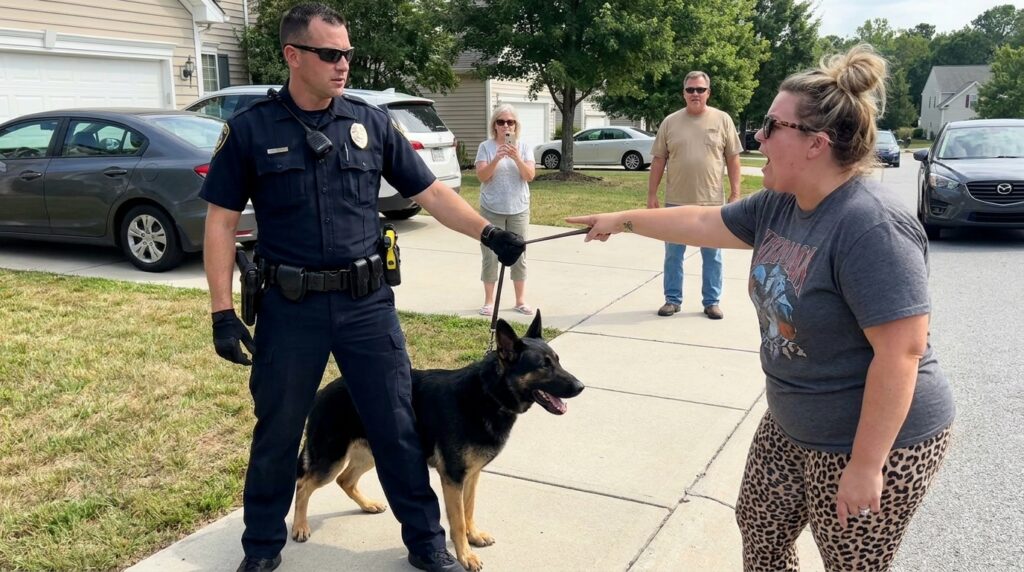
The K-9 officer had a tall, steady stance, his navy uniform crisp despite the oppressive heat. Heavy nylon utility gear clinked faintly with every breath he took—handcuffs, magazines, and the heavy plastic frame of a sidearm resting against his hip. His eyes were entirely hidden behind dark sunglasses that mirrored the suburban street, but his jaw line was set, an unyielding wall of real authority.

Beside his boot, the police K-9—a massive black-and-tan German Shepherd with sharp, upright ears and an open mouth—held a disciplined heel. The animal’s gaze was locked onto the sidewalk lane, its chest rising and falling with deep, controlled breaths, its very existence serving as a terrifying psychological mirror to the guilt trembling across the property line. The single leash running from the officer’s gloved hand to the dog’s heavy leather collar was taut, a line of pure tension holding the animal’s weight back without a single jerk.

Brenda stood three feet away at the lawn edge, her stocky posture twisted into a manic, defensive display. Her light hair had slipped completely from its messy bun, stray strands blowing across her oversized sunglasses. Her gray graphic T-shirt was smeared with dark streaks of dirt from her midnight digging, and her leopard-print leggings were coated in a fine layer of white surveyor’s chalk. She was thrusting a sharp, manicured finger directly into the space between her and the dog, her face contorted in a mixture of public panic and frantic justification.

“He was destroying the historical plat markers, Officer!” she shrieked, her voice cracking as it echoed off the stucco fronts of the neighboring houses. “He brought a crew out here to tear up the common area! Look at the lawn! Look at the stakes!”

David didn’t counter her shout. He kept his ghost ratio perfectly balanced, his face an unbending slate of calculated silence. He glanced toward the driveway band, where Sarah stood back near the rear bumper of their parked vehicle. Her dark top and denim shorts were stark against the white concrete, her hands raised at chest height, holding the smartphone completely steady. The glass lens caught the glare of the sun, tracking Brenda’s trembling finger, tracking the dirt on her clothes, documenting the entire frantic performance for a permanent digital repository.

“Officer,” David said, his voice low, carrying the gritty pragmatism of a man who relied entirely on physical anchors. “We have the whole thing on video from the second she walked onto our grass during the lunch hour. The security loop captured her pulling the iron stake out of the trench.”

Brenda’s arm thrust closer, her finger trembling within inches of the officer’s utility belt. “He’s lying! That video is altered! My husband signed the 1994 easement! The paper is in my house right now!”

The K-9 officer didn’t flinch. He didn’t look down at the yellowed blueprint Brenda was shaking in her left hand. His tall stance simply shifted, his heavy boot taking one precise, lateral step to the left, placing his body completely between Brenda’s pointing hand and the German Shepherd. He subtly shortened his grip on the leather leash, anchoring the dog tighter to his hip with mechanical restraint.

He didn’t raise his voice. He didn’t monologue about county ordinances or trespass laws. He simply raised his free hand, keeping the palm flat and low at chest level—a universal, unyielding command for physical distance.

“Ma’am,” the officer commanded, his tone clipped and holding the absolute weight of the law. “Step back and lower your hand.”

The words hit the sidewalk like a dropped weight. Brenda froze, her mouth remaining open mid-protest, her manicured finger hovering in the hot air for one long, agonizing second. The false authority she had spent decades cultivating over the cul-de-sac—the performance of a warden patrolling a kingdom of trash cans and grass lengths—shattered completely against the flat delivery of the command. Her stocky frame deflated, her arm dropping slowly back to her side as she looked from the unblinking reflection of the officer’s glasses to the steady digital shield of Sarah’s phone.

“The dog tracked the scent from the disturbed turf straight to your boots, ma’am,” the officer added, his voice cutting through the rising heat of the afternoon. “Keep your hands down and stay right where you are while we verify the digital plat.”

David watched her face turn the color of dry sand. The intellect behind her long campaign of harassment had run out of chess moves. The rusted cap she had buried, the yellowed papers she had brandished like shields—they were nothing but old iron and bad ink when measured against a working animal and a digital record that couldn’t be bullied from a sidewalk edge.

CHAPTER 5: THE UNDISTURBED ORANGE

The squad car’s mobile data terminal gave a single, low electronic chime that sounded clear across the quiet cul-de-sac.

The K-9 officer did not look up from the screen immediately. He leaned through the open driver’s side window of the cruiser, his broad shoulder pressing against the hot navy steel of the door frame, his fingers tapping a rhythmic pattern against the rugged laptop casing. The heat radiating from the vehicle’s engine bay smelled faintly of hot coolant and scorched asphalt, a heavy, mechanical scent that mixed with the dry dust kicked up from the curb line.

Brenda stood exactly where the command had left her, her feet pinned to the concrete edge of the sidewalk strip. The confidence that had sustained her through months of early morning surveillance and weaponized phone calls was leaking out through the seams of her posture. Her hands were down, her stocky frame slightly hunched, the yellowed blueprint clutched in her fist now nothing more than a wrinkled wad of paper. The sunglasses still masked her eyes, but the tight, white line of her mouth betrayed the sudden lack of a counter-move.

“Mr. Miller,” the officer said, his voice carrying the flat, unhurried cadence of a man reading a closed ledger. He stepped away from the cruiser, adjusting the heavy utility belt that clinked against his hip. “Come take a look at the official registry pull.”

The surveyor stepped forward, his boots crunching lightly over the loose shale near the trench line. David followed, his movements deliberate, his thumb pressing into the side of his trousers. On the screen, the county’s digital deed repository showed the complete history of the lot. There was no 1994 variance. The blue ink signature Brenda had held over the neighborhood for years belonged to a draft document—a preliminary proposal that had been formally rejected by the zoning board thirty years ago before being logged as an unverified artifact. The real record, permanently locked in the digital archive, showed the property line ran straight through the center of the very dirt Brenda had spent the night trying to turn over.

“It’s a duplicate,” Miller muttered, his gloved hand tracing the digital overlay. “The original draft went missing from the county records basement during the winter update in ninety-six. Her husband didn’t get a variance signed off. He took a discarded file before the clerk could shred it.”

David looked across the lot toward Brenda. The truth didn’t arrive with a dramatic flourish; it arrived with the weight of an old file that had finally caught up with its owner. The intellect she had inherited from her husband’s old deceptions was nothing but a forged legacy, a shield made of stolen paper that had finally met a system too rigid to bend.

Brenda didn’t scream this time. She looked at the officer, then at the smartphone Sarah still held steady from the driveway, its glass lens catching the uncompromising glare of the sky. The realization that her authority was completely unmasked in front of the witnesses she had tried to dominate seemed to age her in seconds. Her shoulders dropped. The manicured finger that had pointed so aggressively into the space of the law enforcement animal remained tucked against her side, dead and motionless.

“Ma’am,” the officer said, stepping into the space between the property line and her lot. His stance was an unyielding wall of professional finality. “The county records confirm the current markers are accurate. You’re being issued a formal citation for criminal trespass and tampering with a registered survey line. The homeowners have a recorded log of the damage. If you cross this line again before the court date, you’ll be taken into custody.”

She didn’t answer. She turned slowly, her leopard-print leggings covered in dust, her light hair spilling entirely from its bun as she walked back toward her own porch. Her front door opened with a dull scrape against the frame and clicked shut, the sound final and hollow against the stillness of the street.

David turned back to the boundary line. The ground was scarred where she had dug in the dark, the soil turned over and loose, but the iron rebar remained planted deep in the shale. Miller reached down, picked up one of the bright orange surveyor flags that had been tossed into the weeds, and cleared the dirt from the wire stem. He drove it back into the earth right beside the rebar anchor, the metal rod sinking true until the flag sat flush with the concrete lip.

Behind him, Sarah lowered the smartphone, the digital screen finally going dark. The cul-de-sac returned to its regular, desaturated quiet. The neighbors who had been watching from behind their blinds didn’t come outside; the status shift was absolute, requiring no public celebration to make it real.

David stood on his own asphalt, his eyes locked onto the small, bright square of orange vinyl as it caught the slight afternoon breeze. The property line was clean, the dust was settling into the gravel trap, and the boundary was entirely undisturbed.

Similar Posts

Leave a Reply

Your email address will not be published. Required fields are marked *