The Millimeter Horizon where the Rusted Pins of the Earth Hold Fast Against the Rising Noise

CHAPTER 1: THE IRON BOUNDARY

The heat in the valley didn’t rise; it sat on the grass like grease. Arthur Vance kept his thumbs hooked over the black foam of the mower handle, feeling the low, rhythmic rattle of the small engine through the bones of his wrists. The blade was sharp—he’d taken an angle grinder to the steel template on Tuesday night—and it sheared the fescue with a dry, mechanical snap. Two inches from his left boot heel, the sun-baked earth gave way to a thin strip of dead clover. Beneath that clover lay forty pounds of poured concrete surrounding a rusted iron rod driven six feet into the clay by a county surveyor in 1974.

Arthur didn’t look down at the pin. He didn’t need to. He knew its location by the way the grade of the land dipped toward Brenda’s driveway, a sharp concrete slant that smelled of old radiator fluid and sun-scorched lime.

Through the blue haze of the exhaust, a door slammed. The sound carried across the yard, flat and heavy.

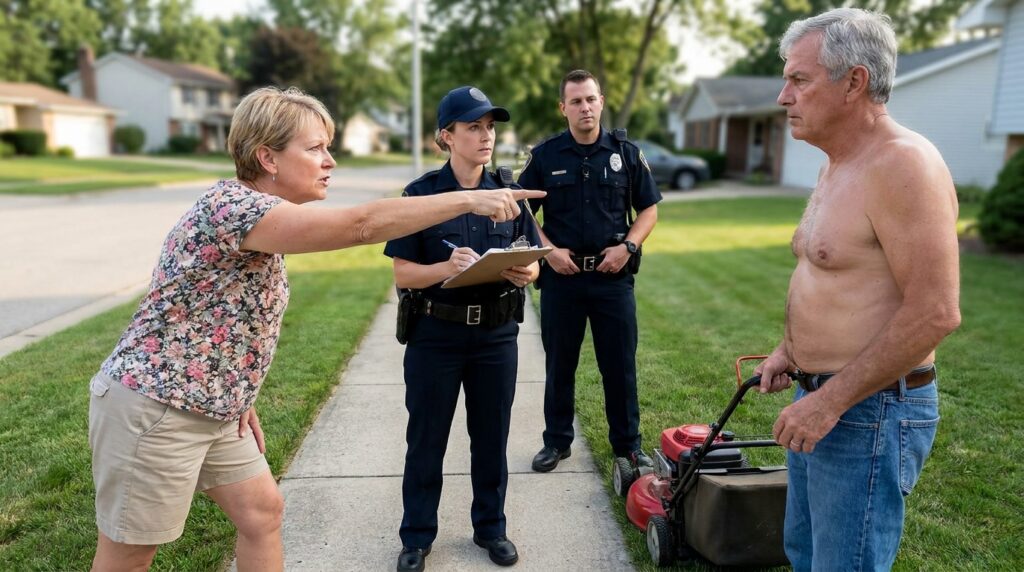
Brenda came down the porch steps with her phone already raised, her fingers clamped over the plastic case like an inspector checking a bad seal. Her floral blouse, bright as a roadside flare against the dead hedge line, billowed with her stride. She wasn’t walking the sidewalk; she was cutting across the lip of the asphalt, her white tennis shoes kicking up dust where the road met the gutter. Her face had already turned that thin, curdled color it took on whenever the mower started before noon on a Saturday.

Arthur didn’t slow the pace. He kept his shoulders rigid, his shirtless torso slick with grease and gray sweat, his old work jeans stiff with dried starch and starch-turnings from the machine shop floor. He had four passes left on the eastern edge.

“Arthur! Turn that damn thing off!”

The scream didn’t reach him as clear speech, just a tear in the engine’s drone. He pushed the machine past the old hickory stump, his eyes fixed on the line where his grass ended and her gravel began. He didn’t look at her until the front wheels of the mower cleared the iron pin by a single millimeter, the red deck hanging over the neutral zone.

Brenda stopped three inches from the handlebar. Her phone screen was live, a small digital eye tracking the sweat rolling down his ribs. Her index finger came up, shaking, pointing straight at the air between them. “You think you’re smart with that line, don’t you? Look at this pavement. Look at the rock you just threw into my side panel!”

Arthur pulled the throttle back. The engine died down to a wet, sputtering cough, then went completely black. In the sudden silence, the sound of insects in the dry brush seemed to grow louder, filling the space between the two houses like gravel shifting under a boot.

“The shroud’s down, Brenda,” Arthur said. His voice was low, dry from the heat, completely devoid of the rhythm she wanted. “It don’t throw rocks sideways.”

“It threw something. I heard it hit the door,” she snapped, stepping half a pace forward, her shoes crossing onto the clover. She held the phone closer to his face, her breath smelling of black coffee and mints. “I’ve got the county on the phone, Arthur. I’ve got them recording. You’re encroaching on the town easement, and you’re doing it maliciously.”

Arthur looked at the small silver watch on his left wrist. The glass was scratched from an old lathe accident. Eleven minutes past eleven. The regular morning patrol car usually turned the corner by the water tower around fifteen after. He didn’t move his hands from the rubber foam of the handle. He just waited for the white reflection of the light bar to crest the hill.


CHAPTER 2: THE CURBSIDE FRICTION

“The shroud is down, Brenda,” Arthur repeated, his forearm resting on the vibrating rubber of the handle. The heat from the exhaust manifold rose in oily waves between them, distorting the sharp floral pattern of her sleeve. “And the only thing hitting your pavement is the shadow of that hedge.”

Brenda’s chest heaved. The smartphone in her hand tilted, and for a split second, the glare of the noon sun caught the screen at a perfect oblique angle. Arthur’s eyes, trained by forty years of reading micrometer increments on oil-slicked steel, didn’t focus on the digital camera interface. He focused on the background application window she had open. It wasn’t the police dispatch screen yet. It was a high-contrast scan of an old plot map, the margins marked by a faint, blue-inked notary stamp from 1991—a document that shouldn’t have existed in the official county registry.

She saw him looking. With a quick, jerky twitch of her thumb, she swiped the screen black, her jaw tightening until the skin around her mouth went white.

“Don’t look at my phone, Arthur. You look at this curb,” she hissed, her voice dropping into a register that was far more dangerous than her public screams. She pointed her white tennis shoe toward the seam where the gray town asphalt met the gravel flare of her driveway. “Look at the pitting right there. Every time you bring this old piece of junk out here, you’re kicking up gravel from my transition strip. You’re eroding the base layer. I had an estimator out here last month from Piedmont Paving, and he told me the vibrations alone are cracking my apron.”

Arthur didn’t shift his weight. His work boots were anchored into the dry clay at the edge of his grass, right above where the surveyor’s iron rod sat in its concrete throat beneath the sod. “Piedmont Paving doesn’t do residential estimates for three feet of asphalt, Brenda. Not unless they’re already out here doing the county right-of-way.”

He knew how the world worked. He knew the cost of cold-mix asphalt, the price of a yard of crushed gravel, and the exact tone a municipal clerk used when they were trying to avoid a formal grievance. He also knew Brenda’s late husband had been an administrative helper for the water district before his heart gave out in the nineties. She had files. She had old carbon copies of utility maps that hadn’t been updated since the township re-zoned the orchards into half-acre lots.

Across the asphalt, the screen door of the Miller house creaked open three inches. A pale forearm appeared, holding a plastic pitcher of sweet tea, then vanished back into the shadows of the porch. The neighborhood was waking up to the theater. It was always the same script, played out on the hot strip of concrete that separated their lives.

“You think because you’ve been here since the trees were cleared that you own the air under the power lines,” Brenda said, her fingers tightening around the phone until her knuckles turned the color of lard. She took another half-step forward. The toe of her sneaker pressed into a tuft of un-mowed orchard grass that belonged entirely to Arthur’s deed. “But the town has an active ten-foot utility allowance from the centerline of the ditch. Your mower deck is twenty-one inches. You’re over the line by six, Arthur. Every single pass.”

Arthur looked down at her foot. The white rubber sole was touching a discarded rusted washer he’d dropped from his blade bolt three weeks ago. It sat precisely four inches on his side of the boundary.

“Brenda,” he said, his voice dropping into the quiet, transactional tone he used when an apprentice brought him a ruined piece of stock. “You’re standing on my grass.”

“I’m standing on public access!” She raised her voice again, the high pitch carrying down the block toward the cul-de-sac where two kids stopped their bicycles to watch. “I’m standing on the ground I pay municipal assessment taxes to maintain! You think you can just stand out here shirtless, looking like… like a vagrant, destroying my property value while I’m trying to keep this street looking respectable?”

She was performing now. She was looking past his shoulder toward the corner of the water tower road, her eyes scanning the shimmering horizon line for the dull white roof of a Ford Interceptor. She had already made the call—the phone was still warm from her cheek when she’d marched down the steps—and she was simply holding the line until the state or the county arrived to validate her perimeter.

Arthur didn’t give her the reaction she needed for her video. He didn’t swear, he didn’t raise his hands, and he didn’t step back onto his porch to hide his bare skin from the neighbors. He just reached down, his fingers catching the metal pull-start cord of the Craftsman. The braided nylon was frayed near the rubber handle, the grease from his palms turning the white fibers a dull, permanent charcoal.

“I’ve got three rows left near the ditch, Brenda,” he said, pulling the slack out of the rope until he felt the teeth of the flywheel engage against the compression stroke. “You might want to step back into your driveway. The exhaust on this thing blows to the right.”

“Don’t you dare start that engine while I’m speaking to you!” She lunged downward, her arm extending over the red steel cowling of the machine as if she could physically pin the flywheel with her palm. her phone screen flared again, and that old blue notary mark seemed to dance in the sun-glare right before his eyes. “If you pull that cord, Arthur, I’m telling the deputy you used the machine as a weapon. I’m telling them you lunged at me.”

Arthur didn’t pull. He held the tension on the rope, his eyes locked on her face. He could hear the faint, high-frequency whine of an alternator coming down the hill behind his garage. The patrol car was early.

CHAPTER 3: THE APPROACHING TREAD

The whine of the alternator resolved into the slow, gravel-crunching bite of sixteen-inch steel-belted radial tires turning off the county blacktop. Brenda didn’t drop her arm. Her index finger remained stiff, suspended two inches above the red paint of the mower deck, a static pointer marking the legal void she claimed as her personal territory. The skin of her forearm was slick with sweat that had turned milky under her heavy application of drugstore lavender lotion, the scent hanging thick in the stagnant pocket of air between them.

Arthur lowered his grip on the starter rope by a fraction of an inch, letting the braided nylon slide back into the recoil housing with a soft, dry hiss. He didn’t turn his head toward the road. He watched the reflection in Brenda’s oversized sunglasses change from the pale green of his porch to the boxy, high-gloss white hood of a county-issue Ford Interceptor. The cruiser came to a stop forty feet away, its front bumper slightly overhang-riding the lip of the common ditch line. The engine kept running, a low, hydraulic thrum that vibrated through the parched sod and into the soles of Arthur’s work boots.

“He’s here, Arthur,” Brenda muttered. Her voice didn’t rise; it fell into a flat, triumphant drone that matched the mechanical idle of the squad car. She didn’t drop her phone. She simply lowered it to her hip, keeping the screen active, the pale blue glow of that 1991 document scan fading beneath the harsh, unshielded overhead sun. “Now you tell him about the stones. You tell him why your machine doesn’t have a factory discharge chute.”

The cruiser’s door didn’t slam with a sharp ring; it closed with the heavy, rubber-sealed thud of a vehicle that had seen three hundred thousand miles of county service. Arthur watched the silhouette of Officer Ramirez break the glare of the windshield. Her uniform shirt was crisp, the sharp polyester creases holding their edge against the noon humidity, but her leather utility belt gave off the dry, organic creak of old gear that had been conditioned with mineral oil too many times. Behind her, from the passenger side, Officer Miller stepped into the gravel flare, his hand not on his holster but resting flat against the heavy steel buckle of his duty belt, his eyes already sweeping the distance between the two mailboxes.

Arthur shifted his thumbs back to the top of the handlebar. His bare chest felt tight under the dry wind that blew off the asphalt, the dust from Brenda’s transition strip settling into the gray hair at his temples. He didn’t offer a greeting. In the valley, you didn’t talk until the shield crossed the ditch line; anything else looked like an early plea.

“Afternoon,” Ramirez said as she reached the edge of the clover strip. Her boots were black leather, polished but scuffed at the toe caps from the iron foot-pegs of the station scales. She didn’t look at Arthur’s lack of a shirt, nor did she look at Brenda’s floral blouse. Her gaze dropped instantly to the red housing of the Craftsman mower, tracking the wheel path through the cut fescue until she found the exact spot where the grass changed from two inches to four. “We got a call about a line dispute and a regular disturbance with flying debris. Who’s the caller?”

“I am,” Brenda said, stepping forward until the white canvas of her sneaker completely obscured the rusted iron washer in the dirt. She held her phone up like an exhibit in a probate hearing. “Brenda Geller. Eleven-fourteen Circle Drive. I have the active easement maps right here on my screen, Officer. He’s been running this commercial-grade equipment without a stone guard for forty minutes. He’s deliberately throwing limestone aggregate onto my apron to pit the surface.”

Ramirez stopped. She didn’t look at the phone Brenda was thrusting toward her face. Instead, she unclipped a heavy, brushed-aluminum clipboard from her vest tab, the metal corners pitted with gray oxidation from winter salt spray. Attached to the top sheet of white ledger paper was a photocopied grid map from the county tax assessor’s office—the legal master that every deputy carried when the calls came out of the subdivisions.

“Mr. Vance?” Ramirez asked. Her eyes turned to Arthur, steady, unaffected by the heat or Brenda’s high-frequency breath. “You want to clear the machine while we look at the pins?”

“The machine stays right where the line is,” Arthur said. His voice was a level monotone, the same tone he used when the line supervisor at the foundry tried to log a short heat on the books. “The deck is twenty-one inches. The left wheel is two inches inside the 1974 survey marker. If I move it back, she’ll say I altered the evidence.”

Brenda let out a short, reedy laugh that ended in a cough. “Evidence? Look at him, Officer. He’s been standing out here since ten o’clock trying to bait me into a confrontation. He knows my late husband worked the utility logs. He knows those old pipes run three feet under his current garden bed, and he’s trying to disrupt the town right-of-way before the inspection crew comes through next month.”

Arthur’s eyes narrowed by a millimeter. He didn’t look at Brenda; he looked at the top page of Ramirez’s clipboard. The document pinned there was a clean, digital printout from the 2022 registry, but beneath the modern laser font, there was a handwritten pencil notation in the margin that read: See Geller modification file ’91.

Miller had moved around the back of the mower now. His boots made a dry, rhythmic crunching sound in the orchard grass as he walked the boundary toward the ditch. He didn’t have his notebook out. He was looking at the ground, his eyes searching for the specific yellow plastic caps the utility company used to flag the gas mains, or the older, unpainted iron stakes that the modern sod had long since swallowed.

“Let’s keep this calm and figure out what happened here,” Ramirez said, her hand flattening against the top of the aluminum board as a sudden gust of wind caught the ledger paper, making the sheets snap like a dry branch. She turned her torso by thirty degrees, a deliberate physical block that forced Brenda to step back off the clover or risk touching the heavy nylon of the officer’s shoulder pad. “Mr. Vance, you say you haven’t crossed the pavement seam?”

“I haven’t crossed the iron,” Arthur said. He reached down with his right hand, his calloused palm catching the grease-caked casing of the mower’s oil dipstick, his fingers feeling the heat of the crankcase through the iron threads. “And the iron doesn’t move for the water district, and it doesn’t move for Brenda.”

CHAPTER 4: THE THRESHOLD SQUEEZE

Brenda’s shoulder joint hitched, her weight rolling onto the ball of her right foot as she drove her smartphone forward like an index finger. Her floral sleeve caught the full glare of the cruiser’s overhead light bar, casting a moving violet shadow across the red metal cowling of Arthur’s parked machine. The air was thick with the scent of hot engine block and the flat, chemical stink of old gasoline sitting in a rusty float bowl.

“Look at the screen, Deputy!” Brenda’s voice had risen past the drone of the idling Interceptor, catching the attention of a man across the street who stopped uncoiling a garden hose to look. “The 1991 utility map shows a three-foot common variance right where his left wheel is resting. My husband signed off on it himself before the water line was laid. It’s a matter of record, and he’s violating it every single Saturday!”

Officer Ramirez didn’t look down at the glass face of the phone. Her fingers remained flat across the aluminum edge of her clipboard, her thumb holding down the modern county tax map. The paper didn’t have the old blue-inked notary stamp Brenda was flashing; it was clean, white, and divided by thin, unbroken black coordinate lines that allocated the land down to the hundredth of an acre.

“Ma’am, keep your hand back from the machine,” Ramirez said. Her voice didn’t carry any anger, but it possessed the heavy, unyielding weight of an iron latch dropping into a slot. She turned her torso by a fraction of an inch, using the stiff leather corner of her radio pouch to nudge Brenda back from the neutral strip of clover. “Mr. Vance, step around to the side of the deck. Miller, get the metal locator out of the trunk.”

Arthur didn’t pull his hands from the rubber foam of the handle. His calloused palms were gray with graphite grease from the mower’s height-adjustment lever, the skin dry and grooved like the face of an old file. He watched Officer Miller walk back to the white cruiser, his heavy utility boots making a short, sharp crunching sound against the loose limestone aggregate at the curb line. The trunk lid lifted with a metallic pop, revealing the rusted spare tire well and the gray canvas bag that held the station’s survey tools.

“The 1991 papers don’t change the concrete, Brenda,” Arthur said. His voice stayed flat, a low, mechanical growl that barely cleared the heat shimmer rising from the cylinder head. “Your husband drafted a lot of lines that didn’t get recorded at the county courthouse. He liked the look of a red pencil on a blue blueprint.”

Brenda’s face twisted, the pale skin around her nose turning the color of skim milk. She turned her phone toward Ramirez, her thumb frantically scrolling through a PDF document that showed a crude, hand-drawn map with an old notary seal at the bottom margin. The ink on the digital scan looked dark, almost purple against the gray grid lines, a remnant of the old spirit duplicators the water district used before the township centralized the engineering offices.

“It is recorded!” she snapped, her voice dropping into a sharp, transactional rattle. “It’s signed by the clerk of courts. The common easement allows for any neighboring property owner to clear debris up to three feet past the ditch line. You’ve been cutting my fescue down to the roots to make my side look un-mowed, Arthur. It’s a deliberate reduction of my property appearance.”

Ramirez tapped her pen against the aluminum board, the sound a steady, rhythmic click like a solenoid firing on a machine line. She looked from the digital scan on Brenda’s phone to the physical grass edge between the two properties. The cut fescue stopped cleanly along a straight line that followed the exact path of Arthur’s left wheels. Not a single blade of Brenda’s taller orchard grass had been nipped by the steel template beneath the deck.

“Miller,” Ramirez called out over her shoulder, her eyes never leaving the property line. “Bring the schematics for the 1974 master plat. The ones with the original iron stakes noted.”

Miller came back across the ditch, the gray canvas bag slung over his shoulder by a faded nylon strap. His hands were covered in thin, black mechanics’ gloves, the palms reinforced with Kevlar stitching that clicked against the metal shaft of the electronic pipe finder. He didn’t look at either neighbor; he kept his eyes on the dry clay, searching for the small, round depression where the sod had tried to heal over the surveyor’s work.

“We got a discrepancy here, Ramirez,” Miller said, his boots freezing right at the edge of the asphalt seam. He didn’t drop the machine; he just held it like an old gun, the gray plastic search head swinging an inch above the clover. “The old water district lines show a variance file that was opened in ninety-one but never stamped by the recorder. It’s listed as a pending draft on the historical log.”

Arthur felt a small, hard knot of muscle tighten in his jaw. He didn’t look down at his boots, but his heel pressed into the exact patch of earth where the iron rod sat six feet deep in the gray subsoil. He knew what was on that draft. He’d seen the paperwork thirty years ago when Brenda’s husband had tried to run a two-inch lateral line under his garden shed without paying the tap fee. His late wife had spent three days at the county seat with a leather folder full of original title receipts, ensuring that the clean deed stayed unblemished by any temporary utility access.

Brenda stepped forward again, her floral blouse brushing against the aluminum frame of Ramirez’s clipboard. Her fingers were trembling now, the phone screen flickering as the battery indicator dropped into the red. “It’s not a draft! It’s an approved modification! If you let him mow this last row, he’s going to destroy the ground markers the town needs for the drainage project next month!”

Ramirez didn’t answer her. She raised the clipboard to chest height, completely breaking the line of sight between Brenda’s phone and Arthur’s face. “Mrs. Geller, go back over to your driveway while Officer Miller runs the locator. We’re not doing this across the deck of a running machine. Move back now.”

The silence that followed was heavy, broken only by the low, regular throb of the Ford’s radiator fan kicking on against the noon heat. Arthur didn’t move. He stood shirtless in the sun, his thumbs hooked over the foam, waiting for the first ping of the detector to strike the iron beneath his feet.

CHAPTER 5: THE INTERACTION LINE

The heavy spring clamp of the aluminum clipboard clicked shut with a dull, flat snap that cut straight through the low hum of the squad car’s engine. Officer Ramirez adjusted her footing, her left service boot sliding an inch into the dry orchard grass, her shoulder silhouette completely eclipsing Brenda’s outstretched smartphone. The air hanging over the property line had turned thick, tasting of unburned oil and the alkaline bite of limestone dust kicked up from the curb.

Brenda didn’t drop the phone. Her knuckles remained pasty white against the plastic casing, her short blond hair clinging to her temples in damp streaks. She tried to peer over the rigid edge of the officer’s shoulder pad, her voice dropping an octave into a forced, shaking precision. “You’re not looking at the dates, Deputy. You’re letting him stand there on my transition strip while his machine sits right over the main lateral. My husband didn’t draft that line for nothing. The town registry has the pending file under Geller-Vance ’91. Look at the margin notes on your own paper!”

Ramirez didn’t turn around to address her. She held her line, her eyes scanning the dry sod between Arthur’s work boots and the gravel flare. “I’m looking at the plat map that came from the county recorder’s office twenty minutes ago, Mrs. Geller. It doesn’t have a pending status. It has an iron pin designation from the 1974 master survey. Miller, where’s that locator head?”

Arthur stood completely still behind the black foam handle of the Craftsman. He could feel the engine block cooling beneath his bare ribs, the heat radiating through his jeans like the face of a cast-iron stove left on after the shop closed. He didn’t offer to step away from the machine. His boots were anchored over the hidden marker, his heel pressing into the small, dry depression where the fescue gave way to the clover. He knew exactly what Miller was going to find with that machine, but his eyes were fixed on the pencil marking on Ramirez’s paper. The letters Geller-Vance ’91 weren’t in the standard county clerk’s script. They were written in the blocky, heavy-handed style of an old water district line foreman who spent thirty years using grease pencils on tracing cloth.

“The 1991 paper was a request, Brenda,” Arthur said. His voice was raw, the words coming out dry and low, barely lifting past the red steel deck of his mower. “Your husband brought it over in a manila folder on a Sunday morning while the concrete on my patio was still curing. He wanted three feet for a clean-out valve so he wouldn’t have to trench his own driveway. My wife told him no before he finished his coffee.”

Brenda’s mouth opened, her lower lip trembling until a small bead of saliva caught the sun-glare at the corner of her jaw. “She didn’t have the title cleared! The old orchard deeds had a standard five-foot municipal reservation from the ditch centerline. He had every right to sign that modification. He was the district clerk!”

“He was an assistant, Brenda,” Arthur said. He didn’t raise his hand, but his thumb traced the worn rubber grip of the throttle lever. “And an assistant can’t sign away an iron boundary pin just because he doesn’t want to dig through his own rock.”

Miller had reached the center of the clover strip now. The electronic pipe finder hummed in his black-gloved hands, a high, rhythmic buzz that altered its tone whenever the circular plastic search head passed over a rusted nail or an old piece of wire fencing buried in the clay. He swept the machine in a two-foot arc, his shoulders hunched under the weight of his vest, his eyes tracking the red digital needles on the small control box strapped to his waist.

“Got a hit here, Ramirez,” Miller called out, his boot heel tapping a spot four inches to the left of Brenda’s sneaker. “But it isn’t an iron pin. It’s an old cast-iron gate box. Looks like an unrecorded shut-off valve for the old lateral.”

Brenda’s chest expanded under her patterned blouse, her finger thrusting back toward the machine screen. “See! I told you! The lateral is right there! That valve belongs to the township utility grid, and his mower wheels are sitting directly on top of the access throat. That’s a Class B misdemeanor obstruction under county code!”

Officer Ramirez stepped forward, her leather utility belt creaking as she bent her knees to inspect the small circle of rusted iron Miller had uncovered with his boot. The metal cap was pitted, the square nut in the center filled with dry gray silt and dead grass roots. She didn’t look back at Brenda. She tapped the edge of her clipboard against her knee, her expression hardening as she noticed the specific ink discoloration on the document Brenda was holding—the purple mimeograph dye was faded, but the date at the bottom didn’t match the 1991 file. It said Draft Phase: September 1993.

Arthur didn’t shift his stance. A new vibration had entered the neighborhood grid—the distant, metallic rattle of a town utility truck coming down from the water tower hill. The situation wasn’t flattening out; it was pulling more weight onto the concrete strip. He could see the yellow strobe light on the truck’s cab flashing against the dry leaves of the oak trees, a regular, rhythmic warning that meant Brenda’s false call had gone all the way to the municipal supervisor’s desk. She had tried to lock him out of his own yard using her husband’s old workspace files, but she hadn’t accounted for the clean title his wife had paid off three decades ago.

“Mr. Vance,” Ramirez said, straightening up until her cap shadow fell across his chest. “Did your wife ever file a formal revocation for the utility access after ninety-one?”

“She didn’t have to file a revocation,” Arthur said, his fingers tightening on the mower handle until the black foam groaned against the steel tubing. “The variance never went past the first reading at the town hall. Brenda knows that. She’s got the rejection notice in the same folder she took that scan from.”

Brenda’s phone clicked as her thumb struck the power button, the digital screen going black in an instant as she pulled the device back against her stomach. “The rejection was stayed! We had the administrative extension through the end of the decade!”

The town truck braked at the curb line, its air brakes releasing with a loud, mechanical hiss that left a white cloud of dust hanging over the ditch. The door opened, and a man in an orange high-visibility vest stepped out onto the asphalt, a long steel T-wrench balanced on his shoulder like an iron bar.

CHAPTER 6: THE SHIFTING WEIGHT

The diesel exhaust from the town utility truck settled over the hedge line like unwashed wool, heavy and greasy with sulfur. The man in the orange high-visibility vest stepped off the cab run-board, his heavy-lugged rubber soles crunching into the dry limestone dust of the curb. The five-foot iron T-wrench balanced across his neck gave off a flat, zinc-plated ring every time his collar bone struck the shaft.

Arthur didn’t alter his grip on the Craftsman’s handle. He watched the utility worker approach the clover line, his eyes tracking the grease-darkened leather of the folder the man carried tucked under his armpit. It wasn’t a standard tablet; it was a bound ledger book with oil-cloth covers, the kind the public works grid foremen used to log physical anomalies that never made the digital conversion down at the county annex.

“What’s the freeze here, Ramirez?” the worker asked, his voice coming out as a wet, gravelly rasp from thirty years of breathing trench dust. He stopped three feet from the mower’s front axle, his eyes dropping to the newly uncovered cast-iron gate box. He didn’t look at Brenda’s phone or Arthur’s lack of a shirt. “We got an emergency call from dispatch about a localized line blockage and property sabotage. Who requested the line key?”

“I did,” Brenda said, her white sneaker pivoting on the grass to clear the path for him. She pointed her phone screen toward the heavy T-wrench. “The Geller-Vance lateral has an unrecorded check-valve right there under his wheel track. He’s deliberately compacting the fill dirt to crush the service sleeve. I want the main isolated and locked off before my basement backup gets worse.”

The worker looked down at the rusted iron cap Miller had scraped clean with his boot. He didn’t use his hands; he just tapped the square nut in the center with the hardened tip of his iron wrench. The metal gave off a low, solid thud—the sound of solid clay underneath, not an empty vault.

“This box has been cold since seventy-six, lady,” the worker said, pulling a stubby grease pencil from behind his ear to scratch a dull blue mark across the iron lip. “This was the old orchard feed line before they laid the twelve-inch main under the north ditch. There ain’t no water in this throat to shut off.”

Arthur felt the skin across his shoulder blades tighten under the dry wind. He didn’t drop his hands to his pockets, but his eyes locked onto the oil-cloth ledger book as the worker opened it against his thigh. The top page wasn’t a clean white tax plat; it was a hand-washed blueprint from September 1993, colored with bright red grease marks that slashed across the boundary line of Arthur’s lot.

“Check the modification registry on page twelve, son,” Arthur said to the worker, his voice level and dry as old cedar. “The ninety-one draft was pulled back by the county board because the engineering crew found out the easement lacked a proper signature from the true deed holder.”

Brenda’s phone clicked against her belt buckle as her hand dropped, her sunglasses slipping down the bridge of her nose to reveal the red, sun-strained rims around her eyes. “The signature was grandfathered through the district water board! My husband had the administrative sign-off! He kept the copy right here in our office for thirty years!”

“An assistant can’t sign an easement over land he don’t own, Brenda,” Arthur said, his fingers remains clamped on the black rubber foam of the mower handle. “And your husband knew that when the county sent the rejection letter back in ninety-three. That’s why he kept the file in his desk instead of sending it down to the courthouse.”

Officer Ramirez stepped between them again, her leather utility belt giving off that familiar organic creak as she reached out to touch the corner of the worker’s ledger book. Her fingernail tapped a small, faded square of purple ink at the bottom of the blue sheet—a stamp that read: Voided by Recorder – Incomplete Title.

The silence that followed was heavy, filled only by the distant, rhythmic thrum of the truck’s air compressor and the dry rattle of a locust somewhere in the old hickory stump. Arthur didn’t move his boots. He could see the decoy narrative Brenda had built for decades—the myth of the hidden utility right-of-way she used to control his fence line—crumbling under the weight of the old public works book. But his own final reality, the small piece of paper his wife had buried deep inside a tin box in their cedar chest before the illness took her, remained locked away from all of them.

“Miller,” Ramirez said, her face turning back toward the white cruiser. “Get the county supervisor on the radio. Tell them we have a civil boundary dispute using non-current municipal documents to summon emergency personnel.”

Brenda took two steps back toward her driveway, her floral blouse catching on a dry twig of the hedge line with a sharp, tearing pop. Her finger was still pointing at Arthur, but the strength had gone out of her wrist, her smartphone screen reflecting nothing but the gray, sun-cracked asphalt of her own empty apron.

CHAPTER 7: THE UNYIELDING CORE

The steel edge of Miller’s trench shovel bit into the baked orchard grass with a flat, metallic ring that jarred up through the wood handle. He threw his weight onto the iron step of the blade, his heavy boot heel forcing the metal three inches down into the dry, grey clay. A small cloud of fine silicate dust puffed out across the seam of the property line, settling on the white rubber trim of Brenda’s sneaker.

Arthur didn’t shift his palms from the foam grip of the mower. The engine housing beneath his forearms was clicking now, the hot aluminum shrinking in the dry wind as it shed the last of its operational heat. He watched the dirt curl off Miller’s shovel—not the loose, dark loam of a recently dug utility ditch, but the hard, flinty subsoil that hadn’t been turned since the county graded the original county line fifty years ago.

“Watch the clearance, Miller,” Ramirez said, her hand resting flat on the top edge of her clipboard. Her voice carried no more weight than a machine belt sliding over a pulley, but her boots didn’t move from the neutral zone of clover. “The original master coordinates show the datum point exactly twenty-four inches off the concrete apron. If the pin isn’t there, the entire subdivision plat shifts out to the township highway.”

Brenda took a step forward, her phone screen clutched against the front of her bright blouse like a shield. The battery icon was dark now, the digital scan of the 1991 paper locked behind a rectangle of dead black glass. Her lower jaw was set, the tendons in her neck tight under the dry midday light. “It’s not there, Deputy. My husband verified the lateral coordinates himself when they put the drainage grates in. The state took that three-foot section back during the orchard clearance. If he’s dug past the transition gravel, he’s trespassing on my private lot lines.”

The utility worker in the orange vest didn’t lift his T-wrench. He stood with his boots planted on the dry asphalt of the gutter, his oil-cloth ledger book open to the 1993 rejection notice. He spit a dark stream of tobacco juice onto the limestone rock at the curb. “The state didn’t take nothing on this side of the ditch, lady. The water board tried to claim a secondary run for the pressure release, but the court threw it out because the original land grants carried a non-severable surface title. If there’s an iron rod down there, it belongs to the man with the master deed.”

Arthur let his breath out through his nose, slow and quiet. His eyes remained fixed on the small square hole Miller was clearing. He knew the layout of the iron down to the millimeter. He’d helped the county team set the reference markers when his late wife, Martha, brought the certified land patents back from the state archives in ninety-four. Brenda’s husband had spent years using his position at the utility office to shift the imaginary lines on the subdivision sketches, trying to carve a clean, three-foot buffer zone out of Arthur’s grass so he could store his flatbed trailer without violating the county setbacks. But Martha had seen the play before the first post-hole was dug.

“Got steel,” Miller muttered. He dropped the shovel, his black-gloved fingers reaching into the hole to tear away a thick clump of matted fescue roots. He took a small brass brush from his vest pocket and scrubbed the top of an object buried six inches beneath the grade. “It’s an un-cleared surveyor’s stake, Ramirez. It’s got the old 1974 county stamp right across the crown. No lateral sleeve, no utility variance. The metal’s solid.”

Ramirez walked over to the edge of the pit, her leather utility belt giving off a sharp, dry creak as she leaned down to verify the stamp. She checked the alphanumeric sequence against the ledger sheet pinned to her clipboard, her pen drawing a thick, decisive black line through the pencil notation Brenda had spent forty minutes defending.

“The marker holds, Mrs. Geller,” Ramirez said, straightening her torso until her cap brim completely blocked the sun from Brenda’s eyes. “The 1974 boundary is the active legal baseline for this entire block. The mower deck is two inches inside the Vance lot. There is no municipal easement encroachment, and there is no property damage to your apron.”

Brenda’s fingers opened, the dead smartphone slipping an inch before her palm caught the plastic casing against her shorts. Her face had gone completely gray, the color of wet lime on a basement wall. She looked at the utility worker, then at Miller, her voice coming out as a dry, breathless whisper that barely carried across the ditch. “The file was extended. My husband had the signature from the road commissioner. It was in the desk… it’s part of the neighborhood record.”

“The road commissioner didn’t have the authority to alter a registered patent, ma’am,” Ramirez said, her voice dropping into the flat, final tone of a report being logged into a station computer. “The utility truck is going to clear the lane now. Miller, fill that hole back in.”

Arthur didn’t take his thumbs off the foam handle. He watched Brenda turn her back to the sidewalk, her white tennis shoes dragging through the dry limestone dust as she walked toward her porch steps. The floral blouse looked small now, the bright pattern losing its color against the shadow of her overgrown privet hedge. She had spent thirty years relying on the authority of an old desk file to crowd his space, never knowing that the real truth of the land—the clean, unencumbered title Martha had recorded in the deep archives—was something she could never touch with a phone call or a fake notice.

“Mr. Vance,” Ramirez said, turning her clipboard toward him as Miller began kicking the dry clay back into the hole. “You can finish your lawn now. We’ll be filing a formal report regarding the misuse of the municipal dispatch line with the town clerk.”

Arthur looked at the rusted red metal of the Craftsman deck, then at the single row of tall fescue remaining along the ditch. The sun was directly overhead now, the shadow of his machine falling straight down between his boots, exactly where the iron pin held the earth together.

CHAPTER 8: THE IMMOVABLE GRADIENT

The heavy iron T-wrench lifted off the unrecorded shut-off cap with a coarse, rusty ring that seemed to draw the last line of institutional presence out of the lot line. The public works driver hoisted the zinc-plated shaft across his orange-vested shoulder, the steel buttons of his harness ticking against the metal as he turned back toward the idling truck. The dust from Miller’s shovel had already settled, leaving a gray, velvety rim over the loose limestone aggregate at the gutter.

Arthur didn’t watch the utility cruiser pull away from the curb. His palms remained locked into the black rubber foam of the Craftsman, feeling the absolute stillness of the dead piston through the tubular steel frames. The sun had crossed the centerline of the ditch now, its unshielded vertical glare bleaching the green turf until the dividing line between his fescue and Brenda’s orchard grass looked like a seam in an old sheet of tin.

Across the asphalt transition, the white screen door of the Geller house hit the frame with a dry, wooden click that carried no echo. Brenda’s floral blouse had vanished into the interior darkness of her hallway, leaving nothing on her concrete porch but a plastic lawn chair and the blue, unmoving shadow of her overgrown boxwood hedge. The window blinds in the Miller house down the street dropped back into place, their thin vinyl slats snapping shut one by one until the block looked completely hollowed out by the heat.

“She won’t be calling the non-emergency board again this season, Mr. Vance,” Officer Ramirez said, her fingers sliding the carbon sheets of her ledger back beneath the heavy spring of her aluminum board. The metal plate gave off a short, clean pop as it seated. She adjusted her utility belt, the thick nylon pouches shifting against her hip with that slow, organic creak of scuffed leather and mineral oil. “Miller’s report is logged directly to the precinct desk. The surveyor’s pin is the only document the county recognizes on the line.”

Arthur looked at the small square of fresh gray earth where the iron rod lay buried beneath the clover. “The pin was set by a man who knew how to measure an acre, Officer. It don’t widen for an office file.”

“No,” Ramirez said, her eyes dropping one last time to the red deck of the mower before she turned toward her cruiser. “It doesn’t. Have a good afternoon, sir.”

Her boots made a loose, rhythmic crunching sound against the roadside gravel as she walked back to the white Interceptor. The squad car shifted into gear with a low, hydraulic click, its radial tires biting into the hot asphalt as it rolled down the hill toward the water tower road, leaving the block entirely to the hum of the cicadas in the hickory stump.

Arthur waited until the white roof of the sedan cleared the line of the horizon before he lowered his torso over the handlebars. His calloused fingers found the nylon handle of the starter rope, the braided fibers rough and oily against his skin. He didn’t pull it hard. He just drew the slack out of the casing until he felt the internal tooth catch the rim of the heavy cast-iron flywheel inside the engine cowl.

With a short, practiced snap of his wrist, the engine caught. The two-stroke cylinder fired with a wet, smoky rattle that cleared the blue oil vapor out of the muffler in a single, pale cloud. The vibration entered his wrists again, a low, mechanical thrum that felt solid, unyielding, and perfectly balanced against the weight of the grade.

He didn’t look back toward Brenda’s dark front windows as he pushed the machine through the final pass. The left wheels followed the exact edge of the limestone gravel, the sharp steel template beneath the deck shearing the last row of fescue down to the identical two-inch margin he’d maintained for thirty years. Every revolution of the blade was a cold calculation of space and title, paid for three decades ago when Martha carried the certified state patents home in her lap. The neighborhood could watch from behind their vinyl blinds all they wanted; the boundary had been driven six feet into the clay, and the rusted pins of the earth were never going to move.

Similar Posts

Leave a Reply

Your email address will not be published. Required fields are marked *