The Iron Easement: A Narrative of Gritty Pragmatism, Rusted Boundaries, and the Weight of Labor
CHAPTER 1: THE FIRST STAKE
The fiberglass rod didn’t slide into the earth; it fought it. Jesse leaned his weight into the T-handle, feeling the vibration of dry gravel and impacted yellow clay grind through the palms of his split-leather gloves. The heat in the cul-de-sac didn’t rise; it sat, heavy with the smell of scorched fescue and two-cycle exhaust. He drove the stake down until exactly eight inches of fluorescent orange vinyl fluttered against the gray sod.
To the delivery trucks and the mail carriers, it was just a plastic ribbon. To Jesse, it was a coordinate locked against a county satellite three hundred miles above.
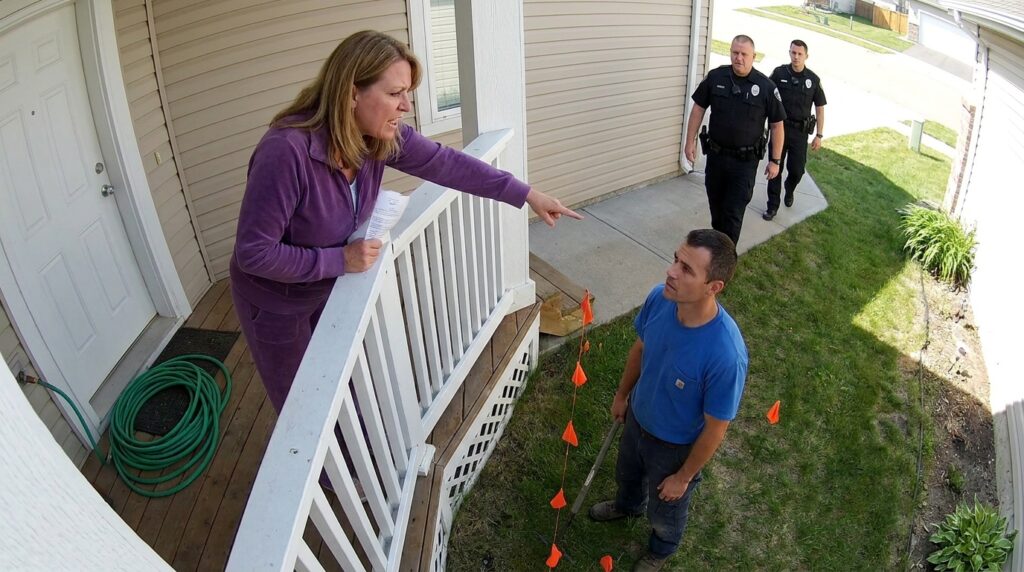
He wiped his brow with his forearm, leaving a smear of dark loam across his forehead. He didn’t look up at the house, but he knew the blinds had twitched. They always twitched by the third stake. The house was a pristine, multi-gabled split-level with vinyl siding so clean it looked like plastic wrap. On the side yard, a green garden hose lay coiled with mechanical precision, its brass nozzle gleaming like a shell casing.
Jesse unclipped the ruggedized tablet from his tool belt. The screen was spider-webbed across the corner, the glare of the July sun turning the vector lines into green streaks. He zoomed into Lot 42. A blinking blue dot marked his boots. According to the city grid, the four-foot easement ran parallel to the white vinyl fence line, but there was a dead spot in the telemetry—a jagged gray anomaly where the municipal fiber route met the old residential water main. It shouldn’t have been there. It looked like an old patch, or a line laid without a voucher.
A screen door clicked. It wasn’t the slam of an angry kid; it was the heavy, intentional pop of a spring-loaded hinge.
Jesse didn’t turn around. He reached into his canvas pouch, drew a second orange flag, and measured three paces north along the property line. He knew the boots were coming before he heard them—the soft, rhythmic thud of thick-soled sneakers moving across expensive turf.
“You’re two feet over the marker from five years ago,” a voice said.
Jesse kept his eyes on the ground. He looked at the white vinyl fence. The bottom rail was stained with a faint green crust from a lawn chemical spider. He drove the second stake down. The metal tip struck something hard—not stone, but the dull, flat thud of treated iron or thick concrete just four inches beneath the topsoil. The vibration stung his wrists.
“Did you hear me, young man?”
Jesse straightened his spine slowly. The vertebrae in his lower back gave three distinct pops. He turned to face the porch. She was standing three steps up, elevated behind a white vinyl railing that looked like a row of teeth. Her purple tracksuit was zipped tight despite the eighty-five-degree heat, and a pair of massive, tortoise-shell sunglasses sat atop a cap of stiff, bleached hair. In her left hand, she held a crisp, uncreased sheet of standard copy paper.
“The city map says the line is here, ma’am,” Jesse said. His voice was flat, dried out by road dust and cheap canteen water. He didn’t offer a smile. In this code, a smile was a sign of weakness or an admission of guilt.
She didn’t look at his tablet. She raised the paper, her thumb pinned against the edge like a splint. “I have the deed restriction right here. No municipal excavation within five feet of an existing residential structure. Your flags are on my grass.”
Jesse looked down at the orange vinyl fluttering by his boot. Between the plastic ribbon and her fence, the earth was dry, cracked, and waiting for the blade. He noticed a small, clean scar on the vinyl fence post directly behind her—a drill hole that had been filled with gray silicone, completely mismatched with the white plastic. It was exactly where the telemetry anomaly ended.

CHAPTER 2: THE SHADOW ON THE SOD
“Section Fourteen, Paragraph B of the county code doesn’t apply to municipal service mains, ma’am,” Jesse said. He didn’t lift his fingers from the fiberglass shaft of the second stake. The orange vinyl ribbon hissed as a hot breeze swept off the asphalt of the cul-de-sac. “You’re reading the residential setback. This is a Class-Three utility corridor. The city owns forty-eight inches from the curb inward, regardless of who paid for the sod.”
The woman behind the white vinyl railing didn’t blink. Through the dark, amber-tinted distortion of her oversized lenses, Jesse could only see the reflection of his own dust-streaked blue T-shirt and the bright, unnatural glare of the marking flags. The copy paper in her hand didn’t tremble. It was heavy bond paper, the kind small-town lawyers used for cease-and-desist notices that had more bluster than black letter law.
“This subdivision has a private maintenance covenant, young man,” she said, her voice dropping into a rhythmic, practiced chill. She tapped her polished acrylic nail against the vinyl top rail, right above the post with the silicone-filled puncture. “The county ceded governance of the greenways to the association in ninety-two. Your ‘Class-Three corridor’ was vacated before you were old enough to hold that shovel.”
Jesse adjusted his grip on the handle. The heat from the iron underground was a myth, but his palms felt slick inside his gloves. He looked past her tracksuit, toward the clean foundation line of the split-level. The concrete was poured thick, coated in gray waterproofing sealant that had begun to flake off near the dirt line like old skin. There was no exterior meter box on this side of the building. In fact, the main service conduit entered the structure forty feet to the west, near the garage.
Yet, the digital transit map on his cracked tablet showed a four-hundred-amp draw pulsing right under the patch of parched fescue where his boot was planted.
“The county doesn’t vacate fiber loops,” Jesse muttered, more to the map than to her. He reached down and unhooked the brass-tipped probing rod from his belt. The metal was pitted, rusted near the collar where the sweat from his hip had eaten through the chrome. “If I don’t drop the flags, the trenching crew brings the ditch-witch through here at six a.m. tomorrow. If they hit a line because I didn’t mark the variance, the sub-contractor pays the fine. Not the county. Not your association.”
“Then I suggest you call your supervisor,” she replied. She took one slow step down the porch stairs, her white sneakers sinking half an inch into the perfectly manicured, chemical-burned grass. The paper notice was lowered now, held flat against her thigh like a weapon kept out of sight until the distance closed. “Because if that machine touches this curb, I have an emergency injunction locked in a file at the municipal district office. I know exactly who signs your checks, Jesse.”
He caught his name on her tongue and felt a hard knot tighten beneath his ribs. He hadn’t introduced himself. His name tag was a faded strip of plastic velcro pinned to his vest, half-covered by the strap of his canvas tool bag. She hadn’t just looked at his badge; she had been waiting for the blue truck to turn into the lane.
Jesse knelt on one knee, the dry clay cracking under the weight of his work pants. He drove the probing rod into the sod, three inches to the left of the filled silicone hole in the fence post. The steel slid through the soft top-dress, then struck the same dull, metallic shelf he’d hit with the stake. It wasn’t stone. It had the slight, ringing resonance of hollow cast iron buried deep under the roots.
“You have a gray-water line out here?” Jesse asked, keeping his eyes on the turf.
The silence from the steps lasted two seconds too long. The rhythmic tapping of her nail against the vinyl rail stopped. When he looked up, she hadn’t moved, but her head had tilted slightly, the amber lenses catching the full, blinding reflection of the mid-day sun, obscuring her eyes completely.
“The utility maps are old, Jesse,” she said, her tone stripping away the bureaucratic formality, leaving something sharper, like the edge of a rusty trowel. “Sometimes it’s better to leave the old lines in the dark.”
Jesse didn’t answer. He turned the probing rod ninety degrees, scraping the tip against the buried iron structure beneath the sod. The digital display on his tool belt hummed, the low-frequency inductive sensor picking up a strange, irregular magnetic field that didn’t match the clean, alternating current of a city main. It was jagged. Erratic. It felt like something heavy was turning over down there, deep beneath the dry roots of Lot 42, entirely independent of the grid.
From three blocks away, the low, metallic rattle of a heavy diesel engine started up, the sound traveling through the heat-thinned air of the subdivision. The excavation crew was testing the hydraulics on the trenching rig.
Jesse stood up, pulling the rusted rod from the earth with a wet suck of clay. “The city doesn’t leave lines in the dark when they’re running three thousand volts of commercial trunk line through the ditch, ma’am. If you’ve got an unmapped structure behind this fence, you need to show me the variance papers now.”
She didn’t retreat. She reached into the pocket of her tracksuit, her fingers wrapping around a small, matte-black cellular phone. “I don’t show papers to the help,” she said quietly. “I call the marshal.”
Jesse looked down at the hole he’d made. A tiny bead of dark, iridescent moisture was bubbling up through the puncture in the clay, smelling faintly of old kerosene and vinegar. It didn’t look like city water. He reached for his tablet to log the fluid variance, but before his thumb could clear the screen, the shadow of her arm fell across his display as she pointed the phone toward the street.
CHAPTER 3: THE GATHERING HEAT
The black phone screen reflected the harsh midday white of the sky, but Jesse didn’t wait for her thumb to hit the dialer. He dropped back down on his knees, his rough denim trousers grinding into the gravel-choked soil of the easement lane. The iridescent puddle the size of a silver dollar was widening, feeding off the heat of the baked earth. It didn’t pool like water; it had a heavy, synthetic surface tension that sluggishly separated the gray dust particles, leaving a greasy, multi-colored ring on the white base of the vinyl fence post.
“You have a structural encroachment, ma’am,” Jesse said. His voice was too quiet to carry past the hedge line, but it held the steady weight of a man who spent ten hours a day reading the hidden plumbing of corporate complexes. He reached into his belt pouch and drew out a short-handled trenching spade, its iron edge chipped and silvered from three years of striking flint. “The city code gives my crew authority to clear any unmapped barrier within forty-eight inches of the curb strip. If you don’t have a stamped engineering variance on file by the time that rig turns the corner, this iron blade goes right through whatever you’ve got buried under this sod.”
The tracksuit trousers shifted back half a foot. The white rubber soles of her sneakers made a wet, tearing sound as she stepped through a small patch of clover that had been poisoned yellow by broadleaf spray. Above him, her breathing was short, erratic, the rhythmic click of her fingernails on the vinyl rail remaining dead silent.
“You touch that fence, and it’s a civil felony,” she said. The legal precision from two minutes ago had curdled into something desperate, an artificial authority scraping against the bottom of its own cage. “That line—that’s private installation. It was permitted before this entire county went to digital recording. You don’t have the clearance to audit a historical plot.”
Jesse didn’t look up to answer. He drove the spade straight down, three inches out from the filled post hole. The hardened iron bit through the parched fescue roots with a dry crunch, then stopped dead against the same unyielding metallic shelf he had struck with the probing rod. The jar of the impact traveled up the ash handle, vibrating through the small bones of his wrist like a low-voltage shock. The odor hit him immediately—a pungent, chemical stink of old copper cleaner mixed with the sour rot of industrial grease. It was the smell of a machine shop basement, not a residential property line.
He pulled the spade back, scraping a three-inch wedge of topsoil away from the obstruction. Underneath the clean yellow clay lay a rough, blackened concrete cap, its surface poured without a trowel finish. Embedded in the aggregate was a thick, unpainted iron conduit, three inches in diameter, held down by heavy galvanized steel saddles that had rusted into flaky orange scabs. The conduit didn’t head toward the house. It ran perfectly parallel to the fence, tracking the exact vector of the municipal fiber path.
Jesse leaned closer, the sweat dripping from his chin onto the rusted iron saddle. Right where the concrete met the clay, two small copper leads—no thicker than household appliance cords—had been spliced directly into the iron casing. They were wrapped in black vulcanized tape that had grown brittle and cracked under the pressure of the earth, leaving the green, oxidized wire exposed. The leads ran through a hole drilled into the very bottom of the vinyl post, completely hidden from anyone standing on the sidewalk.
“That’s a bypass tap,” Jesse muttered, his fingers tracing the green corrosion on the copper wire. The digital map on his tablet was still flickering, its error message highlighting the four-hundred-amp phantom draw that shouldn’t have existed in a standard residential cul-de-sac. “You’re pulling juice directly off the main primary trunk before it hits the transformer box down the block. This isn’t gray-water, ma’am. This is a federal utility theft junction.”
The paper sheet in her hand finally gave a sharp, distinctive rattle as her grip tightened, crumpling the heavy bond paper against the purple fabric of her sleeve. Jesse looked up over his shoulder. The oversized amber lenses were pointed down at the trench lane, her lips compressed into a thin, colorless line that made her jaw look like old limestone. She wasn’t holding the phone to her ear anymore; her knuckles were white against the plastic casing, her arm stiff against her side.
“You don’t know what you’re looking at, boy,” she whispered, her voice dropping all its suburban cadence, leaving only the hard, dry rasp of someone who had spent decades keeping a fence line closed. “The association put those poles in thirty years ago. We paid for the line extension ourselves when the county refused to run the cables past the creek. It’s an equalization link. It’s completely legal under the old residential covenant.”
“The old covenant didn’t let you drill into a city conduit and run unmetered lines up through a vinyl post,” Jesse said. He reached down and clicked his ruggedized camera onto real-time diagnostic mode, the lens focusing on the brittle tape and the weeping iridescent fluid beneath the concrete lip. “The moment the sub-contractor drops the teeth of that ditch-witch into this trench line, they’re going to rip this copper out of the ground. The whole grid for Lot 42 goes dark, and the county sheriff comes out with the fraud unit before five o’clock.”
He heard the heavy, metallic rumble of the diesel machine change pitch at the end of the street. The excavation crew had thrown the transmission into low gear. The vibrations were moving through the pavement now, a low, rhythmic thumping that vibrated through the soles of Jesse’s boots and made the small puddle of chemical fluid in the clay ripple like oil.
She took another step down, her shadow completely covering the exposed concrete lip and the spade. “I have an injunction being filed at the district courthouse right now,” she said, her fingers jabbing toward the street where the yellow silhouette of the trenching rig was just beginning to clear the corner line. “If that machine crosses the flags before the marshal delivers the papers, your company loses its municipal license by morning. Pack up your tools, Jesse. This is your last warning.”
Jesse stood up slowly, the iron spade held low near his thigh. He looked past her bleached hair, toward the high-mounted porch security camera that stared down at the boundary strip like a dead glass eye. The red tally light wasn’t blinking; it was solid, recording every grain of dust, every drop of iridescent moisture, and every line on her face in real-time detail. He didn’t drop his stance. He took his tablet, swiped past her property files, and hit the priority override button for the main office.
“The crew doesn’t stop for an unfiled sheet of paper, ma’am,” he said, his voice dropping into the same flat rhythm as the distant engine. “They stop for a badge or a stop-work order signed by a county judge. If you don’t have either one of those in the next sixty seconds, we’re cutting the sod.”
CHAPTER 4: THE ANCHOR LINE
“You can screen all the calls you want, ma’am, but the router isn’t going to change the property line,” Jesse said. He didn’t look up from the tablet’s glare. His thumb remained hovering over the red-line transmission interface, the data packets struggling against the weak cellular signal bouncing off the neighborhood’s aluminum gutters. The orange flag between his boots flapped once, a crisp, plastic snap that cut through the low, mechanical drone vibrating from the end of the street.
The porch resident didn’t answer with words. She leaned her weight completely onto the white vinyl top rail, the plastic creaking under the sudden leverage of her forearms. The movement was sharp, aggressive, an intentional physical crowding that brought her face within four feet of Jesse’s grease-stained cap. Her thumb was white against the side button of her phone, her knuckles locked.
“You think a plastic badge makes you an inspector, boy?” Her voice was down to a hiss now, dry and hot as the engine room of a scrap-metal baler. She tilted her head, and the amber glare of the afternoon sun slid off her lenses, revealing a spider-web of deep, frantic lines around her eyes that had nothing to do with age. “You don’t touch that line. My husband built this entire block before the county even named this road. You have no idea whose dirt you’re standing in.”
Jesse didn’t give her the reaction she was fishing for. He knelt lower, his fingers sinking into the gritty yellow clay right at the seam where the concrete cap met the rotten vinyl post. The chemical smell was changing, shifting from the sour rot of stale grease to something sharper, like zinc primer and burned wire insulation. The small pool of iridescent fluid had found a narrow fissure in the hard aggregate, bubbling up in tiny, rhythmic bursts every time the distant trenching machine completed a cycle on its drive sprocket.
“I know it’s city dirt, ma’am,” Jesse muttered, his voice dropping into the flat, hollow tone he used for stubborn site bosses. He slipped a small brass calipers from his tool bag, its jaws pitted with gray oxidation, and slid the tips down into the filled silicone hole in the fence post. He didn’t need to look at the scale; his fingers felt the hard, uniform serrations of an unshielded copper core. “And your husband didn’t permit a four-hundred-amp bypass hookup. This isn’t an equalization link. You’ve got an illegal parallel line tapped straight into the primary grid before the residential step-down transformer. That’s why your fence is humming, and that’s why the telemetry map is pulling a dead-zone code.”
“The covenant is closed, Jesse,” she said, her arm jabbing down toward his face, the crumpled sheet of bond paper scraping against the brim of his cap. “The records are private. If your machine cuts that trench, you’re hitting six thousand volts of live lead. You won’t just drop the grid for the cul-de-sac. You’ll burn out your own rig and every circuit on this side of the creek.”
The engine noise from the corner didn’t escalate; it stopped. The sudden absence of the diesel thrum left a heavy, ringing silence over the side yard, broken only by the distant, dry tick-tick-tick of an overhead lawn sprinkler.
Then came the crunch of gravel.
It wasn’t the wide, rubbery slap of a utility truck’s mud flaps. It was the slow, measured roll of high-ply tires moving down the asphalt, followed by the short, authoritative chirp of a standard-issue electronic siren. A clean, black-and-white Ford cruiser drifted into the lane, its roof lights dark but its front bumper angled sharply toward the curb, right where Jesse’s orange marker flags began their line.
Jesse stood up slowly, his knees grinding through the dry fescue. The ash handle of his spade felt heavy against his palm, the iron blade coated in a thick, dark crust of chemical-soaked clay.
The cruiser’s doors didn’t slam; they clicked shut with a heavy, double-latch thud that belonged to official steel. Two men stepped into the heat. The first officer was broad, his black uniform uniform pressed stiff despite the eighty-five-degree humidity, his cropped gray hair glistening with a thin film of sweat under the sun. He didn’t have his hand on his holster, but his thumbs were tucked into his utility belt right beside the heavy plastic casing of his taser. Behind him, a younger deputy followed, his eyes fixed on the white vinyl fence line, his posture loose but watchful.
The porch resident didn’t back away from the railing. She used the height of the steps to keep her chin above the lead officer’s line of sight, her fingers smoothing out the crumpled paper against her purple tracksuit with a frantic, scraping rhythm.
“Officer,” she called out, her voice regaining its sharp, civic cadence before the boots even hit the concrete walkway. “Thank goodness. This sub-contractor is refusing to honor a certified district injunction. He’s actively excavating a private historical plot without a county surveyor present.”
The lead officer stopped right at the boundary line, his boots planting themselves directly on the gray sod between the street and the orange vinyl flags. He didn’t look up at her. His gaze went straight down to the spade in Jesse’s hand, then to the three-inch iron conduit exposed beneath the peeled aggregate. He sniffed the air once, his nostrils flaring as the sour, zinc-and-kerosene odor reached the walkway.
“You Jesse?” the officer asked. His voice was a low, rumbling bass that didn’t carry any anger, just the tired authority of a man who spent his afternoons separating neighbors over six inches of dead hedge.
“Yes, sir,” Jesse said, holding up the cracked tablet. “City sub-contract line forty-two. Running the trunk upgrade. We’ve got an unmapped structural encroachment and a suspected unmetered utility tap inside the easement strip.”
“He’s lying,” the woman snapped from the porch, her arm extended over the rail, her finger pointing straight at the green, bubbling fluid weeping from the post hole. “That’s an old drainage line from the original ninety-two site plan. They’re trying to fabricate a violation so they can clear-cut my privacy hedge.”
The lead officer turned his head slowly, his amber sunglasses catching the reflection of her white vinyl railings. He didn’t look at the paper she was holding out. He looked at the filled post hole, then at the small copper leads wrapped in brittle black tape.
“Ma’am,” the officer said, his voice dropping into a tone that was completely dead of empathy. “Step back from the railing and let us handle this.”
CHAPTER 5: THE STEP BACK
The vinyl railing groaned as she pulled her weight off the top rail. For a split second, the heavy, amber-tinted sunglasses remained tilted downward, fixed on the lead officer’s broad, sweat-shined face, before her heels clipped the lip of the top concrete step. She didn’t drop the uncreased sheet of bond paper, but her fingers crumpled the margin into a sharp, tight fold that gave a loud pop in the stagnant July air.
“The association will hear about the tone of this interaction, Officer,” she said. Her voice lacked the sharp, metric cadence from two minutes ago; it was thinner now, standard-issue suburban panic layered over something ancient and brittle. She took two steps backward toward the heavy oak door frame, her sneakers leaving shallow, gray indentations in the bleached fescue of the upper porch landing. “I have a legal right to expect a certified boundary verification before my private improvements are compromised.”
The lead officer didn’t follow her up the porch. He stayed down on the concrete walkway, his thick-soled duty boots planted precisely at the edge of the orange marking flags. His thumbs remained hooked inside his nylon belt, right beside the matte-black casing of his radio. “Ma’am, I’m not here to debate the deed restrictions,” he said, his voice flat as a gravel bed. “The contractor has an active municipal voucher. If you have an injunction, you present it to the district supervisor at the county line. Until then, you don’t cross the easement strip while the men are working.”
Jesse watched the shadow of her purple tracksuit disappear behind the heavy aluminum frame of the screen door. The lock didn’t turn yet; the dark mesh of the screen stayed grey and opaque, hiding her face, but the soft, rhythmic tapping of her acrylic nail against the interior brass latch continued. She was still standing right behind the wire, watching the dirt.
“Jesse,” the officer said, turning his head just enough to catch the reflection of the trenched yard in his sunglasses. “Show me what you dug up.”
Jesse dropped back to his knees, his denim trousers absorbing the greasy moisture from the clay strip. The sour, chemical odor of zinc primer and old kerosene was stronger now, coming up from the narrow fissure he had carved along the base of the white vinyl fence post. The silver-dollar-sized puddle of iridescent fluid had expanded into a thick, dark film that didn’t sink into the dirt; it clung to the roots of the fescue like old machine oil.
“Right here,” Jesse said, pointing the tip of his brass calipers toward the blackened concrete cap. “The municipal map shows a clear loop, but someone poured this aggregate right over the conduit saddle. These two copper leads are running straight through the bottom rail of her fence. They tapped into the primary line before it hits the pad-mounted transformer at the corner.”
The second officer, the younger deputy, took a step closer, his leather duty belt creaking as he leaned over the white fence line. He reached down with a heavy flashlight, using the aluminum rim to nudge a clump of weed-choked sod away from the exposed post hole. “That’s three-quarter-inch wire,” the deputy muttered, his eyes narrowing as he tracked the green, oxidized corrosion on the copper core. “That isn’t residential grade, Miller. Look at the insulation thickness. That’s old commercial twin-lead.”
The lead officer didn’t answer right away. He walked three paces north, his eyes tracking the straight, unnatural line of the vinyl fence. Every twenty feet, the grass along the bottom rail had the same yellow, chemical-burned tint, a uniform strip of dead turf that followed the exact trajectory of the buried conduit. He stopped near a small green transformer box that sat half-hidden inside a decorative juniper bush three lots down. The lock on the transformer’s steel hatch was gone; a rusted length of baling wire was twisted through the latch instead.
“You’ve got a four-hundred-amp draw on your screen?” Officer Miller asked, looking back at Jesse’s tablet.
“Four-twenty and spiking every time the main sector pump hits its cycle,” Jesse said, holding up the webbed screen. The green vector lines were still jagged, the telemetry anomaly flashing an erratic error code that didn’t fit the standard pattern of a house-flipper’s rogue junction. “If this was just a garage workshop or an unmetered pool heater, the residential breaker would have tripped the primary breaker forty minutes ago. This lead is drawing raw industrial current straight off the three-phase trunk.”
From inside the dark mesh of the screen door, the rhythmic tapping of the nail stopped. A sharp, heavy click echoed through the porch as the interior deadbolt was finally turned, the brass cylinder sliding into the strike plate with a hollow, permanent sound.
Jesse didn’t look at the door. He cleared a second wedge of clay from the iron conduit, his spade scraping against a smooth, unrusted plate of lead that had been cold-soldered over a section of the cast iron casing. The lead patch was thick, stamped with a small, circular logo that had been mostly ground away with a hand file. He could only make out three letters before the oxidation blurred the metal: M-A-N.
“This isn’t a city conduit,” Jesse said, his voice dropping as he rubbed the gritty clay off the lead plate. The fluid weeping from the seam wasn’t coming from a broken water main; it was leaking out from inside the iron pipe itself, a dark, heavy grease that left a faint, blue-green stain on his split-leather gloves. “The old municipal line is three feet lower. This pipe was laid private, Miller. And it’s not carrying power.”
The lead officer walked back to the trench, his boots crunching on the loose gravel Jesse had cleared from the concrete lip. He looked down at the lead patch, then at the iridescent ring widening near the vinyl post. His broad forehead creaked into three deep lines. “If that isn’t a power line, Jesse,” Miller asked quietly, “then what the hell are those copper leads tapping into?”
Jesse didn’t answer. He turned the digital camera toward the lead stamp, but the tablet’s sensor suddenly went grey, the diagnostic screen cycling through three erratic restarts as the low-frequency inductive hum from the fence line grew loud enough to hear without the sensor. The orange flags along the easement began to tremble, not from the wind, but from a deep, rhythmic thumping that had started up again beneath the yellow clay of Lot 42.
CHAPTER 6: THE PERMIT REVIEW
“The packet was stamped by the regional registrar three years ago, Miller,” Jesse said. He held out the clear, grease-smeared plastic folder, his thumb stabilizing the corner where the heavy paper had split from constant exposure to cab heat and field sweat. The corporate logo of the subcontractor was faded to a gray shadow, but the blue ink of the municipal permit seal was still clear enough to catch the blinding white light reflecting off the cruiser’s hood.
Officer Miller took the folder without shifting his weight off his duty boots. His thick leather gloves gave a dry, rhythmic squeak as he turned the three pages over, his eyes scanning the coordinate grid maps while the younger deputy remained near the white vinyl fence, his heavy flashlight beam pointed into the narrow gap where the iron conduit was weeping its dark grease.
“This is an unrestricted utility right-of-way,” Miller muttered, his thumb tracing the blue border of Lot 42 on the paper schematic. He didn’t look up at the porch screen door, but his head tilted just enough to watch the reflection of the blinds inside his amber lenses. “The county didn’t grant a residential offset here. According to this layout, the main fiber line is supposed to drop straight down this lane. The concrete cap isn’t on the county plat.”
“It’s an unmapped variance,” Jesse said, pulling his gloves off with a sharp snap that shook dry yellow clay loose from his wrists. The sulfurous smell from the ditch was thick now, overriding the sweet scent of the neighborhood’s trimmed hedges. It was the heavy, oily stench of a manufacturing pit, a fluid that had no business sitting five feet from a kitchen window. “Someone went through a lot of trouble to cover that iron pipe with aggregate before the developer laid the sod. And those copper leads aren’t running appliances. They’re supplying a high-voltage primary link down into the seam.”
The deputy straightened up, his boot kicking a flaky crust of orange rust off the exposed conduit saddle. “The line’s drawing more than power, Miller,” he called out, his voice dropping into a tight, quiet register that didn’t travel past the white vinyl post. He tapped his flashlight casing against the ground-down lead patch. “The vibration isn’t coming from the grid transformer. It’s hydraulic. You can feel the fluid pulse inside the iron casing every ninety seconds. It feels like a high-pressure line running back toward the old creek bed behind the ridge.”
Jesse unclipped the digital sensor from his belt again. The screen was still scrambling, the pixels pixelating into green and grey lines every time the subsoil thumping rattled his boots. “The map says the old factory line closed in eighty-eight,” he said, squinting through the glare at the faint vector lines on the tablet. “But the telemetry anomaly goes all the way down the fence line. It doesn’t connect to the house’s service panel. It plunges under the foundation wall.”
Behind the dark mesh of the screen door, a shadow moved. The brass latch gave a brief, dry click as it was held down from the inside, but the deadbolt stayed locked in place. Her voice came through the wire screen, flat and stripped of its previous administrative authority, leaving only the cold, unyielding gravel of a property protector who had run out of rules to quote.
“The permits from eighty-eight are grandfathered under the district development charter,” she said. The sound was muffled by the thick oak frame, but her words were slow, calculated to reach the officer’s ear without crossing the threshold of the porch. “The county has no jurisdiction over private distribution systems laid before the incorporation of the township. You’re violating an enclosed estate.”
Miller didn’t answer her. He folded the contractor’s map back into its plastic sleeve, his leather glove smoothing the crinkled edges with a heavy, deliberate stroke. He walked across the narrow strip of dead turf, his boots stopping an inch from the white vinyl post where the green copper leads vanished into the plastic. He reached down and took the paper sheet she had left on the steps—the uncreased warning notice she had brandished like a weapon. He didn’t read it. He turned it over, looking at the blank back, then dropped it onto the oil-slicked fescue near Jesse’s spade.
“Ma’am,” Miller said, his voice rising just enough to cut through the subterranean thrum. “The city main goes in tomorrow morning. If you don’t open this door and provide the engineering log for this conduit by five o’clock, I’m calling the state environmental warden to set a perimeter on this yard. This fluid isn’t water, and this pipe isn’t certified under the residential code.”
The silence from behind the screen door was total. The tapping of her nail didn’t return. Through the dark mesh, Jesse saw the faint silhouette of her purple sleeve turn away from the frame, moving back into the dark interior of the split-level until the shadow disappeared completely into the hallway.
Jesse looked down at the lead patch on the pipe. The third letter—the N—was flanked by a small, stamped emblem of a closed valve. The metal around it was hot to the touch, the heat radiating out through the clay grit like a dying furnace. The decoy of the utility theft was already falling apart in his hands; the copper wires weren’t stealing current to lower her electric bill. They were supplying a constant, low-voltage charge to the pipe’s casing to prevent the rusted iron from collapsing under the weight of whatever was packed inside it.
The younger deputy stepped back onto the walkway, his fingers resting near his holster as another low, heavy thud shuddered through the dry soil under their feet. “We need to clear the block, Miller,” he whispered. “If that trenching machine hits this thing tomorrow, the blade’s going to crack the cast iron wide open.”
Jesse looked at his spade, then at the orange flags that were still shaking in the yellow dust. The primary conflict at the property line was over, but the ground beneath Lot 42 was shifting, and the absolute final truth of the line was still locked deep under the foundation.
CHAPTER 7: THE RESUMED CUT
“Drop the wheel,” Jesse said into the radio handset, his voice small and static-clipped beneath the rising drone of the yellow trenching rig. He didn’t look back toward the oak screen door where the deadbolt remained turned. His eyes stayed on the dry, parched turf of the easement strip, where the orange vinyl flags were vibrating so fast they looked like static lines against the manicured fescue.
The operator fifty feet down the lane didn’t hesitate. The heavy hydraulic cylinders on the back of the Ditch-Witch gave a high-pitched, metallic shriek as they extended, forcing the sixty-inch steel wheel down through the crisp surface soil. The solid iron teeth struck the hard clay with a sound like a low-caliber rifle shot, throwing up a blinding cloud of yellow grit that smelled instantly of sulfur, zinc primer, and hot grease.
Jesse didn’t move away from the white vinyl fence line. He stood with his heavy work boots planted exactly behind the municipal boundary markers, his leather gloves clamped tight around the fiberglass handle of his spade. The vibration through the sod was massive now, an organic, rhythmic thudding that traveled straight up his shinbones and settled into his teeth. Every time the steel teeth completed a revolution, a thick, dark spray of the iridescent chemical fluid misted out from the narrow trench lane, coating the pristine white plastic of her porch railing in a pattern of greasy, blue-green freckles.
Officer Miller had already drawn his cruiser three houses back, his roof lights finally cycling through their silent, blue-and-red sequence to block the entrance of the cul-de-sac. The younger deputy stood near the juniper bushes down the block, his phone pressed flat to his ear as he stayed focused on the green transformer hatch with its wire-twisted latch. The neighborhood had gone completely dead; the distant lawnmowers had cut out, and behind the glare of three separate bay windows across the street, the pale shapes of faces were pressed against the glass, watching the yellow machine tear back into the earth.
The spade wheel sank forty inches deep, the steel chassis of the rig groaning under the resistance of the buried aggregate. Jesse leaned over the edge of the fresh cut, his eyes tracing the line where the iron conduit met the blackened concrete cap. The concrete was splitting now, hair-line fractures webbing out from the impact zone like dry ice cracking under water.
With a wet, tearing crunch, the bottom edge of the spinning wheel didn’t hit shale—it sheared straight through the side of the unauthorized casing.
The pressure release didn’t hiss; it gave a heavy, hollow thump that rattled the vinyl fence posts all the way to the corner of the garage. The sulfurous odor became an active wave, so thick it burned the back of Jesse’s throat and turned the edges of the green weeds instantly gray. A sluggish, dark stream of viscous, blue-black sediment began to spill out into the fresh clay ditch, pooling around the ground-down lead patch with the “MAN” stamp. It wasn’t utility coolant. It was the heavy, aromatic sludge of untreated trichloroethylene and spent zinc slag—the industrial runoff of the defunct manufacturing plant that had supposedly been remediated forty years ago.
Jesse wiped a drop of the grease from his cheek with the back of his split-leather glove, looking up as the oak door behind the wire screen finally gave a long, slow creak.
She didn’t step onto the porch steps. She stayed inside the threshold, her purple tracksuit a dark blur behind the mesh, her oversized amber sunglasses gone. Without the lenses, her eyes were small, pale, and completely fixed on the black fluid filling the trench strip. Her hands weren’t holding the uncreased paper notice anymore; they were pressed flat against the wood frame of the door, her fingers twitching against the grain as the smell of her late husband’s legacy filled the afternoon air.
“It’s thirty feet down,” she said through the screen. Her voice didn’t have any of the administrative ice left; it was just a dry, rattling whisper that barely carried over the mechanical idle of the diesel engine. “He didn’t want the county to forfeit the land value when the factory closed. He said the soil would filter the core before the association ever took over the greenways. We just needed twenty years.”
Jesse didn’t answer her. He reached down and dipped the tip of his brass calipers into the black sludge, watching the digital display flicker once before dying completely as the acidic compound began to eat through the cheap chrome plating of the sensor. The parallel copper leads she had run through the vinyl post weren’t there to steal power for her house; they had been feeding an active, continuous electrical current to an underground sacrificial anode system, using the city’s own power trunk to delay the corrosion of the rotting iron pipe just long enough for the estate to remain cleared of liability.
“The twenty years ended a long time ago, ma’am,” Jesse said flatly.
He turned his back on the screen door, clipping his ruined tablet to his tool belt. The operator down the lane threw the machine’s transmission into reverse, the hydraulic lines whistling as the steel wheel rose from the trench, leaving the black truth of Lot 42 bubbling up into the light under the silent, watchful glare of the suburban windows. The line had been marked, the easement was open, and the weight of the labor was finally off his hands.
CHAPTER 8: THE ENVIRONMENTAL PERIMETER
The yellow tape didn’t stretch; it snapped against the wet trunk of the juniper bush with the clean, plastic crack of a whip. Two state environmental wardens in matte-gray slickers pulled the line taut across the throat of the cul-de-sac, their thick rubber boots leaving deep, waffle-patterned tracks in the chemical-slicked muck of the easement lane. The rain had started ten minutes after the machine stopped—a cold, needle-sharp summer downpour that turned the yellow clay dust into a gritty, bubbling slurry that smelled of old vinegar and sulfur.
“Step back behind the wash-station, contractor,” the nearest warden said. He didn’t look at Jesse’s face. His eyes were shielded behind a wide, clear plastic visor that was already fogging from his breath, his hands clad in thick nitrile gloves that stayed locked around a pressurized decontamination nozzle.
Jesse didn’t drop his shovel. He stood on the driveway of Lot 42, his leather work boots submerged up to the second eyelet in the oily run-off. His blue T-shirt was soaked through, the cotton clinging to his shoulder blades and smelling faintly of the trichloroethylene that was currently turning the white vinyl fence posts a dull, chalky green.
“My truck’s still inside the line,” Jesse said. His voice was raw from the fumes, his throat feeling like he had swallowed a handful of dry smithy scale. He pointed the iron tip of his spade toward the blue utility rig parked near the curb, its amber roof beacon still rotating silently through the gray sheets of rain.
“Your truck belongs to the state logistics pool until the core sample clears, Jesse,” Officer Miller said from behind him. The stocky cop was leaning against the fender of his cruiser, his black uniform uniform dark with water, his cap pulled low over his eyes. He wasn’t holding his clipboard anymore; he had a ruggedized county cell phone pinned between his shoulder and his ear, his voice dropping into a tense, rhythmic murmur that stayed below the rumble of the state generators. “The district supervisor just pulled the original eighty-eight charter from the vault. The site isn’t listed as residential acreage. It’s registered as a closed corporate testing terminal. The whole development shouldn’t have been permitted.”
Jesse wiped a mixture of rainwater and clay grit from his forehead with his forearm. Through the dark mesh of the house’s screen door, the interior lights had gone completely black. The resident hadn’t come down the steps, but the pale, circular shape of her face was still visible behind the double-paned glass of the upper bay window, her forehead pressed directly against the frame like a specimen behind glass. She was watching the wardens drive heavy brass ground stakes into the center of her lawn, right through the clover she had treated with broadleaf spray.
“The telemetry anomaly on my screen didn’t come from the city grid, Miller,” Jesse said, unclipping the spider-webbed tablet from his belt. The screen was dead—the battery casing had bloated from the chemical vapor coming off the trench lane—but his fingers still traced the cracked vector lines from memory. “The four-hundred-amp draw wasn’t an input line. It was an output. The circuit was driving a series of low-frequency induction pumps located under her cellar floor. They’ve been cycling the fluid back into the deep water main every time the neighborhood pressure drops.”
The younger deputy walked back from the white fence line, holding a small brass cylinder he’d pried from the base of the vinyl corner post. The metal was heavy, octagonal, stamped with a serial number that had been coated in thick, red paraffin wax to prevent corrosion. He dropped it into Jesse’s leather-gloved palm with a heavy, metallic clink.
“Look at the thread design,” the deputy whispered, his eyes scanning the road where a third gray warden van was currently turning into the lane. “That’s military surplus from the old ordnance depot across the ridge. It’s an explosive-override cap. If someone tries to shut down that conduit by force without the bypass code, the pressure differential drops a cold-soldered seal that blows the casing line.”
Jesse turned the brass cylinder over in his hand, his thumb catching on a rough edge where the paraffin had peeled away. Beneath the red wax, a second stamp was visible—not the “MAN” logo from the lead patch, but a clean, three-letter engraving that made the skin on the back of his neck tighten: C-O-U.
“The county didn’t lose the records from eighty-eight, Miller,” Jesse said quietly, his eyes tracking the yellow caution tape as it was looped around the neighborhood’s mailboxes. “They hid them. The association didn’t pay for the line extension because they wanted cable. They paid to keep the monitors off this side of the creek.”
Officer Miller didn’t look up from his phone, but his jaw muscle twitched once, a hard, white knot tightening beneath his weathered skin. He hung up the call without saying goodbye, his fingers clenching the ruggedized case until the plastic groaned. “Pack your hand tools into the wash-crate, Jesse,” he said, his voice dropping into the same dead rhythm as the rain hitting the asphalt. “The state warden just called for an underground structural core. They’re bringing the big drill rigs down the highway. We’re going inside that basement.”
CHAPTER 9: THE GRID ISOLATION
“Don’t touch the secondary bus bars until the inductive load drops below ten milliamps,” Jesse said into his dead handset, his voice hoarse against the rising scream of the state drainage pumps. He tossed the useless brick of his tablet into the wet canvas tool sack at his hip and reached for a pair of linesman’s pliers, their insulated handles scarred with gray electrical tape. The cold downpour was turning the interior of the decorative juniper bush into a muddy trap, the slick evergreen needles slapping against his face, leaving a greasy film of soot and water across his eyes.
Beside him, the younger deputy held a heavy fiberglass hot-stick extended toward the transformer hatch, his leather gloves trembling slightly as the low-frequency hum from the earth grew high-pitched, vibrating through the wet soil like an industrial bone-saw.
“The master breaker at the county substation won’t isolate this loop, Jesse,” Officer Miller called out from the edge of the curb. He stood just under the dripping line of the neighbor’s garage gutter, his arms crossed tight over his heavy nylon duty vest, his eyes fixed on the house’s dark bay window. “The regional engineer just logged the feed. This junction box has an unmetered three-phase trunk line running down from the old industrial substation on the ridge. If we drop the city main, the parallel line stays live. It’s back-feeding through the ground.”
Jesse knelt deeper into the wet mulch, his work pants soaking through with a cold, sulfurous sludge that leaked from the base of the transformer housing. He used the nose of his pliers to clear a nest of rotten leaves and rusted wire from the primary latch. The steel hatch didn’t swing open cleanly; the hinges were locked solid with a thick crust of orange iron oxide that flaked off under his fingers like old bark. Inside the dark casing, the layout was a total mess. The standard utility terminals had been cut away with an oxy-acetylene torch decades ago, replaced by a row of oversized, oil-cooled ceramic insulators that bore the distinct, ground-down serial stamps of an industrial foundry.
“They didn’t just steal power to keep the anode system running, Miller,” Jesse muttered, his fingers tracing a heavy, lead-shielded cable that plunged straight through the bottom concrete pad into the subsoil. The grease on the wire was thick, foul-smelling, leaving a dark green stain on his wet leather gloves. “They used the transformer box as a hidden switching yard. Every time the city came out to audit the residential grid, they were reading a false loop. The actual current was being diverted through the vinyl fence line to power the deep extraction pumps under Lot 42.”
The deputy grunted, the tip of his fiberglass stick catching the primary disconnect ring. “The state warden says the pressure inside that iron conduit is hitting four hundred pounds per square inch, Miller. If we cut the current to the anode before they get the structural drill rigs set up, the internal acid is going to eat through the remaining iron casing in less than twenty minutes.”
“Then we don’t cut it yet,” Miller said, taking two deliberate steps toward the fence line, his boots sinking into the chemical-softened sod. He looked up at the raised porch. The screen door was still locked, the deadbolt turned tight, but the shadow behind the wire mesh had moved back down into the lower hallway. A faint, greenish glow was coming from the basement utility windows, a flickering, erratic light that timed perfectly with the rhythmic, underground thudding beneath their feet. “She’s down there running the manual override. She’s trying to purge the core before the state teams break the seal.”
Jesse didn’t wait for the officer’s command. He jammed the nose of his insulated pliers into the central bypass terminal, the metal teeth gripping a thick braid of green, oxidized copper wire that had been wrapped around the main transformer lug. The air inside the juniper bush instantly turned ionized, smelling of ozone and fried plastic. A sharp, brilliant blue arc popped across the terminal, throwing a shower of white-hot sparks into the wet grass and melting the tips of his linesman’s pliers into a dead lump of gray slag.
The mechanical hum from the earth didn’t drop; it changed key, shifting from a rhythmic drone to a long, hollow rattle that shook the white vinyl fence panels until the top rails popped out of their sockets. The small puddle of iridescent fluid in the trench lane began to hiss, the surface bubbling with a thick, frothy scum that turned the yellow clay into a grey, smoking sludge.
“The line’s still live,” Jesse called out, dropping the ruined pliers into the mud. He reached down and scooped up a heavy fragment of the broken ceramic insulator from the base of the box. The underside of the porcelain was clean, unoxidized, stamped with the same sharp, three-letter emblem he’d found on the brass surplus cap near the trench lane: C-O-U.
He held the shard up into the rain, the cold water washing the grease away from the blue ink of the mark. It wasn’t an unauthorized private installation. The components were county property, logged under a specialized municipal utility project number that dated back to the original 1988 incorporation. The gatekeeping wasn’t a personal secret; it was an institutional boundary line, maintained by the township itself to keep the old industrial core shallowly covered and out of the state registries.
“Miller,” Jesse said, his voice dropping into the flat, heavy cadence of a man who had finally read the bottom of the map. “The county supervisor didn’t find the old charter in the vault today. He knew it was here. Your office has been verifying the false loop for thirty-eight years.”
Officer Miller didn’t move. He stood under the gray downpour, his hands remaining tucked into his utility belt, his face completely shadowed by the brim of his wet cap. He didn’t look at the ceramic shard Jesse was holding out. He looked toward the driveway, where the heavy, yellow silhouette of the state core-drill rig was just clearing the corner line, its steel stabilizers rattling against the asphalt as it prepared to drop its teeth into the center of Lot 42.
CHAPTER 10: THE UNEARTHING OF LOT 42
The concrete slab of the driveway didn’t just split; it collapsed into the subsoil with the hollow, deafening roar of a localized cave-in. The four heavy hydraulic outriggers of the state core-drill rig hissed, their polished steel shafts extending under immense pressure to stabilize the yellow frame as the forty-ton chassis tilted backward. Rain fell in dense, gray sheets now, slamming against the hot diesel engine block and turning the exhaust steam into an acrid, sulfurous fog that choked the cul-de-sac.
Jesse didn’t seek cover under the neighbor’s eaves. He stood right at the edge of the collapsing rim, his boots buried to the shins in water-logged yellow mud that churned with thick ribbons of blue-black slime. His hands, raw and freezing inside his split-leather work gloves, held the heavy fiberglass measuring tape tight against the subsiding lip of the pit.
The heavy core bit, an eight-inch diamond-toothed cylinder of blackened industrial steel, plunged down into the gap. It tore through the superficial layers of residential landscaping—the crushed gravel drainage sheets, the layers of weed-barrier plastic, the rich sod she had spent thousands of dollars to maintain—with a high-pitched, tooth-jarring shriek that vibrated through the foundation walls of the entire block.
“The bit isn’t hitting bedrock,” Jesse shouted through the static of the rain, his voice flat and dried out by the rising fumes of trichloroethylene. He didn’t use the dead tablet at his hip; he pointed his flashlight down into the churning cavity. “It’s through the upper structural cap. Look at the return wash. That’s old factory brick and industrial masonry.”
Officer Miller didn’t move away from the edge. The stocky cop stood with his boots planted on the remaining lip of the concrete driveway, his face dark beneath the dripping rim of his cap. He watched the drill rig’s mud-pump expel a thick, frothy slurry into the drainage ditch—a slag-heavy discharge that carried the unmistakable, metallic tang of spent zinc and old manufacturing scale. The red paraffin wax from the county’s historical cap was floating on top of the water like a grease skim.
“She didn’t run,” Miller said quietly. He wasn’t looking at the pit; his eyes were fixed on the lower level of the split-level where the small, rectangular basement windows sat right at the level of the rising mud. The greenish, erratic flicker from the utility room had stopped, replaced by a dull, constant yellow glow that smelled of wet electrical copper and burning transformer oil. “She stayed at the terminal box. The wardens tried the back threshold, but the entire interior stairwell has been blocked from the inside with poured grout.”
The drill rig’s engine gave a sudden, catastrophic growl, its primary hydraulic line bulging until the braided steel casing began to weep clear fluid. The spinning diamond bit had struck something that wasn’t brick. It gave a long, metallic screech—the unmistakable sound of hardened steel grinding against thick, cold-poured lead shielding.
Jesse leaned over the iron safety rail of the pit, his flashlight beam cutting through the steam. The drill had broken through the top layer of the basement wall from the outside. Beneath the three feet of standard residential foundation lay a vast, vaulted subterranean structure that didn’t follow the contours of the house. It was an industrial processing basin, fifty feet wide, tracking the exact line of the old 1988 easement. Inside the chamber, visible through the shattered casing of the iron line, the true scale of the line lay exposed.
The pipe wasn’t a conduit for cables. It was a pressurized relief flue for a massive, unmonitored storage cell that sat directly beneath the living room floor. The thousands of gallons of industrial trichloroethylene weren’t an old spill; the tank was still active, fed by a network of abandoned regional drainage channels that the county had deliberately sealed within the subdivision’s private covenant to save the township from a federal remediation liability that would have bankrupted the district three decades ago.
The screen door on the porch gave a long, splitting crack as the frame buckled under the weight of the settling ground.
She didn’t come down the steps. The resident stood on the upper landing, her purple tracksuit soaked through and clinging to her gaunt shoulders, her hands gripping the white vinyl railing as it pulled away from the house’s siding. Without her glasses, her eyes were wide, hollow, and completely reflectionless under the gray light of the storm. She looked down at the yellow drill rig, then at Jesse, her mouth opening slightly but no words crossing her lips. The performance of the neighborhood gatekeeper had evaporated, leaving only the cold, unyielding reality of a woman who had spent her entire life living on top of a tomb she had been paid to protect.
“The vouchers were signed by my father-in-law,” she whispered into the rain, her voice small and rattling against the roar of the diesel exhaust. “Every resident on this side of the creek received an association credit. We all signed the non-disclosure addendum on the original deeds. Every single house.”
Jesse didn’t answer. He watched the state environmental wardens move past her porch, their gray slickers glistening as they began to affix heavy, serialized seals to her front door frame. He looked down into his palm, where the broken piece of the county insulator still sat, its blue ink stamp—C-O-U—slowly washing clean under the relentless downpour, revealing the true boundary lines of the subdivision. The task was finished. The line had been cut, the earth had been unburied, and the long, rusted truth of the easement was finally laid bare in the mud.