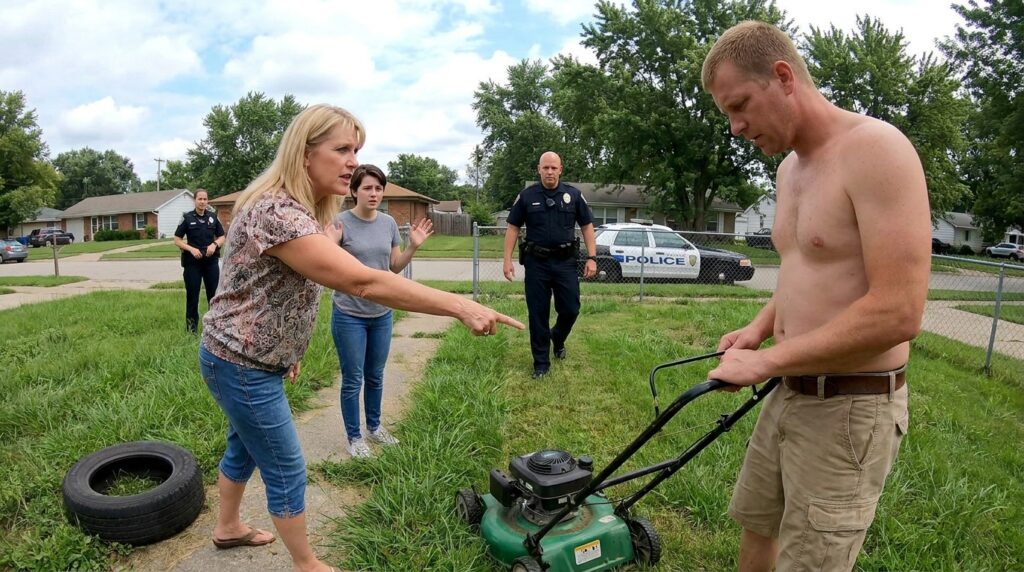
The Three-Foot Feud: How an Unverified Property Line Ignited a Tense Suburban Standoff
CHAPTER 1: THE YELLOW PAPERS
The heat came off the asphalt in visible, shifting layers, smelling of soft tar and old exhaust. Aaron didn’t take off his work boots when he reached the porch. His shins were stained with the dark, greasy dust of the stamping plant, and his shoulders had the dull, unyielding ache that came from twelve hours of feeding raw sheet metal into a hydraulic press. He reached for the brass handle of the screen door, but his fingers hit paper first.
It was neon yellow, bright enough to sting the eyes in the flat glare of the late afternoon sun. It was tucked neatly behind the rusted frame, folded into three exact sections.
Aaron unpeeled it with thumb and forefinger, his calloused skin leaving a gray smudge of industrial grease across the heading: MUNICIPAL CODE VIOLATION: ORDINANCE 42-B (PROPERTY MAINTENANCE).
He didn’t read the text. He didn’t need to. He knew the phrasing by heart now—the precise, cold language detailing the maximum permissible height of fescue grass along an shared easement, the fines that doubled every seven calendar days, the bureaucratic threats stamped with the seal of a county seat fifteen miles away.
But his eyes stopped at the bottom left margin. There was an entry under the field titled Reporting Agent Reference No. That line was usually left blank on standard automated citations. This time, someone had filled it out by hand using a fine-tipped black ballpoint pen: 76-EAS-09.
A truck rumbled down the next block over, its engine backfiring against the empty wooden fences of the subdivision. Aaron stood entirely still on the concrete steps, the yellow paper dry and stiff between his fingers.
The front yard looked exactly as it had when he left at dawn—a patch of parched, faded grass bordered by a low chain-link perimeter that had begun to sag into the dirt three winters ago. Across the narrow gravel driveway, the blinds in the neighboring house were closed tight against the sun, the white vinyl slats gleaming like teeth behind the double-paned glass. Nothing moved. There was no sound but the high, rhythmic buzz of cicadas locked deep inside the dry bark of the pin oaks.
Aaron folded the yellow notice back into three precise sections and slipped it into the back pocket of his work shorts. The edge of the paper scraped against his hip, a sharp, constant reminder of the three feet of dirt that didn’t belong to the city, didn’t belong to the county, and certainly didn’t belong to the woman watching him from behind the white vinyl slats.
He turned back toward his truck, his boots crunching loud against the gravel. The green push mower sat in the rusted bed of his pickup, its steel deck covered in a thick crust of dried, brown clippings from the week before. The sun was dropping, but the iron stayed hot. He reached over the tailgate, his hands gripping the worn rubber handles of the machine.
Inside the quiet dark of the neighboring house, a single vinyl slat tilted downward by less than half an inch.

CHAPTER 2: THE GRIT IN THE MACHINE
The grease on the Briggs & Stratton pull cord was black and cold against Aaron’s palm, despite the humid heat baking the top of his skull. He wrapped the braided nylon twice around his knuckles, feeling the frayed edges bite into his skin. His work boots were planted three inches deep in the parched, unyielding fescue grass—right at the point where the lawn began to die and turn into dry, gray dust.
He pulled.
The starter rope uncoiled with a dry, metallic screech, the piston slamming once inside the rusted cylinder before dying with a heavy, hollow thud. The smell of stale gasoline and scorched oil puffed out from the exhaust port, hanging stagnant in the heavy afternoon air.
Across the gravel driveway, the silence from the neighboring house felt like a weight. Aaron didn’t look up at the white vinyl blinds. He knew the precise angle of the window. He knew that if he lifted his head, he would catch the slight, unnatural distortion in the glass where the plastic slats were being held apart by two fingers. Instead, he stared down at the rusted green steel deck of the mower.
He reset his stance, his heavy boot pressing down on the rear axle to lock the machine against the hard-packed earth. His shoulder muscles bunched, the old industrial strain near his left shoulder blade pulling tight as he yanked the cord a second time.
The engine caught. It didn’t roar; it coughed, a ragged, sputtering sequence of mechanical gasps that vibrated through the rubber grips of the handle and traveled straight up Aaron’s forearms. A cloud of blue-gray exhaust rolled out over the grass line, drifting sluggishly toward the chain-link perimeter.
Through the haze of the burning fuel, Aaron saw the front door of the neighboring house click open.
It didn’t swing wide. It moved slowly, a deliberate, heavy motion that let the screen door shudder against its spring. First came the shadow, then the distinct, stocky silhouette of the Front-Yard Complainant. She wore a bright, loudly patterned floral blouse that seemed completely detached from the faded gray siding of her porch, and her short blonde hair was stiffly styled against the midday breeze. In her left hand, she held her smartphone like a weapon, the glass screen catching the blinding glare of the sun.
She didn’t walk toward him; she marched, her sandals slapping hard against the cracked concrete of her walkway before she hit the grass. She wasn’t alone. Half a pace behind her stood a slimmer, younger woman in a plain gray T-shirt and jeans, her hands nervously twisting the hem of her shirt as she looked everywhere except at Aaron.
Aaron kept his hands locked on the green rubber grip of the mower. He didn’t push it forward yet. He kept the machine idling, the vibration rattling the loose bolts on the deck with a high, rhythmic chatter.
The complainant didn’t stop at her own sidewalk strip. She crossed the transition line where her green, chemically treated turf gave way to his parched, patchy weeds. She planted her feet exactly three feet inside his legal boundary, her shadow falling directly across the rusted fuel cap of his machine.
“Shut it off, Aaron,” she said. Her voice wasn’t loud, but it had the practiced, sharp edge of someone who spent her mornings writing letters to town boards. “I said shut it down. You’re not doing this today.”
Aaron didn’t release his grip. The engine thrummed beneath his palms, a hot, greasy pulse. “The city code says five inches,” he said, his voice flat, stripped of any inflection. “It’s seven at the curb. I’m cutting it.”
“You’re cutting my property,” she snapped, her neck flushing a deep, angry crimson above the collar of her patterned blouse. She jabbed her index finger downward, pointing toward the dry earth beneath her sandals. “This easement belongs to my lot. I’ve told you twice this month, and I’ve already put the paperwork into the city compliance office. I have the case number right here.”
She thrust the smartphone toward his face. On the screen, a digital PDF layout showed a blurred scan of a local property deed, but Aaron’s eyes didn’t look at the map lines. They locked on the bold text typed into the electronic header of the file: REFERENCE FILE: 76-EAS-09.
The exact handwritten alphanumeric code from the neon-yellow violation notice on his screen door.
Aaron’s thumb tightened against the throttle bar. The antagonist wasn’t guessing; she had an official file number linked directly to the municipal enforcement database, an integrated ledger that an ordinary citizen shouldn’t have been able to generate on a Tuesday afternoon. Her late husband had spent twenty years as a land surveyor for the county planning commission before his heart gave out, leaving behind three filing cabinets of official station markers and internal lot revisions in her basement. She wasn’t just yelling at a neighbor; she was working from a layout.
Behind her, the younger woman in the gray shirt shifted her weight, her eyes darting nervously toward the end of the block. “Brenda, maybe we should wait for the truck,” the witness whispered, her voice tightening as she pulled at her sleeve. “He’s just cutting the edge.”
“He’s trespassing, Chloe,” Brenda said, her eyes never leaving Aaron’s face. “And he’s doing it willfully. Look at him. He thinks because he works the night shift he can do whatever he wants to this street.”
Aaron stood his ground, the shirtless heat of his shoulders beginning to sting under the glare. He could feel the small, hard lump of the yellow notice folded in his back pocket. The machine between them kept up its low, sputtering rattle, the blades spinning invisibly beneath the steel shroud, just inches away from the leather toes of her sandals.
At the far corner of the subdivision, the distinct, low whine of a municipal siren began to rise over the sound of the cicadas.
CHAPTER 3: THE STRIP OF GRASS
“You can back that machine up right now, Aaron, or the county’s going to make this very difficult for you,” Brenda said, her fingers tightening until the plastic edge of her phone case groaned. She didn’t blink against the dust coming off his deck. “The line was adjusted in ninety-four when the township widened the culvert. It’s on the master plat. My husband filed the copy himself.”
Aaron let the green rubber handles hum against his palms, the dead weight of the push mower vibrating down through his work boots into the dry fescue roots. The engine’s hot zinc smell was thick between them now, mixing with the sharp scent of wild onions being pulverized beneath the steel deck. He didn’t take his eyes off the ground where her white leather sandals sat firmly embedded in his patchy crabgrass.
“Ninety-four was an unrecorded easement review, Brenda,” Aaron said. His voice was raspy from the plant floor dust, low enough that the rattling mower deck nearly swallowed it. “The culvert stopped six lots down. It never touched this ditch.”
Brenda let out a short, thin laugh that didn’t reach her eyes. She shifted her stocky frame, blocking the narrow space between his old iron fence post and the edge of his gravel driveway. Her floral patterned blouse flared with the sudden mid-afternoon breeze, a bright splash of orange and lilac against the gray, unpainted siding of his porch. “You think you know how the county maps this block? You haven’t even seen the ledger folders in the basement at city hall. My husband spent twenty-six years drafting these coordinates. Every square inch of this frontage has his signature on it.”
She tilted the glass screen of her phone toward him again, her thumb stabbing at the digital layout. Underneath the main map, where the faded grid lines showed the original nineteen-seventy subdivision boundaries, a secondary stamp was visible in dark violet ink—an internal administrative amendment labeled 76-EAS-09: Lot 4 Boundary Extension.
Aaron stared at the numbers. The ink line on the scanned document looked too straight, too clean compared to the rough hand-drawn survey pins from the original builders. He knew every piece of rusted pipe and concrete marker along this ditch line because he had spent three weekends digging out the clogged drainage tiles by hand after the spring rains. He had never found a single iron survey pin three feet inside his grass.
Behind Brenda, the younger woman, Chloe, took two steps back toward the sidewalk, her sneakers squeaking against a patch of dry clay. Her eyes were fixed on the black asphalt street at the end of the block where the low, rising whine of the siren had suddenly dropped into a rhythmic, mechanical growl. “Brenda, the cruiser just turned onto the crescent,” she muttered, her fingers gripping the hem of her gray T-shirt until the cotton stretched tight. “Let them look at the papers inside. We don’t need to stay out here on the edge.”
“We stay right here,” Brenda said without looking back. She took another half-step forward, her capris brushing against the rusted muffler shroud of the idling mower. The heat radiating from the engine block made the air between them shimmer. “He’s been encroaching since he bought the place from old man Miller. Every time he runs these blades past my mailbox, he’s cutting away my property value. Not today.”
Aaron looked down at the cut line. The difference between his unmanaged, sun-bleached weeds and her perfectly level, dark green turf was exactly thirty-six inches of dry dirt. It was a strip of ground that barely grew enough fescue to fill a single collection bag, but it was the only buffer between his front porch and her constant, silent surveillance from the white vinyl blinds. Every citation he had received over the last eighteen months—the trash bin warnings, the vehicle maintenance notices, the lawn length citations—had traveled down this exact three-foot corridor.
The shadow of a large vehicle lengthened across the gravel driveway. The blue-and-white police cruiser didn’t rush; it rolled slowly along the curb, its tires crunching over the loose gravel scattered near the drainage ditch before it came to a halt right behind Aaron’s old work truck. The light bar on top remained dark, but the engine let out a low, heavy rumble that matched the vibration of the lawn mower.
Through the parched fescue, Aaron watched the driver’s side door swing open. A pair of heavy black leather patrol boots hit the asphalt with a solid, dry thud.
Aaron didn’t move his hands from the throttle bar. He kept his eyes on Brenda’s phone screen, watching the digital map lines jitter as her hand began to tremble slightly under the sudden weight of the official presence. He could feel the small, hard corners of the laminated surveyor’s plat he had tucked into the door panel of his truck weeks ago, waiting for this exact intersection of paper and dirt.
“Everything stays exactly where it is,” Aaron said, his voice dropping into the steady register of a man who spent his life monitoring the safety toggles on a multi-ton press. “Don’t move the screen.”
Brenda didn’t pull the phone back, but her jaw tightened, the red flush on her neck spreading toward her ears as the primary officer’s heavy utility belt clinked against the open door of the cruiser.
CHAPTER 4: THE INTERVENTION LANE
The primary officer’s boots were wide and solid on the grass line, his shadow falling across the engine shroud like a heavy shutter. His uniform was starched into stiff, knife-like creases that didn’t give under the midday heat, and his utility belt clicked with a dry, mechanical rattle as he adjusted his stance between Aaron’s left hand and Brenda’s outstretched phone.
“Everyone step back now, let me sort out what happened here,” the officer said. His voice was clipped, practiced, flat as a ledger page. He didn’t look at Brenda’s floral blouse or Aaron’s grease-stained chest. His eyes tracked the narrow space between the two properties, measuring the distance between the sagging chain-link fence and the green steel deck of the push mower.
Behind him, the second officer—the younger woman with her dark hair pinned tightly under her campaign cap—moved to the edge of the gravel driveway. Her hand rested loosely on her belt, her body angled to keep both Aaron’s work truck and the neighbor’s front porch in her line of sight.
Brenda didn’t retreat. She held her ground, her stocky frame shaking slightly with an angry, uneven breath. “Officer, he’s actively destroying my landscaping,” she said, her index finger pointing hard toward the thin line of cut weeds beneath the mower blades. “He’s been told repeatedly. This strip is an extension of Lot Four. My husband filed the boundary amendment with the county seat thirty-two years ago.”
The primary officer looked at the phone screen she was thrusting forward. He squinted against the flat, blinding reflection of the sun on the glass, his brow furrowing as he tracked the purple ink stamp labeled 76-EAS-09.
“Ma’am, keep the device still,” the officer muttered. He reached into his breast pocket, pulling out a small, ruggedized digital tablet that caught the light with a dull blue sheen. He didn’t touch her phone. He began tapping a sequence into his terminal, his thumb making a dry, tapping sound against the plastic casing. “What was the name on the original filing?”
“Gary Vance,” Brenda said, her jaw setting into a rigid line. She reached back, grabbing Chloe’s arm to pull her closer to the line, though the younger woman remained stiff, her eyes fixed on the rear bumper of the patrol car parked at the curb. “He was the senior county drafter. He knew these sections better than anyone in the municipal office. The code enforcement notice on his screen right now was generated under that exact file index.”
Aaron didn’t loosen his hands from the rubber grip of the mower handle, but he didn’t advance either. The machine kept up its low, sputtering rattle between them, the smell of scorched oil rising from the exhaust port in slow, greasy waves. He watched the primary officer’s face change as the tablet terminal connected to the county lot grid.
“Mr. Miller,” the officer said, looking up from the screen toward Aaron. “You have a copy of the deed for this property inside?”
“In the truck,” Aaron said. His voice was raw from the factory shift, short and transactional. “Glove box. Laminated survey map from ninety-one, before the subdivision was re-platted for the culvert expansion.”
The officer turned his head slightly, nodding toward his partner near the driveway. “Check the vehicle,” he commanded.
Brenda let out a sharp, ragged breath, her sunglasses slipping slightly down the bridge of her nose. “The ninety-one survey is obsolete, officer. The ninety-four amendment overrides any previous residential markers. It’s an official city ledger entry. If you look at that file on your tablet, you’ll see my husband’s signature at the bottom of the easement register.”
The primary officer didn’t answer her. He kept his eyes locked on his own terminal screen, his fingers tracking a sequence of dates that didn’t seem to match the paper Brenda was holding. The silence stretched between them, heavy and hot, broken only by the high, rhythmic buzz of the cicadas in the pin oaks and the steady, unyielding thrum of the push mower’s motor.
Aaron watched the officer’s thumb freeze on the tablet screen. A small, hard knot of tension tightened behind Aaron’s ribs. He knew what was on that ninety-four amendment because he had spent three months tracking the old municipal drainage records after his basement flooded. Gary Vance had indeed filed a boundary extension—but the signature line wasn’t stamped by the county clerk. It was stamped by the planning commission’s internal review board, a temporary designation that required an iron survey pin to be driven into the bedrock before the title could legally transfer.
The second officer came back from the truck, her boots crunching over the gravel. In her hand, she held the yellowed, laminated survey plat Aaron had kept inside the logbook. The plastic coating was cracked and scratched, grease-smudged at the edges where Aaron’s thumbs had held it against the steering wheel.
The primary officer took the document, laying it flat against the hood of the patrol car. He didn’t look up at Brenda, but his posture changed, his shoulders squaring into the fabric of his uniform as he cross-referenced the hand-drawn lines from thirty-five years ago with the live digital lot grid on his screen.
“Mrs. Vance,” the officer said, his voice dropping into a low, official register that made Chloe take another deliberate step back toward the sidewalk. “This ninety-four filing your husband submitted—it’s marked as an unverified conditional claim. The tracking index here shows it was suspended three months after entry because the physical survey pins were never verified by a state inspector.”
Brenda’s face went entirely white, the deep red flush on her neck freezing into splotches. “That’s an administrative error,” she whispered, her arm finally dropping down to her side, the phone screen going dark as her fingers slipped against the plastic edge. “The city accepted the notices. They’ve been sending code compliance out here for two years based on that ledger.”
“They sent them because the file was flagged for automatic review, not because the land belongs to you,” the officer said, his voice sharpening as he stepped directly onto the disputed strip of grass, his heavy boot pressing down the exact weeds Aaron had been trying to cut. “According to the county assessor’s plat, the legal boundary hasn’t moved since nineteen-seventy. And right now, you and your witness are standing three feet inside this man’s lot.”
Aaron let his thumbs slowly ease off the throttle bar. The green handle gave a short, metallic shudder as the engine finally gasped and died, leaving the front yard in a sudden, heavy silence that felt louder than the machine.
CHAPTER 5: THE SURVEYORS SHADOW
“The unverified marker doesn’t mean the boundary is void,” Brenda said, her fingers digging frantically into the plastic border of her phone as if she could force the digital lines to shift under the weight of her grip. Her neck was blotched with a violent, uneven red that clashed with the clean, bright pattern of her lilac blouse. “My husband spent twenty-six years drafting the legal coordinates for this township. He wouldn’t have filed an unverified entry. There’s an iron stake driven into the base of the ditch line. I know it’s there. It’s listed right in the annex notes.”
The primary officer didn’t look up from his digital terminal. His heavy black leather boots remained planted squarely in the parched, gray dust where Aaron’s fescue lawn ended, a physical weight anchoring the law precisely to the contested earth. “Mrs. Vance, if the pin isn’t stamped by a certified state inspector, the registry doesn’t recognize the transfer,” he said. His voice was flat, rhythmic, unbothered by the summer heat radiating off the patrol car’s hood. “An internal filing by a municipal drafter is a proposal, not a deed. Without the physical inspector’s seal, the legal boundary reverts back to the nineteen-seventy plat.”
Aaron stood entirely still, his calloused palms remaining loosely draped over the green rubber grips of the lawn mower. The machine’s engine was completely dark now, but the heat coming off the steel deck rose in clear, shimmering waves, baking the dry dirt beneath his work boots. He didn’t offer a defense. He didn’t need to. The quiet mechanics of the county infrastructure were turning against Brenda right on the grass line, shifting the leverage without Aaron having to raise his hand.
Behind Brenda, the younger woman, Chloe, had backed entirely off the grass strip. Her sneakers were planted safely on the hard, hot concrete of the public sidewalk, her arms crossed tight over the front of her gray T-shirt. “Brenda, come on,” she whispered, her eyes darting nervously toward the second officer, who was still holding a vigilant backup posture near the driveway. “The officer just told you what the screen says. Let’s just go back inside the porch. We shouldn’t be out here arguing over three feet of dirt.”
“It’s not just three feet of dirt, Chloe!” Brenda snapped, her voice cracking as she spun around, her sunglasses slipping further down her nose to reveal wide, frantic eyes. “It’s the integrity of Gary’s files. He kept this entire subdivision organized. If this line is wrong, then the fence line behind the garage is wrong. The whole block is off.”
She turned back to the primary officer, her sandals kicking up a tiny puff of dry clay as she stepped even closer to the officer’s heavy utility belt. “He has to have the stake somewhere. He’s probably buried it or dug it up. Look at his truck—he’s got tools in the back right now. Shovels, iron bars. He’s been working out here after the factory shifts when nobody’s watching.”
The primary officer finally turned his head, his eyes tracking from Brenda’s flushed face down to the laminated ninety-one survey map Aaron had provided. The old plastic coating was scratched, showing the deep gray smudges of Aaron’s work-stained thumbs along the border. The officer tapped a single finger against the paper, pointing to a small, hand-drawn circle near the corner of the chain-link fence line.
“Mr. Miller,” the officer said, his voice dropping into a dry, inquisitorial register. “When you cleared the drainage tiles last spring, did you run into any iron markers along this trench?”
“No iron,” Aaron said. His throat was raspy from the press-shop grease, his words short and calculated. “Just the old concrete field tile from seventy. But there’s a stone baseline marker six feet back under the pin oak root. The original township surveyor’s mark from before they laid the asphalt on the crescent.”
Brenda froze, her arm dropping to her side as if the weight of her phone had suddenly multiplied. “The oak tree is on my lot,” she muttered, though her voice lacked its earlier, sharp edge. “The roots don’t change the ninety-four amendment.”
“An original township stone marker outranks a conditional draft entry every single time, ma’am,” the primary officer said, his hand moving to his belt with a slow, deliberate clink of his gear. He closed his tablet terminal, the screen going dark with a faint, plastic snap. “If that stone baseline is still intact under the oak tree, then your husband’s filing wasn’t just incomplete—it was an unapproved overreach. It means the municipal office has been issuing citations to this property based on a fraudulent line index.”
A heavy silence settled over the front yard, thicker than the exhaust that had rolled off the Briggs & Stratton engine minutes before. Across the asphalt street, a pair of neighbors had stopped on their porch, their figures small and dark against their screen doors, watching the blue-and-white cruiser contain the block.
The secondary officer took a step forward from the driveway, her hand resting on the small leather notebook tucked into her vest. “Sir,” she said to her partner, her eyes tracking Brenda’s unsteady posture. “We need to clear the easement lane. The complainant is obstructing the residential walkway.”
The primary officer nodded once, his face hardening into the unyielding baseline of a civil representative who had reached the end of mediation. He looked directly at Brenda, his voice dropping all pretense of neighborly leniency. “Mrs. Vance, I’m instructing you to step back onto your own established lot right now. If we have to pull the original county assessor files to verify a malicious false report, the city will be issuing a misdemeanor citation for filing a deceptive emergency claim. Do you understand?”
Brenda stood rigid on the dry grass, her stocky frame silhouetted against the bright, parched street. Her supporting witness had already turned her back, her sneakers clicking quickly down the concrete sidewalk toward the far end of the block, leaving Brenda entirely alone on the three feet of dirt she had spent two years trying to control.