The Weight of the Line: A Story of Suburban Friction and Broken Boundaries

CHAPTER 1: THE TRENCH

“You cannot just come onto my property and mow my yard!”

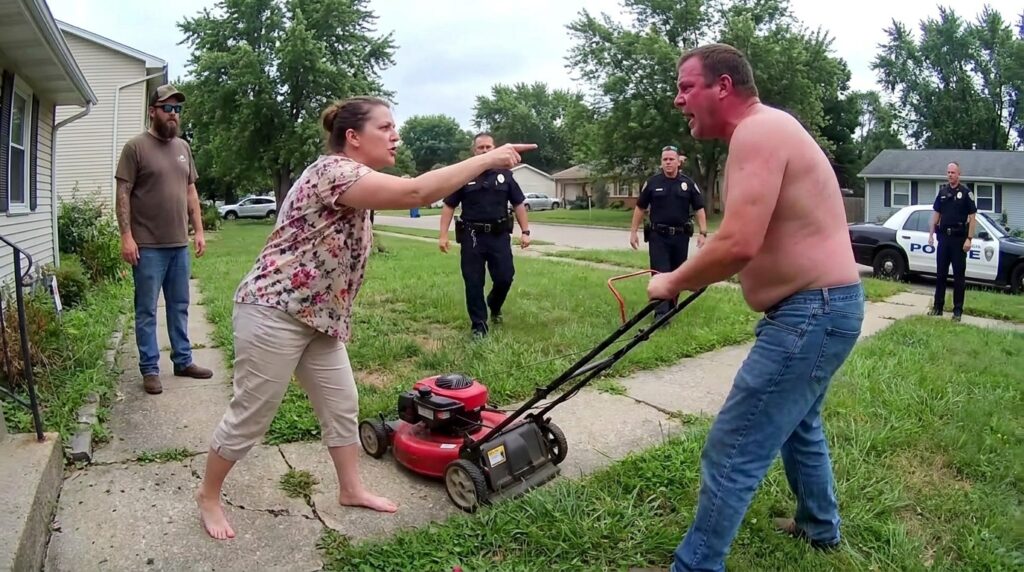
Sarah’s voice cut straight through the humid, gasoline-soaked air, raw and shaking with the weight of a three-week headache. Her bare feet sank into the cool, damp earth of the unclipped lawn, the sharp edges of the overgrown fescue stinging her soles. She didn’t care. She was leaning so far forward over the dead engine that her floral blouse strained at the shoulders, her index finger driven toward the chest of the man standing opposite her.

Gary didn’t flinch. His sturdy frame remained anchored right behind the red push mower, his knuckles white where his hands gripped the black rubber handle. His chest was bare, slick with a film of sweat and fine, pale green grass clippings that clung to his skin like static. His face was a dark, sun-beaten red that ran down his neck into his denim jeans. He didn’t look like an enemy; he looked like a man performing a heavy, uncompensated chore, his jaw set with the rigid, unmovable certainty of a surveyor who had already run the numbers.

“I am doing the work you’re too lazy to do, Sarah,” Gary said. His voice wasn’t loud, but it carried the weight of an iron pipe dropping into dry dirt. He kept both hands on the mower bar, his forearms locked. “Look at this patch. It’s an eyesore. It’s dropping the comps for the whole street, and the rain is only going to make it worse. Somebody had to bring the line down.”

“It’s my line,” she spat.

Between them lay the single red machine, its front metal deck angled sharply toward her bare toes. The engine was silent now, but the heat radiating from the black plastic housing smelled of hot oil and scorched grass, a thick, heavy blanket in the mid-afternoon stillness. To their left, down the narrow concrete path that led to her porch, Mark stood entirely still. His cap was pulled low, sunglasses obscuring his face, his gray T-shirt catching the glare of the sun. He didn’t speak. He just watched the lane between them, his posture passive but heavy with the silent judgment of the block.

Sarah could feel the eyes from the other houses—the faint twitching of blinds across the asphalt, the small, quiet movements of people waiting for someone to break. Her gaze dropped for a fraction of a second to the wheels of the mower. They were sunk deep into her side of the turf, leaving two dark, crushed tracks in the clover. That was when she noticed the small, notched scar on the mower’s side panel—a jagged bit of silver metal where the red paint had peeled back to reveal rusted steel underneath. It wasn’t Gary’s usual machine. It was older, heavier, and it had a tiny brass tag riveted near the oil cap that didn’t belong to any commercial brand.

Gary saw her looking. His grip tightened, a slight shift in his boots sending a scuff of dirt over the boundary line. “You call who you want,” he muttered, his eyes narrowing into a hard, defensive glare. “But that engine’s starting back up the second you step off this grass.”

Sarah pulled her phone from her pocket, her thumb pressing against the cracked screen until the screen lit up her face. Her hand was steady, but her skin felt cold despite the midday heat. She didn’t look back up at him as she dialed the three digits. She kept her eyes locked on that tiny brass tag, realizing with a sudden, cold jolt that the serial number stamped into the metal matched the exact digits of the missing county surveyor tools her father had lost thirty years ago.


CHAPTER 2: THE ANCHOR AT THE CURB

“Suspect is active on the property line, refusing to vacate, operating machinery near my feet,” Sarah said into the receiver. Her words came out flat, stripped of the panic she actually felt, replaced by the hard, transactional clarity of someone documenting a breach. She didn’t look at her phone. Her eyes remained anchored to the jagged silver scar on the mower’s side panel, where the red paint had bubbled away to expose the deep iron pitting beneath. The small brass tag, dull with age and green grease, seemed to grow larger in the humid glare.

“Ma’am, is he threatening you with the equipment?” the dispatcher’s voice crackled through the speaker, thin and tinny against the heavy, mechanical silence of the yard.

“He’s not moving,” Sarah replied, her voice dropping into a register that felt like gravel shifting under a boot. “And neither am I.”

Gary didn’t take his hands off the rubber grip. He let the dead weight of the mower rest between them, the metal deck vibrating slightly as his weight shifted on the uneven turf. A slow, greasy film of sweat tore through the green clippings on his chest, tracing the thick line of his collarbone. He looked down at the phone in her hand, then back up at her face, his jaw working a small, dry piece of tobacco against his back teeth.

“You’re making a mistake, Sarah,” Gary said. The casual arrogance in his tone had vanished, replaced by a cold, structural calculation that made his chest tighten. “You think you’re calling the city to protect your grass? You don’t even know where the iron pins are buried. You don’t know what happens when they actually bring the transit out here.”

“I know whose name is on the deed,” she said, her fingers tightening around the plastic casing of her phone until the glass creaked. She could smell the sulfurous tang of chemical weed killer drifting from the fence line—a sharp, artificial burn that sat on the back of her throat. It was the same smell she’d found near her hydrangeas two mornings ago, a gray, withered patch of rot that Gary had claimed was just fungus.

Mark hadn’t shifted an inch on the concrete path. His sunglasses reflected the desaturated green of the lawn, twin black mirrors that refused to offer an opinion. But his presence was an anchor of a different kind—the block was recording this, calculating the social cost of every inch Gary claimed.

The sound of the first siren didn’t rise from the distance; it cut in suddenly from two blocks over, the sharp, rhythmic yelp of a city cruiser hitting the intersection at Croyden Lane. The sound bounced off the aluminum siding of Sarah’s garage, loud and metallic.

Gary’s shoulders hardened. His eyes flicked toward the cracked asphalt of the curb, where the shadow of the telephone pole stretched long and thin across the gravel. For a second, just one micro-second, his fingers slackened on the mower handle. Sarah saw the skin underneath—white, unweathered, and marked by three distinct, circular scars across the knuckles, the kind left by old hydraulic line snaps. He wasn’t just a neighbor holding a grudge; he was a man holding onto a specific piece of machinery with the desperate, white-knuckled intensity of a thief who had just recognized the owner.

“The old man told me about your father,” Gary said, his voice dropping below the rising whine of the approaching engine. He didn’t look back at the street. He kept his face aligned with hers, his breath smelling faintly of stale coffee and hot zinc. “He told me how the county handled the 1996 re-platting. He said some people kept what wasn’t theirs because the clerks were too lazy to dig through the iron vaults.”

Sarah felt a cold drop of sweat trace the ridge of her spine. Her father hadn’t been a surveyor; he’d been a draftsman for the county extension office, a man who spent forty years rolling up linen maps and filing them in the basement boxes under the courthouse. When he died, the only things he left behind in the garage were three heavy wooden crates labeled Zoning Miscellany that she’d never had the heart to pry open.

The black-and-white cruiser nose-dived as it hit the driveway incline, the front bumper scraping against the concrete lip with a harsh, unyielding screech. The doors didn’t slam; they clicked open with the heavy, pressurized thud of modern fleet steel.

Sarah didn’t step back. Her bare heels were pressed against a buried chunk of concrete—the remnants of an old fence post Gary had insisted was five inches over his line three summers ago. The grit of the dry earth between her toes felt real, heavy, and completely unyielding.

“Step away from the equipment,” a voice called from the curb. It was a woman’s voice, crisp and formal, but carried the weight of leather gear and iron plating. Officer Davis was already moving down the margin of the yard, her boots making a dry, rhythmic crunch-crunch in the dead clover, her hand resting naturally against the top of her holster. Behind her, the larger frame of Officer Miller emerged from the driver’s side, his eyes scanning the hands, the handle, and the rusted tag near the oil cap.

Gary didn’t drop his hands. He just leaned back, his heels digging into his own side of the line, his chest rising as he prepared to lay out his version of the truth to the city.

CHAPTER 3: THE DEFIANT BOUNDARY

Officer Davis moved with the slow, deliberate economy of someone who had spent a decade breaking up domestic border wars. Her heavy utility belt creaked, a rhythmic, mechanical protest against the afternoon heat as she stepped between Sarah and the front wheel of the red mower. Her hand didn’t leave the top of her security holster, but her fingers relaxed slightly, tapping a steady, flat cadence against the textured polymer.

“Sir, take your hands off the equipment and step back toward the driveway,” Davis said. Her voice didn’t rise above the level of the dry turf, yet it carried an institutional frost that made Gary’s chest stop heaving for a fraction of a second.

Gary didn’t drop his grip. Instead, his forearms locked harder, the thick tendons shifting beneath the dust and dried clover cuttings clinging to his skin. “This is a civil matter, Officer. I’m abating a public nuisance. This property line runs five inches deep on my side according to the original 1960 plat. I’ve got the iron pins to prove it.”

“I don’t care about the pins right now,” Officer Miller interrupted from the right margin. He didn’t approach Gary from the front. He moved laterally, his heavy boots crushing a patch of Sarah’s unclipped dandelions with a dull, wet snap. He positioned his bulk between Gary and the concrete path where Mark was watching. “Right now, you’re operating an engine over a resident’s bare feet. Step back.”

Sarah didn’t move her heels. She remained anchored to the buried concrete block, her toes curling into the dirt to keep from shaking. The heat from the mower’s muffler was a physical pressure against her skin, thick with the oily stench of unburned fuel. “He’s been doing this for three weeks,” she said, her voice tight, dry, and direct. “Notes on the mailbox. Chemical spray on the hydrangeas. Now he’s crossing the line when I’m not home.”

“I’m maintaining the neighborhood,” Gary barked, his eyes tracking Miller’s lateral movement. A sharp line of sweat ran through the grime on his temple, dropping onto the faded red metal deck of the machine. “Her father knew the real numbers. He’s the one who shifted the pins back in ninety-six when the county put the sidewalk in. He stole five inches from my family’s old acreage to clear her garage footprint, and I’m taking it back.”

Sarah’s gaze flicked from Gary’s flushed face down to the ground beneath the mower deck. Right where the uncut grass met the clipped, yellowed blades on Gary’s side, a small patch of earth had been freshly disturbed—scuffed away by a heavy boot. Beneath the loose dirt, something dull and metallic glinted in the harsh sun. It wasn’t the brass tag on the engine. It was the top of a square iron stake, ancient, pitted with rust, and buried far deeper than the modern survey markers the city used.

“Gary,” Officer Miller said, his tone dropping an octave into a low, transactional growl. He stepped directly into Gary’s peripheral vision, his right hand rising to hover near the buckle of his tactical vest. “I’m not going to ask you a third time. Leave the mower where it sits. Step back onto the concrete.”

The tension in the yard became a physical weight, thick as the humidity rising from the cracked drainage ditch at the curb. Mark shifted his weight on the porch path, his sunglasses catching the white glare of the sun as he tilted his head toward the buried iron stake. He knew what was under there. Everyone on the block knew that the old surveys were a mess of ink smudges and hand-drawn lines from before the township had even been incorporated.

Gary’s jaw worked, the muscle along his throat twisting into a hard knot. He looked at Sarah, then down at the phone she still held against her hip. His left hand slowly uncurled from the rubber handle, the skin raw, white, and creased from the pressure of the grip. But his right hand remained fixed on the metal crossbar near the oil cap, his thumb resting right next to the small brass tag with the county serial number.

“You think you won something because you called the city?” Gary whispered, his voice thin and dry as paper. He didn’t look at the officers. He looked straight through Sarah, his eyes reflecting a strange, cold certainty that made her bare feet feel even colder against the earth. “Your father left a map in those crates, Sarah. The real one. The one before the county re-platted the whole south side to cover the water main error. Ask yourself why he never registered the deed update before he died.”

Officer Davis didn’t wait for Sarah to answer. She stepped into the gap, her shoulder checking the line of sight between them, her leather gear brushing against the tall grass as she forced Sarah back toward the porch steps.

“Ma’am, let us handle the separation,” Davis said, her eyes already tracking the way Gary’s boots were shifting against the old iron pin. “Go sit on the porch. We’re going to run the names and check the call history.”

Sarah didn’t retreat. She stayed exactly where she was, her heart knocking against her ribs like a trapped bird, her eyes fixed on the small, rusted square of iron sticking out of her dirt. The world had shrunk down to the space between two yards, and the earth underneath them was starting to feel hollow.

CHAPTER 4: THE WITNESS LANE

The concrete porch path felt like old iron under Sarah’s bare soles, radiating the stored heat of five hours of July sun. She didn’t retreat to the steps as Officer Davis had ordered. Instead, she shifted her weight laterally, her lateral visibility widening just enough to see past the black-and-white cruiser’s light bar. Across the asphalt, two more front doors had clicked open. Mrs. Gable was leaning over her porch railing, a pair of garden shears frozen in her gloved hand, while down the curb, two guys from the roofing crew working on number forty-two had stopped hammering altogether, their utility vests bright orange points against the pale gray shingles.

“The call history shows three previous disturbances at this address,” Officer Davis said, her thumb tracing the edge of her mobile terminal screen. The glass gave off a dull glare under the canopy of the silver maple. “All filed as civil property disputes. No enforcement actions taken.”

“Because nobody ever digs,” Gary said. His voice was lower now, raspy from the heat and the dust the cruiser had kicked up from the margin. He had finally taken both hands off the mower handle, but he hadn’t moved his boots from the scuffed earth over the rusted iron stake. His chest, streaked with oil and pale green clippings, rose and fell in short, transactional jerks. “The city doesn’t want to touch it. If they verify the ninety-six plat error, the whole utility easement for the eastern quadrant loses its anchor. Sarah knows it. Her old man was the one who signed off on the variance.”

“My father didn’t sign off on anything private,” Sarah said, her voice cutting through the dry drone of a distant cicada. She stepped off the path, her feet finding the gravelly margin where the driveway met the grass. The stones were sharp, biting into her heels, but she needed the leverage. “He followed the county code, Gary. If there was an issue with your grandfather’s land, he should have filed the discrepancy before the township took over the drainage infrastructure.”

“He tried,” Gary spat back, his eyes narrowing into two dark slits under his wet brow. “The records went missing from the basement vault the same week your father bought this house. You think that’s a coincidence?”

Officer Miller didn’t join the debate. He reached down with one gloved hand and grabbed the crossbar of the red push mower, pulling it three inches backward. The metal wheels gritted against the dry earth, the front edge of the steel deck scraping over the top of the buried iron stake with a sharp, metallic scree that made Sarah’s teeth ache. As the mower moved, the old oil cap vibrated loose, dropping a thick, yellow bead of lubricant onto the grass.

“Nobody’s digging anything today,” Miller said, his boots firmly planted between Gary and the tool. “Sir, I need you to step onto the asphalt. We’re blocking the lane until the supervisor checks the municipal code on this easement. If you touch this machine again before we have a disposition, it’s an active obstruction charge.”

Mark shifted his stance on the walkway behind Sarah. He hadn’t removed his sunglasses, but he reached down and pulled a pack of cigarettes from his gray T-shirt pocket, his movements slow, passive, and entirely focused on the way Gary’s boots were still twitching near the hidden marker. “He’s right, Gary,” Mark said, his voice flat, carrying no neighborly warmth. “The whole block’s watching you sweat out there. Just let the truck come out.”

Gary’s face went from sun-beaten red to a dark, mottled purple along the jawline. His fingers twitched against the seam of his blue jeans, leaving dark grease smudges on the denim. He looked at the orange vests on the roof down the street, then at Mrs. Gable’s frozen garden shears. The public authority he had tried to perform by dropping his engine into her yard was dissolving into a cheap curb-side exhibition.

“You think you’ve got it locked down, don’t you?” Gary said to Sarah, his voice dropping into a low, jagged whisper that barely reached past Officer Miller’s utility belt. He stepped backward, his sneakers finally leaving the disturbed dirt above the iron stake, hitting the hot, oil-stained asphalt of his own driveway with a dry slap. “Check the back of that brass tag on the engine housing, Sarah. If you’ve got the guts to pry it off. Look at the county inventory code. That wasn’t your father’s tool. It belonged to the estate my grandfather had to liquidate when the city ran the water main through our basement wall.”

Sarah felt the phone in her hand grow heavy, the plastic casing slick with the moisture of her own palm. She didn’t look at the tag. She kept her eyes on the small, square iron pin now fully exposed in the dirt between their lawns—a rusted tooth sticking out of the dry earth, waiting for someone to trip over the truth.

CHAPTER 5: THE STANDOFF AT THE EDGE

The tires of the second cruiser ground into the loose gravel at the lawn’s edge, spitting a small, sharp cloud of grey limestone dust that settled across Sarah’s bare ankles. The sound was a harsh, physical compression—the weight of two tons of municipal steel dropping between two property lines that had begun to warp under the heat. The engine idle of the Ford utility vehicle ran low and steady, a deep bass vibration that pulsed through the dry roots of the fescue beneath her feet.

Officer Davis moved with a rigid, practiced caution, her heavy duty belt popping as she swung her leg clear of the door frame. Her sunglasses didn’t move from Gary’s hands. “Miller, watch the lane,” she said, her voice dropping into the flat, hollow tone of someone who had spent twenty years reading the small, violent twitches of small-town disputes. “Sir, step completely away from the red deck. Do it now.”

Gary didn’t drop his stance immediately. His blue jeans were dark with grease along the thighs, his work boots caked in the thick, wet mulch of the unclipped grass he had already cut down. His skin looked raw under the direct sun, the sweat turning the fine dirt on his neck into a dark, river-like crust. “I’m on the plat line,” he said, but his voice lacked the sharp, cutting edge it had carried five minutes ago. It sounded like old tin being dragged over gravel. “I’m five inches inside the original nineteen-sixty easement. Ask her what’s in her basement boxes. Ask her about the surveyor logs.”

“I don’t care about the logs, Gary,” Officer Miller said. He stepped across the crushed tracks where the mower had traveled, his heavy, rubber-soled boots leaving deep, square prints in the dandelion heads. He didn’t touch his belt, but his bulk occupied the center of the lane, cutting off Gary’s path to the porch where Mark stood like a carved post. “The city dispatch received an active trespass complaint with a running engine. That machine stays dead until we verify the county marker.”

Sarah’s fingers curled tighter around the edge of her phone, the plastic creaking with a dry, thin stress. The sun was hitting the small brass tag on the engine housing now, the metal reflection throwing a sharp, yellow needle of light directly onto the rusted square pin protruding from the lawn. It wasn’t just old iron; it had three distinct notches filed into the top face—the unique signature of the early township engineers who had run the water lines before the county had consolidated the records.

“He’s been setting this up for months,” Sarah told Davis, her voice flat, matching the rhythmic thrum of the cruiser’s radiator fan. She didn’t look at Gary. She looked at the small, disturbed circle of dry earth around the pin where his boot had tried to pack the evidence back down. “The notes on the box weren’t about the height of the grass. They were timestamps. He was tracking when the county maintenance trucks cleared the drainage culvert at the corner.”

“Ma’am, let us establish the perimeter,” Officer Davis said, her hand flat against Sarah’s shoulder blade, a firm, grease-blackened leather gesture that forced her three steps back toward the gravel driveway. “Miller, get the name off that registration plate on the trailer behind his garage. Let’s see if the numbers match the old industrial sector files.”

Gary’s jaw tightened, the dry piece of tobacco inside his cheek shifting with a wet, clicking sound. He looked past Miller’s shoulder toward the street, where Mrs. Gable’s garden shears had dropped into the dry soil of her flowerbed, forgotten. The two roofers at number forty-two had come down to the lower eave, their leather tool belts hanging heavy, their faces dark silhouettes against the bright white sky. The neighborhood pressure was no longer a silent friction; it was a physical ring closing in on the property edge.

“You don’t know what you’re digging up, Sarah,” Gary whispered, his forearms starting to shake against his sides as his hands finally came loose from his pockets. His fingers were stained a deep, indelible black from old transmission fluid, the skin around the nails split and full of grit. “You think your father left you a house. He left you an unpaid debt to every family that lived on this ridge before the utility grid went public. That pin under the mower deck isn’t a property line. It’s an anchor for the main line valve, and it runs straight through your crawlspace.”

The radiator of the lead cruiser clicked, a sharp, metallic ping that signaled the thermostat opening under the load of the air conditioning. The smell of hot antifreeze and old vinyl rose from the grill, mixing with the sour, chemical reek of the weed killer Gary had laid down along the fence.

Sarah felt the earth beneath her soles give slightly—not from moisture, but from the strange, hollow instability that came when the boundaries of a life began to slide into the county ledger. She didn’t look away from the rusted iron square. It remained locked between them, a jagged tooth holding the weight of two histories that were about to tear the topsoil clean off the block.

CHAPTER 6: THE DIVIDED LANE

Officer Miller’s gloved hand clamped down on Gary’s right forearm with the heavy, unyielding pressure of a hydraulic vise. The synthetic leather of the officer’s glove made a dry, scraping sound against Gary’s sun-hardened skin, forcing his knuckles away from the red mower’s crossbar. Simultaneously, Officer Davis stepped hard into Sarah’s path, her equipment belt clanging loudly as her torso blocked the line of sight between the two neighbors.

“Back up, both of you—clear the deck now!” Miller ordered. His boots slid three inches through the unclipped grass, tearing the dandelion stems down to the dark, dusty topsoil. He used his weight to pivot, shifting his shoulder to wedge a permanent gap between Gary and the steel handle of the machine.

Gary lunged slightly forward before the grip tightened, his work boots slipping on the slick, grass-cut turf. “You’re pulling the wrong guy, Miller!” he snarled, his face darkening until the veins across his forehead showed like thick cords under the sweat. “Look at the alignment! The machine is sitting squarely on the township foundation. She’s encroaching on the drainage easement, and you’re letting her stand there like she owns the block!”

“Step back, sir!” Miller repeated, his voice dropping into a flat, monotone register designed to drain the air out of an argument. He didn’t pull his nightstick, but his arm remained extended, a solid bar of black nylon and muscle separating Gary from the red metal deck.

Sarah felt Davis’s gloved palm press firmly into the center of her collarbone, forcing her backward toward the loose gravel of the driveway. Her bare heels dug into the sharp stones, the gritty heat of the rock biting into her skin. “He touched the line,” she said, her chest rising in short, jagged gasps that tasted of raw fuel and old oil. “Look under the front wheels, Officer. He wasn’t just cutting the grass. He was trying to unearth the survey stake.”

“We see what he’s doing, ma’am,” Officer Davis said without turning her head. Her sunglasses remained locked on Gary’s twitching fingers. “Miller, check the soil condition under that front axle. There’s an iron sleeve showing.”

The crowd along the curb had grown completely silent. Mark had moved two steps down the concrete porch path, his hands stuck flat into his jeans pockets, his dark beard dusting with a fine layer of grey limestone powder kicked up by the second cruiser. Across the street, the roofing crew at number forty-two had put down their pneumatic guns, their shadows long and blue against the light grey shingles as they leaned over the eave to watch the officers split the yard.

Below the red mower’s front blade edge, where Gary’s heavy boot had torn away the clover, the dirt had sloughed off to reveal more than just the rusted survey pin. A heavy, black steel casing—thick as an industrial main pipeline valve index—showed through the grass roots. It was ancient, pitted with deep pockets of iron scale, and it had a series of six heavy bolts holding a flange directly into the subsoil. The red push mower’s front metal rim was wedged directly into the groove between two of those bolts, trapped by the very boundary Gary had tried to claim.

“The whole thing’s unrecorded,” Gary muttered, his resistance suddenly giving way as Miller forced his arm down toward his hip. His chest was covered in a grey paste of sweat and road dust, his breath coming in dry, rattling wheezes. “Your father knew it, Sarah. He knew if anyone ever put a real transit on this ridge, the city would have to condemn the entire concrete apron between our houses just to service the high-pressure line. He kept his mouth shut so he could clear the sale on this lot.”

Sarah’s hand went cold against the plastic of her phone. She looked at the heavy flange emerging from her soil, then at the two dark tracks the mower wheels had cut into her clover. The small brass tag near the oil cap was still catching the white glare of the afternoon sun, its county serial number a direct link to the basement files her father had spent a lifetime hiding from the light.

“Davis, get the tape out of the trunk,” Officer Miller said, his boots still holding the grass margin between the two houses. “We’re locking this quadrant down until the code inspector runs the underground index. Nobody touches this dirt until we get a signature from the municipal clerk.”

The engine of the lead cruiser clicked again, a long, drawn-out metallic sigh that echoed off the aluminum siding of Sarah’s garage. The neighborhood had shrunk down to a few feet of torn grass, and the ground beneath them felt less like a yard and more like the top of a buried vault.

CHAPTER 7: THE STERN RESTRAINT

“Both of you step back now.”

Officer Miller’s voice didn’t rise, but the hard, metallic click of his tactical belt buckle shifting against his vest pocket carried the finality of an iron gate dropping into place. His heavy leather glove tightened around Gary’s left shoulder, the textured synthetic hide grinding a small mound of dry grass clippings into the man’s bare skin. With a short, blunt pivot of his hips, Miller locked his boots into the turf, forcing Gary three feet to the right of the dead red machine, establishing a clean, open lane down the center of the contested dirt.

Gary’s jaw ground sideways, a thin string of dark tobacco juice staining the edge of his bottom lip. He didn’t drop his stance, but his knees buckled an inch under the officer’s downward torque. “You’re locking down the wrong fence line, Miller,” Gary spit, his breath hot and rattling through his chest. “That black flange under the blade belongs to the old township station. Her father didn’t register the easement shift because he was hiding the fact that the line is collapsing under her living room joists.”

“I told you to clear the machine, sir,” Miller repeated, his forearm a solid bar of black nylon pressed across Gary’s collarbone. “The code inspector’s truck is coming down Croyden Lane right now. Until they verify the municipal index numbers on that brass housing tag, nobody touches this grass. Not with a mower, not with a shovel.”

Sarah felt Officer Davis’s palm maintain its flat, heavy pressure against her ribs, guiding her backward across the jagged limestone stones of the driveway margin. The sharp edges of the gravel bit into her raw heels, but the cold weight of her phone against her hip felt heavier than the rock. From this angle, she could see past the cruiser’s light bar straight down Gary’s side of the drive. Tied to the rusted fence post near his garage was a fresh, bright yellow placard from the county building authority—a formal citation notice that hadn’t been there when she left for work that morning.

“He knew the inspector was coming,” Sarah said, her words coming out dry, matching the rhythmic, mechanical whine of the second cruiser’s radiator fan. She didn’t look at Gary’s mottled face. She kept her eyes on the small, square iron marker poking through the dirt near the front axle. “That’s why he brought the machine over today. He wasn’t trying to tidy the block. He wanted to disturb the topsoil before the town surveyor could locate the original nineteenth-century pin.”

“We’re verifying the records, ma’am,” Officer Davis said, her sunglasses tracking the lateral movement of the roofing crew down the block. The two men at number forty-two had stepped down to the lower scaffold, their leather tool pouches swinging heavy against their thighs as they leaned out over the gutter line to map the confrontation yard. “Mark, stay on the concrete path. Nobody moves into the separation lane.”

Mark didn’t look up from behind his dark lenses. He took a long, slow drag from his cigarette, the gray ash dropping onto his sneaker before he ground it into the sidewalk crack with his toe. His silence was an anchor, holding the public pressure of the block right at the edge of the grass.

Below the red metal deck of the stopped mower, the rusted steel flange was continuing to slough off its dry earth crust. The heavy bolts were exposed now, their square, hand-forged heads showing the deep pitting of seventy years of damp subsoil corrosion. As the heat shimmer rose from the engine casing, a thin, sour smell of raw gasoline and stagnant water began to drift up through the grass roots—the specific odor of an iron valve box that had been buried too long without air.

“You think you’ve secured the lot, Sarah?” Gary whispered, his voice thin, dry, and jagged as his body finally went slack under Miller’s grip. He didn’t try to pull away from the glove, but his chest remained expanded, a dark smear of transmission fluid running from his collarbone down to the waistband of his jeans. “Go look at the ledger from nineteen-ninety-six. Look at the signature on the third page of the variance box. Your father didn’t save this house from the easement. He just made sure the city wouldn’t find out the water main was splitting the foundation until after he was gone.”

Sarah didn’t answer him. Her hand was steady as she dropped her phone back into her capri pocket, but the skin across her knuckles felt brittle in the humid sun. She looked at the tiny brass tag near the mower’s oil cap—the serial number still throwing its sharp yellow glare across the dirt. The small town suburb around them had gone cold and quiet, and every house on the ridge suddenly looked like it was sitting on top of an old trench.

CHAPTER 8: THE SECURED PERIMETER

The yellow warning tape crinkled as Officer Davis pulled it taut across the two metal stakes, the sharp, plastic hum cutting through the low idle of the code enforcement truck that had finally parked at the curb. The bright ribbon divided the front yard into two separate, uneven sectors, its reflection cast in long, yellow bars against the black paint of the police cruiser’s door.

“This is your official notice of a boundary quarantine, Gary,” Officer Miller said. He unclipped his pen from his vest pocket, his thumb pressing down on the plastic cap with a dry, mechanical click that sounded like an old lock catching. He handed a white carbon copy of the citation across the yellow line, his glove brushing against the rusted handle of the mower that remained stuck dead center in the grass. “You don’t cross this fescue. You don’t operate machinery within ten feet of the industrial index until the city engineer maps the valve seat from the main ledger.”

Gary didn’t reach for the paper. He let the white sheet flutter against his knee before his grease-stained fingers slowly closed around the margin, his knuckles gray with the dust of the lawn. His chest had stopped heaving, but his mouth remained twisted into a tight, hard line that running sweat had washed clean of grit. “The ledger doesn’t change the footprint, Miller,” he muttered, his voice dropping into a register that was barely louder than the drone of the truck’s radiator fan. “The valve box is still sitting four inches onto her side of the nineteen-sixty foundation. When that sleeve cracks, the town isn’t going to fix her basement floor. They’re going to dig the whole apron up.”

“That’s for the courthouse to settle,” Miller replied, his boots shifting back toward the asphalt edge. He didn’t look at the crowd that had gathered near Mrs. Gable’s fence. He simply touched the brim of his cap toward Sarah, his heavy leather gear creaking as he turned back to his vehicle. “Ma’am, keep your line clear until the surveyor files the update on Monday. If he comes over the gravel before then, you call the desk directly.”

Sarah didn’t speak. She watched the black-and-white cruiser lift as its front tires cleared the concrete incline, the engine whine fading down Croyden Lane until the only sound left on the block was the slow, rhythmic ticking of the cooling metal under the code truck’s hood. Her bare feet were numb from the cold grease that had leaked out of the mower’s housing, the sharp limestone dust of the driveway margin clinging to her skin like dried salt.

Mark was still standing by the porch rail, his sunglasses tucked into his shirt pocket now, his eyes tracking the way Gary was backing his truck down his own side of the concrete lane. “He’s not going to stop, Sarah,” Mark said, his voice entirely flat, stripped of neighborly comfort. “He’s just going to wait until the city sends the assessment notice. Once the tax maps change, everyone on this ridge is going to see the numbers.”

Sarah turned her back on the road. She walked toward the narrow crawlspace door beneath her kitchen window, her heels sinking into the unclipped clover where the tracks had been torn by the blade. In the shade of the foundation wall, a small green plastic box sat nestled between two foundation blocks—the newly mounted security camera she had spent three hours configuring the night before. The small glass lens caught the grey afternoon light, a tiny black eye recording the silent, empty margin between the two houses.

She reached down and pulled the brass inventory tag from the mower’s oil cap, using the edge of her house key to pry the copper rivets out of the rusted housing. The metal was thin, cold, and pitted with green rot on the reverse side. Stamped directly into the underside of the plate, beneath forty years of grease and old soil, were two letters followed by a five-digit code: M.V. 1996-04. Her father’s initials, carved into the very tool Gary’s grandfather had surrendered to the township to pay for the first drainage easement.

The house didn’t feel like a home anymore; it felt like a temporary deck built over a massive, unrecorded cavern of old public debts. She tucked the tag into her pocket, her fingers finding the rusted key to the garage crates, knowing that when she turned that lock tonight, the lines on the linen maps wouldn’t match the dirt she was standing on.

Similar Posts

Leave a Reply

Your email address will not be published. Required fields are marked *