
The Weight of Cobalt on the Curb: A Suburban Standoff at the Edge of Property and Law
CHAPTER 1: COBALT ON THE LATCH
“Put the mail back and step away.”
The words didn’t cross the manicured rye grass as a shout. They carried the heavy, flat cadence of an order issued over a workbench.
Arthur didn’t lower the white ceramic mug. The steam rose in a thin, pale thread against the August heat, smelling faintly of chicory and dark roast. He stood two inches behind the lip of his top porch step, his boots anchored in the shadow of the overhang.
Ten yards away, beside the black steel mailbox post anchored in cured concrete, Evelyn Vance froze.
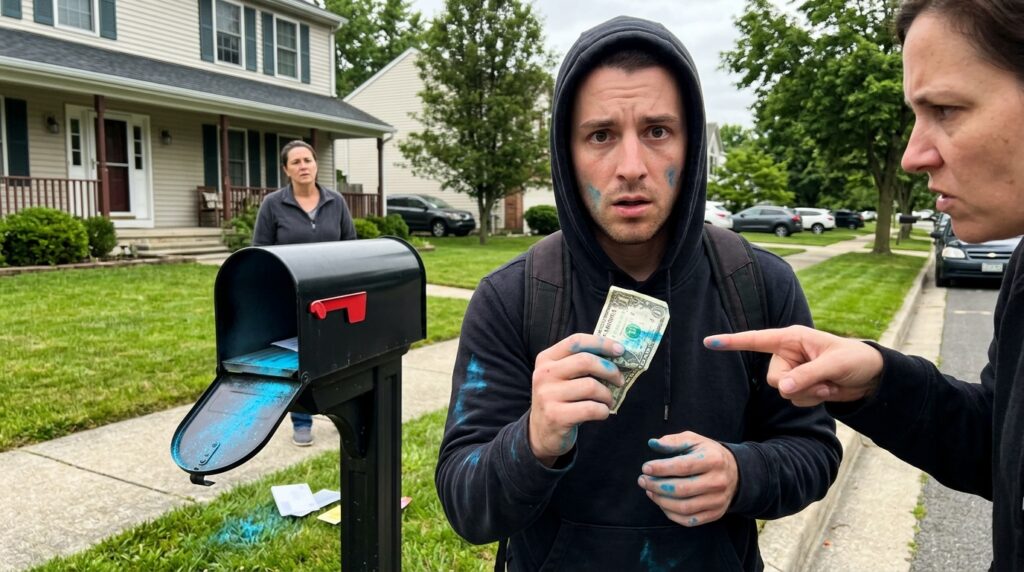
Her hand was still deep inside the dark aluminum box. Her fingers, wrapped tightly around a thick cream-colored envelope containing a single paper banknote, twitched. She wore a tailored jacket with a high geometric pattern—a garment designed for board meetings that had long since migrated to driveway confrontations.
“I’m executing a boundary audit, Arthur,” Evelyn said. Her voice was thin, clipped with the false authority of someone who had spent twenty years reading community bylaws aloud to silent rooms. “This box is non-compliant. The latch mechanism is loose, and the delivery profile suggests unauthorized commercial volume.”
“You’re on federal mail protocol, Evelyn,” Arthur said. He took a slow sip from the mug. The porcelain was thick, cool against his lip despite the hot coffee inside. “And your palms are blue.”
Evelyn’s jaw tightened. She pulled her right hand out of the box, intending to smooth her lapel with an practiced, dismissive gesture.
She stopped mid-motion.
The palm of her hand was no longer pale. A deep, electric cobalt blue was blooming across her skin, creeping into the fine lines around her knuckles and staining the underside of her manicured fingernails. As she instinctively wiped her thumb against her jawline to clear a drop of sweat, she dragged a vibrant streak of indigo across her cheekbone.
“What is this?” Her voice cracked, losing its rehearsed cadence. She looked down at her hand, turning it over as if it belonged to a mannequin. “What did you put on this latch?”
“Transfer dye,” Arthur said softly. He didn’t move from the shadow of the porch. “Industrial grade. It reacts to lipid moisture on human skin. Takes about four seconds to bind to the keratin layer. You can scrub with turpentine, but it won’t clear until the skin sheds next week.”
Evelyn took a frantic step backward onto the sidewalk, but her left hand—the one holding the paper banknote—was already turning navy blue. The dye was bleeding off the envelope, smearing across the crisp watermark of the cash.
Down the block, the mechanical whine of a lawnmower sputtered and died. Mr. Henderson, two doors down, paused on his driveway, wiping his brow with a greasy shop rag. His eyes locked onto the bright blue smear across Evelyn’s face.
Evelyn saw him looking. Her posture snapped back into rigid alignment, though her blue-stained fingers twitched against her hip.
“This is an illegal booby trap, Arthur!” she barked, her voice rising to reach the street. “You’ve poisoned a public fixture! I was securing this envelope because it bears a routing symbol for an offshore holding group. You’re running an unregistered business out of this residential zoning!”
Arthur set the white mug down on the wooden handrail with a dull clink. He pulled a worn black smartphone from his canvas pocket, tapping the screen once without looking down.
“The envelope has your name on the inside, Evelyn,” Arthur said, his voice dropping into the quiet space between them. “Because I addressed it to you before I put it in my box.”
Evelyn’s eyes widened behind her oversized sunglasses. She looked down at the cream paper in her dye-stained hand. Through the thin stock, printed in block lettering beneath the blue powder, was her own house number.
“That’s not why you opened it,” Arthur added, stepping down onto the first gravel tread of the walkway. “You opened it because for three months, every check with a state seal on it disappeared twenty minutes before I got home from the yard.”
Evelyn stepped back again, her heel catching the edge of the curb grass. She raised the blue-stained bill like a shield, but the phone in Arthur’s hand emitted a low chime, signaling a completed file transfer to an external server.
“That’s the front camera,” Arthur said, pointing the screen toward her. The high-definition display showed her face from five minutes ago, crisp and clear, her hand reaching into the box as the blue powder burst invisibly across her fingers. “And the postal inspector’s vehicle just turned onto Elm.”

CHAPTER 2: THE PAPERWORK PARADOX
“You think a phone call frightens me, Arthur?”
Evelyn didn’t drop the blue-stained banknote. Her fingers, dark indigo to the second knuckle, clamped harder around the cotton-blend paper. The dye had seeped through her skin pores and onto the crisp portrait of Jackson, bleeding inward like spilled ink on a blotter.
“I have served on this township planning board for fourteen years,” she said, her chest heaving against the tailored lapels of her patterned jacket. “I know the postal statutes better than whatever local deputy you managed to pull off highway patrol. This box sits within the municipal easement. That means it is subject to public nuisance codes.”
Arthur didn’t answer right away. He lowered his smartphone three inches, just enough to keep her face in the center of the optical lens. The phone was a ruggedized, rubber-cased model with grease smudges on the glass, showing the live recording timer ticking past three minutes and twelve seconds.
“You’re standing on my gravel apron, Evelyn,” Arthur said. The soles of his work boots crunched softly as he shifted his weight on the driveway edge. “And the United States Postal Service doesn’t share jurisdiction with the subdivision board.”
From down the cul-de-sac, the low, steady rumble of a heavy V8 engine broke the suburban quiet. A white utility sedan with a blue stripe along the beltline turned slowly past the fire hydrant, its roof-mounted strobe lights unlit but its grill low and purposeful against the blacktop.
Evelyn’s head snapped toward the vehicle. For a fraction of a second, her posture faltered—her shoulders slumping just enough to expose the tension locked in her neck. But as the sedan pulled up to the curb and idled beside the mailbox, she smoothed her jacket with her clean forearm, leaving a pale smear where the fabric dragged over her wrist.
A man in a sharp charcoal uniform got out of the driver’s side. He wore no high-visibility vest, no duty belt bristling with steel, only a silver badge pinned to his breast pocket bearing the eagle emblem of the Postal Inspection Service. His face was weathered like cured leather, his hair cropped close and graying at the temples.
“Morning,” the inspector said. His voice was flat, unhurried, carrying the dry rasp of a man who had spent thirty years reading federal dockets. He didn’t look at Arthur first. His eyes landed directly on Evelyn’s hands.
“Inspector,” Evelyn said instantly, stepping toward the driver’s door. “I’m glad you’re here. I’m Evelyn Vance, president of the local property association. I was performing a routine inspection of this receptacle after multiple reports of unregistered commercial transit—”
“Ma’am,” the inspector interrupted softly. He reached into his door pocket and pulled out a pair of clear nitrile gloves, snapping them onto his hands with a sharp, rubbery pop. “Step two feet back from the box, please.”
“I am the complainant here!” Evelyn’s voice rose an octave, sharp enough to make Mr. Henderson drop his shop rag over his fence line to watch. “He loaded this latch with an industrial chemical! He’s poisoned a public utility!”
“Receptacle belongs to the homeowner, ma’am. The mail inside belongs to the addressee or the United States Government,” the inspector said. He stepped between Evelyn and the open mailbox, his eyes sweeping the flaking black paint on the latch, where a thin crust of blue powder remained visible in the corner hinges. “And that chemical is standard transfer indicator powder. It isn’t toxic. It just doesn’t wash off.”
He turned his head slightly, looking at Arthur. “You the property owner?”
“Arthur Vance,” Arthur said, extending his hand.
The inspector paused, his gloved hand hovering mid-air as he processed the surname. He looked from Arthur’s worn canvas work trousers to Evelyn’s blue-stained, tailored jacket.
“Relation?” the inspector asked, his eyes narrowing slightly.
“Sister-in-law,” Arthur replied, his voice remaining level, flat as a board. “My brother died fourteen months ago.”
Evelyn’s mouth snapped shut. Her jaw muscles worked frantically beneath her makeup, the indigo streak across her cheekbone darkening as sweat broke out along her hairline.
“He left the property to me in the probate settlement,” Arthur continued, gesturing with his phone toward the open box. “And every third Tuesday since the estate closed, the dividend notices from his old credit union have vanished before I get home from the shop.”
“That is a lie!” Evelyn shouted, taking a sudden step forward. Her blue fingers twitched toward her handbag. “His estate wasn’t settled! There were outstanding municipal liens against this structure! I was retrieving those notices to prevent a tax seizure!”
From her leather handbag, she pulled out a folded white paper encased in a clear vinyl sheath—an unofficial, self-printed warning notice bearing the crest of the neighborhood association.
The inspector reached out and took the paper from her hand, his nitrile gloves picking up a fresh trace of blue powder from the vinyl cover. He unfolded it slowly, skimming the dense, single-spaced text printed on the page.
“This isn’t a county tax lien, ma’am,” the inspector said, his voice dropping into a colder, lower register. He held the paper up so the morning light hit the header. “This is a private demand note. And it’s addressed to a corporate entity that closed four years ago.”
He looked back at the open mailbox, then down at the paper banknote still clutched in Evelyn’s left hand.
“You pulled a live financial instrument out of a locked box using a fake association notice as cover,” the inspector said quietly. “That’s not a municipal audit, Mrs. Vance. That’s a federal felony under Title 18.”
Evelyn backed up until her heels hit the grass margin, looking frantically toward the porch where Arthur stood motionless.
“Arthur,” she whispered, the authoritative veneer completely gone, leaving behind something raw and desperate. “Tell him. Tell him about the business account. You know what Edward did before he died.”
Arthur took a step off the porch, his boots crunching on the gravel as he walked toward the curb. He stopped two feet from her, his eyes cold and unreadable.
“Edward’s accounts were closed, Evelyn,” Arthur said quietly. “Except the one you opened in his name two weeks after the funeral.”
CHAPTER 3: THE COBALT STAIN
“You have no proof of that,” Evelyn said. Her voice didn’t carry the ringing authority she used at the zoning hearings. It came out as a thin, dry whistle, like air escaping a pinched tire. “You don’t know what Edward owed. You don’t know what it took to keep the creditors off this house while he was in hospice.”
She didn’t look at the inspector. She looked at Arthur’s boots, her indigo-stained knuckles twitching as she tried to tuck her hands behind the lapels of her patterned coat. The dye had already dried, forming a powdery, matte crust that made her skin look mummified under the flat morning sun. Every time she flexed her fingers, tiny flakes of cobalt drifted down onto the sun-baked asphalt.
Inspector Miller didn’t raise his voice. He reached into the rear seat of his unmarked utility sedan and pulled out a heavy metal clipboard fitted with a spring-loaded clamp. Attached to the top was a sheet of yellow evidence paper, already pre-printed with the federal seal.
“Mrs. Vance,” Miller said, his tone as flat and unyielding as a slab of poured concrete. “Hold your hands out. Palms up.”
“I am not under arrest,” she snapped, though her heels didn’t move from the edge of the grass. “I have a right to consult with the association attorney before I sign or yield anything.”
“You aren’t signing anything yet,” Miller replied. He took a step forward, his nitrile gloves catching the glare of the windshield. “I’m securing physical evidence before you transfer it to that leather bag or rub it off on municipal property. Palms up, or I call the township deputy to place you in administrative holds. Your choice.”
Arthur stayed three paces back, his shoulder resting lightly against the rusted steel mailbox post. The metal was warm through his shirt, heated by the rising sun. Across the street, two more porch doors clicked open. Mrs. Gable from number forty-two stepped out onto her gravel apron, holding a pair of garden shears she wasn’t using, her eyes wide behind thick wire-rimmed glasses. Behind her, a delivery van slowed to a crawl, its tires crunching heavily over the loose road grit as the driver leaned over his dashboard to take in the scene.
Evelyn saw the crowd gathering. Her jaw worked silently, a faint tremor running through the muscle near her ear. Slowly, with agonizing slowness, she raised her hands.
The indigo dye was bright, almost luminescent against her pale skin. It covered her right palm completely, mapping the lines of her hand in deep, electric blue. Her fingertips were stained black where the powder had mixed with the sweat under her nails. In her left hand, the cream envelope was crumpled, the paper banknote within visibly smeared with dark blue thumbprints.
Miller picked up an instant-camera unit from his passenger seat. The shutter clicked three times in rapid succession—a sharp, mechanical thwip-snap that sounded like a stapler hitting cardboard. White photo slips ejected from the bottom, developing slowly in the dry summer heat.
“The banknote in your hand,” Miller said, taking a small glassine bag from his kit. “Drop it in.”
Evelyn’s fingers didn’t obey at first. They seemed locked in a rigor of denial.
“Arthur,” she whispered, her eyes shifting to him, glassy and unblinking. “You’re destroying his name. If this goes into a federal record, the entire estate gets audited. They’ll pull the deeds for the workshop. They’ll pull the tax credits Edward claimed for the equipment.”
“Edward’s name isn’t on that envelope, Evelyn,” Arthur said softly. “Mine is. And the signature on the authorization form you filed with the credit union last month isn’t his either. He was in an ICU bed in Saint Jude’s on the fourteenth. I have the visitor logs.”
A sharp gasp came from the edge of the sidewalk. Mrs. Gable had walked down to her driveway gate, her garden shears held loosely at her side, her face pale with shock.
Evelyn turned toward the sound, her posture shattering completely. The arrogant, posture-perfect president of the subdivision board looked suddenly small, swallowed up by the oversized geometric coat. The banknote slipped from her blue fingers, fluttering down into the open glassine bag Miller held beneath her hands.
“I took care of him,” she muttered, her voice dropping into a raspy, frantic rhythm. “When he couldn’t pay the equipment leases, who talked to the bank? When the county threatened to lien the storage barn, who paid the filing fees out of pocket? You were off in the mountains running timber, Arthur! You weren’t here when the collection notices started coming twice a week!”
“I was paying his medical co-pays directly to the hospital billing office,” Arthur said, his voice dropping an octave, solid and unmovable. “I have every receipt stacked on my desk inside. And every one of them shows an outstanding balance because someone was redirecting his monthly pension drafts to a P.O. Box in North Arlington.”
Evelyn went rigid. The color drained from her lips, leaving the indigo streak across her cheek looking like a fresh bruise on a corpse.
Miller sealed the glassine bag with a strip of red tamper-evident tape, marking the date and time with a black marker. He didn’t look surprised. In thirty years of federal service, the story was always the same—a long, slow creep of quiet entitlement that started with opening a relative’s mail “to help out” and ended under the harsh lights of a federal magistrate’s court.
From the leather bag resting on her arm, a thin strip of paper slid out, caught by the dry breeze off the asphalt. It tumbled twice across the gravel, landing against the toe of Arthur’s work boot.
Arthur bent down and picked it up before the wind could take it. It wasn’t an HOA notice. It was a deposit slip from the local savings and loan, stamped with a crimson ink seal dated three days prior.
At the top of the slip, typed in clean, carbon-ribbon print, was an account number Arthur recognized immediately—not Edward’s old commercial line, and not the estate account. It was a secondary trust account registered under Evelyn’s maiden name.
And the amount listed beside the stamp wasn’t a pension check or a dividend draft. It was a five-figure clearing transfer from an insurance casualty group in Ohio.
Arthur looked up from the paper, his eyes locking onto Evelyn’s pale, sweating face.
“This isn’t about Edward’s debts,” Arthur said, holding the stamped slip between his calloused fingers. “This is about the shop fire in twenty-two.”
CHAPTER 4: THE DECOY DEPOSIT
“Don’t read what you don’t understand, Arthur,” Evelyn said.
Her voice had dropped from a public screech into a tight, grating rattle. She took one step toward him, her blue-crusted hand twitching at her side before Inspector Miller’s outstretched forearm blocked her path like an iron gate.
“That slip is for an equipment liquidation account,” she hissed, her eyes darting toward the gathering neighbors on the sidewalk. “Edward didn’t own those tools when the shop burned. He’d leased them through my father’s trust. When the fire investigators closed the file, the carrier paid out to the primary lienholder. That’s me, Arthur. That’s my family’s money.”
Arthur didn’t blink. He smoothed the crumpled deposit slip against the stiff backing of his own palm, his thumbnail tracing the faint carbon trail beneath the red bank stamp.
“The shop burned in October,” Arthur said, his voice level, carrying over the idling hum of the inspector’s sedan. “The carrier closed the claim in January. Why is an endorsement check clearing through a regional branch forty miles away three days ago?”
“Because the probate court took eighteen months to clear the liability waivers!” Evelyn shot back. She turned toward Inspector Miller, her posture stiffening again as she tried to reclaim her administrative footing. “Inspector, this man is intentionally conflating private estate recovery with a postal matter. The check in that mailbox was a commercial draft issued to an inactive business entity registered at this address. Under municipal ordinance four-B, any mail delivered to an abandoned or unverified commercial point is subject to impoundment by the neighborhood board—”
“Mrs. Vance,” Inspector Miller interrupted. He didn’t look up from his metal clipboard as he recorded the deposit slip’s serial number in neat, block lettering. “Municipal ordinance four-B isn’t a federal law. And a private neighborhood board doesn’t have the authority to reach into a locked or unlocked residential box to intercept a draft, regardless of who it’s made out to.”
He clicked his pen once, the sharp metallic snap echoing against the asphalt.
“Furthermore,” Miller continued, turning his weathered face toward her, “this deposit slip shows a clearing draft from an insurance casualty group. But the endorsement stamp on the back of this voucher isn’t from an equipment lessor. It’s a second-party transfer.”
Evelyn’s breath hitched. She reached instinctively for her leather handbag, but Miller stepped neatly into her line of movement, his body positioning forcing her back onto the grass margin.
“A second-party transfer,” Arthur repeated softly. He turned the slip over in his hands. Embedded in the crease was a tiny, carbon-copy endorsement voucher, stained with moisture at the edge. “Who endorsed it over to you, Evelyn?”
“It’s an estate adjustment,” she said, though her words lacked the sharp edge they had two minutes ago. Her fingers pulled at the lapel of her patterned coat, smearing another faint haze of blue powder across the fabric. “It was signed by the executor.”
“Edward was the executor,” Arthur said. “And Edward was in a hospice bed in Saint Jude’s three days ago.”
A heavy silence settled over the driveway. Down the block, Mr. Henderson took a slow step off his lawn, his boots crunching on the loose gravel of the shoulder as he leaned forward to listen. Mrs. Gable hadn’t moved from her gate; her garden shears hung limp in her hand, forgotten.
Evelyn looked around the street, her eyes bouncing from one familiar face to another. For six years, she had run the subdivision association from her sunroom, issuing fines for unclipped hedges and parking violations, enforcing a rigid standard of suburban order. Now, standing on the curb with cobalt dye dried across her cheek and hands like a brand, the illusion of authority was stripping away piece by piece.
“He signed the authorization before he went into ICU,” she whispered, her voice faltering as she looked directly at Arthur. “He knew the debts were coming for this house. He gave me power of attorney over the casualty claims so the bank wouldn’t take the lot out from under you!”
She stepped closer, pointing a blue-stained index finger at Arthur’s chest.
“You think I took that money for myself?” she barked, her voice suddenly cracking into a raw, ragged strain. “I paid his back taxes! I paid the contractor who cleared the charred timbers out of the back lot after the town threatened to condemnation-lock the property! You were off working timber lines in Oregon while I spent every Tuesday arguing with county assessors to keep this roof over his head!”
Inspector Miller looked from Evelyn’s furious, blue-streaked face to Arthur’s quiet, stone-hard expression.
“Is that true, Mr. Vance?” Miller asked quietly. “Was she acting under a power of attorney for estate liabilities?”
Arthur didn’t answer right away. He reached into his shirt pocket and pulled out a small, folded piece of yellowed paper—a receipt from the county clerk’s office dated two months prior.
“The back taxes were paid, Inspector,” Arthur said, holding out the receipt. “By a cashier’s check drawn from my credit union account in Eugene. The tax lien was cleared in May.”
He looked Evelyn dead in the eye.
“So where did that casualty money actually go, Evelyn?” Arthur asked. “Because it didn’t go to the town. And it didn’t go to Edward’s care.”
Evelyn froze. Her blue fingers opened and closed against her coat, unable to form a word as the decoy logic she had built around the shop fire collapsed around her boots.
Inspector Miller reached down, picked up his portable radio from his belt, and raised it to his lapel.
“Control,” Miller said into the mic, his voice calm and methodical. “This is Inspector Miller, unit four-seven. Send a marked township unit to my location for a transport assist. We have a confirmed Section 1708 mail theft with secondary financial fraud indicators on site.”
CHAPTER 5: THE LENS AND THE LOCKBOX
The crackle of Inspector Miller’s shoulder radio hadn’t even faded before Evelyn moved.
It wasn’t a calculated maneuver. It was the blind, frantic thrashing of an animal realizing the fence had closed. She lurched sideways toward the curbside mailbox, her blue-crusted hand sweeping downward in a wild arc aimed directly at the open metal lid. Her knuckles slammed against the sharp aluminum lip, sending a metallic reverberation echoing down the driveway as she tried to crush the remaining powder residue into the gravel.
“Stop!” Miller barked, his heavy boots planting into the asphalt as he grabbed her forearm, spinning her back toward the road margin.
“Get your hands off me!” Evelyn screamed, her voice cracking as she clawed at his charcoal sleeve, leaving a wide smear of cobalt powder across his cuff. “It’s my property! My family built this subdivision! You can’t lock me out of my own brother’s yard!”
“The mailbox belongs to the United States Government, Mrs. Vance,” Miller said, his voice dropping into that chilling, unyielding baseline. He didn’t twist her arm; he simply leveraged his weight, forcing her backward until her knees hit the edge of the grass. “And you just committed a second federal violation by attempting to destroy an active crime scene in my presence.”
Across the lawn, Arthur didn’t move toward her. He stood beside the bottom porch tread, his fingers cold against the glass screen of his smartphone.
“It’s already off the curb, Evelyn,” Arthur said.
Evelyn stopped pulling against Miller’s grip, her chest heaving, the indigo streak across her cheek glistening with sweat. She glared at Arthur through her smudged sunglasses. “What did you say?”
Arthur turned the phone screen toward the street. He tapped the center icon once.
A high-definition, wide-angle video feed played across the glass. The camera angle was low, mounted right beside the porch light fixture, capturing the entire front apron with razor-sharp clarity. On the screen, timestamped at precisely 8:14 AM, Evelyn’s geometric coat fills the frame. Her right hand reaches out, fingers curling around the latch. The camera captures the exact micro-second the spring releases, puffing a cloud of blue powder straight into her open palm. The audio playback is crisp: the metallic clack of the hinge, the rustle of the cream envelope being pulled from the slot, and her own sharp, triumphant intake of breath before the chemical dye blooms across her skin.
“The doorbell camera isn’t routed to a local drive,” Arthur said, his voice flat, devoid of anger, carrying only the cold, unshakeable weight of a surveyor measuring a property line. “It uploads to a secure cloud server every four seconds. Even if you took the box, even if you scrubbed every grain of dye off that post, the recording was archived before you reached the sidewalk.”
Down the street, the high-pitched wail of a township siren broke the quiet. The white-and-blue patrol car rounded the corner by the water tower, its lightbar flashing blue and red against the dry oak trees lining the cul-de-sac.
Mr. Henderson stepped entirely off his lawn now, his heavy work boots crossing the center line of the street. Mrs. Gable followed, holding her garden shears against her skirt like an anchor, her eyes fixed on the digital screen in Arthur’s hand.
“Evelyn,” Mrs. Gable said softly, her voice carrying over the distant siren. “Is that… is that Edward’s mail?”
Evelyn didn’t look at her. She couldn’t. Her head hung low, her eyes fixed on the asphalt between her designer flats, where tiny blue specks of transfer powder were being scattered by the morning wind.
“I kept this street clean,” Evelyn whispered, her voice hollow, stripped of every layer of procedural authority she had cultivated over twenty years. “I made sure the houses held their value. I made sure nobody brought down the neighborhood.”
“You used the neighborhood board to cover your hands, Evelyn,” Arthur said, stepping down onto the driveway gravel as the patrol car pulled up behind Miller’s sedan, its tires spraying a light shower of dust against the curb. “You thought if you dressed it up as an inspection, nobody would ever ask to see the checks.”
The township officer got out of the cruiser, his hand resting casually on his belt as he assessed the scene—the federal inspector, the blue-stained suspect, and the quiet homeowner holding a smartphone with a live video loop playing on the screen.
Inspector Miller handed the glassine evidence bag to the officer, along with the digital photo prints. “Officer, take custody of Mrs. Vance. We’re holding her under Section 1708, pending federal arraignment at the district court.”
As the officer stepped forward and clicked his steel handcuffs open, Evelyn looked up one last time at Arthur.
“You won’t get a dime from the estate,” she spat, her teeth showing through a grimace of pure venom. “The accounts are locked. You think you won, Arthur? You’re going to spend the next ten years in probate court trying to prove Edward didn’t sign those releases!”
Arthur didn’t flinch as the cuffs clicked around her blue-stained wrists. He reached into his canvas jacket pocket and pulled out a small, worn leather notebook—Edward’s old ledger book, its spine cracked and bound with black electrical tape.
“I don’t need probate court, Evelyn,” Arthur said softly, opening the book to a marked page filled with neat, pencil-drawn columns. “Edward didn’t sign the releases. But he kept a second set of books right here under the floorboards in the shop.”
CHAPTER 6: THE SECOND LEDGER
The officer paused with one knee pressed against the rear bumper of the patrol car, his thumb resting over the chrome ratchet of the handcuffs.
“What ledger, Mr. Vance?” Inspector Miller asked, turning away from the vehicle’s open door. His gloved hand hovered over his clipboard, the pen tip poised above the yellow evidence sheet.
Evelyn twisted in the township officer’s grip, her face contorting as she stared at the cracked leather spine in Arthur’s hand. “He’s lying! That’s a personal notebook! It has no legal standing in a corporate audit!”
Arthur didn’t look at her. He turned the worn notebook sideways, thumbing past three decades of hand-drawn wiring schematics, lumber yard invoices, and engine rebuild part numbers until he reached the final ten pages. The paper was heavy, cream-colored, stained at the margins with grease and old machine oil.
“Edward kept a running tally of every check that went missing after his first stroke,” Arthur said. His thumb stopped on a page dated two autumns ago. “He didn’t know how she was getting into the box at first. He thought the postal carrier was dropping them in the ditch down by the culvert. So he started writing down the check numbers, the issuing banks, and the exact dividend amounts.”
Inspector Miller stepped closer, his boots crunching over the loose stone shoulder. He leaned down, his eyes scanning the tight, precise pencil script.
“Look at the bottom entry, Inspector,” Arthur said softly. “October fourteenth. Three days before the shop burned.”
Miller’s gaze dropped to the bottom line. Beneath a listed dividend draft from the regional credit union, a single line was written in Edward’s shaky, late-stage hand: E. V. opened third account at First National. Dividend checks redirected per her instruction. No authorization given.
Evelyn’s breath hitched in a sharp, wet rasp. She tried to pull her right arm free, but the officer held her firm against the door frame.
“He knew,” Arthur said, looking up from the page into her wide, bloodshot eyes. “He knew months before he died that you weren’t clearing his debts. You were liquidating his equipment shares and diverting the yield into your own trust so the estate wouldn’t show an asset surplus when the hospice bills came due.”
“It was to save the property!” Evelyn shrieked, her voice echoing off the brick facade of Mr. Henderson’s garage. “If the state saw he had liquid assets, they would have attached a lien to the house before he was even in the ground! I was protecting the land!”
“You were protecting your share of the inheritance,” Arthur replied, his voice dropping into that flat, unyielding register. “Because under his original will, the house went to the estate, but the liquid yields went to his brother. To me.”
Inspector Miller took out a small glassine sleeve from his inner jacket pocket, holding it open. “I’m going to need to take custody of that ledger, Mr. Vance. It’s a primary material record for the fraud investigation.”
Arthur looked down at his brother’s handwriting—the neat, sloping numbers that had tracked a lifetime of hard physical labor, ending in the quiet, desperate inventory of a betrayal. Slowly, carefully, he placed the leather book into the inspector’s waiting hands.
“There’s one more thing,” Arthur said, reaching into his pocket and pulling out the small carbon-copy endorsement slip he had retrieved from the gravel moments earlier. “The deposit slip she dropped. The check clearing number matches the October fourteenth entry in this book.”
Miller accepted the paper, placing it alongside the ledger in the evidence folder. He sealed the plastic closure with a firm press of his thumb and turned to the township officer.
“Place her in the vehicle,” Miller said. “We’re taking her directly to the federal building in Wilmington. I’ll file the supplementary fraud charges at the desk.”
The officer guided Evelyn into the back seat of the cruiser. She didn’t fight him this time. Her body seemed to deflate, her shoulders slumping inside the heavy geometric coat as the blue powder on her cheek smeared against the vinyl door frame. The door shut with a heavy, muffled thump, sealing her inside behind the reinforced glass.
Down the sidewalk, Mrs. Gable slowly lowered her garden shears. She didn’t say a word as she turned and walked back up her driveway, her head bowed. Mr. Henderson stood by his mailbox for a long moment, looking at Arthur, before giving a single, solemn nod and retreating into his yard.
Inspector Miller closed his clipboard with a loud snap. “I’ll need you to come down to the district office tomorrow morning to sign the formal affidavit, Mr. Vance. Nine o’clock.”
“I’ll be there,” Arthur said.
The inspector nodded once, stepped into his utility sedan, and pulled away from the curb. The township cruiser followed, its red and blue lights flashing silently against the asphalt as it rounded the bend toward the main road, leaving the cul-de-sac in absolute, heavy silence.
Arthur stood alone at the edge of his driveway. The sun had cleared the tree line, casting long, sharp shadows across the manicured lawns. He walked over to the open metal mailbox, reached out, and pulled the lid shut.
The latch clicked into place with a solid, definitive sound that carried across the empty street.
CHAPTER 7: THE SETTLED LINE
The exhaust fumes from the township cruiser hung in the still August heat, a pale blue film dissolving above the asphalt.
Arthur didn’t watch the cars turn at the end of the cul-de-sac. He walked back toward the porch, his heavy boots making a dry, crunching sound over the gravel apron where Evelyn had stood ten minutes ago. On the third wood step, the white ceramic coffee mug sat exactly where he had left it. The steam was gone now, the surface of the black coffee still and mirror-dark, reflecting the sharp white angle of the roofline above.
He picked up the mug. The porcelain was no longer warm, but its heavy weight anchored his hand as he turned back to look at the street.
Across the cul-de-sac, Mr. Henderson’s garage door rolled down with a slow, mechanical groan, sealing the workshop away from the public road. Mrs. Gable’s porch light switched off, the amber glow dying behind the glass panel. One by one, the neighborhood returned to its quiet, suburban rhythm. But the air felt different—thinner, stripped of the silent, suffocating oversight that had governed the block for fifteen years.
Arthur walked to the edge of the lawn where the mailbox stood.
On the gravel beneath the post, a few specks of cobalt dye still glinted in the sunlight like crushed sapphire dust. He nudged the gravel with the toe of his boot, burying the blue powder under a layer of gray river stone until the ground looked uniform and unbroken again.
He opened the metal box once more. The latch moved smoothly on its hinge, freed from the sticky crust of transfer dye that Inspector Miller had scraped into his evidence pouch. Inside, the dark aluminum floor was empty, save for a small brass key resting in the back corner—a duplicate key Edward had hidden under the lining years ago, one Evelyn had never found because she had been too busy reaching in from the front.
Arthur picked up the key, the cool brass rough against his thumb. He slipped it into his canvas trousers alongside his own keyring, feeling the metal click into place.
He walked past the side of the house toward the back lot, where the scorched timber beams of Edward’s old shop had been cleared away three months back. In their place stood a neat stack of rough-sawn white pine, seasoned and bound under a heavy canvas tarp to keep out the rain.
He laid his palm against the top board. The wood was warm, smelling of resin and sawdust, holding the steady heat of the late-morning sun. For two years, every conversation on this lot had been about liabilities, liens, probate delays, and the endless, sharp assertions of what Edward owed or didn’t owe. Now, with the federal dockets opened and the second ledger secure in Miller’s hands, the noise had ceased. The property didn’t belong to a committee. It didn’t belong to a trustee. It belonged to the soil beneath his boots and the work he put into it with his own hands.
Arthur took a slow sip of the cold coffee. It was bitter on his tongue, but it cleared the taste of road dust and chemical powder.
He looked down at his right hand. His skin was clean, calloused at the palm, free of blue powder or ink. He hadn’t needed to shout. He hadn’t needed to throw a punch or tear down a fence line. All it had taken was four seconds of chemical dye, a five-dollar digital camera, and the patience to let a thief prove her own nature in front of the people she tried to rule.
He turned toward the back porch, stepping into the shade of the overhang as the noon sun reached its peak over the neighborhood. He placed the ceramic mug on the workbench by the kitchen door, pulled a pair of leather work gloves from his back pocket, and walked toward the woodpile.
There was a fresh fence line to set along the western boundary before the rain came on Thursday, and for the first time in two years, nobody was coming down the driveway to tell him where to dig.







