CHAPTER 3: THE COBALT STAIN
“You have no proof of that,” Evelyn said. Her voice didn’t carry the ringing authority she used at the zoning hearings. It came out as a thin, dry whistle, like air escaping a pinched tire. “You don’t know what Edward owed. You don’t know what it took to keep the creditors off this house while he was in hospice.”
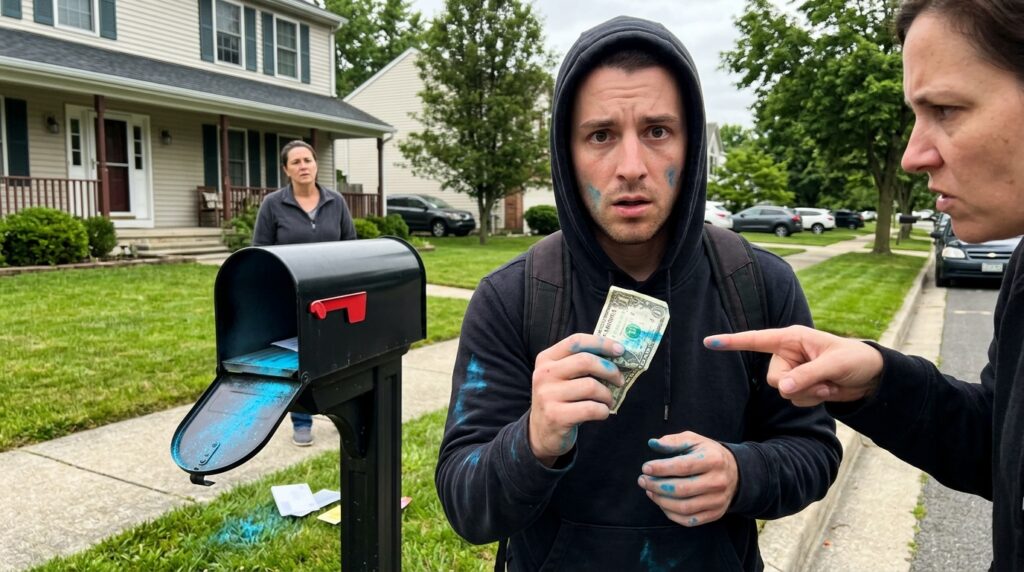
She didn’t look at the inspector. She looked at Arthur’s boots, her indigo-stained knuckles twitching as she tried to tuck her hands behind the lapels of her patterned coat. The dye had already dried, forming a powdery, matte crust that made her skin look mummified under the flat morning sun. Every time she flexed her fingers, tiny flakes of cobalt drifted down onto the sun-baked asphalt.
Inspector Miller didn’t raise his voice. He reached into the rear seat of his unmarked utility sedan and pulled out a heavy metal clipboard fitted with a spring-loaded clamp. Attached to the top was a sheet of yellow evidence paper, already pre-printed with the federal seal.
“Mrs. Vance,” Miller said, his tone as flat and unyielding as a slab of poured concrete. “Hold your hands out. Palms up.”
“I am not under arrest,” she snapped, though her heels didn’t move from the edge of the grass. “I have a right to consult with the association attorney before I sign or yield anything.”
“You aren’t signing anything yet,” Miller replied. He took a step forward, his nitrile gloves catching the glare of the windshield. “I’m securing physical evidence before you transfer it to that leather bag or rub it off on municipal property. Palms up, or I call the township deputy to place you in administrative holds. Your choice.”
Arthur stayed three paces back, his shoulder resting lightly against the rusted steel mailbox post. The metal was warm through his shirt, heated by the rising sun. Across the street, two more porch doors clicked open. Mrs. Gable from number forty-two stepped out onto her gravel apron, holding a pair of garden shears she wasn’t using, her eyes wide behind thick wire-rimmed glasses. Behind her, a delivery van slowed to a crawl, its tires crunching heavily over the loose road grit as the driver leaned over his dashboard to take in the scene.
Evelyn saw the crowd gathering. Her jaw worked silently, a faint tremor running through the muscle near her ear. Slowly, with agonizing slowness, she raised her hands.
The indigo dye was bright, almost luminescent against her pale skin. It covered her right palm completely, mapping the lines of her hand in deep, electric blue. Her fingertips were stained black where the powder had mixed with the sweat under her nails. In her left hand, the cream envelope was crumpled, the paper banknote within visibly smeared with dark blue thumbprints.
Miller picked up an instant-camera unit from his passenger seat. The shutter clicked three times in rapid succession—a sharp, mechanical thwip-snap that sounded like a stapler hitting cardboard. White photo slips ejected from the bottom, developing slowly in the dry summer heat.
“The banknote in your hand,” Miller said, taking a small glassine bag from his kit. “Drop it in.”
Evelyn’s fingers didn’t obey at first. They seemed locked in a rigor of denial.
“Arthur,” she whispered, her eyes shifting to him, glassy and unblinking. “You’re destroying his name. If this goes into a federal record, the entire estate gets audited. They’ll pull the deeds for the workshop. They’ll pull the tax credits Edward claimed for the equipment.”
“Edward’s name isn’t on that envelope, Evelyn,” Arthur said softly. “Mine is. And the signature on the authorization form you filed with the credit union last month isn’t his either. He was in an ICU bed in Saint Jude’s on the fourteenth. I have the visitor logs.”
A sharp gasp came from the edge of the sidewalk. Mrs. Gable had walked down to her driveway gate, her garden shears held loosely at her side, her face pale with shock.
Evelyn turned toward the sound, her posture shattering completely. The arrogant, posture-perfect president of the subdivision board looked suddenly small, swallowed up by the oversized geometric coat. The banknote slipped from her blue fingers, fluttering down into the open glassine bag Miller held beneath her hands.
“I took care of him,” she muttered, her voice dropping into a raspy, frantic rhythm. “When he couldn’t pay the equipment leases, who talked to the bank? When the county threatened to lien the storage barn, who paid the filing fees out of pocket? You were off in the mountains running timber, Arthur! You weren’t here when the collection notices started coming twice a week!”
“I was paying his medical co-pays directly to the hospital billing office,” Arthur said, his voice dropping an octave, solid and unmovable. “I have every receipt stacked on my desk inside. And every one of them shows an outstanding balance because someone was redirecting his monthly pension drafts to a P.O. Box in North Arlington.”
Evelyn went rigid. The color drained from her lips, leaving the indigo streak across her cheek looking like a fresh bruise on a corpse.
Miller sealed the glassine bag with a strip of red tamper-evident tape, marking the date and time with a black marker. He didn’t look surprised. In thirty years of federal service, the story was always the same—a long, slow creep of quiet entitlement that started with opening a relative’s mail “to help out” and ended under the harsh lights of a federal magistrate’s court.
From the leather bag resting on her arm, a thin strip of paper slid out, caught by the dry breeze off the asphalt. It tumbled twice across the gravel, landing against the toe of Arthur’s work boot.
Arthur bent down and picked it up before the wind could take it. It wasn’t an HOA notice. It was a deposit slip from the local savings and loan, stamped with a crimson ink seal dated three days prior.
At the top of the slip, typed in clean, carbon-ribbon print, was an account number Arthur recognized immediately—not Edward’s old commercial line, and not the estate account. It was a secondary trust account registered under Evelyn’s maiden name.
And the amount listed beside the stamp wasn’t a pension check or a dividend draft. It was a five-figure clearing transfer from an insurance casualty group in Ohio.
Arthur looked up from the paper, his eyes locking onto Evelyn’s pale, sweating face.
“This isn’t about Edward’s debts,” Arthur said, holding the stamped slip between his calloused fingers. “This is about the shop fire in twenty-two.”