
CHAPTER 2: THE PAPERWORK PARADOX
“You think a phone call frightens me, Arthur?”
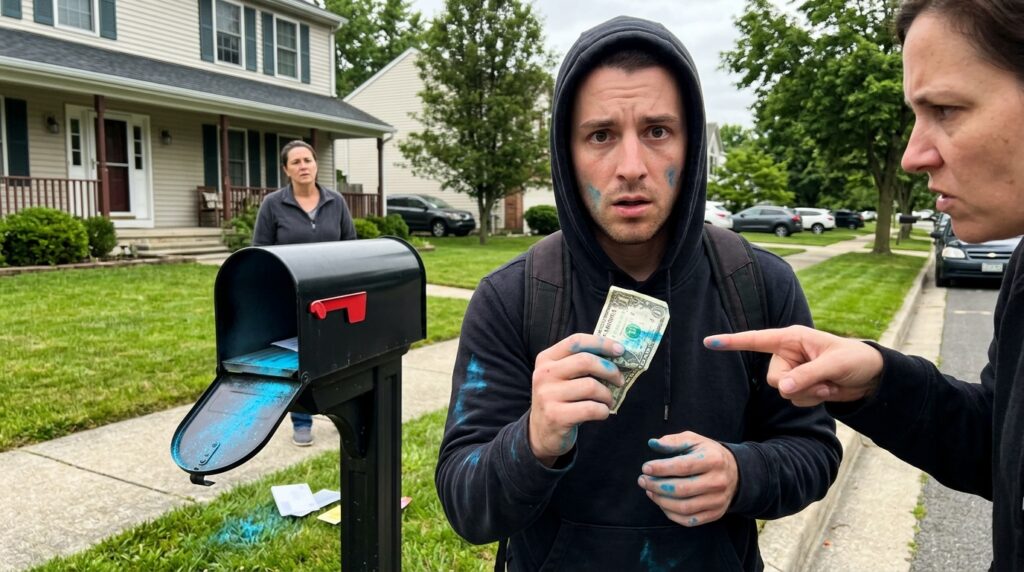
Evelyn didn’t drop the blue-stained banknote. Her fingers, dark indigo to the second knuckle, clamped harder around the cotton-blend paper. The dye had seeped through her skin pores and onto the crisp portrait of Jackson, bleeding inward like spilled ink on a blotter.
“I have served on this township planning board for fourteen years,” she said, her chest heaving against the tailored lapels of her patterned jacket. “I know the postal statutes better than whatever local deputy you managed to pull off highway patrol. This box sits within the municipal easement. That means it is subject to public nuisance codes.”
Arthur didn’t answer right away. He lowered his smartphone three inches, just enough to keep her face in the center of the optical lens. The phone was a ruggedized, rubber-cased model with grease smudges on the glass, showing the live recording timer ticking past three minutes and twelve seconds.
“You’re standing on my gravel apron, Evelyn,” Arthur said. The soles of his work boots crunched softly as he shifted his weight on the driveway edge. “And the United States Postal Service doesn’t share jurisdiction with the subdivision board.”
From down the cul-de-sac, the low, steady rumble of a heavy V8 engine broke the suburban quiet. A white utility sedan with a blue stripe along the beltline turned slowly past the fire hydrant, its roof-mounted strobe lights unlit but its grill low and purposeful against the blacktop.
Evelyn’s head snapped toward the vehicle. For a fraction of a second, her posture faltered—her shoulders slumping just enough to expose the tension locked in her neck. But as the sedan pulled up to the curb and idled beside the mailbox, she smoothed her jacket with her clean forearm, leaving a pale smear where the fabric dragged over her wrist.
A man in a sharp charcoal uniform got out of the driver’s side. He wore no high-visibility vest, no duty belt bristling with steel, only a silver badge pinned to his breast pocket bearing the eagle emblem of the Postal Inspection Service. His face was weathered like cured leather, his hair cropped close and graying at the temples.
“Morning,” the inspector said. His voice was flat, unhurried, carrying the dry rasp of a man who had spent thirty years reading federal dockets. He didn’t look at Arthur first. His eyes landed directly on Evelyn’s hands.
“Inspector,” Evelyn said instantly, stepping toward the driver’s door. “I’m glad you’re here. I’m Evelyn Vance, president of the local property association. I was performing a routine inspection of this receptacle after multiple reports of unregistered commercial transit—”
“Ma’am,” the inspector interrupted softly. He reached into his door pocket and pulled out a pair of clear nitrile gloves, snapping them onto his hands with a sharp, rubbery pop. “Step two feet back from the box, please.”
“I am the complainant here!” Evelyn’s voice rose an octave, sharp enough to make Mr. Henderson drop his shop rag over his fence line to watch. “He loaded this latch with an industrial chemical! He’s poisoned a public utility!”
“Receptacle belongs to the homeowner, ma’am. The mail inside belongs to the addressee or the United States Government,” the inspector said. He stepped between Evelyn and the open mailbox, his eyes sweeping the flaking black paint on the latch, where a thin crust of blue powder remained visible in the corner hinges. “And that chemical is standard transfer indicator powder. It isn’t toxic. It just doesn’t wash off.”
He turned his head slightly, looking at Arthur. “You the property owner?”
“Arthur Vance,” Arthur said, extending his hand.
The inspector paused, his gloved hand hovering mid-air as he processed the surname. He looked from Arthur’s worn canvas work trousers to Evelyn’s blue-stained, tailored jacket.
“Relation?” the inspector asked, his eyes narrowing slightly.
“Sister-in-law,” Arthur replied, his voice remaining level, flat as a board. “My brother died fourteen months ago.”
Evelyn’s mouth snapped shut. Her jaw muscles worked frantically beneath her makeup, the indigo streak across her cheekbone darkening as sweat broke out along her hairline.
“He left the property to me in the probate settlement,” Arthur continued, gesturing with his phone toward the open box. “And every third Tuesday since the estate closed, the dividend notices from his old credit union have vanished before I get home from the shop.”
“That is a lie!” Evelyn shouted, taking a sudden step forward. Her blue fingers twitched toward her handbag. “His estate wasn’t settled! There were outstanding municipal liens against this structure! I was retrieving those notices to prevent a tax seizure!”
From her leather handbag, she pulled out a folded white paper encased in a clear vinyl sheath—an unofficial, self-printed warning notice bearing the crest of the neighborhood association.
The inspector reached out and took the paper from her hand, his nitrile gloves picking up a fresh trace of blue powder from the vinyl cover. He unfolded it slowly, skimming the dense, single-spaced text printed on the page.
“This isn’t a county tax lien, ma’am,” the inspector said, his voice dropping into a colder, lower register. He held the paper up so the morning light hit the header. “This is a private demand note. And it’s addressed to a corporate entity that closed four years ago.”
He looked back at the open mailbox, then down at the paper banknote still clutched in Evelyn’s left hand.
“You pulled a live financial instrument out of a locked box using a fake association notice as cover,” the inspector said quietly. “That’s not a municipal audit, Mrs. Vance. That’s a federal felony under Title 18.”
Evelyn backed up until her heels hit the grass margin, looking frantically toward the porch where Arthur stood motionless.
“Arthur,” she whispered, the authoritative veneer completely gone, leaving behind something raw and desperate. “Tell him. Tell him about the business account. You know what Edward did before he died.”
Arthur took a step off the porch, his boots crunching on the gravel as he walked toward the curb. He stopped two feet from her, his eyes cold and unreadable.
“Edward’s accounts were closed, Evelyn,” Arthur said quietly. “Except the one you opened in his name two weeks after the funeral.”








