The Weight of the Line: A Novel of Asphalt, Easements, and the Heavy Toll of Suburban Sovereignty
CHAPTER 1: THE DRIVEWAY LINE
The steering wheel felt like cold grit under Arthur’s palms. He didn’t cut the ignition. When you’ve spent twenty-two years working infrastructure for the county, you learn to let seven tons of steel do the talking before you ever open your mouth. The asphalt of the driveway was old, webbed with hairline fractures that leaked small tufts of crabgrass near the margins, but it was solid enough to hold the weight of the gravel bed. He shifted the stick into neutral, the hydraulic fluid giving a low, wet sigh through the chassis.
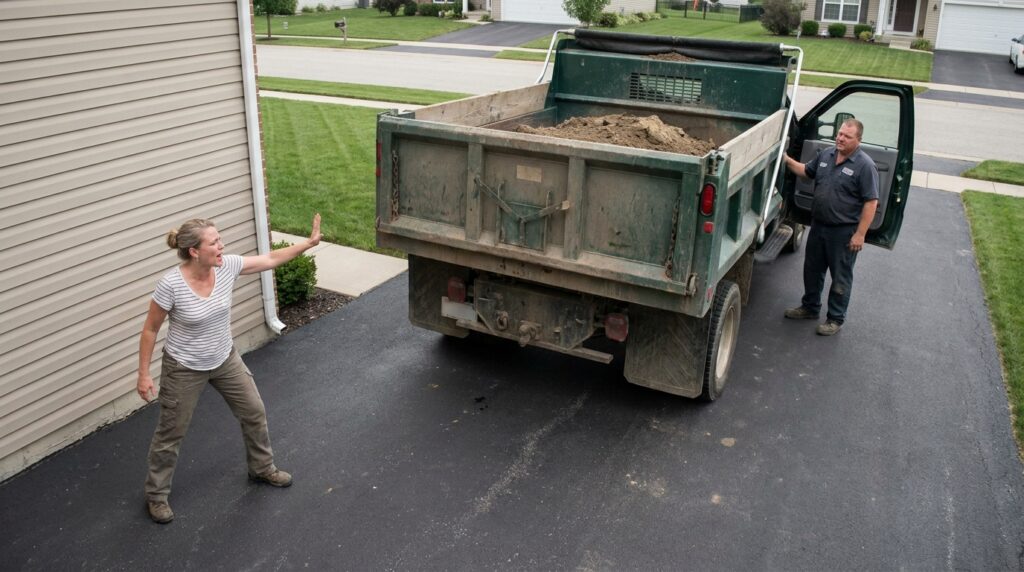
Through the salt-filmed windshield, she appeared before the truck had even fully settled on its springs. She didn’t walk out of the split-level house; she erupted from the screen door, her work pants rustling against the overgrown clover of the lawn strip. Her light hair was pulled back into a knot so tight it seemed to pull the skin at her temples into sharp, defensive angles. In her left hand, tucked under an arm like a shield, was a heavy plastic clipboard.
Arthur didn’t move. He watched her through the side mirror as she stepped off the grass and directly into the path of the front left tire. She planted herself there, her feet wide, an open palm thrust forward against the radiator grill as if she could halt forty thousand pounds of industrial momentum with her skeleton alone.
“This is my property,” her voice cut through the rhythmic thrum of the diesel, thin and sharp as a utility blade. “You don’t get to do whatever you want.”
Arthur reached down, his fingers catching the worn brass ring of his key ring. The heavy set of keys clinked against his belt loop as he cracked the heavy steel door of the cab. He didn’t drop down into the driveway; he stayed on the running board, using the elevation to look over the hood. The air out here was thick with the smell of sun-baked pine needles and the faint, bitter tang of leaking coolant from a job three miles back.
“We’re on the job order, ma’am,” he said. His voice was low, flat, entirely stripped of the cadence of an argument. It was the tone he used for city inspectors and busted water mains. “We’re not damaging anything. We’re clearing the drainage line.”
“That still doesn’t make this okay,” she snapped, her head giving a single, rigid jerk to the left. Her fingers tightened on the edge of the clipboard until the plastic groaned. “The HOA has a weight limit for private lanes. You’re cracking the base structure. I want this vehicle moved out to the county curb right now.”
Arthur looked down at the asphalt between them. Right there, where the gray driveway met the yellowing sod of the lawn, a small orange flag fluttered on a wire stem. Just three inches behind it, barely visible under a clump of unraked leaves, the dull square head of an old iron survey pin sat frozen in the earth. He knew what the blueprints in his cab said—the thirty-foot right-of-way didn’t care about neighborhood weight limits or manicured borders.
But as his eyes tracked the line from the iron pin toward the corner of the house, he noticed something else. A dark, oily smudge was weeping out from beneath the vinyl siding, right where the main foundation met the driveway’s edge, dripping onto a fresh, unauthorized patch of concrete that hadn’t been poured by any county crew.

CHAPTER 2: THE GUIDELINE BOUNDARY
“You have exactly thirty seconds to cut that engine before I call the township towing inspector,” she said.
The words came out clipped, rattling against the steady, metallic thrum of the seven-ton dump truck. She held the plastic clipboard high against her chest, a shield of white paper over a faded floral print. The pages underneath the heavy wire clip were dog-eared, yellowing at the edges with the distinct texture of outdated bylaws that had been thumbed through too many times in dark rooms.
Arthur didn’t shift his weight from the running board. The steel plate beneath his work boots vibrated with the deep, mechanical pulse of the idling diesel. He looked down at her—at the strict, pale line of her jaw and the small, twitching muscle just beneath her left eye. Up close, the striped short-sleeve top she wore looked stiff, starch-burnt and smelling faintly of cheap laundry detergent and old floor wax.
“Township doesn’t tow county trucks on a registered job order, ma’am,” Arthur said. He kept his hands flat on the top edge of the cab door, the rough, salt-crusted paint scraping against his calluses. “We’re clearing the drainage culvert at the base of the slope. If we don’t drop the stone today, the next heavy rain is going to compromise the foundation line on three of these lots.”
“There is no registered easement on this parcel,” she shot back, her voice tightening as she took a half-step closer to the massive front tire. The rubber was caked with dry, gray mud from the yard three miles north, and she looked at the debris as if it were a personal insult. She tapped her index finger against the clipboard. “Section four, paragraph B of the community guidelines explicitly forbids commercial vehicles exceeding three tons from staging within forty feet of a residential facade. I signed the notice myself.”
Arthur turned his head slightly, his gaze tracking past the sharp angle of her shoulder to the corner of the split-level house. The sun was clearing the tree line now, casting a flat, desaturated glare across the concrete driveway. The light wasn’t warm; it was the pale, dusty gray of an early July morning in a subdivision built on old gravel pits.
There it was again—the dark, damp stain weeping through the seam where the gray vinyl siding met the foundation.
In the dry heat of the last three weeks, that patch of ground should have been bone-white. Instead, the soil at the very edge of the fresh concrete patch looked loose, waterlogged, and covered by a thin skin of iridescent oil. A tiny, metallic glint caught his eye near the base of the siding—a brass clean-out plug, half-buried under a layer of decorative mulch that had been violently kicked aside. It was standard commercial-grade plumbing, the kind the county used for main water line taps, completely out of place on a standard residential lateral.
“Who poured that section by the corner wall?” Arthur asked, his voice dropping into a quiet, pragmatic rhythm.
Her finger stopped tapping the clipboard. For less than a second, her posture didn’t just stiffen—it locked. The muscles in her throat pulled taut, her chin lifting just enough to make the thin, light hair at her temples shake.
“That is none of your concern,” she said, her voice dropping an octave into a forced, defensive hiss. “That is private maintenance. If your crew touches that concrete, or if that truck so much as leaks a drop of oil onto this asphalt, I will have the HOA board file an emergency injunction before noon.”
Arthur looked back at the iron survey pin in the grass. The orange flag wire was rusted at the base where it entered the soil, vibrating slightly from the secondary shockwaves of the truck’s engine. He knew every line on the county transit map by heart. This wasn’t a standard residential driveway boundary; it was a designated triple-utility corridor established in 1994 before these houses were even framed. The county didn’t just have an easement here—they owned the dirt six feet down.
He reached into the cab, his fingers wrapping around the cold, zinc-plated handle of his aluminum permit case. He pulled it free, the metal corner clipping the door frame with a sharp, resonant tink.
“I’m not here to debate the handbook with you, ma’am,” Arthur said, stepping down onto the asphalt. The soles of his boots made a gritty, grinding sound against the loose stones. He unlatched the case, pulling out a three-page, blue-line schematic stamped by the county registrar’s office. “This is the structural schematic for the drainage right-of-way. Your property line stops exactly fourteen inches to the left of that foundation vent. This truck is parked in the public zone.”
She didn’t look at the paper. Her eyes remained fixed on Arthur’s face, two flat disks of hardened gray behind her sunglasses. She didn’t retreat an inch as he approached the front fender. Instead, she reached out with her right hand, her fingers catching the lip of the truck’s heavy steel bumper, her knuckles turning white against the grime.
“You think because you have a stamp on a piece of paper from the city building you can just tear up twenty years of peace?” she whispered. The calm, bureaucratic mask was beginning to fray at the edges, revealing a strange, desperate panic that didn’t match the scale of a simple gravel delivery. “You people don’t live here. You don’t pay the assessments. You don’t see what happens when the water starts coming up through the floorboards.”
Arthur stopped. The phrase water coming up through the floorboards wasn’t in any maintenance log for this sector. The drainage culvert was purely for surface runoff from the upper ridge—unless something else was discharging into the system from behind the walls.
He looked down at her hand on the bumper. Just beneath her cuff, her wrist was smeared with a fresh streak of black, graphite-heavy pipe dope—the specific chemical sealant used to lock high-pressure water valves.
Before he could speak, the heavy diesel engine behind the grill gave a sudden, hard cough. The RPMs dropped dangerously low as a thick plume of black exhaust belched from the vertical stack, settling over the driveway like wet charcoal. From the back of the truck, the low, rhythmic clatter of a secondary hydraulic pump began to whine—someone was trying to override the bed controls from the auxiliary panel.
CHAPTER 3: THE STRANGE OVERRIDE
The steel deck plates beneath Arthur’s boots shook as the hydraulic line bellowed. It was a sharp, high-pitched screech—the sound of valves being forced against an internal mechanical lock.
He lunged past the front fender, the grease-slicked steel of the dump body scraping his shoulder as he rounded the chassis. His hand went instantly to the secondary control housing mounted behind the cab, a heavy cast-iron box rusted shut at the hinge pins. The auxiliary lever was down, pinned into the raise position by a wedge of weathered pine wood.
Arthur jammed the heel of his palm against the wood, splintering the dry pine until the grain tore into his skin. The iron lever slammed back into neutral with a heavy, wet thunk, and the high-pressure groan subsided into the standard, rhythmic rattling of the diesel.
“Get away from that side panel,” he said without turning around.
The woman hadn’t run. She stood near the rear duals, her breath coming in shallow, ragged gaps that whistled through her nose. The plastic clipboard was tucked tight under her left arm, but her right hand was tucked into her pocket, her thumb hooked over a small, brass-plated key ring that didn’t belong to any standard residential deadbolt.
“This vehicle is an unpermitted hazard,” she said, though the words lacked the structural force of her initial bureaucratic performance. Her gaze flicked toward the house corner, where the damp, iridescent smear on the foundation concrete patch seemed to grow darker under the rising sun. “The pressure from your equipment is cracking the subterranean retention walls. If you discharge that load here, the structural damage will be total.”
Arthur wiped his blood-flecked palm against his work pants, leaving a dark streak across the canvas. He looked down at the auxiliary lever. The cast-iron housing had fresh scratch marks around the lock cylinder—bright, unoxidized silver cuts in the old green enamel. Someone had spent time trying to pick the maintenance plate open before he even put the truck in reverse.
“The only thing down there is a standard sixteen-inch reinforced concrete pipe for storm runoff,” Arthur said, his voice dropping into a flat, investigative register. He stepped closer to the edge of the driveway, his eyes tracking the line of the utility flags. “Unless somebody put something into the easement that isn’t on the county plat.”
“Everything in this subdivision is built according to the master plan,” she said, her head jerking back toward the street. “We don’t allow modifications. We don’t allow deviations. That’s why we have the guidelines.”
Arthur looked at her hands. The black pipe dope on her wrist had begun to dry, cracking into tiny, charcoal-colored fissures that highlighted the tension in her tendons. He knew the look of an operator holding onto a losing hand. In twenty years of clearing lines, he’d seen men stand over illegal septic bypasses with shotguns, and he’d seen municipal clerks alter books to hide thousands of gallons of unmetered water. This wasn’t about a neighborhood weight limit. This was about what happens when the ground gets turned over.
“Let’s see the handbook,” Arthur said, extending a calloused hand toward the clipboard.
She drew back instantly, her shoulders dropping into a hard, protective posture that mirrored the defensive architecture of her house. “The documents are proprietary to the association members. You have no legal standing to inspect them.”
“If you’re using them to halt a county crew on a registered utility corridor, they’re part of the record,” Arthur replied. He didn’t wait for her to hand them over; he stepped into her space, his heavy frame blocking the pale daylight until she was forced to lean against the cold siding of her own garage.
He didn’t grab the papers, but he looked down at the exposed page under the wire clip. The text wasn’t printed on standard legal stock. The heading at the top of the sheet didn’t have the official seal of the county registrar or the corporate tracking number required for an active homeowners’ association. It was a photocopied template from an office supply store, the dates in the margins filled in with a heavy black felt-tip pen that looked less than forty-eight hours old.
The low murmur of an opening garage door across the cul-de-sac broke the silence. A neighbor in a gray undershirt stepped out onto the driveway two doors down, a plastic trash bin in his hands, his eyes locked on the massive dump truck pinned against the split-level facade.
The woman noticed him instantly. Her jaw tightened, the pale skin around her lips turning a stark, bloodless white. She adjusted the clipboard, flipping the top page over with a rapid, defensive movement that completely hid the template from view.
“We have an agreement in this valley,” she muttered, her eyes remaining fixed on the neighbor across the street. “We keep the costs low. We handle our own infrastructure. We don’t need the city coming in with meters and tax assessments for things that were settled twenty years ago.”
Arthur didn’t answer. He looked back down at the damp patch by the foundation, then at the auxiliary pump box on his truck. The scratches on the lock cylinder weren’t from a screwdriver. They were the exact width of a commercial water key—the kind used to turn the underground gate valves on the main county line.
CHAPTER 4: THE SUBTERRANEAN TAP
The spade hit something that wasn’t bedrock. It was a dull, heavy thud that vibrated straight up the hickory handle and shook Arthur’s shoulders.
He leaned his weight into the iron tread of the shovel, scraping back a thick layer of damp decorative mulch and gray river gravel. The soil beneath was completely saturated, consistency of thick black grease, smelling strongly of stale iron and old, pressurized water that had spent years in total darkness. With his boot, he cleared the remaining loose silt until the flat blade of the spade hit a solid, light-colored ridge.
It was the edge of the unauthorized concrete patch he’d noticed from the cab. Only it wasn’t four inches thick like a standard residential walkway. The pour went deep, plunging straight down into the structural easement line like a heavy pillar.
“I told you to step away from that foundation line,” her voice came from behind him, colder now, the bureaucratic pitch completely gone. She was standing at the edge of the garage door frame, her fingers clawing into the weathered trim. The clipboard was gone, discarded on a plastic patio chair by the porch steps. “You’re tracking mud across the lot. You have no authorization to excavate private landscaping.”
Arthur didn’t look up. He reached into his back pocket, pulling out a heavy, double-jointed steel utility wrench—the sixteen-inch model with the teeth worn smooth from two decades of working municipal gate valves. He knelt in the grease-slicked mud, the knee of his work pants soaking through instantly with a cold, foul-smelling moisture.
“The county right-of-way covers everything up to fourteen inches from your crawlspace vent, ma’am,” Arthur said, his tone flat, even, operating purely on the logic of maintenance codes. “This isn’t landscaping. This is an obstruction of a priority drainage channel.”
He jammed the nose of the iron wrench down into the narrow gap between the raw foundation stone and the fresh concrete pour. He leaned his entire weight against the handle, using the heavy steel chassis of the dump truck’s rear tire as an anchor for his boot. The concrete gave a low, wet groan, the hairline fractures along the seam widening until a thick chunk of aggregate broke free with a sharp crack.
A sudden, sharp hiss of escaping air whistled through the newly opened seam.
Arthur froze. That wasn’t a sound a storm culvert made. Storm drainage lines were gravity-fed, open-ended systems; they didn’t hold head-pressure unless the lower basin was entirely submerged, and there hadn’t been a drop of rain in three weeks.
He reached into the hole, his fingers brushing past rough gravel until they met a cold, unyielding cylindrical surface. It wasn’t the ribbed, gray plastic of a modern code-compliant line, nor was it the thick, pitted iron of the old county main. It was a bright, clean six-inch copper sleeve, wrapped in heavy commercial-grade insulation that had been sliced open with a utility knife.
Tapped directly into the top of that copper sleeve was a heavy brass T-junction valve. The valve was weeping from the packing nut, a steady, rhythmic drip of crystal-clear water that was pooling in the loose dirt beneath the foundation before draining directly into the lower culvert line.
“The county main runs fifty feet out under the curb,” Arthur muttered, his thumb tracing the clean, uncorroded edge of the brass fitting. He looked up at her through the gray daylight, his eyes narrowed against the glare. “But this tap comes straight out from under your crawlspace. This is a high-pressure commercial bypass line, ma’am. It’s drawing straight off the primary water infrastructure before it ever hits the neighborhood meter bank.”
The woman didn’t answer. Her face had gone completely rigid, her hands dropping to her sides, the fingers twitching against the canvas of her work pants. Across the street, the neighbor with the trash bin had stopped at the edge of his driveway, two more residents from down the cul-de-sac joining him on the curb, their eyes locked on the deep trench Arthur was uncovering.
“My husband was a senior inspector for the district for thirty years,” she whispered, her voice barely carrying over the low, rhythmic rattle of the idling diesel engine. She didn’t look at Arthur; she looked down at the bright brass fitting gleaming in the black mud. “He knew how this valley was piped. He knew what they were charging people for water that runs right through our own hills. He said the county had no right to meter the natural flow.”
Arthur stood up slowly, the iron utility wrench dangling from his hand, its weight pulling his shoulder down. He looked from the illegal water tap back to the corner of the house, where the dark, oily smear on the vinyl siding was now fully explained—it wasn’t engine oil, it was the residue of graphite pipe dope used to seal a high-pressure, non-regulated connection.
The decoy was perfect. She had used the authority of the HOA handbook to scare away any private contractors or county workers who came near the easement line for over a decade, claiming weight violations and structural concerns to prevent anyone from setting up an excavation team near the hidden tap. It was a flawless infrastructure heist, hidden beneath the mask of a fanatical neighborhood enforcer.
But as Arthur’s eyes drifted toward the old plastic clipboard lying on the patio chair, he noticed the bottom sheet of paper had flipped over in the morning breeze.
The document underneath wasn’t an HOA notice or a township regulation. It was a final, certified termination order from the state department of corporations, dated August 2021, bearing a heavy red stamp across the center page: CHARTER FORFEITED – NON-COMPLIANCE.
Before Arthur could move toward the chair, a sharp, prolonged air-brake hiss erupted from the main road at the entrance of the cul-de-sac. A white county supervisor vehicle with high-visibility chevron decals on the tailgate rounded the corner, its amber light bar turning silently against the gray July sky.
CHAPTER 5: THE GATHERING SILENCE
“Arthur, tell me you haven’t started tearing up an established lateral without a secondary surveyor present,” a voice called out.
The driver’s door of the white Ford utility truck clicked shut with a dull metallic slam. Miller, the regional district supervisor, stepped off the gravel shoulder and onto the worn mouth of the asphalt driveway. His high-visibility orange vest was crisp, unstained by grease or pipe dope, rustling softly against his starched uniform shirt as he walked. He carried a heavy, ruggedized field tablet under his arm, its screen casting a flat, bluish reflection against his chin.
Arthur didn’t drop the iron utility wrench. He stood up slowly from the trench, the wet mud on his work pants growing heavy and cold against his shins. “The lateral isn’t where the district maps put it, Miller. And it’s not a gravity-fed storm pipe either.”
The woman shifted her position, her back coming off the garage wall. She took two steps toward the supervisor, her hands sliding smoothly back into the pockets of her work pants, her posture recovering a fraction of its previous rigid authority.
“Your employee has exceeded the scope of the county work order,” she said to Miller, her tone reverting instantly to the sharp, practiced cadence of a board president managing a vendor. “He has actively vandalized a private drainage easement, cracked an unmanaged concrete walkway, and harassed a property owner using an outdated utility schematic. I expect this truck off the lane immediately, and I will be filing a formal complaint with the county administration before the noon recess.”
Miller stopped, his eyes flicking from the woman to Arthur, then down to the deep, waterlogged trench where the clean copper sleeve and the weeping brass T-junction valve sat exposed in the black earth. He didn’t answer her right away. He tapped the screen of his tablet, his thumb moving through the county GIS layers with a rhythmic, dry click.
“Ma’am, our records show this utility corridor has been zoned for open infrastructure maintenance since the original plot subdivision in ninety-four,” Miller said, his voice carrying the professional neutrality of a bureaucrat who had spent twenty years reading land disputes. “But Arthur’s right about the pipe. The district doesn’t lay six-inch copper for neighborhood storm runoff. That looks like a primary feed line.”
Across the street, the neighbor with the trash bin had crossed the asphalt curb, stepping onto the opposite shoulder of the cul-de-sac. Two more residents—a man in an aviation cap and an older woman holding a garden hose—moved closer to the driveway’s edge, their voices a low, gravelly murmur that died out the moment Miller looked up.
“What’s going on with the water line, Miller?” the man in the cap called out. “She told us last month the county was planning to hike the district infrastructure surcharge by fifteen percent to repair the lower basin. Is that what they’re doing down there?”
The woman turned on her heel, her jaw locking as she glared at the gathering neighbors. “The association affairs are private, George. Return to your lot. This is a technical matter between the board and the municipal department.”
Arthur took a step away from the truck fender, his boots making a heavy, suctioned sound as he pulled them out of the wet silt. He didn’t join the argument. His eyes were still fixed on the plastic patio chair by the porch steps, where the morning wind was tugging at the loose pages of the clipboard. The bottom sheet—the one with the red state department stamp declaring the charter forfeited—was vibrating against the plastic backing.
He looked back at the woman. Her face remained covered by the flat gray lenses of her sunglasses, but the skin around her throat was mottled with red, blotchy patches of sudden, unmanageable adrenaline. She wasn’t just defending her yard; she was gatekeeping the entire block’s access to the conversation.
“Miller,” Arthur said quietly, pointing the tip of the iron wrench toward the house corner. “Take a look at the pressure reading on the district main map for this branch. If this is a direct tap before the cul-de-sac manifold, it’s not just her house that’s tied into it.”
Miller frowned, his thumb pausing on the tablet casing. He walked to the edge of the trench, kneeling down near the exposed brass nut where the clear water was pulsing into the mud. He leaned close, the ambient odor of old calcified silt and chemical pipe dope hitting him.
“This is drawing a steady five gallons a minute right now,” Miller muttered, his face darkening as he tracked the direction of the copper sleeve where it disappeared beneath the foundation wall. “And the pressure regulator isn’t standard county issue. This is an industrial bypass valve.”
He stood up, his eyes meeting the woman’s face with a hard, unyielding intensity that shattered the remaining pretense of a routine neighborhood dispute.
“Ma’am,” Miller said, his voice dropping the polite administrative cadence entirely. “Who installed this junction? Because if this line runs back to the main trunk line under the hill, someone’s been diverting unmetered county water into this private loop for a long, long time.”
The woman didn’t flinch. She drew her shoulders back, her fingers tightening inside her pockets until the canvas seams groaned.
“The county built the reservoir on our family’s old pasture lot in seventy-eight,” she whispered, her voice sharp and rattling like dry gravel. “They paid two hundred dollars an acre and promised this development would have free access to the high ridge flow forever. Then the registration laws changed. The county broke the agreement. My husband didn’t steal anything. He just kept the valve open.”
Arthur watched her, the weight of the story settling into the small space between them. It was a perfect, multi-decade retribution arc, hidden beneath a forged HOA handbook and a clipboard. But as he looked past her toward the garage, he heard a low, metallic click from inside the house—the distinct sound of an automatic booster pump kicking on behind the foundation wall, its high-frequency hum vibrating through the very asphalt beneath his feet.
The truck’s diesel engine gave another violent, choked sputter, the exhaust stack emitting a thick cloud of unburnt fuel that obscured the driveway in a gray, chemical fog.
CHAPTER 6: THE TRUE SURVEY BOUNDARY
The high-frequency whine from behind the foundation wall grew so sharp that it cut through the thick exhaust smoke like a bone saw. Then came the vibration—not from the dump truck’s engine block, but a deep, subterranean judder that rose directly through the soles of Arthur’s boots.
The wet clay at the bottom of the trench began to slough away, sliding off the copper sleeve as a fresh surge of water bubbled up around the brass T-junction. The pressure was mounting. The small, weeping drip had turned into a steady, rhythmic pulsing that pushed gray sand out from beneath the concrete driveway’s edge.
“Arthur, get back from the edge,” Miller barked, his eyes locked on the digital display of his field tablet. The screen was flashing a sequence of amber alert bars. “The main line pressure for this entire cul-de-sac loop just dropped twelve pounds in thirty seconds. Whatever that booster pump is pulling, it’s back-feeding into the auxiliary distribution manifold.”
Arthur didn’t pull back. He dropped to his knees at the very margin of the asphalt, his fingers plunging into the cold, grease-slicked mud to grope for the base of the copper riser. The friction of the raw stone aggregate scraped his knuckles, but his hand found the cold iron casing of the primary shut-off valve buried six inches beneath the illegal tap. It was a standard municipal curb-stop, but the iron operating nut was completely rounded off, rusted into an unyielding lump by twenty years of subterranean moisture.
“The stop-cock is seized, Miller,” Arthur called out, his voice straining against the wet, sucking sound of the waterlogged clay. “If that pump keeps pulling against a dry main, it’s going to collapse the lateral line under the street.”
The woman didn’t move from her position by the garage door frame. Her hands remained wedged deep inside the pockets of her work pants, her shoulders raised against the pale, desaturated glare of the morning sky. She looked down at the rising water with a look that wasn’t panic—it was a cold, fatalistic validation.
“It won’t run dry,” she said, her voice thin but remarkably clear across the mechanical din. “It hasn’t run dry since ninety-four. The line goes straight to the old high-ridge reservoir tank behind the orchard. The county abandoned the storage facility, but the pressure head remains. It belongs to this land.”
Miller looked up from his tablet, his brow furrowed into a sharp, unyielding line. “The high-ridge tank was drained and decoupled from the grid five years ago, ma’am. There shouldn’t be any head-pressure in that direction unless someone bypassed the primary isolation gate by the utility sub-station.”
Arthur froze, his hands still submerged in the freezing mud. He tracked the direction of the copper pipe with his mind’s eye, mapping it against the three-page blue-line schematic he’d pulled from his cab. The diagram didn’t show a dead-end lateral; it showed a loop that cut behind the residential fences, terminating near the old orchard easement. If that loop had been illegally bridged to an abandoned, unmetered reservoir line, the entire development wasn’t just drawing free water—they were sitting on top of an unmonitored high-pressure loop that bypassed every safety relief valve in the county network.
Across the asphalt curb, George and the other gathering neighbors were no longer just watching from a distance. They had advanced to the very edge of the lawn strip, their heavy boots trampling the yellowing sod. One of them held a phone up, the plastic lens capturing the steady eruption of gray silt from beneath the driveway.
“What do you mean, an illegal loop?” George called out, his voice sharp with a property owner’s immediate calculation of liability. “She’s been collecting seventy-five dollars a month from every house on this street for infrastructure maintenance since the corporate charter renewal in twenty-one. She told us the fees were going directly to the county water district to keep our local rates capped.”
The woman turned her head toward him, her sunglasses reflecting the pale amber light of the supervisor’s truck. “The county would have doubled your baseline usage fee the moment they took over the local lines, George. I saved you thirty thousand dollars in municipal assessments over the last ten years. You signed the proxies. You wanted the costs kept down.”
“We signed the proxies for the association, not a private utility heist,” George spat back, taking another step forward before Miller raised a flat, orange-vested arm to stop him.
“Stay off the driveway, folks,” Miller warned, his voice tight. “The sub-base is washing out under the asphalt. Arthur, pull out of there now. The weight of the rear wheels is going to drop the whole chassis into the trench if that sand keeps shifting.”
Arthur reached for his heavy steel utility wrench, jamming the long handle under the truck’s rear leaf spring to use as a temporary lever against the slipping mud. The iron tool creaked under the immense strain, the cold metal slipping against the grease-slicked casing of the axle. He could feel the physical failure coming—the subtle, sickening tilt of seven tons of steel as the underlying earth turned to liquid grout. He had the legal right, the permits, and the blueprints, but the material reality of the old infrastructure didn’t care about the chain of command. It was breaking beneath them anyway.
He looked across the yard toward the patio chair. The wind had caught the clipboard again, lifting the top pages completely. Beneath the forged bylaws and the expired charter lay a third document, printed on old carbon paper with a faded purple ink signature that matched the name of the supervisor who had run this district three decades ago.
It wasn’t a deed or a utility permit. It was a handwritten map of the neighborhood valve network, annotated with small, meticulous numbers that detailed exactly how many turns of a key it took to isolate the cul-de-sac from the county meters without tripping the main office alarms.
The booster pump inside the crawlspace suddenly gave a wet, metallic screech as the intake lines filled with thick, gray silt, the sudden resistance sending a violent hydraulic shockwave backward through the exposed brass T-junction.
CHAPTER 7: THE STRIDENCY OF THE CHARTER
The brass T-junction didn’t just leak—it split.
The wet, metallic snap echoed from the depths of the trench as the pressurized line back-fed from the underground reservoir, sending an instantaneous column of gray silt and gravel twenty feet straight up into the air. The water hit the vinyl siding of the house with a heavy, rhythmic wallop, tearing three panels of gray plastic clean off their mounting tracks and exposing the rotting plywood sheathing beneath.
“Arthur! Jump!” Miller’s voice was lost beneath the immediate roar of the breach.
Arthur threw his weight backward, his work boots slipping on the slick, waterlogged asphalt. He scrambled up the incline of the driveway as the trench walls sloughed inward, the massive rear tires of the seven-ton dump truck tilting three inches to the left as the concrete pad beneath them cracked completely in half. The heavy steel chassis groaned under the uneven shifting of the gravel load, the hydraulic fluid lines straining until they whistled.
He didn’t look at the truck. He lunged across the buckling sod toward the plastic patio chair. The force of the geyser had blown the old clipboard to the grass, its pages plastered down by a film of dirty water. Arthur knelt in the weeds, his calloused thumbs sliding under the wire clip, peeling back the wet, translucent layers of paper until he reached the final sheet.
The ink was running, but the red state seal was unmistakable. The legal existence of the subdivision’s homeowners’ association hadn’t just lapsed—it had been terminated five years ago by the state department of corporations for non-compliance and systemic tax evasion. Every violation notice she had issued, every weight limit fine she had threatened, and every dollar of infrastructure assessments she had collected from the families on this cul-de-sac had been a total fiction.
“Miller!” Arthur yelled, his voice cutting through the thrum of the diesel and the roar of the water. He held up the wet document, the ink bleeding down his wrist like charcoal water. “There is no HOA. The charter was dissolved in twenty-one. She’s been running a ghost board.”
Miller looked up from his ruggedized tablet, his face completely pale under the amber flashers of his utility truck. He ran a hand across his mouth, his fingers coming away wet with the overspray. Behind him, the murmuring crowd of neighbors went dead silent. The man in the aviation cap stepped closer, his boots pressing into the ruined turf.
“What do you mean, dissolved?” George asked, his voice dropping into a dangerous, flat register. He looked from Arthur to the woman standing by the exposed garage wall. “She collected three hundred dollars from every house on the lane last Tuesday for the culvert cleaning. Where did that money go if there isn’t an account?”
The woman didn’t move away from the house. Her work pants were soaked through to the hip with gray silt from the geyser, and her sunglasses were speckled with fine sand, hiding her eyes completely. She looked at her neighbors, her lips pulling into a thin, tight grimace that showed the edges of her teeth.
“It went into the valve maintenance,” she said, her voice rising above the sound of the rushing water, hard and defensive as iron plate. “It went to the operators who keep the county inspectors from looking at the grid maps. If I didn’t pay them, the district would have come in with back-taxes and infrastructure liens that would have taken every house on this ridge. I didn’t steal your money—I kept the county off your backs.”
“You forged the notices,” Arthur said, standing up and stepping toward her. He pointed the iron utility wrench at the clipboard lying on the wet grass. “You kept the neighborhood locked behind an imaginary rulebook so nobody would ever look at the survey stakes. You didn’t want the city workers out here because you knew the minute a real crew dug into this driveway, we’d find the main line bypass your husband left behind.”
She didn’t retreat. She stood her ground on the remaining strip of uncracked concrete, her hand reaching down to catch the brass key ring in her pocket, her knuckles white with tension. She was a sovereign protector of a broken empire, fighting for a legacy that had turned into a criminal extraction ring beneath her feet.
“You think these people want the truth, Arthur?” she whispered, her voice dropping into a sharp,Transactional hiss that only he could hear over the roar of the geyser. “They wanted the cheap water. They wanted to pretend the county didn’t own the dirt. They looked the other way for fifteen years because it suited their margins. I just provided the paper line they needed to sleep at night.”
Arthur looked past her to the neighbor layer. George and the others weren’t moving forward anymore; they had frozen on the curb, their faces catching the cold, desaturated light of the noon sun. They weren’t looking at her with anger now—they were looking down at the ground beneath their own driveways, realizing for the first time that the entire cul-de-sac was tied into the same illicit loop, and that every single house on the ridge was legally compromised.
Before Miller could call for the emergency isolation crew, the ground beneath the dump truck’s front axle gave a massive, structural heave. The old asphalt broke into jagged, charcoal-colored blocks as a second, larger fissure ripped open along the exact survey line, the high-pressure water from the high ridge main finding a new path through the foundation stone.
CHAPTER 8: THE HEAVY TOLL
The earth under the front left tire didn’t just drop—it vanished.
The primary asphalt pad sheared with a sound like a small caliber rifle shot, a clean vertical break that sent a spiderweb of hot black fractures tracing across the remaining apron. The seven-ton dump truck hung for one protracted, agonizing heartbeat on its heavy steel crossmembers before the hydraulic oil reservoirs ruptured under the twist. A twin stream of red fluid hissed out onto the scalding iron brake drums, filling the narrow space between the houses with a thick, choking cloud of vaporized grease.
Arthur lunged forward, not away. His heavy work boots ground into the shifting, liquefied silt as he grabbed the side-mounted control lever of the gravel bed. He didn’t lock it; he threw his entire skeletal weight against the manual emergency release pin. The internal locking dogs, caked with old corrosion and gray lime dust, screamed as they slipped, then fired open with an explosive metallic ring.
The dump body shot skyward with a high-pitched hydraulic squeal. Twenty thousand pounds of crushed limestone gravel slid from the tailgate in one continuous, thundering sheet, pouring directly into the gaping cavern where the high-pressure geyser had unearthed the foundation. The weight of the stone didn’t just fill the hole—it acted as a massive structural ballast, hitting the fractured copper main and the broken brass T-junction with a crushing, suffocating force that instantly strangled the geyser down to a low, muddy boil.
The silence that followed was heavy, wet, and absolute.
The diesel engine had choked out when the frame twisted, its cooling fan spinning down into a clicking stop. The pale gray light of the July noon caught the fine mineral mist that settled over everything—the truck, the ruined driveway, the gathering cluster of neighbors who stood perfectly frozen at the edge of the yellowing sod.
Arthur stayed down, his hands resting on the raw iron handle of his wrench, his breath coming in hot, shallow rattles through his teeth. His face was gray with limestone dust, his knuckles bleeding into the wet sand that clung to his canvas work pants. He looked down into the crater. The bright copper pipe was buried now, crushed flat beneath three tons of public aggregate, but the rusted iron head of the original county survey pin remained visible at the absolute perimeter, unyielding, a silent witness to the true boundary line.
The woman hadn’t moved from the corner of her garage wall. The wet spray had washed away the starch in her floral shirt, leaving it plastered against her ribs like a second skin. Her sunglasses had slipped slightly down her nose, revealing her eyes for the first time—not the cold, calculated disks of a neighborhood tyrant, but two bloodshot, exhausted hollows that looked at the pile of stone with the numb, hollow stare of someone who had spent twenty years defending an empty vault.
“It’s over, ma’am,” Arthur said. His voice was low, flat, carrying the immense physical exhaustion of a man who had spent his entire life working the dirty margins of a city that didn’t care about his history. He didn’t lift the wrench. He didn’t point his finger. “The loop is dead. The pressure’s gone. The district will have an excavation crew out here with concrete cutters before the shift change.”
She looked at him, then past his shoulder to where George and the other residents stood. None of them spoke. None of them pulled out their phones to take another picture. The collective realization was a quiet, suffocating pressure that seemed to flatten the entire cul-de-sac. They weren’t just neighbors anymore; they were an unindicted group who had signed the fake books and accepted the cheap, unmetered flow from a ghost board because it kept their private balance sheets clean.
Miller stepped into the space between the truck’s listing bumper and the foundation, his digital tablet tucked under his arm like a piece of useless timber. He didn’t look at his schematics. He looked at the white carbon paper map that Arthur had pulled from the lawn—the handwritten ledger of the illegal taps.
“The state attorney’s office is going to require the full registration books, ma’am,” Miller said, his administrative voice sounding thin and small against the vast, ruined architecture of the driveway line. “For every house on this branch. We have to trace where the infrastructure bypasses terminate.”
The woman reached up, her fingers trembling slightly as she pushed her sunglasses back up the bridge of her nose, restoring the flat gray mask that had hidden her face for decades. She drew her shoulders back, her chin lifting into one final, tragic performance of the sovereign gatekeeper.
“The books are inside,” she said, her voice dropping into a clear, rhythmic cadence that sounded exactly like a board meeting adjournment. “They’ve been ready since ninety-four. My husband kept them in alphabetical order by parcel number.”
She turned and walked back toward the screen door, her wet work pants making a heavy, scraping sound against the concrete porch steps. The door clicked shut behind her with a soft, hollow rattle that marked the absolute end of the empire she had forged out of paper and secrets.
Arthur stood up slowly, his spine popping with a series of sharp, painful clicks as he straightened his back. He didn’t follow her. He walked to the back of the dump truck, his calloused hands catching the cold steel gate to steady his balance as the heavy frame settled into the gravel base. The job was done. The line was closed. He reached down and picked up his heavy aluminum permit case from the grass, shaking the wet sand from the metal edges before latching it shut with a quiet, dull snap.