The Weight of the Curb: How One Driver’s Cold Calculation Dismantled a Self-Appointed District Dictator
CHAPTER 1: THE YELLOW STRIPE
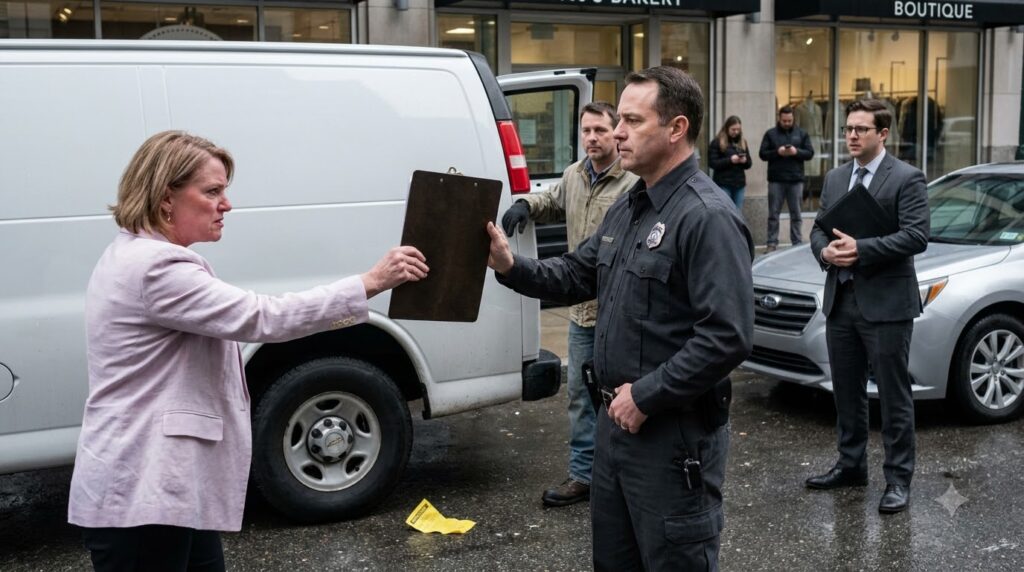
The morning air smelled of burnt espresso beans and wet concrete, the particular signature of a downtown block that woke up too early and cared too little about who kept its shelves stocked. Julian Vance sat inside the cab of his unbranded delivery van, his thumb brushing the cool, dark glass of his transit tablet. He didn’t look at Brenda immediately. To look at her was to grant her theater an audience, and ten years in long-haul logistics had taught him that the first rule of holding a disputed line was absolute, unyielding stillness.
The clipboard hit the glass again, harder this time. The pastel linen of her blazer strained against her shoulder as she jabbed a manicured finger toward the municipal loading zone sign bolted to the rusted iron post six feet away.
“I’ve logged your plates twice this week,” Brenda’s voice cut through the glass, high and thin like tearing silk. “This is a private service corridor designated exclusively for the boutique cooperative. Move this truck right now, or I’ll have the district marshal down here before you’ve unloaded a single crate.”
Julian exhaled slowly, letting the stale air leave his lungs before he turned the ignition key one notch back, killing the auxiliary blower. The sudden drop in ambient sound made the street feel smaller, tighter. He reached down, his fingers finding the worn leather of his work glove, and pulled the door handle.
The hiss of the rubber seal breaking felt louder than it should have. He stepped down onto the asphalt, his boots meeting the grit with a dry crunch. He stood at an even six feet, his shoulders broad beneath a faded canvas jacket that had seen three winters of salt spray and diesel grime. He didn’t tower over her, but he didn’t shrink either. He simply occupied his space with the heavy, unmovable weight of a load-bearing beam.
“Morning, ma’am,” Julian said, his voice flat, low, and stripped of all conversational inflection. “Commercial delivery window runs from six to ten. It’s eight-fourteen.”
“Don’t ‘ma’am’ me with that tone,” Brenda snapped, stepping closer, her designer sunglasses reflecting two distorted miniatures of his face. She tapped the laminated badge pinned to her lapel—a self-printed emblem bearing the stylized crest of the Cypress District Merchants League. “We voted on this corridor layout at the Tuesday board session. Unbranded vehicles under three tons carrying commercial freight are restricted to the alleyway behind the pharmacy. You’re trespassing on private commercial equity.”
Julian glanced past her shoulder. Thirty feet away, the heavy glass doors of her boutique, Verre & Velvet, remained locked against the morning foot traffic. A small porcelain Closed sign swung lazily from a brass chain.
“City department of transportation painted that yellow stripe twelve years ago,” Julian said, his gaze fixed on the edge of her collar where a stray thread hung loose. “The alleyway behind the pharmacy has a three-foot clearance limit. My box truck won’t fit without tearing the gutter off the roof. The permit is on the windshield.”
“That permit is a recycled relic,” she hissed, lifting her phone and angling the lens toward his eyes with the practiced aggression of a tourist confronting a street performer. “And you’re blocking sightlines for my morning window shoppers. I’m giving you ten seconds to start that engine, or I’m calling my husband’s firm to file an emergency injunction for commercial harassment.”
Across the street, a pair of municipal sanitation workers paused beside a green waste bin, their orange vests catching the pale slant of sunlight. They didn’t look away; they stopped to watch, their movements freezing with the synchronized interest of crows on a fence line.
Julian felt the old, familiar heat rise behind his ribs—the cold, metallic coil of adrenaline that always accompanied a false accusation. It was the exact sensation he’d felt three years ago in the corporate compliance office in Seattle, when a regional supervisor had pointed a trembling finger at an unverified inventory discrepancy and whispered fraud before Julian even had time to open his logbook. That mistake had cost him six months of his life and every dollar of his savings to clear. He had sworn then never to raise his voice, never to argue with a man or woman who used volume as a substitute for fact.
“Phone’s recording,” Julian said quietly, nodding toward the black glass lens inches from his chin. “That’s good. Keeps things clear.”
Brenda blinked, her expression tightening as she realized the performance wasn’t eliciting the flinch or the retreat she had rehearsed. Her hand trembled slightly—just a fraction of an inch—before she recovered, pressing the record button harder.
“You think you’re untouchable because you hide behind anonymous plates,” she whispered, her voice dropping into a register meant to carry across the pavement. “People like you come into our neighborhood, drop your boxes, and leave us to clean up the disruption. Move the truck.”
Julian didn’t move. He reached into his canvas pocket, his fingers wrapping around the smooth, cold aluminum cylinder of a heavy-duty flashlight, grounding himself in its weight.
Before he could answer, the sharp, authoritative chirp of a municipal scooter engine cut through the morning air from the corner of Fourth and Elm, rolling toward them with the steady, unavoidable momentum of an oncoming tide.
CHAPTER 2: THE PAPERWORK PARADE
Text:
The green and white municipal scooter rolled to a halt three feet from the front bumper of the van, its electric motor dying with a soft, expiring whine. Officer Marcus Reed didn’t dismount immediately. He sat perched on the low saddle, one booted foot planted firmly on the asphalt to steady the weight of the vehicle, his dark-tinted visor flipped up to reveal a face carved from years of midday sun and bureaucratic indifference.
Brenda was already moving, her stride shortening into a sharp, purposeful march as she intercepted him before his boots could fully settle onto the street.
“Marcus, thank goodness,” she said, her voice dropping instantly from public-shaming volume into the conspiratorial register of an old acquaintance. She gestured wildly toward Julian’s unbranded van with the edge of her laminated clipboard. “We have an unlicensed commercial vehicle blocking the designated merchant loading corridor during peak foot-traffic hours. He’s been parked here for twenty minutes, refusing to identify himself or produce a valid retail permit. It’s a complete violation of the downtown cooperative ordinance.”
Julian didn’t rush. He remained leaning against the side panel of his van, his left hand tucked securely into the canvas pocket of his jacket, his fingers finding the smooth aluminum of the flashlight once more. He watched Reed’s eyes. A seasoned enforcement officer didn’t look at the person shouting loudest; he looked for the person who wasn’t shouting at all.
Reed didn’t look at Brenda. He looked past her shoulder, his gaze fixing squarely on Julian’s face for three solid beats before shifting slowly downward to examine the front license plate, then tracking up toward the windshield.
“Morning, Vance,” Reed said, his voice flat, gravel-rough, and entirely neutral.
“Morning, Marcus,” Julian replied, his tone level. “Routine drop at the bakery. Manifest’s on the dash.”
Brenda’s posture stiffened, the pastel linen of her blazer pulling taut across her back. Her head whipped between Reed and Julian like she had missed a crucial line in a badly rehearsed play. “Wait. You two know each other? Marcus, this isn’t a casual wave-through matter. This man is operating outside the district association guidelines. If you aren’t going to write the citation, I will call the commissioner’s office and log a formal complaint about municipal negligence.”
Reed killed the scooter’s ignition completely, the small dashboard light winking out. He swung his leg over the seat, his holster creaking with the dry, stiff protest of well-oiled leather. He adjusted the strap of his high-vis vest, taking his time, letting the silence stretch just long enough to make Brenda’s breathing audible over the hum of the distant bakery exhaust fans.
“District association guidelines don’t write municipal code, Brenda,” Reed said evenly, stepping past her as if she were a temporary construction cone. He walked straight up to the passenger-side window of the van, peering through the glass at the digital tablet resting on the center console. The screen was dark, locked behind a biometric sleep mode, but the blue paper permit taped firmly in the bottom corner of the windshield caught the pale morning light.
Brenda wheeled around, her face mottling into an ugly, flushed pink. “The Cypress District Merchants League holds jurisdiction over this block’s curb allocation under the 2024 commercial revitalization rider. I have the signed documentation right here.” She thrust the thick, plastic-sleeved binder forward, shoving it uncomfortably close to Reed’s shoulder.
Reed didn’t flinch. He reached out with two fingers, caught the edge of the binder, and pushed it down just an inch—not violently, but with the immovable authority of a man accustomed to handling aggressive drivers on narrow downtown avenues.
“That rider applies to private alleyways behind the old wool mill, Brenda,” Reed said, his eyes scanning the permit on the glass. “This is a public arterial corridor managed directly by the Department of Transportation. City code section four-eighteen explicitly protects commercial delivery access until ten ante meridiem. Your board doesn’t own this stripe.”
Julian watched the micro-twitch in the corner of Brenda’s left eye—a tiny, involuntary flutter that betrayed the absolute collapse of her prepared script. She had expected compliance. She had expected the quiet, sheepish retreat of an outsider who didn’t want trouble. Instead, she had run headfirst into a city ordinance that couldn’t be bullied by a clipboard or a polyester blazer.
“He’s parked illegally,” Brenda insisted, her voice climbing back toward its shrill peak as three bakery patrons paused near the curb with their morning pastries, watching the standoff unfold. “Look at him! Unbranded plates, no corporate logo, no uniform. For all we know, he’s dumping unauthorized freight or running an illicit operation out of that box.”
Reed didn’t answer immediately. He reached down to his belt, unclipped his municipal handheld scanner, and flicked the screen awake with his thumb. A sharp, green digital glow washed across his chin. He stepped around the front of the hood, drawing closer to the driver’s side where Julian stood motionless.
“Open the door, Julian,” Reed said quietly, loud enough only for the two of them to hear. “Let’s scan the transit QR and clear the manifest before her husband starts circling the block in his sedan.”
Julian nodded once. He reached out, pulled the handle, and swung the heavy door wide, but as he did, his eye caught something tucked into the spine of Brenda’s discarded binder where it rested on the hood of Reed’s scooter—a loose sheet of paper covered in handwritten annotations detailing a schedule of upcoming ‘curb reclamation actions’ across three different blocks, all marked with red exclamation points.
The micro-mystery flickered in his mind: this wasn’t just about his van. It was part of a coordinated push to choke off independent deliveries across the entire commercial district before the city council’s zoning vote next month.
Reed held his scanner steady, waiting for the digital handshake. Julian tapped his tablet, waking the screen to display the active municipal barcode, knowing full well that the moment this scan cleared, Brenda’s manufactured emergency would detonate right in her face.
CHAPTER 3: THE LEDGER PAGE
Text:
The municipal scanner emitted a short, dual-tone chirp that cut sharply through the hum of the bakery’s cooling vents.
Officer Reed didn’t look up immediately. His thumb tracked across the illuminated plastic face of the unit, scrolling through the metadata packet streamed directly from the city Department of Transportation’s active server. A small green confirmation block expanded across the screen, detailing the vehicle’s registration, the municipal commercial courier waiver, and the exact timestamps authorizing curb occupancy from six in the morning until ten past meridian.
“Manifest checks out, Julian,” Reed said, his voice dropping another notch as he turned the screen just enough so the edge of the green indicator caught Brenda’s field of vision. “Active commercial permit. Code section four-eighteen. Unrestricted staging rights for regional distribution.”
Brenda’s hand tightened around the plastic spine of her binder until her knuckles lost all their color, skin turning the chalky white of old porcelain. “That database is running on an unpatched server protocol,” she said, her voice dropping into a dangerous, vibrating hiss that lacked its earlier theatrical resonance. “The district board voted to suspend all municipal exemptions in this corridor pending our autumn beautification review. Marcus, you know the rules. If you let him stay, you’re overriding an active neighborhood resolution.”
“Neighborhood resolutions don’t write traffic warrants, Brenda,” Reed replied, clipping the scanner back onto his duty belt with a sharp clack. He stepped back, clearing the space between the van and the curb, his posture shifting from casual observer back to functional neutrality. “If your board wants to challenge DOT code four-eighteen, you file an injunction with the municipal magistrate’s office on Third. You don’t bring bolt cutters and clipboards to a live public thoroughfare.”
Julian kept his eyes fixed on Brenda’s face, watching the micro-shifts in her expression. Beneath the rigid veneer of outraged civic pride, something else was flickering across her eyes—a thin, brittle panic that had nothing to do with parking codes or sightlines for window shoppers. It was the frantic calculation of someone whose entire structure of control was fraying at the seams.
As she jerked her arm back to pull the heavy plastic binder against her chest, a single folded sheet of paper slipped free from the unsecured front pocket, fluttering downward like an autumn leaf before landing squarely in the wet gutter grit near Julian’s boot.
Julian didn’t bend down instantly. He let it sit there for a heartbeat, watching the gray asphalt stain the crisp white margin.
Brenda gasped, her head snapping down toward the gutter with an intensity that gave away the document’s value. She lunged forward, her heel catching slightly on the curb edge, but Julian was already moving. His boot settled over the edge of the paper just as her manicured fingers clawed empty air against the pavement.
“Careful, ma’am,” Julian said, his voice quiet, flat, and entirely devoid of mockery. He bent down with the practiced, heavy-shouldered grace of a man used to lifting awkward crates, scooped the paper from the wet grit, and straightened up without breaking eye contact.
The paper wasn’t an HOA ordinance. It wasn’t a beautification guideline or a neighborhood meeting agenda. It was a printed financial collection notice from a regional commercial property holding firm, stamped FINAL DEMAND: UNPAID LEASE ARREARS – VERRE & VELVET BOUTIQUE, with a red handwritten notation scrawled across the bottom margin: Seizure scheduled for first of month unless curbside retail traffic targets are met.
Brenda’s breath hitched, a sharp, ragged sound that she tried to mask by pressing her hand hard against her mouth. The pastel linen of her blazer seemed to droop around her shoulders, the immaculate structure of her public authority suddenly looking like cheap theater props under the cold morning sun.
“Give that back,” she whispered, her voice stripped of every trace of its previous shrill command. It wasn’t a demand anymore; it was a plea.
Julian looked down at the paper for one long, unblinking second, registering the numbers—numbers that showed a boutique bleeding thousands of dollars a month in a district that was pricing out everyone except corporate chains. He didn’t gloat. He didn’t smile. He recognized the exact shape of financial desperation because he had worn those same invisible chains three years ago when the corporate auditors came for his department.
Instead of waving it in her face or reading it aloud to the gathering crowd of morning commuters, Julian folded the paper neatly, twice, and tucked it back into the front sleeve of her binder, sliding the plastic tab shut with a soft click.
“Your business is your business, Brenda,” Julian said, his voice dropping low enough that even Officer Reed had to lean in slightly to catch the words. “But this loading zone is mine until ten. And my delivery window doesn’t wait for anyone’s foreclosure schedule.”
Brenda stood frozen, her designer sunglasses sliding slightly down the bridge of her nose to reveal eyes wide with shock and sudden, burning humiliation. She didn’t shout. She didn’t threaten to call her husband’s firm or log a complaint with the commissioner. Without uttering another syllable, she turned on her heel, her posture collapsing inward, and marched back toward the locked doors of her boutique, her head bowed against the morning wind.
Officer Reed watched her go, scratching the back of his neck beneath his high-vis vest before looking over at Julian with a slow, heavy-lidded expression.
“Well,” Reed muttered, adjusting his belt. “Looks like you won the curb today, Julian. But she’s not the type to take a quiet loss. Keep your cameras rolling.”
Julian nodded slowly, turning back toward the rear doors of his van to pull the first heavy crate of bakery supplies onto his shoulder, knowing full well that the quiet street was only holding its breath before the next storm broke.
CHAPTER 4: THE DIGITAL ESCALATION
Text:
The heavy oak door of Verre & Velvet clicked shut with a dry, mechanical finality, but Brenda did not retreat into the shadows of her store. Instead, her silhouette remained framed behind the fogged glass of the front display window, rigid and unyielding as a porcelain mannequin. Through the transparent pane, Julian watched her fingers move with frantic speed across her smartphone screen, her thumb striking the glass in sharp, rhythmic jabs.
Julian hoisted the second wooden crate of bakery goods onto his shoulder, the cedar slats biting slightly through the thick canvas of his jacket. The weight was familiar, grounding him against the sharp, rising friction of the morning. Officer Reed’s scooter had already vanished around the corner toward Fourth Street, leaving behind only the faint scent of two-stroke exhaust hanging in the cool air.
As Julian cleared the edge of the van’s side panel, his tablet—resting securely on the passenger seat—buzzed with a sharp, double-pulse notification. A low-priority municipal advisory ping. He didn’t check it immediately; he carried the crate past the wrought-iron bistro tables, setting it down with a controlled thud onto the tiled floor of the bakery kitchen. The head baker, an older man with flour-dusted forearms and a perpetual scowl, gave a silent nod of acknowledgment before returning to his dough press.
When Julian stepped back out onto the sidewalk, the morning foot traffic had thickened. Commuters in charcoal overcoats sidestepped the loading zone, their eyes averted, conditioned by city life not to linger near confrontation. But across the asphalt, parked diagonally in a designated municipal slot directly opposite his van, sat a gleaming silver sedan with tinted windows and local county plates.
The driver’s door swung open. A man in a tailored charcoal suit stepped out—not a merchant, not a parking officer, but someone wearing the polished leather shoes and gold-rimmed glasses of a junior municipal lobbyist. Julian recognized the posture instantly: it was the stance of a man accustomed to attending closed-door zoning subcommittee meetings where public curbs were quietly reallocated behind closed doors.
Brenda emerged from her boutique at that exact second, her pastel linen blazer buttoned tight, her chin tilted up to restore the mask of absolute authority. She didn’t look at Julian. She walked straight past his van, her heels clicking a sharp, staccato rhythm against the pavement, and intercepted the lobbyist near the trunk of the silver sedan.
Julian leaned his shoulder against the cold metal door frame of his delivery van, his thumb brushing the frayed seam of his work glove. He didn’t rush his movements. He pulled his tablet from the dashboard mount, letting the screen wake under his thumbprint.
The notification banner wasn’t just a municipal advisory. It was a digital calendar sync ping, routed through the public-access municipal portal that tracked open zoning variance requests. Public docket entry 44-B: Cypress District Commercial Cooperative proposal to convert public loading zones 12 through 15 into private merchant reservation bays. Filed yesterday evening. Sponsored by a holding company bearing the exact address listed on Brenda’s foreclosure notice.
The pieces clicked into place with the cold, undeniable precision of a well-oiled breechblock. Brenda wasn’t just acting out of personal malice or general neighborhood tyranny. Her frantic crusade against unbranded delivery vans was part of a desperate, coordinated push by the district association to weaponize city zoning laws—transforming public infrastructure into private assets to inflate local commercial property values just enough to satisfy her impending lease default. The merchants weren’t protecting the neighborhood; they were carving it up.
Brenda turned her head sharply, catching Julian watching her from across the lane. Her eyes widened behind her designer sunglasses, the pale skin around her mouth tightening once more into a hard, defensive line. She whispered something rapid to the lobbyist, pointing a manicured finger directly at Julian’s chest, her expression twisting from bureaucratic coldness into outright hostility.
The lobbyist adjusted his gold-rimmed glasses, turned his head slowly to inspect Julian’s unbranded plates, and reached into his interior jacket pocket—not for a notepad, but for a black leather portfolio bearing the official seal of the county executive’s office.
Julian didn’t flinch. He slid the tablet back into his canvas pocket, feeling the solid, cool edge of the aluminum flashlight against his palm, and stood his ground on the gray city asphalt as the second phase of Brenda’s campaign began to close the distance.
CHAPTER 5: THE LOBBYISTS BRIEF
Text:
The leather portfolio snapped open with a dry, sharp crack that sounded like a dry branch breaking underfoot. The junior lobbyist didn’t waste time with pleasantries or civic introductions. He stepped across the yellow municipal loading stripe, his polished Italian leather shoes grinding into the loose grit of the street, and extended a stiffly printed parchment notice toward Julian’s chest.
“Mr. Vance,” the lobbyist said, his voice clipped and smooth, carrying the practiced cadence of someone who spent his life arguing zoning variances in windowless basement hearing rooms. “Notice of administrative suspension. Effective immediately under emergency district ordinance 88-C, commercial freight staging in this corridor is restricted to licensed franchise holders carrying district-tier validation badges. Your transit authorization has been flagged for administrative review.”
Julian didn’t reach for the paper. He kept his hands buried deep in the canvas pockets of his jacket, his left fingers curling securely around the smooth aluminum casing of his flashlight. He let the parchment hover inches from his ribs, the black-lettered heading vibrating slightly in the cool breeze rolling off the concrete.
Across the lane, Brenda stood beside the open door of the silver sedan, her arms crossed tight over the pastel linen of her blazer. Her face was flushed with the desperate vindication of someone who had just called in a heavy artillery strike to settle a street-corner argument. Behind her, the silver sedan’s motor hummed a low, expensive purr that mocked the rattling diesel idle of Julian’s aging delivery van.
“You’re standing on public asphalt, counselor,” Julian said, his voice flat, steady, and devoid of any rising inflection. “DOT code four-eighteen governs this lane until ten ante meridiem. An emergency district ordinance signed yesterday afternoon doesn’t override twelve years of statutory transit scheduling without a magistrate’s signature.”
The lobbyist’s smile didn’t reach his eyes—a pair of cold, gray beads behind gold-rimmed frames. He tapped the parchment twice with an index finger bearing a heavy signet ring. “The magistrate’s signature was secured at 0730 hours this morning by the Cypress District Executive Committee. Emergency powers allow the board to summarily close any loading zone deemed an impediment to public safety or commercial revitalization. Your vehicle is currently classified as an unverified obstruction.”
Julian felt the cold, metallic coil of adrenaline tighten behind his ribs. It was happening again—the exact mechanical maneuver that had broken his department in Seattle three years ago. They weren’t fighting him on facts; they were rewriting the rules mid-game, burying him under a mountain of fabricated emergency paperwork while the clock ran out on his delivery schedule. If he let them impound the van or issue an official obstruction notice, his distribution contract would be flagged, his daily manifest voided, and his livelihood choked off before noon.
“You’ve got no municipal seal on that printout,” Julian said, his eyes dropping to the bottom corner of the notice where a blank white box where the registrar’s stamp should have been sat empty. “That’s an administrative draft printed from a desktop laser jet in a private office. It wouldn’t hold up for ten seconds in traffic court.”
The lobbyist’s composure slipped—just a fraction of a millimeter. A tiny tic pulsed at the corner of his jawline. “Mr. Vance, I strongly advise you to comply. Officer Reed has already been dispatched an amended citation order from the central district desk.”
As if summoned by the threat, the familiar high-pitched whine of an electric scooter cut through the morning traffic from the opposite corner. But it wasn’t Officer Reed’s green and white municipal unit. It was a heavy, unmarked dark grey cruiser bearing the crest of the county transit sheriff’s department—and behind the wheel sat Lieutenant Miller, a man known across three districts as the administrative executioner for corporate utility disputes.
Brenda gave a sharp, triumphant nod, stepping forward as the cruiser slid to a halt right behind Julian’s van, boxing him in completely between the curb and the law.
Julian’s breath hitched for a micro-second, the weight of the trap closing around him heavier than any crate he had ever lifted. He looked from the lobbyist’s blank-stamped notice to the flashing amber light on the cruiser’s roof, realizing that the first layer of defense had just been systematically dismantled.
CHAPTER 6: THE MUNICIPAL MATRIX
Text:
The heavy door of the transit cruiser clicked open with a muffled, industrial thud. Lieutenant Miller didn’t rush his emergence; he swung his right boot out first, his heavy-soled heel hitting the pavement with a dense, flat impact that signaled absolute administrative permanence. He was a man built like a concrete pillar—broad-shouldered, thick-necked, and wrapped in a dark charcoal uniform devoid of decorative brass, wearing only the silver insignia of a senior district inspector who answered to numbers rather than neighborhoods.
Brenda’s posture straightened instantly. The tight, pinched lines of her face relaxed into a thin, triumphant smile as she stepped past the junior lobbyist, her heels clicking across the asphalt to meet the inspector before he had even adjusted the strap of his duty belt.
“Lieutenant Miller,” Brenda began, her voice pitching upward into its practiced civic register. “Thank you for responding so swiftly. We have an unverified commercial agitator operating outside district compliance parameters, blocking active emergency egress lanes, and refusing to honor the committee’s emergency zone suspension.”
Julian didn’t move. He stood half a step behind the rear bumper of his van, his left hand still anchored securely to the smooth aluminum flashlight inside his canvas pocket. He watched Miller’s face—a surface as weathered and expressionless as a concrete bridge abutment. Miller didn’t look at Brenda; he didn’t look at the junior lobbyist holding out the blank-stamped parchment notice either. His gaze tracked past them both, locking onto the faded blue commercial permit taped to the lower corner of Julian’s windshield.
“Morning, Vance,” Miller said, his voice grating like gravel shifting under a heavy tire.
“Morning, Lieutenant,” Julian replied, his tone flat and unyielding.
The lobbyist stepped forward, thrusting the parchment notice closer to the inspector’s chest with an air of practiced entitlement. “Lieutenant, I am counsel for the Cypress District Commercial Cooperative. Under emergency municipal docket 88-C, this vehicle’s operating privileges have been summarily suspended by executive committee fiat. We require an immediate tow order and a formal citation for commercial obstruction.”
Miller stopped. He reached out with two thick, calloused fingers, took the top edge of the parchment, and pulled it away from the lobbyist’s hand. He didn’t read it like a man evaluating a legal document; he looked at it the way a mechanic looks at a broken part scavenged from a junk heap.
“Docket 88-C,” Miller murmured, his voice low and raspy. He turned the paper over, exposing the pristine, unblemished white box at the bottom where the official registrar’s stamp should have anchored the text. “Issued by the executive committee. Signed at zero-seven-thirty hours this morning.”
“That is correct,” Brenda chimed in, stepping closer, her voice vibrating with premature victory. “The board holds emergency authority to clear public corridors when local retail interests are compromised. You have full legal backing to impound the vehicle right now.”
Miller raised his head slowly. He looked past Brenda, past the lobbyist, and looked straight at the digital dashboard clock glowing through Julian’s windshield, then down at the mechanical watch strapped to his own thick wrist.
“Funny thing about docket 88-C,” Miller said, his tone dropping into a dangerous, flat register that made the lobbyist take an involuntary half-step backward. “My dispatch log shows this emergency petition wasn’t entered into the county municipal server until eight-zero-four. That’s forty minutes after my cruiser rolled onto this block, and nearly an hour after Mr. Vance logged his morning delivery manifest under statutory DOT code four-eighteen.”
The silence that dropped over the street was instantaneous and absolute. Even the distant hum of the bakery exhaust fans seemed to recede, swallowed by the sudden, heavy pressure of administrative reality colliding with manufactured theater.
Brenda’s triumphant smile froze, fracturing at the edges like cheap porcelain under a hammer. Her hand dropped slowly from the air, the pastel linen of her blazer suddenly looking entirely too thin against the morning chill.
“That… that’s a clerical discrepancy,” the lobbyist stammered, his smooth corporate cadence cracking for the first time, a frantic edge leaking into his voice. “The executive committee holds retroactive adjustment powers under the urban revitalization charter. The timestamp on the server entry is a technicality—”
“A technicality in traffic court is a dismissed ticket,” Miller interrupted, his voice dropping another octave. He crumpled the parchment notice into a tight, gray ball with one hand and tossed it carelessly into the open gutter beside Julian’s boot. “A technicality on an emergency warrant issued without a registrar’s seal is falsifying administrative record. And last I checked, counselor, my department doesn’t enforce committee daydreams.”
Julian let out a slow, silent breath, the cold metallic coil in his chest loosening just enough to let the air back into his lungs. The first layer of their defensive wall had held, but he knew the battle wasn’t over. Brenda’s desperation was too deep, her lease arrears too absolute, for her to walk away from a street-corner defeat without one final, reckless push.
CHAPTER 7: THE COUNTERCLAIM
Text:
The crumpled parchment notice lay in the wet gutter grit, looking less like an official legal instrument and more like a discarded candy wrapper under the cold light of the morning sun. Brenda Sterling didn’t look down at it. Her eyes remained locked on Lieutenant Miller’s chest, her breath coming in short, shallow gasps that ruffled the pastel linen collar of her blazer.
“You’re misinterpreting the operational charter, Lieutenant,” Brenda said, her voice climbing back toward that thin, brittle register of forced authority. She stepped forward, ignoring the gray transit cruiser idling behind Julian’s van, and gestured sharply toward the junior lobbyist who was quietly trying to reassemble his black leather portfolio. “The emergency executive resolution gives the district committee immediate enforcement jurisdiction over any unregistered vehicle staging in a commercial corridor. If you refuse to cite him for obstruction, then you are actively enabling a municipal hazard.”
Lieutenant Miller didn’t flinch. He didn’t shift his weight, nor did he reach for the citation book clipped to his duty belt. He simply stood there, a wall of dark uniform and heavy-set muscle, letting Brenda’s words shatter against his silence like waves against a concrete pier.
“Ma’am,” Miller said, his voice grating like dry gravel. “An emergency resolution that misses the municipal register window by forty minutes isn’t an enforcement order. It’s a scrap of paper. And the only hazard on this street right now is an unpermitted silver sedan blocking a live transit lane and an executive committee trying to write traffic laws from a boutique back room.”
The junior lobbyist winced, his fingers fumbling with the brass clasp of his portfolio before he snapped it shut with a dull thud. He took half a step backward toward the passenger door of the sedan, clearly calculating how fast he could distance himself from a sinking bureaucratic ship.
Brenda caught the movement out of the corner of her eye, and her panic flared hot and visible across her features. Her self-composed facade cracked entirely, the last remaining threads of her neighborhood control snapping under the weight of the reality she had tried so hard to outrun.
“He’s destroying the district’s retail value!” Brenda screamed, her voice finally breaking its careful restraint, carrying across the pavement as two more pedestrians stopped near the corner bakery with their morning coffee cups frozen halfway to their lips. “We have lease payments due on the first! If the unbranded freight trucks aren’t cleared out, the entire co-op defaults! Don’t you understand? We built this district from the ground up!”
Julian watched her from behind the rear doors of his van. The raw, desperate truth had finally bled through the polished veneer of civic duty and community safety. It wasn’t about beautification, sightlines, or pedestrian access. It was a desperate, clawing struggle to protect a failing lease against the inevitable tide of economic reality—and she had chosen to use the public curb as a scapegoat for her own corporate slide.
Julian felt no surge of triumph, only a heavy, cold fatigue. He had stood in that exact place three years ago, watching his own career get carved up by people who preferred paperwork to truth.
Miller took a slow step forward, looking down at Brenda with a gaze devoid of sympathy, yet entirely free of malice. “If your shop is failing, Brenda, you take it up with your landlord or your bank. You don’t take a pair of bolt cutters to a public loading zone and try to bully delivery drivers to pad your balance sheet.”
Miller turned his head slightly, his eyes fixing on the junior lobbyist who was now sliding sideways into the front seat of the silver sedan. “And as for your little emergency committee? My office will be auditing every single ‘revitalization’ permit filed under docket 88-C by close of business today. Tell your board to have their books ready.”
The sedan’s engine revved high, the rear tires kicking up a brief cloud of street dust against the curb as the driver threw the transmission into reverse, abandoning Brenda standing alone on the gray pavement with her clipboard clutched like a broken shield against the morning wind.
CHAPTER 8: THE SILENT CURB
Text:
The tail-lights of the silver sedan dissolved into the grey morning fog at the intersection of Fourth and Elm, leaving behind only the faint, acrid tang of unburnt fuel and the empty, echoing space where manufactured authority had tried to stake its claim.
Brenda Sterling stood motionless on the pavement. The sharp, immaculate lines of her pastel linen blazer seemed to lose their structural defiance, her shoulders sagging inward as if the heavy air itself were pressing down upon her. She didn’t look at Lieutenant Miller. She didn’t look at the small cluster of morning commuters who lingered by the bakery window, their phones lowered, their murmurs reduced to a dry, uncomfortable rustle of canvas coats and paper cups.
Without a word, Brenda turned away from the curb. Her heels no longer struck the concrete with that crisp, rhythmic demand for attention; they scraped dully against the grit, dragging slightly as she walked back toward the heavy glass doors of Verre & Velvet. She reached out with a trembling hand, her manicured fingers brushing against the cold brass handle where the porcelain Closed sign still swung lazily from its chain. She didn’t try to open the door. She simply leaned her forehead against the glass, closing her eyes behind her oversized designer sunglasses, a solitary figure shrinking against the massive plate-window display of her own failing enterprise.
Lieutenant Miller adjusted the strap of his duty belt, exhaling a long, grey plume of vapor into the chilled autumn air. He looked over the roof of Julian’s delivery van, his weathered face settling into a mask of quiet, permanent neutrality.
“Paperwork’s going to take a week to clear, Julian,” Miller muttered, his gravel-rough voice cutting through the quiet. “District board’s going to find out real quick that forging a municipal docket entry carries a heavier penalty than a parking ticket. You shouldn’t have any more trouble with their ‘revitalization’ committees.”
Julian stood beside the open rear doors of his truck, his hand resting firmly on the wooden edge of the final delivery crate. He didn’t smile, and he didn’t offer a triumphant nod. He felt only the deep, heavy exhaustion of a man who had successfully defended a patch of ground that never should have been contested in the first place.
“Appreciate it, Lieutenant,” Julian said, his voice flat and steady. “The route has to keep moving.”
Miller gave a short, single nod of his head, turned on his heel, and climbed back into the heavy transit cruiser. The engine rumbled to life with a deep, authoritative thrum, and the grey unit pulled away from the curb, sliding smoothly into the stream of early commuter traffic.
Julian pulled the heavy rear doors of his van shut with a clean, metallic clack, locking the latches into place. He walked around to the driver’s side, climbed up into the cab, and settled onto the worn vinyl seat. The dashboard clock glowed a quiet, steady neon blue: 8:44 ante meridiem. Twenty-six minutes left in his authorized delivery window.
He turned the key in the ignition. The diesel engine caught immediately, vibrating through the frame of the truck with a familiar, mechanical pulse. He checked his side mirror one last time. Across the grey street, Brenda was gone from the glass; the heavy oak door had finally clicked shut, sealing her inside the dim, quiet interior of her store with her ledgers, her foreclosure notices, and the silence of an empire built on sand.
Julian shifted into drive, his hands steady on the wheel, and eased the van away from the yellow stripe. Some people spent their entire lives trying to police everyone else, forgetting that the ground beneath them always belongs to the truth long before it belongs to the rules.