
CHAPTER 3: THE LEDGER PAGE
Text:
The municipal scanner emitted a short, dual-tone chirp that cut sharply through the hum of the bakery’s cooling vents.
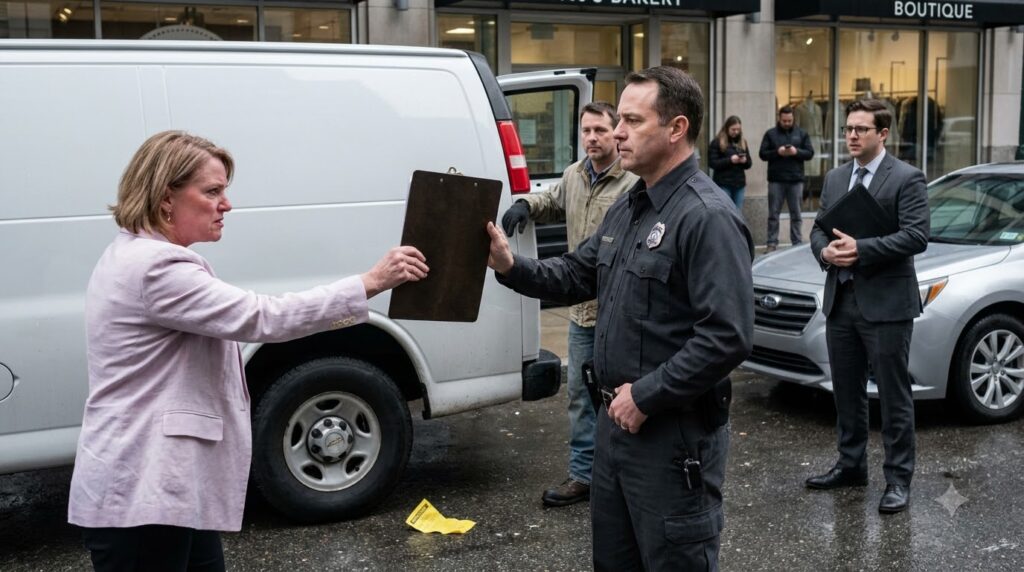
Officer Reed didn’t look up immediately. His thumb tracked across the illuminated plastic face of the unit, scrolling through the metadata packet streamed directly from the city Department of Transportation’s active server. A small green confirmation block expanded across the screen, detailing the vehicle’s registration, the municipal commercial courier waiver, and the exact timestamps authorizing curb occupancy from six in the morning until ten past meridian.
“Manifest checks out, Julian,” Reed said, his voice dropping another notch as he turned the screen just enough so the edge of the green indicator caught Brenda’s field of vision. “Active commercial permit. Code section four-eighteen. Unrestricted staging rights for regional distribution.”
Brenda’s hand tightened around the plastic spine of her binder until her knuckles lost all their color, skin turning the chalky white of old porcelain. “That database is running on an unpatched server protocol,” she said, her voice dropping into a dangerous, vibrating hiss that lacked its earlier theatrical resonance. “The district board voted to suspend all municipal exemptions in this corridor pending our autumn beautification review. Marcus, you know the rules. If you let him stay, you’re overriding an active neighborhood resolution.”
“Neighborhood resolutions don’t write traffic warrants, Brenda,” Reed replied, clipping the scanner back onto his duty belt with a sharp clack. He stepped back, clearing the space between the van and the curb, his posture shifting from casual observer back to functional neutrality. “If your board wants to challenge DOT code four-eighteen, you file an injunction with the municipal magistrate’s office on Third. You don’t bring bolt cutters and clipboards to a live public thoroughfare.”
Julian kept his eyes fixed on Brenda’s face, watching the micro-shifts in her expression. Beneath the rigid veneer of outraged civic pride, something else was flickering across her eyes—a thin, brittle panic that had nothing to do with parking codes or sightlines for window shoppers. It was the frantic calculation of someone whose entire structure of control was fraying at the seams.
As she jerked her arm back to pull the heavy plastic binder against her chest, a single folded sheet of paper slipped free from the unsecured front pocket, fluttering downward like an autumn leaf before landing squarely in the wet gutter grit near Julian’s boot.
Julian didn’t bend down instantly. He let it sit there for a heartbeat, watching the gray asphalt stain the crisp white margin.
Brenda gasped, her head snapping down toward the gutter with an intensity that gave away the document’s value. She lunged forward, her heel catching slightly on the curb edge, but Julian was already moving. His boot settled over the edge of the paper just as her manicured fingers clawed empty air against the pavement.
“Careful, ma’am,” Julian said, his voice quiet, flat, and entirely devoid of mockery. He bent down with the practiced, heavy-shouldered grace of a man used to lifting awkward crates, scooped the paper from the wet grit, and straightened up without breaking eye contact.
The paper wasn’t an HOA ordinance. It wasn’t a beautification guideline or a neighborhood meeting agenda. It was a printed financial collection notice from a regional commercial property holding firm, stamped FINAL DEMAND: UNPAID LEASE ARREARS – VERRE & VELVET BOUTIQUE, with a red handwritten notation scrawled across the bottom margin: Seizure scheduled for first of month unless curbside retail traffic targets are met.
Brenda’s breath hitched, a sharp, ragged sound that she tried to mask by pressing her hand hard against her mouth. The pastel linen of her blazer seemed to droop around her shoulders, the immaculate structure of her public authority suddenly looking like cheap theater props under the cold morning sun.
“Give that back,” she whispered, her voice stripped of every trace of its previous shrill command. It wasn’t a demand anymore; it was a plea.
Julian looked down at the paper for one long, unblinking second, registering the numbers—numbers that showed a boutique bleeding thousands of dollars a month in a district that was pricing out everyone except corporate chains. He didn’t gloat. He didn’t smile. He recognized the exact shape of financial desperation because he had worn those same invisible chains three years ago when the corporate auditors came for his department.
Instead of waving it in her face or reading it aloud to the gathering crowd of morning commuters, Julian folded the paper neatly, twice, and tucked it back into the front sleeve of her binder, sliding the plastic tab shut with a soft click.
“Your business is your business, Brenda,” Julian said, his voice dropping low enough that even Officer Reed had to lean in slightly to catch the words. “But this loading zone is mine until ten. And my delivery window doesn’t wait for anyone’s foreclosure schedule.”
Brenda stood frozen, her designer sunglasses sliding slightly down the bridge of her nose to reveal eyes wide with shock and sudden, burning humiliation. She didn’t shout. She didn’t threaten to call her husband’s firm or log a complaint with the commissioner. Without uttering another syllable, she turned on her heel, her posture collapsing inward, and marched back toward the locked doors of her boutique, her head bowed against the morning wind.
Officer Reed watched her go, scratching the back of his neck beneath his high-vis vest before looking over at Julian with a slow, heavy-lidded expression.
“Well,” Reed muttered, adjusting his belt. “Looks like you won the curb today, Julian. But she’s not the type to take a quiet loss. Keep your cameras rolling.”
Julian nodded slowly, turning back toward the rear doors of his van to pull the first heavy crate of bakery supplies onto his shoulder, knowing full well that the quiet street was only holding its breath before the next storm broke.








