
CHAPTER 6: THE MUNICIPAL MATRIX
Text:
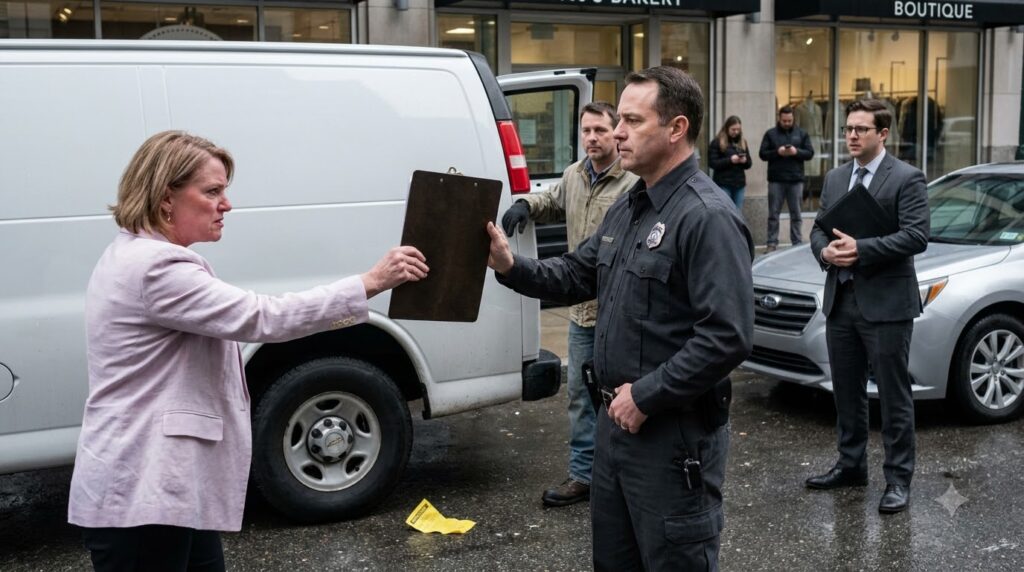
The heavy door of the transit cruiser clicked open with a muffled, industrial thud. Lieutenant Miller didn’t rush his emergence; he swung his right boot out first, his heavy-soled heel hitting the pavement with a dense, flat impact that signaled absolute administrative permanence. He was a man built like a concrete pillar—broad-shouldered, thick-necked, and wrapped in a dark charcoal uniform devoid of decorative brass, wearing only the silver insignia of a senior district inspector who answered to numbers rather than neighborhoods.
Brenda’s posture straightened instantly. The tight, pinched lines of her face relaxed into a thin, triumphant smile as she stepped past the junior lobbyist, her heels clicking across the asphalt to meet the inspector before he had even adjusted the strap of his duty belt.
“Lieutenant Miller,” Brenda began, her voice pitching upward into its practiced civic register. “Thank you for responding so swiftly. We have an unverified commercial agitator operating outside district compliance parameters, blocking active emergency egress lanes, and refusing to honor the committee’s emergency zone suspension.”
Julian didn’t move. He stood half a step behind the rear bumper of his van, his left hand still anchored securely to the smooth aluminum flashlight inside his canvas pocket. He watched Miller’s face—a surface as weathered and expressionless as a concrete bridge abutment. Miller didn’t look at Brenda; he didn’t look at the junior lobbyist holding out the blank-stamped parchment notice either. His gaze tracked past them both, locking onto the faded blue commercial permit taped to the lower corner of Julian’s windshield.
“Morning, Vance,” Miller said, his voice grating like gravel shifting under a heavy tire.
“Morning, Lieutenant,” Julian replied, his tone flat and unyielding.
The lobbyist stepped forward, thrusting the parchment notice closer to the inspector’s chest with an air of practiced entitlement. “Lieutenant, I am counsel for the Cypress District Commercial Cooperative. Under emergency municipal docket 88-C, this vehicle’s operating privileges have been summarily suspended by executive committee fiat. We require an immediate tow order and a formal citation for commercial obstruction.”
Miller stopped. He reached out with two thick, calloused fingers, took the top edge of the parchment, and pulled it away from the lobbyist’s hand. He didn’t read it like a man evaluating a legal document; he looked at it the way a mechanic looks at a broken part scavenged from a junk heap.
“Docket 88-C,” Miller murmured, his voice low and raspy. He turned the paper over, exposing the pristine, unblemished white box at the bottom where the official registrar’s stamp should have anchored the text. “Issued by the executive committee. Signed at zero-seven-thirty hours this morning.”
“That is correct,” Brenda chimed in, stepping closer, her voice vibrating with premature victory. “The board holds emergency authority to clear public corridors when local retail interests are compromised. You have full legal backing to impound the vehicle right now.”
Miller raised his head slowly. He looked past Brenda, past the lobbyist, and looked straight at the digital dashboard clock glowing through Julian’s windshield, then down at the mechanical watch strapped to his own thick wrist.
“Funny thing about docket 88-C,” Miller said, his tone dropping into a dangerous, flat register that made the lobbyist take an involuntary half-step backward. “My dispatch log shows this emergency petition wasn’t entered into the county municipal server until eight-zero-four. That’s forty minutes after my cruiser rolled onto this block, and nearly an hour after Mr. Vance logged his morning delivery manifest under statutory DOT code four-eighteen.”
The silence that dropped over the street was instantaneous and absolute. Even the distant hum of the bakery exhaust fans seemed to recede, swallowed by the sudden, heavy pressure of administrative reality colliding with manufactured theater.
Brenda’s triumphant smile froze, fracturing at the edges like cheap porcelain under a hammer. Her hand dropped slowly from the air, the pastel linen of her blazer suddenly looking entirely too thin against the morning chill.
“That… that’s a clerical discrepancy,” the lobbyist stammered, his smooth corporate cadence cracking for the first time, a frantic edge leaking into his voice. “The executive committee holds retroactive adjustment powers under the urban revitalization charter. The timestamp on the server entry is a technicality—”
“A technicality in traffic court is a dismissed ticket,” Miller interrupted, his voice dropping another octave. He crumpled the parchment notice into a tight, gray ball with one hand and tossed it carelessly into the open gutter beside Julian’s boot. “A technicality on an emergency warrant issued without a registrar’s seal is falsifying administrative record. And last I checked, counselor, my department doesn’t enforce committee daydreams.”
Julian let out a slow, silent breath, the cold metallic coil in his chest loosening just enough to let the air back into his lungs. The first layer of their defensive wall had held, but he knew the battle wasn’t over. Brenda’s desperation was too deep, her lease arrears too absolute, for her to walk away from a street-corner defeat without one final, reckless push.








