
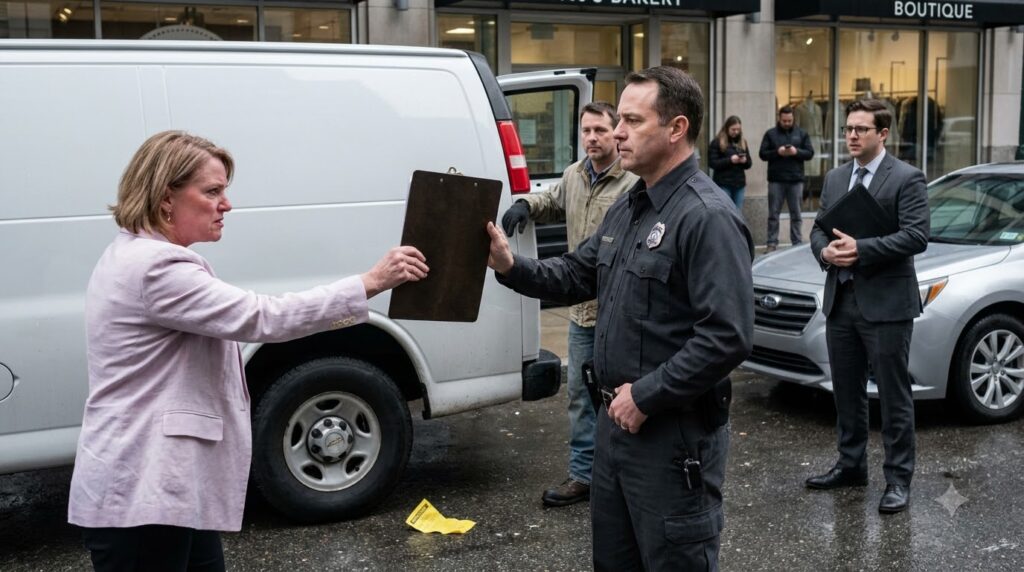
CHAPTER 1: THE YELLOW STRIPE
The morning air smelled of burnt espresso beans and wet concrete, the particular signature of a downtown block that woke up too early and cared too little about who kept its shelves stocked. Julian Vance sat inside the cab of his unbranded delivery van, his thumb brushing the cool, dark glass of his transit tablet. He didn’t look at Brenda immediately. To look at her was to grant her theater an audience, and ten years in long-haul logistics had taught him that the first rule of holding a disputed line was absolute, unyielding stillness.
The clipboard hit the glass again, harder this time. The pastel linen of her blazer strained against her shoulder as she jabbed a manicured finger toward the municipal loading zone sign bolted to the rusted iron post six feet away.
“I’ve logged your plates twice this week,” Brenda’s voice cut through the glass, high and thin like tearing silk. “This is a private service corridor designated exclusively for the boutique cooperative. Move this truck right now, or I’ll have the district marshal down here before you’ve unloaded a single crate.”
Julian exhaled slowly, letting the stale air leave his lungs before he turned the ignition key one notch back, killing the auxiliary blower. The sudden drop in ambient sound made the street feel smaller, tighter. He reached down, his fingers finding the worn leather of his work glove, and pulled the door handle.
The hiss of the rubber seal breaking felt louder than it should have. He stepped down onto the asphalt, his boots meeting the grit with a dry crunch. He stood at an even six feet, his shoulders broad beneath a faded canvas jacket that had seen three winters of salt spray and diesel grime. He didn’t tower over her, but he didn’t shrink either. He simply occupied his space with the heavy, unmovable weight of a load-bearing beam.
“Morning, ma’am,” Julian said, his voice flat, low, and stripped of all conversational inflection. “Commercial delivery window runs from six to ten. It’s eight-fourteen.”
“Don’t ‘ma’am’ me with that tone,” Brenda snapped, stepping closer, her designer sunglasses reflecting two distorted miniatures of his face. She tapped the laminated badge pinned to her lapel—a self-printed emblem bearing the stylized crest of the Cypress District Merchants League. “We voted on this corridor layout at the Tuesday board session. Unbranded vehicles under three tons carrying commercial freight are restricted to the alleyway behind the pharmacy. You’re trespassing on private commercial equity.”
Julian glanced past her shoulder. Thirty feet away, the heavy glass doors of her boutique, Verre & Velvet, remained locked against the morning foot traffic. A small porcelain Closed sign swung lazily from a brass chain.
“City department of transportation painted that yellow stripe twelve years ago,” Julian said, his gaze fixed on the edge of her collar where a stray thread hung loose. “The alleyway behind the pharmacy has a three-foot clearance limit. My box truck won’t fit without tearing the gutter off the roof. The permit is on the windshield.”
“That permit is a recycled relic,” she hissed, lifting her phone and angling the lens toward his eyes with the practiced aggression of a tourist confronting a street performer. “And you’re blocking sightlines for my morning window shoppers. I’m giving you ten seconds to start that engine, or I’m calling my husband’s firm to file an emergency injunction for commercial harassment.”
Across the street, a pair of municipal sanitation workers paused beside a green waste bin, their orange vests catching the pale slant of sunlight. They didn’t look away; they stopped to watch, their movements freezing with the synchronized interest of crows on a fence line.
Julian felt the old, familiar heat rise behind his ribs—the cold, metallic coil of adrenaline that always accompanied a false accusation. It was the exact sensation he’d felt three years ago in the corporate compliance office in Seattle, when a regional supervisor had pointed a trembling finger at an unverified inventory discrepancy and whispered fraud before Julian even had time to open his logbook. That mistake had cost him six months of his life and every dollar of his savings to clear. He had sworn then never to raise his voice, never to argue with a man or woman who used volume as a substitute for fact.
“Phone’s recording,” Julian said quietly, nodding toward the black glass lens inches from his chin. “That’s good. Keeps things clear.”
Brenda blinked, her expression tightening as she realized the performance wasn’t eliciting the flinch or the retreat she had rehearsed. Her hand trembled slightly—just a fraction of an inch—before she recovered, pressing the record button harder.
“You think you’re untouchable because you hide behind anonymous plates,” she whispered, her voice dropping into a register meant to carry across the pavement. “People like you come into our neighborhood, drop your boxes, and leave us to clean up the disruption. Move the truck.”
Julian didn’t move. He reached into his canvas pocket, his fingers wrapping around the smooth, cold aluminum cylinder of a heavy-duty flashlight, grounding himself in its weight.
Before he could answer, the sharp, authoritative chirp of a municipal scooter engine cut through the morning air from the corner of Fourth and Elm, rolling toward them with the steady, unavoidable momentum of an oncoming tide.








