
CHAPTER 4: THE DIGITAL ESCALATION
Text:
The heavy oak door of Verre & Velvet clicked shut with a dry, mechanical finality, but Brenda did not retreat into the shadows of her store. Instead, her silhouette remained framed behind the fogged glass of the front display window, rigid and unyielding as a porcelain mannequin. Through the transparent pane, Julian watched her fingers move with frantic speed across her smartphone screen, her thumb striking the glass in sharp, rhythmic jabs.
Julian hoisted the second wooden crate of bakery goods onto his shoulder, the cedar slats biting slightly through the thick canvas of his jacket. The weight was familiar, grounding him against the sharp, rising friction of the morning. Officer Reed’s scooter had already vanished around the corner toward Fourth Street, leaving behind only the faint scent of two-stroke exhaust hanging in the cool air.
As Julian cleared the edge of the van’s side panel, his tablet—resting securely on the passenger seat—buzzed with a sharp, double-pulse notification. A low-priority municipal advisory ping. He didn’t check it immediately; he carried the crate past the wrought-iron bistro tables, setting it down with a controlled thud onto the tiled floor of the bakery kitchen. The head baker, an older man with flour-dusted forearms and a perpetual scowl, gave a silent nod of acknowledgment before returning to his dough press.
When Julian stepped back out onto the sidewalk, the morning foot traffic had thickened. Commuters in charcoal overcoats sidestepped the loading zone, their eyes averted, conditioned by city life not to linger near confrontation. But across the asphalt, parked diagonally in a designated municipal slot directly opposite his van, sat a gleaming silver sedan with tinted windows and local county plates.
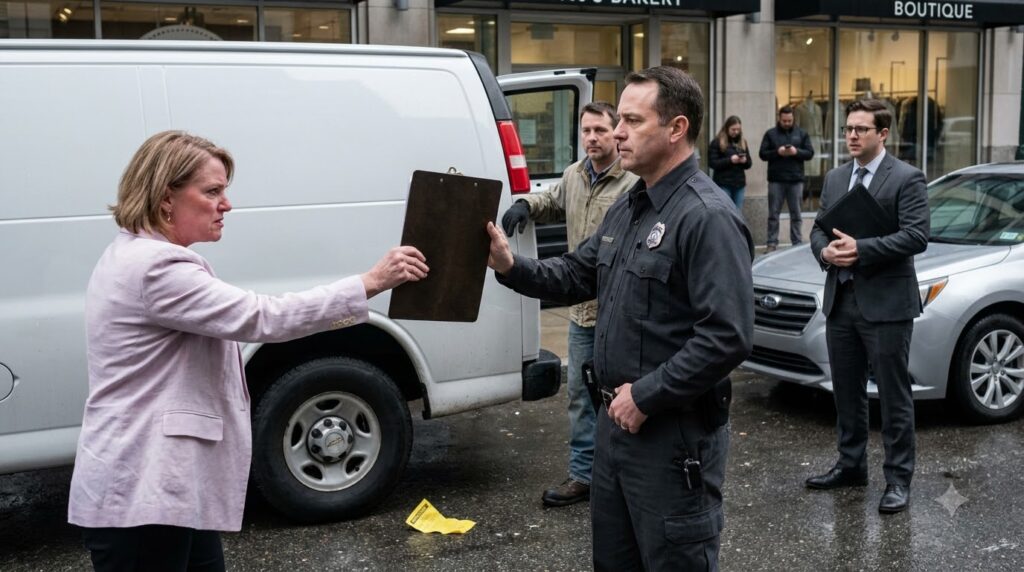
The driver’s door swung open. A man in a tailored charcoal suit stepped out—not a merchant, not a parking officer, but someone wearing the polished leather shoes and gold-rimmed glasses of a junior municipal lobbyist. Julian recognized the posture instantly: it was the stance of a man accustomed to attending closed-door zoning subcommittee meetings where public curbs were quietly reallocated behind closed doors.
Brenda emerged from her boutique at that exact second, her pastel linen blazer buttoned tight, her chin tilted up to restore the mask of absolute authority. She didn’t look at Julian. She walked straight past his van, her heels clicking a sharp, staccato rhythm against the pavement, and intercepted the lobbyist near the trunk of the silver sedan.
Julian leaned his shoulder against the cold metal door frame of his delivery van, his thumb brushing the frayed seam of his work glove. He didn’t rush his movements. He pulled his tablet from the dashboard mount, letting the screen wake under his thumbprint.
The notification banner wasn’t just a municipal advisory. It was a digital calendar sync ping, routed through the public-access municipal portal that tracked open zoning variance requests. Public docket entry 44-B: Cypress District Commercial Cooperative proposal to convert public loading zones 12 through 15 into private merchant reservation bays. Filed yesterday evening. Sponsored by a holding company bearing the exact address listed on Brenda’s foreclosure notice.
The pieces clicked into place with the cold, undeniable precision of a well-oiled breechblock. Brenda wasn’t just acting out of personal malice or general neighborhood tyranny. Her frantic crusade against unbranded delivery vans was part of a desperate, coordinated push by the district association to weaponize city zoning laws—transforming public infrastructure into private assets to inflate local commercial property values just enough to satisfy her impending lease default. The merchants weren’t protecting the neighborhood; they were carving it up.
Brenda turned her head sharply, catching Julian watching her from across the lane. Her eyes widened behind her designer sunglasses, the pale skin around her mouth tightening once more into a hard, defensive line. She whispered something rapid to the lobbyist, pointing a manicured finger directly at Julian’s chest, her expression twisting from bureaucratic coldness into outright hostility.
The lobbyist adjusted his gold-rimmed glasses, turned his head slowly to inspect Julian’s unbranded plates, and reached into his interior jacket pocket—not for a notepad, but for a black leather portfolio bearing the official seal of the county executive’s office.
Julian didn’t flinch. He slid the tablet back into his canvas pocket, feeling the solid, cool edge of the aluminum flashlight against his palm, and stood his ground on the gray city asphalt as the second phase of Brenda’s campaign began to close the distance.








