
CHAPTER 2: THE PAPERWORK PARADE
Text:
The green and white municipal scooter rolled to a halt three feet from the front bumper of the van, its electric motor dying with a soft, expiring whine. Officer Marcus Reed didn’t dismount immediately. He sat perched on the low saddle, one booted foot planted firmly on the asphalt to steady the weight of the vehicle, his dark-tinted visor flipped up to reveal a face carved from years of midday sun and bureaucratic indifference.
Brenda was already moving, her stride shortening into a sharp, purposeful march as she intercepted him before his boots could fully settle onto the street.
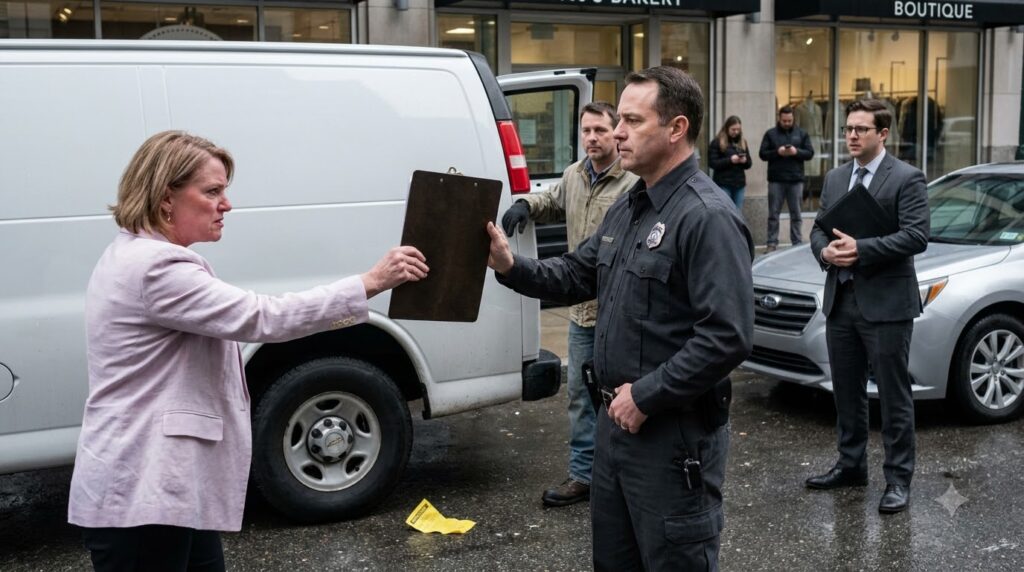
“Marcus, thank goodness,” she said, her voice dropping instantly from public-shaming volume into the conspiratorial register of an old acquaintance. She gestured wildly toward Julian’s unbranded van with the edge of her laminated clipboard. “We have an unlicensed commercial vehicle blocking the designated merchant loading corridor during peak foot-traffic hours. He’s been parked here for twenty minutes, refusing to identify himself or produce a valid retail permit. It’s a complete violation of the downtown cooperative ordinance.”
Julian didn’t rush. He remained leaning against the side panel of his van, his left hand tucked securely into the canvas pocket of his jacket, his fingers finding the smooth aluminum of the flashlight once more. He watched Reed’s eyes. A seasoned enforcement officer didn’t look at the person shouting loudest; he looked for the person who wasn’t shouting at all.
Reed didn’t look at Brenda. He looked past her shoulder, his gaze fixing squarely on Julian’s face for three solid beats before shifting slowly downward to examine the front license plate, then tracking up toward the windshield.
“Morning, Vance,” Reed said, his voice flat, gravel-rough, and entirely neutral.
“Morning, Marcus,” Julian replied, his tone level. “Routine drop at the bakery. Manifest’s on the dash.”
Brenda’s posture stiffened, the pastel linen of her blazer pulling taut across her back. Her head whipped between Reed and Julian like she had missed a crucial line in a badly rehearsed play. “Wait. You two know each other? Marcus, this isn’t a casual wave-through matter. This man is operating outside the district association guidelines. If you aren’t going to write the citation, I will call the commissioner’s office and log a formal complaint about municipal negligence.”
Reed killed the scooter’s ignition completely, the small dashboard light winking out. He swung his leg over the seat, his holster creaking with the dry, stiff protest of well-oiled leather. He adjusted the strap of his high-vis vest, taking his time, letting the silence stretch just long enough to make Brenda’s breathing audible over the hum of the distant bakery exhaust fans.
“District association guidelines don’t write municipal code, Brenda,” Reed said evenly, stepping past her as if she were a temporary construction cone. He walked straight up to the passenger-side window of the van, peering through the glass at the digital tablet resting on the center console. The screen was dark, locked behind a biometric sleep mode, but the blue paper permit taped firmly in the bottom corner of the windshield caught the pale morning light.
Brenda wheeled around, her face mottling into an ugly, flushed pink. “The Cypress District Merchants League holds jurisdiction over this block’s curb allocation under the 2024 commercial revitalization rider. I have the signed documentation right here.” She thrust the thick, plastic-sleeved binder forward, shoving it uncomfortably close to Reed’s shoulder.
Reed didn’t flinch. He reached out with two fingers, caught the edge of the binder, and pushed it down just an inch—not violently, but with the immovable authority of a man accustomed to handling aggressive drivers on narrow downtown avenues.
“That rider applies to private alleyways behind the old wool mill, Brenda,” Reed said, his eyes scanning the permit on the glass. “This is a public arterial corridor managed directly by the Department of Transportation. City code section four-eighteen explicitly protects commercial delivery access until ten ante meridiem. Your board doesn’t own this stripe.”
Julian watched the micro-twitch in the corner of Brenda’s left eye—a tiny, involuntary flutter that betrayed the absolute collapse of her prepared script. She had expected compliance. She had expected the quiet, sheepish retreat of an outsider who didn’t want trouble. Instead, she had run headfirst into a city ordinance that couldn’t be bullied by a clipboard or a polyester blazer.
“He’s parked illegally,” Brenda insisted, her voice climbing back toward its shrill peak as three bakery patrons paused near the curb with their morning pastries, watching the standoff unfold. “Look at him! Unbranded plates, no corporate logo, no uniform. For all we know, he’s dumping unauthorized freight or running an illicit operation out of that box.”
Reed didn’t answer immediately. He reached down to his belt, unclipped his municipal handheld scanner, and flicked the screen awake with his thumb. A sharp, green digital glow washed across his chin. He stepped around the front of the hood, drawing closer to the driver’s side where Julian stood motionless.
“Open the door, Julian,” Reed said quietly, loud enough only for the two of them to hear. “Let’s scan the transit QR and clear the manifest before her husband starts circling the block in his sedan.”
Julian nodded once. He reached out, pulled the handle, and swung the heavy door wide, but as he did, his eye caught something tucked into the spine of Brenda’s discarded binder where it rested on the hood of Reed’s scooter—a loose sheet of paper covered in handwritten annotations detailing a schedule of upcoming ‘curb reclamation actions’ across three different blocks, all marked with red exclamation points.
The micro-mystery flickered in his mind: this wasn’t just about his van. It was part of a coordinated push to choke off independent deliveries across the entire commercial district before the city council’s zoning vote next month.
Reed held his scanner steady, waiting for the digital handshake. Julian tapped his tablet, waking the screen to display the active municipal barcode, knowing full well that the moment this scan cleared, Brenda’s manufactured emergency would detonate right in her face.








