The Weight of the Oak and the Cold Metric of the Earth

CHAPTER 1: THE CONFRONTATION AT THE CURB

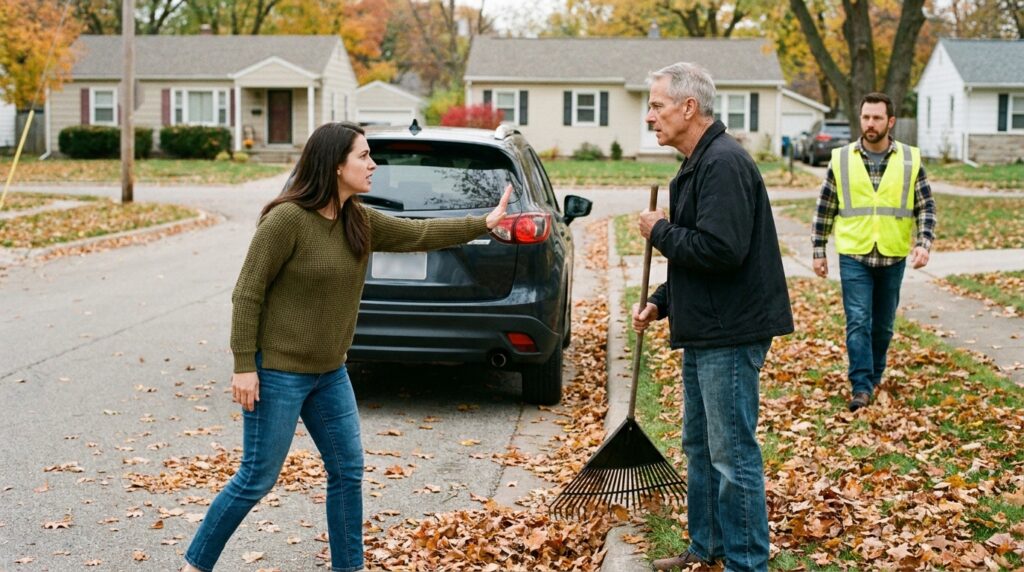
The orange tines of the plastic rake caught against a fracture in the old asphalt, sending a dull vibration up the ash-wood handle and into the meat of Arthur’s palms. The air smelled of cold mud and the sour rot of damp pin oak leaves. It was 5:14 PM, the sky the color of a greasy nickel, when the shadow crossed his workspace.

Chloe didn’t yell. She moved with the deliberate, heavy cadence of someone delivering a legal summons, her olive-green knit sweater catching the gray light as she stepped off her manicured turf and onto the cracked concrete of the public curb lane. She stopped exactly two feet from the silver flank of Arthur’s parked SUV, squaring her shoulders until her silhouette looked blocky against the pale houses across the street.

“Stop putting me in this position, respect my boundaries,” she said.

Her right hand was up, palm flat and rigid, fingers pointing toward the gray sky—the exact gesture a traffic cop makes before the metal collides.

Arthur didn’t drop the rake. He didn’t lift it either. He held the ash handle low across his thighs, his thumbs hooked over the worn grain, his knuckles gray from the late afternoon chill. His old canvas utility jacket was stiff with grease and salt stains at the cuffs. He looked at the flat plane of her hand, then up at her face. Her dark hair was tucked tight behind her ears, her mouth set into a thin, bloodless line that looked like an old scar.

Behind her, three doors down, a storm door clicked open. Old man Miller stepped out onto his porch, his yellow cardigan a sharp speck against the peeling paint of his siding. He didn’t come down the steps. He just stood there, leaning against the railing, his eyes locked on the curb. Further down, near the cul-de-sac, the low rumble of a delivery truck cut out, leaving only the sound of dry leaves scratching against the gutters as the wind kicked up from the valley.

“I am clearing the public gutter, Chloe,” Arthur said. His voice was flat, dry as old cedar. “The rain tomorrow will back up the culvert if these stay.”

“The water isn’t your property, Arthur. This lane is,” she replied, her palm remaining unmoving between them, a hard wall of meat and intent. Her fingers twitched slightly, indicating the dark soil just behind his boot heels. “The runoff from your roof comes through my ditch. I’m serious, this stops before it gets worse. I’ve already logged the spatial violation with the county.”

Arthur looked down at the curb. Right where the concrete met the asphalt, half-buried under a three-inch layer of wet black mulch, a tiny point of orange paint showed. It was the top of a rusted iron survey pin, driven into the earth forty years ago when the county still used steel chains to measure the dirt. The paint was chipping, flaking away into the mud, but the iron underneath was cold and fixed.

He didn’t look back up at her windows, though he knew the small black dome of her security camera was clicking behind the double-paned glass of her porch, its lens tracking the heat of his skin against the autumn chill. He could feel the eyes of the street now—the subtle shifting of curtains at the Miller house, the low murmur of two women standing by a mailbox fifty yards away. They were waiting for the shout. They were waiting for him to swing the wood.

Instead, Arthur slowly rotated his wrists, letting the tines of the rake settle flat against the dead leaves until the weight of the tool was entirely supported by the earth.

“Alright,” Arthur said, his voice dropping an octave into the quiet of the street. “Let’s talk this through.”

Behind Chloe, from the main access road, the orange flash of a strobe light cut through the gray mist. The heavy diesel engine of a city utility truck groaned as it rounded the corner, its tires grinding against the loose gravel at the edge of the asphalt.


CHAPTER 2: THE SURVEILLANCE FROM THE GLASS

The heavy orange strobe of the city utility truck cut through the low-hanging mist, painting the wet flank of Arthur’s SUV in rhythmic, greasy flashes. The diesel engine idled with a wet, gravelly rattle that shook the dead oak leaves still clinging to the curb. Chloe didn’t drop her hand immediately; her fingers remained stiffly upright for three more beats, a frozen monument to her own claimed perimeter, before she slowly let her arm fall against the dark fabric of her jeans. Her eyes didn’t leave Arthur’s face, but her chin tilted toward the arriving yellow cab of the municipal truck.

Arthur didn’t give her the satisfaction of a retreat. He lifted the ash handle of the rake just enough to clear the heavy mulch, his boots grinding into the soft, unpaved easement strip that separated his gravel driveway from her sod line. The iron pin beneath the leaves stayed buried, but his heel remained two inches to the left of it—his side of the ledger.

“We’ll talk,” Chloe said, her voice dropping below the rattle of the diesel cylinders, losing none of its sharp, clinical edge. “But we’ll do it with the county logs open. You’ve been encroaching on the eastern drainage vector for seven seasons, Arthur. The water doesn’t lie.”

She turned on the heel of her leather boot, the movement clean and practiced, and walked toward her front porch without looking back. Her silhouette passed through the beam of her own garage floodlight, casting a long, blocky shadow that stretched across the asphalt like a black finger pointing straight at Arthur’s foundation.

Arthur watched her go, his jaw set until the bone ached. He didn’t answer. He turned his back to her house and looked at the utility truck. The driver’s side door creaked open with the scream of ungreased hinges, and a pair of heavy, mud-caked work boots hit the pavement with a flat thud. It wasn’t the inspector yet. It was a younger man in a faded neon vest, carrying a bundle of slender fiberglass rods tipped with bright pink plastic flags.

The worker didn’t look at Arthur. He walked with the heavy, indifferent stride of a man paid by the hour, stopping at the edge of the ditch where Chloe’s property met the public right-of-way. With a rhythmic, metallic thunk, he began driving the fiberglass rods into the damp earth, spacing them exactly four feet apart, directly inside the swale Arthur had spent twenty years clearing of silt and branches.

“Who ordered the markers?” Arthur asked, his voice flat against the roar of the idling engine.

The worker didn’t look up from his bundle. “Work order came down from county civil engineering this morning. Dispute resolution and flow-line assessment. Just setting the sight lines for the surveyor.”

Arthur stepped closer, the wooden handle of his rake cold against his palm. He looked at the pink flags. They weren’t aligned with the rusted iron pin buried by the curb; they were biased three feet onto his turf, cutting a straight, jagged line through his established perennial bed. The plastic flags fluttered in the cold wind, screaming high-visibility pink against the muted grays and browns of the suburban rot.

“That line’s wrong,” Arthur said. “The original plat pins are down by the concrete. I drove them with the county surveyor back in eighty-four.”

The worker stopped, one rod held mid-air. He looked at Arthur then, his eyes small and bloodshot under the brim of a grease-stained cap. He didn’t look angry; he looked tired. “I don’t map ’em, mister. I just stick ’em where the tablet tells me. If you got a problem with the alignment, you take it up with the clerk at the municipal records office. Box forty-two. They updated the vector maps three months ago.”

The man turned back to his labor, driving the final flag into the mud with a hard, crunching blow from his heel. He climbed back into the yellow cab, slammed the door, and the truck groaned as it pulled away, leaving a blue cloud of exhaust that smelled of unburnt fuel and old oil hanging over the wet grass.

Arthur stood alone in the darkening lane. The street had gone completely silent again, but the silence was heavy now, full of hidden weight. He looked up at Chloe’s house. The windows were dark, but behind the double-paned glass of her second-story sunroom, a tiny, blue-white light pulsed twice. It was the digital eye of her data terminal, sync-linking her external camera footage with the city’s online reporting portal. She wasn’t just watching him through the glass; she was building a digital fence, line by line, filing data points like bricks to wall him out of his own front yard.

He walked back to his porch, his boots heavy with the grey clay of the easement. He didn’t put the rake away in the shed. He stood it up against the peeling white pillar of his porch, the orange tines resting against the old wood like a warning flag.

Inside his kitchen, the air was cold and smelled of old coffee. He didn’t turn on the overhead light. He moved through the shadows to the front window, pulling back the faded lace curtain just enough to see across the driveway.

In the dim light of the streetlamp, something caught his eye—a strange, unnatural glint down in the drainage ditch, exactly halfway between the new pink flags and his foundation. It wasn’t a leaf, and it wasn’t water. It was a long, thin strip of silver metal, half-buried in the mud, reflecting the pale light of the moon like a silver wire drawn tight across the earth. Someone had been digging in his ditch while he was inside, and they hadn’t used a shovel. They had used a core-drill.

CHAPTER 3: THE WEIGHT OF THE INK

The heavy glass door of the county records annex didn’t swing so much as it dragged, its lower weatherstripping scraping a white arc across the salt-stained linoleum. The air inside smelled precisely of the past forty years—damp cellulose, dry ozone from a laboring copy machine, and the metallic tang of rusted iron flat-files. Arthur stepped into the fluorescent hum of the basement repository, his fingers still numb from the cold drive downtown.

He didn’t need the directory. He knew the layout of Box forty-two before the clerk even looked up from her terminal. He had stood at these exact high-pressure laminate counters in 1984, watching the ink dry on his original construction permit while the county surveyor stamped the true boundary lines with a brass seal that left an indentation you could feel with a thumb.

The woman behind the counter didn’t speak. She took Arthur’s handwritten request slip, her yellowed acrylic nails clicking a slow rhythm against the formica before she disappeared into the narrow aisles of the rolling stacks. When she returned, she dropped a square, battered cardboard container onto the rubber mat between them. A small cloud of gray lint rose from the corners, settling into the light.

“Microfiche index has been down since Tuesday,” she said, her voice dry as the documents she guarded. “If it’s the eighty-four plat updates for the eastern drainage sector, you’ll have to look through the manual ledger inserts. Nobody’s digitized the engineering amendments from that block yet.”

Arthur pulled the thick, canvas-bound ledger from the box. The metal corner brackets were oxidized, leaving a chalky green residue on his thumbs as he laid the book flat. The pages were heavy, vellum-backed sheets that crackled like dry leaves under his calloused fingertips. He flipped through the entries, his eyes tracing the clean, hand-drawn draftsman lines of his neighborhood—the neat squares of the lots, the dotted markers of the utility lines, and the solid black ink of the storm-water right-of-way.

He stopped at page seventy-eight. His own property line was there, rendered in steady, fade-resistant India ink. But as his thumb trailed along the eastern boundary—the exact edge where his turf met Chloe’s sod line—the texture of the paper changed.

He leaned down, the stark fluorescent light reflecting off a microscopic ridge in the vellum. Someone had used a razor blade here.

With the careful precision of a man who had spent forty years measuring lumber, Arthur ran his fingernail across the margin. The original line hadn’t just been amended; it had been scraped thin. Underneath the fresh, dark ink that designated the modern flow-line vector, there was a faint ghost of a previous entry. The original 1984 developer’s seal had been physically cut out and replaced with a circular patch of bond paper, held in place from behind with yellowed cellophane tape that had gone brittle and brown at the edges.

The new line—the one that biased the entire three-foot drainage liability onto Arthur’s property—was signed with a sharp, blocky hand that didn’t match the elegant cursive of the original county surveyor. In the corner of the modified section, a small, unrecorded municipal amendment stamp bore an engineering code that didn’t exist in the county index: AM-84-X.

“This change isn’t cross-referenced,” Arthur said, his voice cutting through the silent basement like a small snap of dry wood.

The clerk didn’t look up from her screen. “If it’s in the book, it’s the legal record, mister. The county doesn’t keep track of old clerical overrides.”

“It’s a white-out,” Arthur said, his hand remaining steady on the edge of the heavy page. “The developer who cleared lot twelve shifted the entire retention liability thirty inches to the west before the concrete was poured for the adjacent foundation. They did it to clear the buildable area for the house next door.”

Chloe’s house.

The silver core-drill plug he had found in his ditch wasn’t an assessment tool for a minor neighborhood dispute; it was a verification check. Someone was trying to confirm how much water his soil could take before the artificial boundary lines collapsed entirely. The pink flags placed by the utility worker weren’t based on the true iron pins driven into the curb; they were aligned to this specific, butchered sheet of vellum, drawn up in secret to protect a basement that never should have been built in the first place.

Arthur closed the ledger, the heavy canvas cover landing with a flat, concussive thud that sent a shudder through the counter mat. He didn’t make a copy. He didn’t need one. He knew the shape of the forgery now, and he knew that Chloe’s ice-cold confidence wasn’t built on a misunderstanding. She had the copies of this exact modified page in her folder. She knew about AM-84-X, and she was using the county’s own administrative rot as a shield to claim his yard before the weather changed.

He walked out of the annex and back into the gray afternoon light. The wind had shifted, blowing hard from the north now, carrying the wet, metallic smell of the approaching storm system. As he reached his truck, his phone buzzed once against his hip—a blunt text notification from the neighborhood association portal, signed by the board’s legal liaison. A formal notice of easement obstruction had been logged against his address, effective at midnight. They were moving fast, using the modified plat maps to lock him out before he could challenge the ledger.

Arthur put his truck in gear, his foot pressing hard against the mechanical linkage of the accelerator. He had to get back to the line. If they brought the physical barriers before the inspector arrived, the false map would become the active reality, and the true iron pin beneath the leaves would be buried under concrete for good.

CHAPTER 4: THE ARRIVAL OF THE HIGHVIS VEST

The steel tires of a triple-axle commercial flatbed ground a deep, black trench through the roadside turf, spitting wet clay against the silver quarter-panels of Arthur’s parked SUV. A sharp, metallic ping echoed off the chassis as the driver threw the rig into reverse, the air brakes releasing with a high-volume hiss that smelled of hot oil and scorched lining.

Arthur slammed his truck door shut before the engine had fully died, his work boots sinking four inches into the churned mud of his own front yard. Rain was falling now—not a clean pour, but a cold, heavy drizzle that clung like grease to the stiff canvas of his utility jacket.

“Unhook the chains,” a man shouted from the back of the flatbed. He wasn’t a city worker. He wore the black-and-gold jacket of a private security fence contractor, his high-visibility vest pulled taut over a thick, insulated canvas coat. He was already unbolting the binders on a stack of ten-foot steel privacy barriers. “We got forty rods of perimeter layout to drop before the ground goes entirely soft. Get the anchor posts into the drainage line first.”

“Get that rig off my grass,” Arthur said. He didn’t raise his voice to a scream, but his tone had the iron weight of an ancient joist settling into place. He walked directly toward the rear of the trailer, his old ash-handled leaf rake gripped low in his right hand like an extended measuring rod. He planted the orange plastic tines exactly where the grass ended and the asphalt began. “You’re three feet over the original county pin.”

The contractor didn’t check his stride. He dragged a heavy, zinc-plated steel post across the diamond-plate deck, the metal shrieking until it hit the mud with a hollow, concussive thud. “I got a signed easement enforcement order from the home association board and a civil flow-line map stamped three months ago by the municipal clerk. We’re fencing the designated runoff zone. Step back from the rig, mister.”

Across the property line, the front door of the modern house swung wide. Chloe didn’t hurry down the steps, but she had her digital folder held high against her chest like an armor plate. She wore a heavy Gore-Tex shell over her olive sweater now, the hood pulled low over her dark, unmoving eyes. Two other neighbors—the younger couple from lot fourteen—had walked down to their driveway edge, their phones already up, their screens glowing white through the gray October mist.

“It’s a civil boundary order, Arthur,” Chloe called out, her voice clear and level over the rhythmic thrum of the flatbed’s diesel engine. “The contractor has the updated GIS registry sheets. The fence lines follow the active municipal drainage vector AM-84-X. You’re obstructing a certified water management corridor.”

Arthur didn’t look at her folder. He looked at the contractor who was lifting a heavy, gas-powered post-driver off the trailer bed. The machine’s small two-stroke engine started with a high, buzzing whine that tore the quiet of the street into shreds. If that steel post went through the turf right here, it wouldn’t just block his lawn; it would pierce the old concrete casing of the primary culvert line he had spent forty years maintaining with his own hands.

“Stop the engine,” a new voice commanded from the road lane.

The sound was quiet, but it had the flat, dry authority of an official seal.

A white city sedan had pulled up behind the flatbed, its roof-mounted amber strobe light spinning silently through the mist. Mark, the vest-wearing city code enforcement inspector, stepped out of the driver’s seat. He didn’t carry a shovel or a rod. He held a long, cylindrical aluminum blueprint tube under his left arm and a ruggedized digital tablet in his right hand. His orange safety vest was clean, the silver retroreflective bands gleaming with municipal authority against the mud-splattered landscape.

The fence contractor hesitated, his thumb lingering on the throttle of the post-driver, the engine idling down to a low, metallic chatter. “We’re working a private board order, inspector. Enforcing the updated runoff easement.”

Mark walked down the center of the asphalt, his eyes never leaving the tire tracks in the grass. He stopped exactly between Arthur and the flatbed, his boots planted on the cold concrete of the curb. He didn’t look at Chloe’s digital folder, and he didn’t look at Arthur’s leaf rake. He unlatched the cap of the aluminum tube with a sharp, plastic pop.

“I don’t care about your board order,” Mark said, his voice level and entirely empty of emotion. He pulled out a large, heavy sheet of waterproof Mylar—a master county survey map dated September 14, 1984, bearing the deep, pressed indentation of the original state surveyor’s seal. He unrolled it across the wet hood of Arthur’s SUV, weighting the corners down with a heavy iron hitch pin. “And I don’t care about code AM-84-X. That was a developer’s construction amendment, not a legal property conveyance. It was never ratified by the county commissioners.”

Chloe took two sharp steps forward, her boot heels crunching into the soft sod at her lawn’s edge. Her face didn’t break, but the skin around her eyes went tight as wire. “The digital portal accepted the updated vector filing three months ago. The drainage liability sits on lot eleven.”

Mark didn’t look up from the Mylar map. He drew a long, heavy steel tape measure from his belt, the metal ribbon extending with a loud, rhythmic clack-clack-clack. “The digital portal accepts whatever data a title company uploads until an inspector comes out with the chain. Arthur, give me a hand with the zero-anchor.”

Arthur dropped his rake onto the grass. He stepped forward, his cold fingers gripping the rusted metal loop at the end of the steel tape, pinning it exactly against the center of the chipped orange paint on the buried iron pin by the curb.

Mark walked twenty feet back toward Chloe’s foundation, the steel tape singing as it pulled taut against the damp earth. As the numbers on the tape clicked past thirty feet, the metal line didn’t settle on the grass. It cut straight through the center of Chloe’s gravel landscape bed, passing four inches inside the lower wooden timber of her retaining wall.

The inspector stopped. He looked at his tablet, then at the Mylar map, then down at the ground beneath his boots. The mud there wasn’t just wet; it was vibrating. A tiny, steady stream of gray, silty water was bubbling up from a small fissure right beneath the foundation block of Chloe’s porch—not runoff from Arthur’s roof, but a deep, pressurized leak from a main line that wasn’t even marked on the neighborhood plat.

Mark’s face changed then. The dry, bureaucratic indifference vanished, replaced by the cold stillness of an engineer looking at a failing bridge. He looked up at Chloe, then down at the bubbling gray silt.

“This isn’t an easement dispute,” Mark said softly, his voice barely rising over the low rattle of the fence contractor’s truck. He reached down and stuck a single yellow utility flag directly into the gray mud. “The main storm culvert isn’t shifted onto Arthur’s lot. It’s sitting directly under your living room, Chloe. And it’s been collapsing for five years.”

CHAPTER 5: THE UNFOLDING OF THE TRUTH

The yellow flag shivered as the gray silt pooled thicker around its thin wire stem. Chloe didn’t look down at the bubbling mud; her eyes remained fixed on the rigid silver edge of Mark’s steel tape measure, which still trembled three inches inside her decorative stone border. The ruggedized tablet in the inspector’s hand emitted a flat, double-tone chirp that sounded dangerously final in the cold rain.

“That’s an administrative tracking error,” Chloe said. The precision in her voice had thinned, replaced by a rigid, rapid cadence that clicked like ice against glass. She didn’t look at the fence contractors, who were already stepping away from their flatbed trailer, their heavy gloves tucked under their armpits. “The municipal main was redirected during the phase-two subdivision extension. The HOA board holds the signed turnover certificates.”

Mark didn’t look up to meet her stare. He knelt on the wet sod, his safety vest bunching around his neck as he cleared a handful of decorative river stones away from the base of her porch pillar. His fingers, covered in the slick gray clay of the lower stratum, traced a jagged hairline fracture that began at the concrete footer and ran straight up through the mortar joints of her front steps.

“The board holds a bill of sale from a shell developer who filed for bankruptcy in November of eighty-five,” Mark said. His thumbs pressed against the dry-stack stone. A tiny, dry puff of powdered lime fell onto his boot—not from surface moisture, but from a grinding mechanical friction deep inside the wall. “The main line wasn’t redirected, Chloe. It was capped with a non-reinforced concrete sleeve to make room for your garage footers. The city never signed the structural release. Look here.”

He pointed a muddy finger toward the gap where the concrete met the earth. A low, hollow draft was sucking the cold air downward into the void, carrying the faint, sulfurous stench of old storm-water decay and wet limestone rot. The earth beneath her lot wasn’t a solid bed of engineered fill; it was a hollow chamber, slowly being hollowed out by forty years of trapped runoff that had nowhere else to go.

Arthur stepped closer, his boots heavy but silent on his side of the iron pin. The wooden handle of his leaf rake remained tucked beneath his arm, its orange tines dripping with gray rainwater. He watched the way the gravel inside Chloe’s landscape bed was settling—not washing away from the top, but dropping vertically, inch by inch, as the support beneath it dissolved into the hidden culvert.

The fence contractor cleared his throat, spitting a dark stream of tobacco juice onto the asphalt before he unhitched the primary chain from the steel barriers. “We’re logging a site-safety hold on this perimeter, ma’am. If the main vault’s structural integrity is compromised past the curb lane, my rigs can’t stay on the right-of-way. The weight of the flatbed alone could trigger a lateral shear.”

“The order is active,” Chloe said, her voice rising an octave, stripping away the polished administrative veneer to reveal something raw and desperate underneath. She turned toward the couple standing at the edge of lot fourteen, her hand gesturing toward her darkened windows. “Sarah, you saw the filing. The easement is valid. The water is coming from his property line.”

The couple didn’t answer. The woman dropped her phone to her side, her thumb sliding across the dark screen as she stepped half a pace behind her husband. They didn’t speak; they simply watched the tiny yellow flag by Chloe’s porch tilt three degrees to the left as the mud beneath it gave way, disappearing into a fist-sized throat that opened silently in the turf.

Arthur looked down at his own yard. His grass was rough, untrimmed at the edges where the wild blackberry vines crept in from the cul-de-sac, but the earth was firm. The old pin he had driven into the concrete in 1984 hadn’t moved a fraction of an inch. It remained anchored in the deep stone shelf that formed the natural drainage lip of the valley—the shelf the original builders had cut away from Chloe’s lot to maximize the square footage of her basement.

“You knew about the AM-eighty-four override,” Arthur said, his voice dropping into the space between them like a heavy iron wedge. “You didn’t find a clerical error three months ago, Chloe. You found the original structural warning notice from the county engineering office when you performed your title search. You filed the drainage complaint against me to get the city to excavate the ditch line on my dollar before your foundation dropped.”

Chloe didn’t look at him. She stood completely still under the cold drizzle, her Gore-Tex shell slick with rain, her broad silhouette looking suddenly smaller against the massive, failing facade of her house. Her mouth opened, but no weaponized HR phrasing came out. The calculation had run out of variables.

Mark stood up, wiping his muddy palms on a rag from his pocket. He turned to the fence contractor, his face hard. “Clear your rig off the right-of-way. I’m calling in a structural emergency utility crew to isolate the flow-line before the midnight surge hits. And Chloe?”

She slowly shifted her eyes to the inspector’s face.

“You need to empty your basement,” Mark said. “By tomorrow morning, this whole corner is going to be red-tagged.”

CHAPTER 6: THE FINAL SWEEP OF THE TINES

The heavy commercial flatbed groaned as its rear tires cleared the crushed sod, dragging two thick ribbons of black mud onto the gray asphalt before the tail-lights flickered and disappeared around the corner. The diesel rattle died away, leaving only the thin, sharp whistle of the north wind cutting through the bare branches of the oak trees.

Chloe didn’t move. She stood on the edge of her disintegrating retaining wall, her hands still pressed tight against the digital folder on her chest. A heavy droplet of cold water ran from the brim of her hood down to her chin, but she didn’t wipe it away. Her eyes were fixed on the raw, open throat in the grass where the yellow utility flag sat crookedly in the silty mud.

Mark, the inspector, rolled the Mylar maps back into his aluminum tube with a series of quick, rhythmic snaps that sounded like dry twigs breaking underfoot. He adjusted the strap over his shoulder, his eyes catching Arthur’s for a brief, neutral second. There was no victory in the look—only the flat acknowledgment of two men who had spent their lives dealing with the cold metrics of the ground.

“The emergency citation will hit your portal by six, Chloe,” Mark said, his boots crunching as he turned back toward his sedan. The amber strobe on his roof cast a pale, repeating glare over her wet brickwork. “Don’t turn on your washing machine. Don’t run the taps. If the line shifts another inch before the city crew jacks the main, the lateral pressure will crack that basement slab wide open.”

The door of the white city car clicked shut. The engine started with a clean, muffled hum, and the sedan pulled away from the curb, its tires splashing softly through the standing water in the public gutter.

Down the block, the curtains at the Miller house dropped closed. The young couple from lot fourteen turned away without a word, their screens going dark as they retreated up their long concrete driveway, their shoulders hunched against the increasing chill of the drizzle. The show was over. The authority had spoken, and the balance of the street had reset itself back into the gray muck of the earth.

Arthur waited until the taillights of the city car vanished past the main intersection. Then, with a slow, deliberate movement, he reached down and picked up his ash-handled rake from the grass. His fingers clamped around the worn wood, finding the old groves his thumbs had worn into the grain over twenty winters. The plastic tines were wet and smeared with gray clay, but the frame was whole.

He didn’t speak to Chloe. He didn’t offer a warning, and he didn’t check the line of her fence. He turned his back to her house and walked the three paces to his side of the iron pin, his boots finding the firm, unyielding gravel of his own easement strip.

With a rhythmic, pulling stroke, he brought the rake down into the leaves. Scritch. Scritch. The sound was clean, cutting through the damp silence of the evening. He worked from the edge of his driveway toward the concrete curb, gathering the heavy, waterlogged mass of red and brown oak leaves into a neat, compressed pile right at the boundary line.

Behind him, a soft, plastic click broke the rhythm. Chloe had turned toward her porch, her steps slow and heavy, the soles of her leather boots dragging across the concrete tiles of her walk. She reached her front door, her fingers trembling slightly as she touched the electronic keypad. The small black dome of her security camera hummed as it tracked her movement, its blue light pulsing once before she pushed the heavy door open and let it slam behind her. The deadbolt engaged with a dull, internal metallic thud.

Arthur didn’t look up at the glass. He kept his head down, his arms moving in the same steady, unhurried circle he had practiced since the day the county pins were set. The wind blew hard from the valley now, carrying the smell of woodsmoke from the houses further down the ridge, but here at the curb, the air was clearing.

He pulled the last bundle of wet debris away from the concrete lip, exposing the gray, pitted face of the original gutter. The water from the upper road was already beginning to trickle through the cleared channel, running clean and fast past his tires, dropping down into the culvert mouth without a single drop catching on his lawn.

He stopped, resting both hands on the top of the ash handle, his breath rising in a small, white cloud against the darkening sky. Some people spent so much time watching their neighbors that they forgot where their own house ends. He let the thought settle into the cold iron of his mind, then lifted the rake and walked up his path toward the dark porch, leaving the line clean behind him.

Similar Posts

Leave a Reply

Your email address will not be published. Required fields are marked *