
The Concrete Setback: A Gritty Texas Tale of Unyielding Lines and Bedrock Justice

CHAPTER 1: THE CRUSHED PERIMETER

The sun over Collin County didn’t just shine; it baked the moisture out of the earth until the Bermuda grass turned stiff as wire and the limestone gutters gleamed like bleached bone. Marcus Thorne knelt in the dust at the edge of his property, his fingers tracing the fresh, jagged indentation left in the topsoil. The track was broad—nearly twelve inches across—stamped deep into the loam by the aggressive tread of a high-flotation commercial tire. The dark green leaves of his newly set boxwood hedge lay crushed beneath a smear of dark grease, the stems snapped clean where the weight had pinned them against the hard ground.

He didn’t stand up immediately. He reached down, his calloused palm closing around the cold, heavy weight of the brass plumb bob resting in his utility pocket. The metal was cool against his skin, a grounding reminder of straight lines and unyielding metrics in a world that preferred to blur them. For three months, the ruts had reappeared like clockwork every Tuesday and Thursday morning, always tracking exactly two feet further into his deeded lot, always leaving the sharp scent of unburnt diesel lingering in the dry heat.

The low, hydraulic whine of a heavy machine cut through the suburban quiet before Marcus could finish clearing the ruined roots. From around the bend of the pristine cul-de-sac came the massive silhouette of the John Deere commercial mower, its twin steel exhaust pipes puffing faint wisps of gray smoke into the clear air. At the controls sat Richard Blevins, his linen sports coat draped loosely over the back of the high-backed vinyl seat, his gold-plated watch catching the glare of the noon sun as he gripped the steering levers. Richard didn’t slow down as he approached the corner lot. He adjusted his trajectory, his gaze fixed straight ahead, intentionally veering the massive cutting deck toward the remaining green fringe of Marcus’s border.

Marcus stood up, his posture straight as a surveyor’s rod, his high-visibility work shirt bright against the desaturated brick facade of his home. He didn’t wave his arms. He simply stepped forward, stopping exactly eighteen inches inside the concrete road gutter, his boots marking the precise boundary line he had verified down to the millimeter.

Richard yanked the levers back, the hydrostatic drive groaning under the sudden resistance as the heavy machine skidded to a halt mere inches from Marcus’s shins. The hot blast from the radiator fanned across Marcus’s face, carrying the smell of iron and boiling coolant.

“Get that trash off my easement by Friday, Thorne, or my trucks will scrape it down to the dirt for you,” Richard shouted, his face already turning a deep, sun-baked crimson beneath his sunglasses. He tapped a thick plastic clipboard resting against his knee. “The architectural committee just logged the violation. You don’t own the frontage, boy. This whole lane is slated for secondary access, and your little garden project is an unzoned hazard.”

Marcus looked down at the crumpled boxwood leaf stuck to the front wheel cowl of the tractor, then back up into Richard’s hidden eyes. “The municipal setback ends exactly eighteen inches from the concrete gutter, Richard. You’re sitting two feet past it.”

Richard let out a dry, rattling laugh, his fingers tightening on the levers. “I platted this entire subdivision before you had a license, Thorne. The mapping says what I want it to say.” With a sharp jerk, he engaged the blades, the metallic roar drowning out the wind as he backed the machine onto the asphalt, leaving a fresh scar of dark rubber on the white stone curb. He didn’t look back as he drove away, but as the dust settled, Marcus noticed a small, weathered copper token dislodged from the tractor’s frame lying directly in the mud—a detail that didn’t match any standard commercial machinery.

CHAPTER 2: THE PAPER SHIELD

“The county zoning office doesn’t make accounting errors, Thorne, but people like you certainly do,” the voice on the other end of the line rasped, the low hum of a luxury sedan’s climate control bleeding through the phone’s speaker.

Marcus didn’t blink. He kept his shoulder pressed against the dry, sun-bleached cedar pillar of his front porch, his thumb tracing the rough, stamped edges of the copper token he had pulled from the mud after Richard’s departure. The metal was heavily oxidized, bearing a partial serial number—TX-CAD-04—that didn’t belong to any commercial lawn tractor. It was an inspection tag from the County Appraisal District, the kind used to anchor physical boundary markers during major infrastructural surveys.

“A three-foot variance isn’t an accounting error, Jenkins,” Marcus said, his voice flat, stripped of the fatigue that usually settled into his joints after a twelve-hour field shift. “It’s a deliberate shift on a digital ledger. The master plat map uploaded to the Silverbrook community portal on Monday doesn’t match the original 2020 county registry. Someone manually dragged the right-of-way vector.”

A short, defensive silence stretched across the line. Jenkins was the chief administrative clerk for the subdivision’s architectural review board, a man whose entire existence was dedicated to maintaining the pristine, desaturated perfection of the neighborhood’s brick facades and limestone curbs.

“The board relies on the documentation provided by the primary developer,” Jenkins replied, his tone hardening into that transactional, defensive shield common to county bureaucrats caught between a wealthy benefactor and a hard metric. “Blevins Ventures handles the infrastructure updates for the phase two extension. If the committee received a revised plat showing an expanded clearance easement for utility access, we log it. If your stone wall encroaches on that updated line, the five-thousand-dollar enforcement lien will stand. I suggest you take it down before the county inspector arrives on Friday.”

The line went dead with a clean, electronic click.

Marcus slowly lowered the phone. The noon air smelled of hot asphalt and dry Bermuda grass, a gritty, desaturated heat that made the horizon shimmer over the multi-car garages across the cul-de-sac. He looked down at the copper token in his palm. Richard hadn’t just drifted over the curb out of petty arrogance; he was driving a path that he had already cleared on paper.

He walked inside, the cool, dark interior of his home offering no real reprieve. In his home office, three separate monitors glowed against the shadow-drenched walls, displaying high-resolution scans of the Collin County land registry. As a professional surveyor, Marcus had access to the raw, unedited architectural archives—the bedrock data that developers usually buried under layers of municipal amendments.

He opened the Silverbrook master file, pulling up the digital plat map Richard’s company had submitted to the local board less than forty-eight hours ago. On the surface, it looked flawless. The lines were clean, the county stamps were visible, and the secondary subdivision access point was clearly marked as a four-foot public right-of-way cutting directly across the corner of Marcus’s lot. It was the perfect decoy—a legal justification that would allow Richard’s commercial excavation crews to tear up the lawn, remove the boxwoods, and establish a permanent haul road for his new development without paying a single dollar for the land.

But Marcus didn’t look at the lines. He zoomed in on the metadata embedded within the digital file, focusing on the cryptographic signature of the rendering software.

The file had been modified. The vector points detailing the road clearance hadn’t been entered by a county clerk; they had been exported from a private workstation registered to Blevins Ventures three weeks prior. Richard had weaponized the neighborhood archive, inserting a falsified draft into the official community records to create the illusion of public authority. He had built a paper shield to cover a private land grab.

Marcus reached into his drawer, pulling out his weathered leather field log. The pages were filled with handwritten coordinates, angles, and physical measurements he had taken himself over two decades of technical labor. He knew the limestone bedrock beneath his lawn didn’t care about modified digital files. The earth held its own records, driven deep into the stone in the form of high-tensile steel boundary pins that no developer’s computer could erase.

He looked back at the screen, his internal monologue calculating the parameters of Richard’s next chess move. Richard expected him to panic. He expected a standard homeowner to hire an expensive real estate attorney, tying the dispute up in formal board meetings for months while the excavation trucks rolled through the cul-de-sac anyway. Richard was counting on the target’s financial exhaustion.

Marcus closed the laptop with a firm, quiet snap. He didn’t need a lawyer to argue over a falsified digital file. He needed to make the physical reality of the land completely undeniable to anyone standing on the street.

He walked out to his garage, the heavy scent of motor oil and dry earth rising from the concrete floor. In the corner sat his heavy commercial rotary hammer drill, its long, carbide-tipped steel bit covered in a fine layer of white limestone dust from his last commercial job site. Beside it were four sacks of high-strength structural concrete mix and a bundle of thick, deformed steel rebar.

If Richard wanted to use the authority of a false mapping document to clear a path through Marcus’s life, Marcus would ensure that the confrontation didn’t take place in a distant city office or a quiet boardroom. It would happen right at the edge of the asphalt, where the tires met the stone. He picked up a heavy framing hammer, its steel head cold and unyielding, and began loading the truck. He could hear the distant, faint rumble of heavy diesel engines from the highway—Richard’s construction crews were already moving into position for the phase two expansion, but they were about to run directly into a metric they couldn’t alter.

CHAPTER 3: DIGGING THE LINE

The sharp, metallic whine of the rotary hammer bit chewed into the subterranean limestone shelf with an ear-splitting screech, venting small, geyser-like plumes of white, chalky powder across Marcus’s heavy leather boots. The sun hung low and fat over the western ridge of McKinney, turning the air into a thick, dry kiln that smelled of burnt grease and pulverised stone. Every impact vibrated up the steel shaft of the tool, through his locked wrists, and settled as a deep, rhythmic ache in his shoulders.

Marcus didn’t care about the heat. He didn’t care about the sweat sting in his eyes. His gaze was anchored entirely on the guide string—a neon orange line stretched taut between two high-tensile steel boundary stakes driven precisely eighteen inches back from the curb line.

He shut off the motor, letting the sudden silence of the cul-de-sac rush back in. As the dust settled into the three-foot-deep trench he had carved into his own turf, Marcus knelt down, wiping his palm against his work pants before reaching into the loose shale. His fingers brushed against something hard and distinct, caught down at the base of the native stone shelf. It wasn’t raw limestone.

He dug out a secondary survey cap, heavily scarred and tarnished by underground dampness. He held it up to the failing light. It wasn’t the official county surveyor’s mark. Stamped deep into the brass face was a crude, private corporate insignia—B.V. Dev Corp—and a date that preceded the neighborhood’s municipal incorporation. Marcus felt his jaw tighten. Richard hadn’t just modified the digital records last week; his company had physically staked a false perimeter decades ago, hiding the evidence beneath the topsoil until the neighborhood grew to match his lie.

Marcus tossed the private brass cap into his tool box with a flat, metallic clunk. The decoy was deep, built to ensure that if any ordinary surveyor came looking for simple iron pins, they would hit Richard’s buried marker and turn back. But Richard hadn’t anticipated someone tracking the bedrock itself.

Marcus hauled a heavy length of number-four deformed steel rebar from the bed of his truck. He dropped the grid into the trench, the metal bars interlocking like a dark, rusted cage within the belly of the earth. He picked up the heavy structural epoxy gun, injecting thick, grey binding compound directly into the anchor holes he had drilled into the solid limestone floor. One by one, he drove the vertical steel dowels deep into the bedrock, hammering them down until they rang with a flat, solid pitch that meant they were one with the planet.

“You’re wasting your time and your money, Thorne,” a sharp voice cut through the hot evening air.

Marcus didn’t startle. He slowly stood up, turning his head to see Mrs. Gable, one of the Ridgeview Watchers, standing near her brick mailbox with her arms crossed over her standard-issue athletic jacket. She pointed a manicured finger at the concrete mixer humming gently in the back of Marcus’s truck.

“Richard already showed the board the easement blueprints this morning,” she said, her voice carrying that thin, neighborhood-sanctioned warning. “The township trucks are scheduled to clear this corner lane for the pipeline easement expansion by next Monday anyway. You build that stone wall, and the county will just fine you to tear it down. We don’t want the street tore up over a private grudge, Marcus.”

Marcus grabbed a fresh bag of high-strength structural mix, slicing the paper sleeve open with his pocketknife. “The township isn’t expanding a pipeline here, Mrs. Gable.”

“The documents are on the portal,” she insisted, her tone defensive, her hand twitching toward the phone in her pocket. “We all saw the county stamp.”

“The stamp is a digital layer,” Marcus said quietly, his voice carrying the calm weight of a man who spent his life measuring absolute reality. “Watch the curb on Wednesday morning. You’ll see what the stamp is actually worth.”

He turned his back to her, terminating the exchange with calculated silence, and tipped the mixer. The thick, grey slurry of commercial-grade concrete spilled into the trench, swallowing the steel rebar cage in a heavy, wet rush. It filled the gap, bonding perfectly with the excavated limestone shelf.

Working by the amber beam of his truck’s work lights, Marcus began setting the heavy, rough-cut fieldstone blocks onto the wet foundation. Each piece of gray stone was coated in industrial structural adhesive before being tapped into alignment with his heavy rubber mallet. He checked the plumb bob, the brass cone hanging perfectly still, pointing down to the absolute center of gravity.

To anyone walking the cul-de-sac the next morning, it would look like nothing more than a standard, decorative garden border—a short, suburban wall designed to catch the eye. But Marcus knew the truth hidden behind the desaturated stone facade. The stone was just the skin. Beneath it lay a solid core of steel and reinforced concrete rooted three feet into the foundational bedrock of the county. He packed the loose black soil back around the base, hiding the concrete footing until the wall appeared to grow naturally out of the grass.

He reached up, checking the cedar birdhouse mounted five feet away on the post. The small glass lenses of the dual 4K cameras gleamed once in the darkness, capturing the clean, gray line of the stonework and the dark asphalt beyond. The trap was set, but it wasn’t a snare—it was a metric line made physical. Marcus wiped the gray dust from his hands, looked at the silent houses lining the cul-de-sac, and walked inside. The countdown to Wednesday had already begun, and the earth was ready to hold its ground.

CHAPTER 4: THE CORE COLLISION

The high-pitched, metallic buzz of the John Deere’s twin hydro pumps didn’t drop in register when the wheels left the smooth asphalt. Instead, the tone sharpened into a raw, angry scream as Richard Blevins slammed the control levers forward, throwing the full force of the five-hundred-pound machine directly over the grass line.

Marcus stood on the second step of his porch, his boots static against the wood, his hand clamped tightly around the cold brass sleeve of his field notebook. Through the shimmering heat waves rising off the driveway, time seemed to catch on the rough textures of the cul-de-sac—the gray glare of the limestone gutter, the flash of Richard’s gold watch in the sun, the white-knuckle grip of the developer’s fingers on the steering handles. Richard’s silhouette was rigid, leaned low over the chassis, his face set in a heavy, triumphant leer. He was driving the precise vector of his falsified digital plat map, aiming the heavy steel corner of the front right wheel cowl to tear clean through the decorative stones.

Then came the impact.

It wasn’t a wet crunch of displaced earth or the light shatter of garden brick. It was a violent, low-frequency detonation of steel against concrete-reinforced granite that rattled the windowpanes of Marcus’s craftsman home. The immovable object did not yield a single millimeter; it simply absorbed the momentum and pushed it back into the machine.

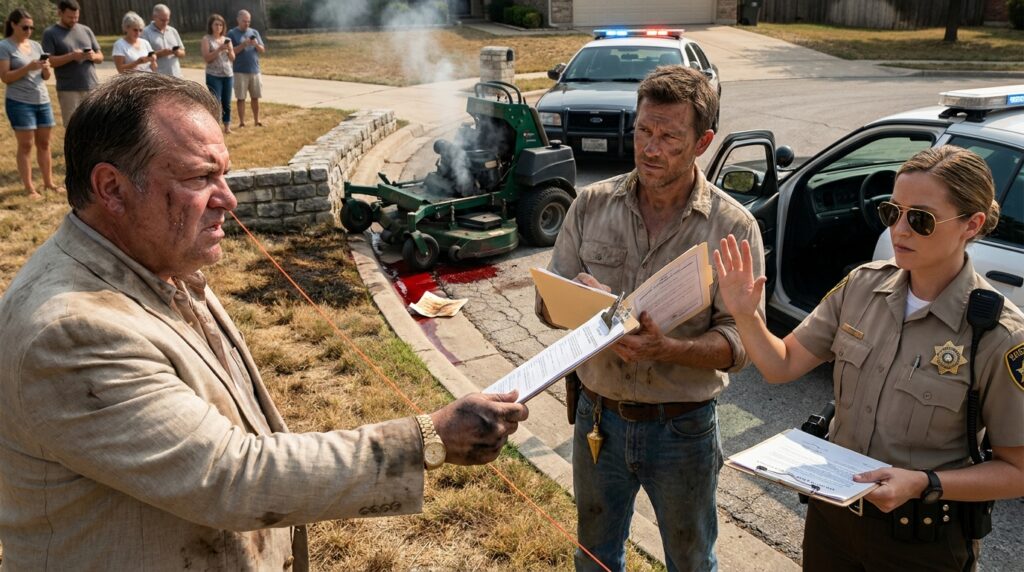
The massive commercial mower didn’t ride up or plow through. The front right caster wheel assembly hit the core foundation and disintegrated instantly, sending jagged chunks of vulcanized black rubber and sheared cotter pins spinning across the dry lawn like shrapnel. The main frame of the tractor buckled violently upward, the heavy gauge steel deck warping inward until it met the spinning cutting blades with a terrifying, screeching roar of self-mangling metal. The sudden, absolute arrest of four hundred pounds of moving mass sent a hydraulic shockwave back through the transmission lines—the high-pressure hoses ruptured with a sharp pop, spraying hot, red hydrostatic fluid across the chalky stone and smoking exhaust pipe.

Richard was thrown forward into the steering levers, his plastic clipboard slipping from his hands and cracking against the steel frame as his sunglasses flew off into the grass. The engine died with a wet, heavy thud, leaving only the sound of boiling coolant hissing against the ruined block and a dense cloud of white grease-smoke rising from the mangled undercarriage.

Marcus stepped down from the porch, his boots crunching methodically against the loose gravel of his driveway. He didn’t rush. He didn’t shout. He kept the folder tucked securely under his arm as he walked down to the perimeter line.

Richard was already scrambling backward off the vinyl seat, his linen sports coat stained with dark hydraulic oil, his face matching the deep purple hue of the fluid pooling in the concrete road gutter. He stumbled as his boots hit the grass, his chest heaving as he pointed a trembling, grease-blackened finger at the pristine face of the stone wall.

“You’re done, Thorne!” Richard bellowed, his voice cracking into a raw, panicked screech that echoed off the surrounding brick garages. “You engineered this! This is a dynamic hazard! You intentionally placed an unpermitted fortification on a county right-of-way to cause catastrophic vehicular damage! I’m having the sheriff out here, and I will personally see you stripped of your engineering license before the sun sets!”

From across the cul-de-sac, doors began to click open. The Ridgeview Watchers emerged—Mrs. Gable in her athletic gear, two men from the corner lots holding coffee mugs, their eyes wide as they took in the smoking wreck of the luxury tractor and the dark trail of oil cutting across the manicured turf. They began to cluster near the curb line, their low murmurs rising in a wave of collective hesitation.

“Look at this!” Richard shouted to the gathering neighbors, waving a crumpled sheet of paper he had yanked from his pocket—a certified stop-work order bearing a bright red municipal seal. “He ignored the board notice! He built a lethal trap on a public access easement! He’s putting every family in this development at risk!”

Marcus stopped exactly two feet behind the neon orange guide string, looking down at the red seal on Richard’s paper. Even from a distance, the texture was wrong—the lettering was slightly soft, the registration number matching the old subdivision corporation rather than the current county planning office. Another decoy. Another piece of fabricated authority designed to freeze a target in place through intimidation.

“The sheriff is already turning onto the block, Richard,” Marcus said, his voice flat and unyielding as the limestone bedrock below their feet.

Richard let out a harsh, wet spit onto the grass, his fingers curling into fists. “Good. Let them bring the handcuffs. Let’s see how far your surveyor’s maps get you when you’re looking at a felony charge for malicious property destruction.” He stepped closer, his heavy frame blocking the path to the street, his jaw set in the final, desperate resistance of a man who believed the ground beneath his feet was his by right of birth. He didn’t look at the birds hidden in the cedar post above him, where the steady, red optical indicators of the dual 4K cameras continued to record every drop of oil leaking from his totaled machine.

CHAPTER 5: THE FINAL BOUNDARY

The sharp crunch of gravel signaled the arrival of the Collin County Sheriff’s cruiser. It coasted to a halt at the edge of the cul-de-sac, its overhead lights throwing rhythmic flashes of blue and red across the desaturated brick facades of the surrounding homes. Deputy Sarah Lin stepped out into the dry, shimmering heat, her boots hitting the asphalt with a measured, professional weight. Her gaze immediately locked onto the smoking, twisted chassis of the John Deere mower, the dark red pool of hydrostatic fluid spreading toward the storm drain, and the purple-faced fury of Richard Blevins.

“Officer! Arrest this man!” Richard barked instantly, his heavy frame lunging forward as he thrust his clipboard toward her. He pointed a trembling, grease-smeared hand back at the unblemished gray stones of the retaining wall. “He built a deliberate trap on a designated neighborhood right-of-way. Look at my machine! It’s completely totaled. He ignored a formal, municipality-sanctioned stop-work notice and created a structural hazard that explicitly violates public access clearance!”

The Ridgeview Watchers pressed closer to the curb line, their whispers rising in a sharp wave of mutual unease. Mrs. Gable adjusted her sunglasses, her phone still elevated, capturing the jagged profile of the wrecked tractor. The crowd’s collective focus swung toward Marcus, waiting for the default panic that usually accompanied a developer’s formal accusation.

Deputy Lin raised a hand, stopping Richard’s advance with a quiet, unyielding authority. She turned her head toward Marcus, her expression hidden behind dark aviators. “Mr. Thorne, do you have the county encroachment permits required for a permanent structure within the municipal roadway setback?”

Marcus didn’t alter his stance. His boots remained planted firmly behind the neon orange string line. He opened the laminated folder tucked beneath his arm, pulling out a crisp, white document bearing a metallic, multi-layered county seal.

“I don’t need an encroachment permit, Deputy,” Marcus said, his voice flat, carrying the calm vibration of absolute measurement. “Because this structure sits entirely within my deeded private parcel. I am a licensed professional surveyor. These are the certified, state-stamped land plat maps retrieved directly from the County Appraisal District registry.” He extended the folder. “The municipal setback lane terminates exactly eighteen inches from the face of the road gutter. The outermost edge of this fieldstone wall is built precisely eighteen and a half inches back. There is no encroachment.”

Richard let out a harsh, barking laugh, his fingers tightening against his belt line as he stepped into the gap between Marcus and the officer. “That map is an outdated draft, Thorne! Blevins Ventures drew the original infrastructural framework for the Ridgeview extension. We retained an absolute four-foot utility and roadway expansion easement along this entire frontage. The updated plat has been logged into the subdivision’s architectural portal since Monday. Your wall is a public violation, and it’s coming down today.”

The neighbors shifted, their glances darting back to Richard’s clipboard. It was his final resistance beat—the heavy weight of a multi-million-dollar corporate legacy deployed to overwrite the physical reality of the ground beneath their feet.

Marcus pulled a secondary document from the base of the folder. It wasn’t a digital printout from the community board archive; it was a heavy, tri-folded sheet of parchment bearing a live, blue-ink signature and a raised, physical notary stamp from the county recorder’s vault dated November 2022.

“You did draw the original plat, Richard,” Marcus said quietly, his voice cutting cleanly through the heavy hum of the cruiser’s idling engine. “But four years ago, when your development firm required upstream creek drainage privileges across the southern boundary of this parcel to pass municipal environmental inspection, you struck a trade with the previous owner. You legally traded away the right-of-way easement on this lot in exchange for that drainage lane.”

Marcus stepped forward, placing the open document directly over the top of Richard’s clipboard. He pointed a single, dirt-stained finger at the bottom of the third page. “Look at the signature next to the official county notary stamp, Deputy. That is the corporate seal of Blevins Ventures, and that is Richard Blevins’s personal signature. You legally dissolved the easement on this property four years ago to save your own project. You simply forgot that the earth keeps the record.”

Richard froze. His hand dropped from the side of his clipboard, the thick plastic sheet tilting until the false stop-work notice slipped out, fluttering into the pool of red hydraulic oil in the gutter. The aggressive, purple hue on his face vanished, replaced by a pale, hollow grayness as his eyes scanned the blue-ink strokes of his own signature. His chest hitched, his lips twitching silently as he realized the decoy mapping file he had inserted into the neighborhood archive had just collided with an unyielding, recorded deed.

The silence that settled over the Ridgeview cul-de-sac was absolute. No one moved. No one whispered.

Then, the witness layer broke. The neighbor with the smartphone lowered his arm, shaking his head with a low scoff. “Unbelievable,” he muttered, his voice carrying clearly across the grass. “He tried to run the guy down on his own deeded land.” Mrs. Gable stepped backward, her posture collapsing from rigid defense into deep embarrassment as she slowly put her phone away. The three other homeowners turned away from Richard, moving across the asphalt to stand near the edge of Marcus’s driveway, their expressions shifting to open disgust.

Deputy Lin took the notarized document, verified the raised seal with her thumb, and looked down at the false notice sitting in the oil. She turned back to the developer, her tone hardening into strict legal finality. “Mr. Blevins, this deed is valid and currently active within Collin County records. This wall is a lawful structure on private land. Which means you didn’t hit a public hazard. You drove a five-hundred-pound commercial vehicle off the public roadway and intentionally trespassed onto a private lawn.”

Richard tried to reframe the words, his hands gesturing vaguely toward his ruined mower, but his voice was gone. The absolute authority he had used to rule the subdivision had shattered completely in front of the people he had spent a decade controlling.

“Mr. Thorne has already submitted multi-angle camera footage detailing two prior incidents of deliberate property destruction by this exact tractor,” Deputy Lin continued, pulling her notebook from her uniform pocket. “I am placing this vehicle under impound as evidence for criminal mischief under Texas Penal Code 28.03. You will arrange for a commercial flatbed to remove this wreckage from Mr. Thorne’s lawn immediately, and the county environmental department will be notified regarding the cleanup costs for this chemical spill.”

Richard stood motionless beside the buckled steel frame of his John Deere, his expensive linen coat soaked in oil, completely stripped of power. He didn’t look at the neighbors as they watched him walk away. He began the long, silent trek back down the asphalt toward the entrance of the development, his head bowed against the blinding Texas sun, followed only by the rhythmic flash of the cruiser’s lights.

Two days later, the morning air was crisp and clear. Marcus Thorne stood at the edge of his porch, his fingers curled around a fresh mug of coffee. The ruts had been filled, the gravel had been swept, and the street was completely quiet. He walked down the lawn, stopping beside the fieldstone wall. The gray stone stood perfectly aligned, solid, and completely unbothered by the violence of the collision. Marcus took a slow sip, looked down the clean, straight line of his perimeter, and smiled. The boundary was secure.

Similar Posts

Leave a Reply

Your email address will not be published. Required fields are marked *






