
CHAPTER 3: DIGGING THE LINE
The sharp, metallic whine of the rotary hammer bit chewed into the subterranean limestone shelf with an ear-splitting screech, venting small, geyser-like plumes of white, chalky powder across Marcus’s heavy leather boots. The sun hung low and fat over the western ridge of McKinney, turning the air into a thick, dry kiln that smelled of burnt grease and pulverised stone. Every impact vibrated up the steel shaft of the tool, through his locked wrists, and settled as a deep, rhythmic ache in his shoulders.
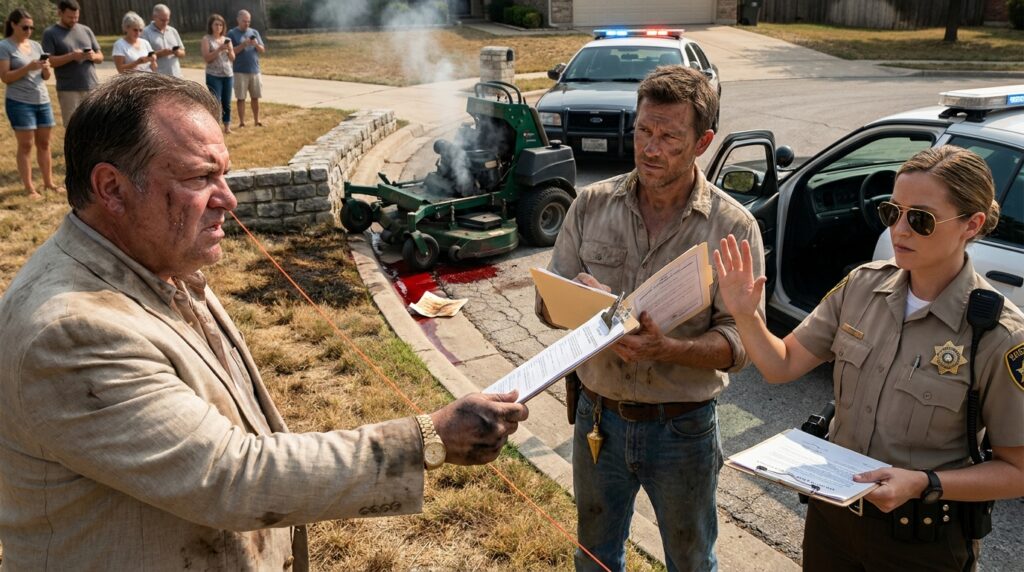
Marcus didn’t care about the heat. He didn’t care about the sweat sting in his eyes. His gaze was anchored entirely on the guide string—a neon orange line stretched taut between two high-tensile steel boundary stakes driven precisely eighteen inches back from the curb line.
He shut off the motor, letting the sudden silence of the cul-de-sac rush back in. As the dust settled into the three-foot-deep trench he had carved into his own turf, Marcus knelt down, wiping his palm against his work pants before reaching into the loose shale. His fingers brushed against something hard and distinct, caught down at the base of the native stone shelf. It wasn’t raw limestone.
He dug out a secondary survey cap, heavily scarred and tarnished by underground dampness. He held it up to the failing light. It wasn’t the official county surveyor’s mark. Stamped deep into the brass face was a crude, private corporate insignia—B.V. Dev Corp—and a date that preceded the neighborhood’s municipal incorporation. Marcus felt his jaw tighten. Richard hadn’t just modified the digital records last week; his company had physically staked a false perimeter decades ago, hiding the evidence beneath the topsoil until the neighborhood grew to match his lie.
Marcus tossed the private brass cap into his tool box with a flat, metallic clunk. The decoy was deep, built to ensure that if any ordinary surveyor came looking for simple iron pins, they would hit Richard’s buried marker and turn back. But Richard hadn’t anticipated someone tracking the bedrock itself.
Marcus hauled a heavy length of number-four deformed steel rebar from the bed of his truck. He dropped the grid into the trench, the metal bars interlocking like a dark, rusted cage within the belly of the earth. He picked up the heavy structural epoxy gun, injecting thick, grey binding compound directly into the anchor holes he had drilled into the solid limestone floor. One by one, he drove the vertical steel dowels deep into the bedrock, hammering them down until they rang with a flat, solid pitch that meant they were one with the planet.
“You’re wasting your time and your money, Thorne,” a sharp voice cut through the hot evening air.
Marcus didn’t startle. He slowly stood up, turning his head to see Mrs. Gable, one of the Ridgeview Watchers, standing near her brick mailbox with her arms crossed over her standard-issue athletic jacket. She pointed a manicured finger at the concrete mixer humming gently in the back of Marcus’s truck.
“Richard already showed the board the easement blueprints this morning,” she said, her voice carrying that thin, neighborhood-sanctioned warning. “The township trucks are scheduled to clear this corner lane for the pipeline easement expansion by next Monday anyway. You build that stone wall, and the county will just fine you to tear it down. We don’t want the street tore up over a private grudge, Marcus.”
Marcus grabbed a fresh bag of high-strength structural mix, slicing the paper sleeve open with his pocketknife. “The township isn’t expanding a pipeline here, Mrs. Gable.”
“The documents are on the portal,” she insisted, her tone defensive, her hand twitching toward the phone in her pocket. “We all saw the county stamp.”
“The stamp is a digital layer,” Marcus said quietly, his voice carrying the calm weight of a man who spent his life measuring absolute reality. “Watch the curb on Wednesday morning. You’ll see what the stamp is actually worth.”
He turned his back to her, terminating the exchange with calculated silence, and tipped the mixer. The thick, grey slurry of commercial-grade concrete spilled into the trench, swallowing the steel rebar cage in a heavy, wet rush. It filled the gap, bonding perfectly with the excavated limestone shelf.
Working by the amber beam of his truck’s work lights, Marcus began setting the heavy, rough-cut fieldstone blocks onto the wet foundation. Each piece of gray stone was coated in industrial structural adhesive before being tapped into alignment with his heavy rubber mallet. He checked the plumb bob, the brass cone hanging perfectly still, pointing down to the absolute center of gravity.
To anyone walking the cul-de-sac the next morning, it would look like nothing more than a standard, decorative garden border—a short, suburban wall designed to catch the eye. But Marcus knew the truth hidden behind the desaturated stone facade. The stone was just the skin. Beneath it lay a solid core of steel and reinforced concrete rooted three feet into the foundational bedrock of the county. He packed the loose black soil back around the base, hiding the concrete footing until the wall appeared to grow naturally out of the grass.
He reached up, checking the cedar birdhouse mounted five feet away on the post. The small glass lenses of the dual 4K cameras gleamed once in the darkness, capturing the clean, gray line of the stonework and the dark asphalt beyond. The trap was set, but it wasn’t a snare—it was a metric line made physical. Marcus wiped the gray dust from his hands, looked at the silent houses lining the cul-de-sac, and walked inside. The countdown to Wednesday had already begun, and the earth was ready to hold its ground.








