
CHAPTER 5: THE FINAL BOUNDARY
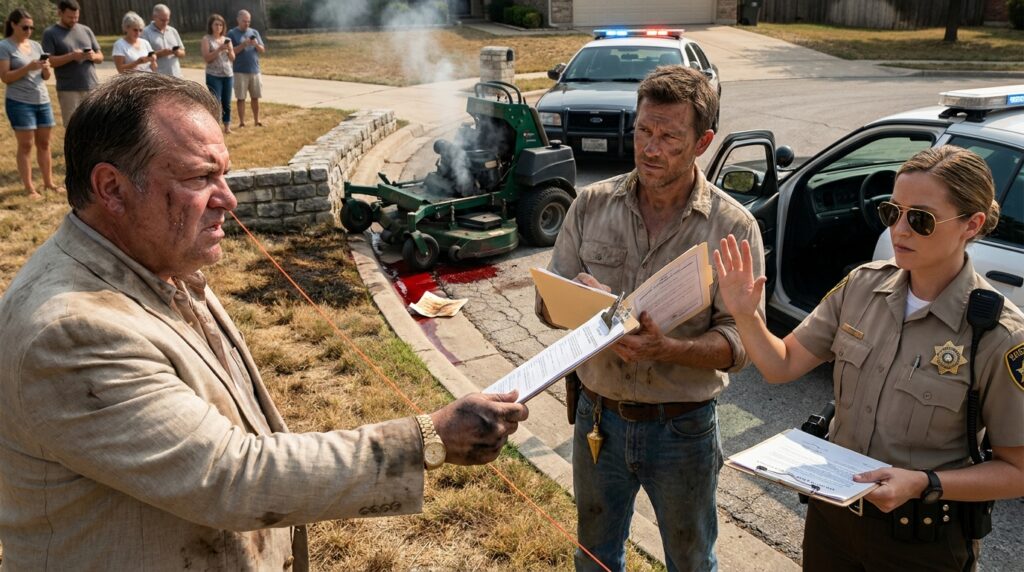
The sharp crunch of gravel signaled the arrival of the Collin County Sheriff’s cruiser. It coasted to a halt at the edge of the cul-de-sac, its overhead lights throwing rhythmic flashes of blue and red across the desaturated brick facades of the surrounding homes. Deputy Sarah Lin stepped out into the dry, shimmering heat, her boots hitting the asphalt with a measured, professional weight. Her gaze immediately locked onto the smoking, twisted chassis of the John Deere mower, the dark red pool of hydrostatic fluid spreading toward the storm drain, and the purple-faced fury of Richard Blevins.
“Officer! Arrest this man!” Richard barked instantly, his heavy frame lunging forward as he thrust his clipboard toward her. He pointed a trembling, grease-smeared hand back at the unblemished gray stones of the retaining wall. “He built a deliberate trap on a designated neighborhood right-of-way. Look at my machine! It’s completely totaled. He ignored a formal, municipality-sanctioned stop-work notice and created a structural hazard that explicitly violates public access clearance!”
The Ridgeview Watchers pressed closer to the curb line, their whispers rising in a sharp wave of mutual unease. Mrs. Gable adjusted her sunglasses, her phone still elevated, capturing the jagged profile of the wrecked tractor. The crowd’s collective focus swung toward Marcus, waiting for the default panic that usually accompanied a developer’s formal accusation.
Deputy Lin raised a hand, stopping Richard’s advance with a quiet, unyielding authority. She turned her head toward Marcus, her expression hidden behind dark aviators. “Mr. Thorne, do you have the county encroachment permits required for a permanent structure within the municipal roadway setback?”
Marcus didn’t alter his stance. His boots remained planted firmly behind the neon orange string line. He opened the laminated folder tucked beneath his arm, pulling out a crisp, white document bearing a metallic, multi-layered county seal.
“I don’t need an encroachment permit, Deputy,” Marcus said, his voice flat, carrying the calm vibration of absolute measurement. “Because this structure sits entirely within my deeded private parcel. I am a licensed professional surveyor. These are the certified, state-stamped land plat maps retrieved directly from the County Appraisal District registry.” He extended the folder. “The municipal setback lane terminates exactly eighteen inches from the face of the road gutter. The outermost edge of this fieldstone wall is built precisely eighteen and a half inches back. There is no encroachment.”
Richard let out a harsh, barking laugh, his fingers tightening against his belt line as he stepped into the gap between Marcus and the officer. “That map is an outdated draft, Thorne! Blevins Ventures drew the original infrastructural framework for the Ridgeview extension. We retained an absolute four-foot utility and roadway expansion easement along this entire frontage. The updated plat has been logged into the subdivision’s architectural portal since Monday. Your wall is a public violation, and it’s coming down today.”
The neighbors shifted, their glances darting back to Richard’s clipboard. It was his final resistance beat—the heavy weight of a multi-million-dollar corporate legacy deployed to overwrite the physical reality of the ground beneath their feet.
Marcus pulled a secondary document from the base of the folder. It wasn’t a digital printout from the community board archive; it was a heavy, tri-folded sheet of parchment bearing a live, blue-ink signature and a raised, physical notary stamp from the county recorder’s vault dated November 2022.
“You did draw the original plat, Richard,” Marcus said quietly, his voice cutting cleanly through the heavy hum of the cruiser’s idling engine. “But four years ago, when your development firm required upstream creek drainage privileges across the southern boundary of this parcel to pass municipal environmental inspection, you struck a trade with the previous owner. You legally traded away the right-of-way easement on this lot in exchange for that drainage lane.”
Marcus stepped forward, placing the open document directly over the top of Richard’s clipboard. He pointed a single, dirt-stained finger at the bottom of the third page. “Look at the signature next to the official county notary stamp, Deputy. That is the corporate seal of Blevins Ventures, and that is Richard Blevins’s personal signature. You legally dissolved the easement on this property four years ago to save your own project. You simply forgot that the earth keeps the record.”
Richard froze. His hand dropped from the side of his clipboard, the thick plastic sheet tilting until the false stop-work notice slipped out, fluttering into the pool of red hydraulic oil in the gutter. The aggressive, purple hue on his face vanished, replaced by a pale, hollow grayness as his eyes scanned the blue-ink strokes of his own signature. His chest hitched, his lips twitching silently as he realized the decoy mapping file he had inserted into the neighborhood archive had just collided with an unyielding, recorded deed.
The silence that settled over the Ridgeview cul-de-sac was absolute. No one moved. No one whispered.
Then, the witness layer broke. The neighbor with the smartphone lowered his arm, shaking his head with a low scoff. “Unbelievable,” he muttered, his voice carrying clearly across the grass. “He tried to run the guy down on his own deeded land.” Mrs. Gable stepped backward, her posture collapsing from rigid defense into deep embarrassment as she slowly put her phone away. The three other homeowners turned away from Richard, moving across the asphalt to stand near the edge of Marcus’s driveway, their expressions shifting to open disgust.
Deputy Lin took the notarized document, verified the raised seal with her thumb, and looked down at the false notice sitting in the oil. She turned back to the developer, her tone hardening into strict legal finality. “Mr. Blevins, this deed is valid and currently active within Collin County records. This wall is a lawful structure on private land. Which means you didn’t hit a public hazard. You drove a five-hundred-pound commercial vehicle off the public roadway and intentionally trespassed onto a private lawn.”
Richard tried to reframe the words, his hands gesturing vaguely toward his ruined mower, but his voice was gone. The absolute authority he had used to rule the subdivision had shattered completely in front of the people he had spent a decade controlling.
“Mr. Thorne has already submitted multi-angle camera footage detailing two prior incidents of deliberate property destruction by this exact tractor,” Deputy Lin continued, pulling her notebook from her uniform pocket. “I am placing this vehicle under impound as evidence for criminal mischief under Texas Penal Code 28.03. You will arrange for a commercial flatbed to remove this wreckage from Mr. Thorne’s lawn immediately, and the county environmental department will be notified regarding the cleanup costs for this chemical spill.”
Richard stood motionless beside the buckled steel frame of his John Deere, his expensive linen coat soaked in oil, completely stripped of power. He didn’t look at the neighbors as they watched him walk away. He began the long, silent trek back down the asphalt toward the entrance of the development, his head bowed against the blinding Texas sun, followed only by the rhythmic flash of the cruiser’s lights.
Two days later, the morning air was crisp and clear. Marcus Thorne stood at the edge of his porch, his fingers curled around a fresh mug of coffee. The ruts had been filled, the gravel had been swept, and the street was completely quiet. He walked down the lawn, stopping beside the fieldstone wall. The gray stone stood perfectly aligned, solid, and completely unbothered by the violence of the collision. Marcus took a slow sip, looked down the clean, straight line of his perimeter, and smiled. The boundary was secure.








