
The Weight of the Asphalt: How a Single Strip-Mall Standoff Exposed the Hollow Core of Self-Appointed Authority

CHAPTER 1: The First Rapping on Glass

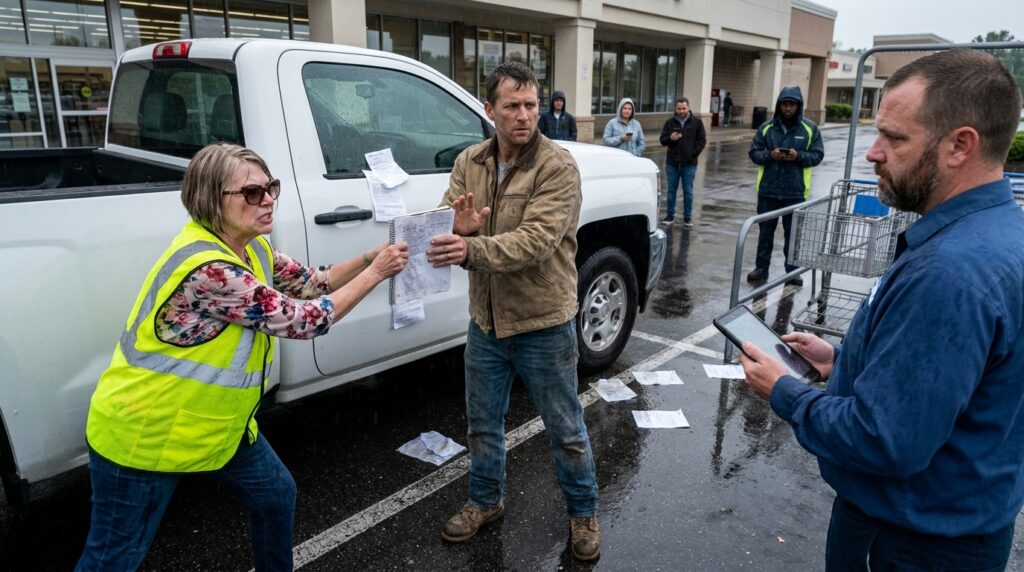
The afternoon sun hit the cracked asphalt of the Valley Plaza supermarket parking lot at a harsh, blinding angle, baking the scent of hot rubber and dry autumn dust into the heavy air. Julian Vance sat behind the steering wheel of his utility pickup, his calloused hands resting calmly at ten and two. He had spent the morning wrestling with recalcitrant soil and precise grade lines for a hillside client project, and his mind was still tuned to the quiet mathematics of levels and drainage.

Then came the rap against the glass.

It wasn’t a casual tap. It was sharp, rhythmic, and demanding—the precise cadence of someone accustomed to commanding immediate compliance. Julian turned his head slowly. Standing squarely in his path, blocking the driver-side door with a rigid, unnatural posture, was a woman wearing an oversized pair of designer sunglasses and a neon visitor vest that strained over a floral blouse. Her hair was cropped into a severe, sharp-edged bob, and her right hand gripped a plastic clipboard so tightly her knuckles looked chalk-white.

Julian exhaled through his nose, letting the breath out in a measured stream. He kept his expression neutral, deliberately refusing to feed the sudden spike of adrenaline that prickled at the base of his neck—that old, defensive reflex from a life spent dodging unprovoked accusations.

He pushed the door open, the hinge groaning against the afternoon heat. The door swung out six inches before hitting the rigid plastic rim of Evelyn Vance’s sneaker.

“You’ve been idling in a restricted delivery lane for twelve minutes,” Evelyn announced, her voice pitched to cut across the rolling rack of shopping carts twenty feet away. She didn’t wait for him to step down. She thrust her chin upward, her jaw locked into a hard line of manufactured authority. “People who drive commercial heaps into retail spaces think rules are mere suggestions. Move this truck right now, or I am having the private tow unit out here before you can blink your eyes.”

Julian didn’t look at her face. His gaze dropped deliberately to the painted white line three inches from his front tire, then to the faded stenciling on the pavement that read CUSTOMER LOADING – 15 MIN MAX.

“Take half a step back,” Julian said, his voice flat, low, and completely devoid of heat. “You’re standing on private commercial blacktop, and you’re looking at a standard customer loading zone.”

Evelyn’s sunglasses slipped down an eighth of an inch, revealing eyes narrowed to cold, hard points. “Don’t lecture me about property lines, mister. I keep the books for the civic improvement district that borders this lot. Your kind comes down from the county roads and treats our retail spaces like a salvage yard.” A small knot of pedestrians exiting the sliding glass doors slowed their pace, their heads turning toward the sound of her rising voice, their eyes darting between Julian’s faded work jacket and Evelyn’s gleaming clipboard.

Julian slid out of the cab, his heavy work boots hitting the gravel-strewn asphalt with a solid, grounding thud. He stood a full head taller than her, yet he kept his shoulders loose, his hands loose at his sides, calculating the distance between her aggression and his own tightly controlled temper. He smelled the faint, artificial scent of her rosewater perfume cutting through the exhaust fumes.

“If you’re keeping the books,” Julian said quietly, stepping past her line of sight to secure the tailgate latch on his second crate of equipment, “you might want to check page four of the municipal plat. This asphalt belongs to the plaza developers, not your subdivision committee.”

Evelyn spun on her heel, her high heels clicking a frantic, sharp tattoo against the ground. She raised the clipboard like a shield, her voice cracking with sudden, shrill vindication as she pointed a manicured finger directly at his chest.

CHAPTER 2: The Clip of Authority

“You think you can hide behind your work truck and your smug silence?” Evelyn’s voice clipped the dry afternoon air like a pair of rusted shears. She took half a step forward, her high heels grinding sharply against a stray gravel pebble on the blacktop. The clipboard rose higher, the plastic edge tapping rhythmically against her neon vest in time with her spiking pulse. “This plaza has standards. The district oversight committee has received three complaints about your commercial clutter this month alone. You’re bleeding property value from every house within half a mile.”

Julian didn’t blink. He kept his weight balanced evenly over his boots, his hands resting loose at his sides. Through the gap between Evelyn’s shoulder and the front fender of his pickup, he watched the sliding glass doors of the supermarket part. Two elderly shoppers stepped out, halted by the noise, their shopping carts locked in a half-turn as they took in the spectacle.

“Three complaints,” Julian repeated, his tone flat, measured, carrying the weight of a man addressing a malfunctioning piece of machinery rather than an angry adversary. “Strange. Considering I finished this layout permit only yesterday morning, and the county didn’t post the public notice until noon. Fast mail service for a neighborhood committee that doesn’t own the property.”

A flicker of hesitation crossed Evelyn’s face—microscopic, gone in the space of a heartbeat—replaced instantly by a harder, more defensive glaze. Her grip on the clipboard tightened until her thumb turned bloodless. Tucked beneath the clear plastic sleeve of her binder, a corner of a pink carbon-copy slip fluttered in the draft of a passing car—bearing a stamp from the municipal civic desk that didn’t match the county code enforcement style Julian knew by heart.

“Don’t play legal games with me,” Evelyn snapped, her voice pitching slightly higher as she noticed the small audience forming near the carts. “We have procedures. We have an executive board that signs off on every vehicle layout permitted within fifty yards of our perimeter. You’re violating municipal ordinance four-dash-twelve, and I am documenting every minute of this obstruction.”

“Ordinance four-dash-twelve,” Julian said quietly, his eyes dropping briefly to the pink slip before returning to her face, “regulates drainage easements on residential turf. This is commercial asphalt. Zoned C-2 retail. You’re standing on private developer land.”

“For now!” Evelyn shot back, her composure fraying at the edges as she realized the gathered onlookers weren’t nodding along with her outrage. A man in a blue windbreaker near the cart corral had already pulled out his phone, the dark glass of the screen catching the glare of the noon sun.

Julian felt the familiar, cold knot of tension tighten in his chest. It was the same sensation he remembered from years ago—the helpless, suffocating weight of being cornered by someone high on a petty badge, twisting facts while a crowd watched, waiting for the blood to rise. He forced his breathing to stay slow. He refused to give her the shouting match she was manufacturing.

“If you’ve got an executive board,” Julian said, his voice dropping an octave, forcing Evelyn to strain slightly to catch the words over the hum of the store’s rooftop HVAC units, “then you won’t mind stepping inside to the customer service desk. Marcus keeps the master site plat pinned right by the security monitors. Let’s go ask him if four-dash-twelve applies to a delivery drop.”

Evelyn’s jaw set hard. She jerked her chin back, her oversized sunglasses sliding another millimeter down her sweaty nose. “I don’t need to consult a grocery manager to know an infraction when I see one. You’re stalling because you know you’re trapped.”

“I’m not stalling,” Julian said, his hand moving deliberately to the handle of his truck door. “I’m offering you an audience with someone whose signature actually holds weight on this property.”

Before Evelyn could fire back another accusation, the heavy glass doors swung wide again, and Marcus Vance stepped out onto the concrete apron, a heavy-duty store tablet clutched in one hand and a security radio crackling softly at his hip. His eyes scanned the loading zone, locking instantly on the rigid, neon-clad figure blocking Julian’s door.

CHAPTER 3: The Boundary Line

Marcus Vance didn’t rush. General managers of high-volume suburban supermarkets learned early that moving with too much speed only triggered flight instincts in volatile customers. He stepped onto the sun-baked tarmac, his boots crunching on stray gravel, his radio murmuring static at his waist. He didn’t look at Julian. His eyes fixed squarely on the neon vest and the rigid, white-knuckled grip Evelyn maintained on her clipboard.

“Morning, Mrs. Vance,” Marcus said, his voice level, professional, carrying the practiced weariness of a man who had mediated a dozen neighborhood disputes before ten o’clock. “I caught the tail end of your conversation through the glass. What seems to be the obstruction out here?”

Evelyn didn’t waste a heartbeat. She pivoted toward the manager, her sunglasses sliding back up her nose with a sharp click of plastic against bone, her voice rising to reclaim the momentum she had lost when Julian mentioned the master plat.

“Marcus, thank goodness you’re out here,” Evelyn said, her tone dripping with performative urgency as she thrust the plastic edge of her clipboard toward his chest. “Your loading apron is being treated as a permanent commercial storage bay. This gentleman has left his vehicle idling, blocking standard patron sightlines, and completely violating the commercial-residential buffer agreement the district committee filed with county zoning last month.”

Julian leaned back slightly against the side of his truck bed, his face expressionless. He watched Marcus’s eyes drop automatically to the paper she waved. Underneath the primary citation sheet, the corner of a secondary document caught the afternoon light—a dog-eared carbon duplicate featuring a stamp from an unincorporated residential association, detailing uncollected fines leveled against three other local contractors over the past two quarters. It was a pattern of paper-pushing intimidation, systematic and entirely unauthorized.

“A buffer agreement,” Marcus repeated slowly, his fingers tapping once against the smooth plastic casing of his store tablet. He didn’t take the clipboard. Instead, he folded his arms across his heavy blue manager’s shirt. “Evelyn, let’s get something straight right now. The property line for Valley Plaza ends ten feet past those blue parking stripes. The district committee doesn’t hold jurisdiction over our delivery lanes, and county zoning hasn’t changed our C-2 retail designation since nineteen-ninety-four.”

Evelyn’s face flushed a mottled, angry crimson, the skin tightening over her cheekbones. “I have the documentation right here! We represent the stakeholders who keep this neighborhood clean of commercial blight. If you’re telling me you condone illegal dumping and obstruction—”

“I’m not telling you anything about dumping,” Marcus interrupted, his tone hardening just enough to strip the theatricality from her performance. “I’m telling you that Mr. Vance is parked in an authorized vendor loading space with a valid commercial service manifest for our bakery remodel. He’s entirely within his rights.”

“He’s violating the spirit of the community!” Evelyn snapped, her voice cracking as a small murmur rippled through the gathering cluster of shoppers near the entrance doors. The man in the blue windbreaker had his phone raised higher now, the camera lens tracking her rigid posture. “You’re encouraging lawlessness. If you won’t enforce the standards of this zip code, I’ll have the municipal transport inspector down here to review every single permit on this lot before the sun goes down.”

Julian pushed off the truck bed, his boots hitting the pavement with a deliberate, grounding thud. He didn’t raise his voice. He stepped into the narrow space between the manager and the angry resident, closing the physical distance just enough to force her to tilt her chin upward to maintain eye contact.

“The inspector’s office is open until four,” Julian said quietly, his gaze steady and cold as winter ice. “You’re welcome to call them from inside the lobby. Marcus has a landline right by the customer service desk.”

Evelyn stepped back, her heel catching awkwardly on a ridge in the asphalt. For a split second, her professional facade fractured entirely, revealing the panicked, defensive reflex of a woman whose fabricated world was shrinking by the second. She pulled the clipboard tight against her chest like a breastplate, her eyes darting between Marcus’s neutral expression and the silent, watching crowd.

“This isn’t over,” she hissed, her voice dropping an octave into genuine malice. “Your little commercial operation won’t last another week in this township.”

Without waiting for a reply, she spun around on her high heels, her neon vest snapping in the dry wind as she marched stiffly toward her sedan parked three rows away. Marcus watched her go, shaking his head slowly before turning to Julian, a faint, dry smirk touching the corner of his mouth.

“She’s been doing this to every contractor who pulls into the western lot for a month,” Marcus murmured under his breath, leaning closer so only Julian could hear. “Corporate hasn’t wanted to press charges because her husband sits on the utility board. But she’s running out of road.”

Julian didn’t smile back. He looked past Marcus toward Evelyn’s car, watching the vehicle’s reverse lights flash amber against the dull gray metal. The core truth of the interaction settled into his bones: people like Evelyn didn’t fight because they were right; they fought because losing their self-invented authority meant facing the terrifying emptiness underneath.

CHAPTER 4: The Escalation Under Gray Skies

The heavy cloud cover rolled over the Valley Plaza ridge within an hour, dropping the temperature and turning the asphalt a bruised, metallic gray. Julian didn’t let the weather slow his work rhythm. He hoisted the final crate of irrigation fittings into the bed of his pickup, his muscles straining against the dead weight, his boots crunching rhythmically into the loose gravel near the edge of the service lane. But the quiet focus he usually found in physical labor was fractured. Marcus’s warning lingered in his mind like a pebble in a shoe. This wasn’t just a random encounter with an eccentric local; it was part of an organized pattern of bureaucratic bullying designed to squeeze commercial vendors off the perimeter.

Before Julian could slide his tailgate closed, the harsh glare of high beams cut through the gloom. A dark sedan swung sharply into the adjacent lane, cutting off a delivery van and stopping at an aggressive, diagonal angle right against the rear bumper of Julian’s truck.

The driver-side door flew open with a sharp metallic clatter. Evelyn Vance stepped out, but the confident, rigid posture she had worn earlier was replaced by a frantic, jittery edge. Her neon vest was unzipped halfway, and she clutched a thick stack of laminated notices in one hand, her face flushed with cold and vindictive adrenaline.

“You think you won round one because your manager friend protects his loading dock,” Evelyn shouted over the low rumble of her sedan’s exhaust, marching directly toward Julian with reckless speed. “You haven’t seen the district’s legal leverage yet. We have filed formal injunctions against three different contractors this quarter, and your commercial tag is next on the docket.”

Julian didn’t flinch. He planted his boots firmly against the asphalt, resting his forearms on the cold steel of the truck bed. He watched the way her fingers trembled slightly as she shuffled the laminated sheets, exposing a torn receipt from a commercial print shop in town—an invoice for fifty identical unauthorized parking violation notices, paid out of pocket. The realization hit him with cold clarity: this wasn’t backed by an official municipal budget. This was a private crusade, funded by someone desperately trying to project an illusion of municipal power.

“You’re wasting your ink, Evelyn,” Julian said, his voice cutting through the rising wind with absolute, chilling calm. “A printed card from a copy shop doesn’t carry the weight of a court order.”

“Don’t you dare minimize the authority of the district committee!” she shrieked, stepping so close he could smell the stale coffee and cheap mints on her breath. She slammed a laminated sheet against the side panel of his truck, leaving a dull scuff mark on the clean white paint. “I have neighbors on the city council. I have enforcement logs dating back six months. I can make your business toxic in this county before the week is out.”

A crowd was beginning to form again near the entrance, drawn by the escalation of her voice against the whipping wind. A couple of grocery clerks stepped outside to smoke, their eyes fixed on the spectacle, while a delivery driver paused with a hand on his cart, watching the confrontation unfold with undisguised curiosity.

Julian’s pulse ticked upward, the old defensive anger threating to break through his careful discipline. Every instinct urged him to fire back, to match her volume, to tear the fake citation off his truck and throw it into the gutter. But the memory of past conflicts—where losing his temper had handed victory to people just like her—grounded him. He forced his breathing to deepen, his fingers curling slowly into his palms until the tension dissipated into raw, calculated resolve.

“If you’ve got logs,” Julian said softly, his eyes boring straight into hers, “and if you’ve got council backing, then you won’t mind waiting right here while I call the county sheriff’s non-emergency line to verify your jurisdiction.”

Evelyn froze. The manic confidence in her eyes flickered, replaced instantly by a sharp, panicked dart toward her car. For a split second, the facade completely cracked; the rigid enforcer of the neighborhood dissolved into a cornered woman terrified of an official audit that would expose her fake authority to the people whose respect she was desperately trying to buy.

“You… you’re playing games,” she stammered, her voice losing its theatrical projection, dropping into an ugly, defensive snarl. “You’re harassing me in a public space! I’m calling the authorities myself!”

She turned abruptly, her high heel catching in the deep groove of an asphalt expansion joint. She stumbled hard, dropping half her laminated notices across the wet pavement, scattering papers in the dirt as the wind picked up, driving the first cold drops of rain across the parking lot.

CHAPTER 5: The Digital Ledger

The cold autumn rain drove sideways across the asphalt, turning the scattering of loose papers Evelyn had dropped into sodden pulp. Julian didn’t hesitate. He stepped around the fluttering debris, reached into the cab of his truck to grab his gear bag, and strode toward the sliding glass doors of the Valley Plaza market. Behind him, the sound of tires spinning against wet gravel echoed sharply as Evelyn scrambled back into her sedan, her pride thoroughly punctured by her own clumsy retreat.

Inside the automated doors, the air was warm, smelling faintly of roasted coffee beans and damp wool. Julian shook the worst of the rain from his canvas jacket and walked straight past the customer service desk toward the managerial hallway. Marcus was already waiting by the open door of his office, a heavy-duty store tablet in one hand and a steaming mug of black coffee in the other.

“Saw the spill out there,” Marcus said, his voice dry as he gestured for Julian to step inside out of the draft. “Looks like she traded her high heels for a quick retreat. You alright, Julian?”

“I’m fine,” Julian said, dropping his bag onto a metal folding chair and wiping moisture from his brow with the back of his wrist. “But her campaign is getting erratic. She’s printing unauthorized citations out of her own pocket and shaking down every vendor who pulls onto this lot. If the committee is backing this, it’s a structural liability.”

Marcus sighed, setting his coffee mug down on a scarred oak desk with a dull thud. He tapped the screen of his tablet, bringing up a split-window interface that glowed with crisp, high-definition video feeds. “The committee isn’t backing it officially. That’s the part she’s hiding. Her husband used to sit on the utility board three years ago before he was voted out. She’s been coasting on expired credentials and sheer intimidation ever since, trying to prove to the neighborhood board that she still holds influence over local commercial spaces.”

Marcus swiped across the glass, bringing up the exterior camera footage from forty minutes prior. The timestamp glowed in amber digital font in the corner: 10:14 AM. The camera angle was mounted high above the western entrance, looking down across the parking grid.

“Look here,” Marcus muttered, zooming in on the frame.

The video clearly displayed Julian’s service truck parked entirely within the clean, white boundaries of an unreserved customer loading slot. A second later, Evelyn’s dark sedan pulled up three rows over. The footage tracked her stepping out, adjusting her neon vest, and marching with deliberate, aggressive strides straight toward Julian’s vehicle—completely bypassing any semblance of an accidental infraction. It was a targeted, premeditated confrontation, captured in unyielding digital precision.

“This is clean,” Julian said, his eyes tracing the timestamp and the spatial markers on the screen. “If she escalates this to an actual legal filing or tries to lean on the county inspectors again, this recording strips away every leg she has to stand on.”

“Oh, she won’t escalate it legally,” Marcus replied, a cold, satisfied edge creeping into his tone. “Because when she stormed off just now, she didn’t just drop her fake citations. She dropped her master logbook. One of my stockers picked it up by the cart return.”

Marcus reached into his desk drawer and slid a water-damaged spiral notebook across the wood. Julian reached down, flipped open the cover, and stared at the handwritten entries inside—dozens of fabricated fines, vehicle plate numbers, and dates cataloging months of unauthorized harassment against local delivery drivers, small contractors, and weekend shoppers. It was a complete paper trail of a private, unhinged crusade.

Julian closed the notebook slowly, the weight of the evidence settling into his hands. The game of hollow authority was finally unraveling, and the next step would bring the entire fabricated structure down to the ground.

CHAPTER 6: The Collapse of Paper Authority

The rain had settled into a steady, gray drizzle by midday, slicking the asphalt of the Valley Plaza lot with a mirror-like sheen that reflected the buzzing neon signage overhead. Julian stepped out from the automated sliding doors, his boots finding purchase on the wet concrete. In his hand, held with the quiet, balanced weight of a carpenter’s rule, was Evelyn’s water-damaged logbook. Beside him walked Marcus, his store tablet glowing in the dim, storm-lit air, displaying the synchronized timestamp of the security feed alongside the master property plat.

They didn’t have to look far. Evelyn’s dark sedan was idling near the cart corral, its engine humming, wipers thrashing a frantic rhythm across the windshield. Before Julian could take three steps toward her bumper, the driver’s door swung open. Evelyn stepped out into the chill rain, ignoring the water soaking into her hair and staining the shoulders of her floral blouse. Her neon visitor vest hung crookedly, and the calculated veneer of authority had completely eroded, leaving behind the raw, jagged panic of a woman cornered by her own accumulated fictions.

“You took my property,” Evelyn shrieked, her voice cutting sharply through the steady patter of the rain as she marched across the painted dividing lines. “That ledger contains private committee correspondence! Hand it over right now, or I’m calling the county deputies to charge you with theft and corporate espionage!”

Julian stopped ten feet away. He didn’t rush. He didn’t raise his voice to match her frantic pitch. He let the silence stretch between them, heavier than any threat she could hurl, while the few shoppers lingering beneath the overhang slowed their pace to watch.

“Private committee correspondence,” Julian repeated, his voice smooth and cold as river stone. He flipped the cover of the ruined spiral notebook back with his thumb, exposing the raw, water-logged ink of page twelve. “Strange way to spell a private shakedown log. You’ve billed twelve different local vendors and contractors for parking infractions on C-2 commercial asphalt over the last eight months. None of these lots belong to your subdivision. None of these fines went to the county. They went straight out of your pocket, and straight back into an elaborate performance to convince your neighbors you still ran this zip code.”

Evelyn stopped dead in her tracks. Her breath hitched, a sharp, ragged sound that got lost beneath the hum of the store’s HVAC units. For a fleeting second, the terrifying truth of her own vulnerability flashed across her face—the sudden realization that her petty tyranny wasn’t a defense of neighborhood standards, but a desperate, pathetic mask hiding her family’s impending financial and social freefall within the subdivision.

“You don’t know anything about the district,” she whispered, her voice cracking, dropping from a shrill accusation to a raw, defensive tremor. “We protect our property values. People like you—coming in with your work trucks and mud-stained boots—you think you can just roll over everything we’ve built.”

“This asphalt belongs to the developers, Evelyn,” Marcus interjected, stepping up beside Julian and lifting the store tablet so the screen faced the gathering crowd. He tapped the display, and the high-definition security loop began to play right there under the gray sky: Evelyn marching across the lot, slamming her clipboard against a truck mirror, fabricating an infraction out of thin air. “And this footage belongs to us. We kept quiet while you played hall monitor on the side roads. But harassing our contractors on private commercial property crosses a line.”

A murmur rippled through the onlookers huddled near the entrance. A delivery driver crossing the apron shook his head, and a woman holding a plastic grocery bag let out a dry, audible scoff. The illusion of power—built on laminated cards, colored vests, and counterfeit authority—shattered completely under the cold light of verifiable facts.

Evelyn looked at the tablet screen, then down at the ruined ledger in Julian’s hand. The fight drained out of her posture instantly. Her shoulders slumped, and her hands, which had gripped clipboards and pointed accusing fingers for years, hung uselessly at her sides. Without another word, she turned on her heel, her wet high heels slipping slightly against the painted stripe before she caught her balance and hurried back to her sedan.

She climbed inside, slammed the door shut, and threw the car into reverse. Tires throwing a vicious spray of muddy water against the curb, the sedan shot backward out of the stall, clipped a plastic traffic cone with a hollow plastic thud, and tore out toward the main highway, disappearing into the gray curtain of rain.

Julian watched her taillights fade into the drizzle. He closed the logbook, handed it to Marcus with a quiet nod, and walked back to his service truck. The air smelled of clean wet asphalt and ozone, cleared of artificial friction at last. He climbed into the cab, slid the key into the ignition, and pulled out into the open lane, leaving the hollow theater of self-appointed rules far behind in the rearview mirror.

Similar Posts

Leave a Reply

Your email address will not be published. Required fields are marked *






