CHAPTER 5: The Digital Ledger
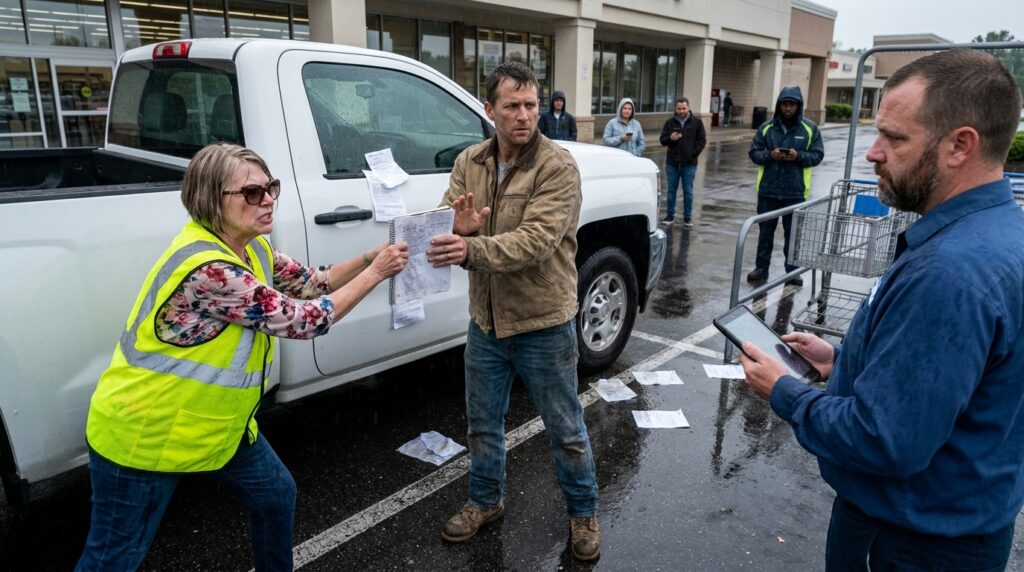
The cold autumn rain drove sideways across the asphalt, turning the scattering of loose papers Evelyn had dropped into sodden pulp. Julian didn’t hesitate. He stepped around the fluttering debris, reached into the cab of his truck to grab his gear bag, and strode toward the sliding glass doors of the Valley Plaza market. Behind him, the sound of tires spinning against wet gravel echoed sharply as Evelyn scrambled back into her sedan, her pride thoroughly punctured by her own clumsy retreat.
Inside the automated doors, the air was warm, smelling faintly of roasted coffee beans and damp wool. Julian shook the worst of the rain from his canvas jacket and walked straight past the customer service desk toward the managerial hallway. Marcus was already waiting by the open door of his office, a heavy-duty store tablet in one hand and a steaming mug of black coffee in the other.
“Saw the spill out there,” Marcus said, his voice dry as he gestured for Julian to step inside out of the draft. “Looks like she traded her high heels for a quick retreat. You alright, Julian?”
“I’m fine,” Julian said, dropping his bag onto a metal folding chair and wiping moisture from his brow with the back of his wrist. “But her campaign is getting erratic. She’s printing unauthorized citations out of her own pocket and shaking down every vendor who pulls onto this lot. If the committee is backing this, it’s a structural liability.”
Marcus sighed, setting his coffee mug down on a scarred oak desk with a dull thud. He tapped the screen of his tablet, bringing up a split-window interface that glowed with crisp, high-definition video feeds. “The committee isn’t backing it officially. That’s the part she’s hiding. Her husband used to sit on the utility board three years ago before he was voted out. She’s been coasting on expired credentials and sheer intimidation ever since, trying to prove to the neighborhood board that she still holds influence over local commercial spaces.”
Marcus swiped across the glass, bringing up the exterior camera footage from forty minutes prior. The timestamp glowed in amber digital font in the corner: 10:14 AM. The camera angle was mounted high above the western entrance, looking down across the parking grid.
“Look here,” Marcus muttered, zooming in on the frame.
The video clearly displayed Julian’s service truck parked entirely within the clean, white boundaries of an unreserved customer loading slot. A second later, Evelyn’s dark sedan pulled up three rows over. The footage tracked her stepping out, adjusting her neon vest, and marching with deliberate, aggressive strides straight toward Julian’s vehicle—completely bypassing any semblance of an accidental infraction. It was a targeted, premeditated confrontation, captured in unyielding digital precision.
“This is clean,” Julian said, his eyes tracing the timestamp and the spatial markers on the screen. “If she escalates this to an actual legal filing or tries to lean on the county inspectors again, this recording strips away every leg she has to stand on.”
“Oh, she won’t escalate it legally,” Marcus replied, a cold, satisfied edge creeping into his tone. “Because when she stormed off just now, she didn’t just drop her fake citations. She dropped her master logbook. One of my stockers picked it up by the cart return.”
Marcus reached into his desk drawer and slid a water-damaged spiral notebook across the wood. Julian reached down, flipped open the cover, and stared at the handwritten entries inside—dozens of fabricated fines, vehicle plate numbers, and dates cataloging months of unauthorized harassment against local delivery drivers, small contractors, and weekend shoppers. It was a complete paper trail of a private, unhinged crusade.
Julian closed the notebook slowly, the weight of the evidence settling into his hands. The game of hollow authority was finally unraveling, and the next step would bring the entire fabricated structure down to the ground.