CHAPTER 4: The Escalation Under Gray Skies
The heavy cloud cover rolled over the Valley Plaza ridge within an hour, dropping the temperature and turning the asphalt a bruised, metallic gray. Julian didn’t let the weather slow his work rhythm. He hoisted the final crate of irrigation fittings into the bed of his pickup, his muscles straining against the dead weight, his boots crunching rhythmically into the loose gravel near the edge of the service lane. But the quiet focus he usually found in physical labor was fractured. Marcus’s warning lingered in his mind like a pebble in a shoe. This wasn’t just a random encounter with an eccentric local; it was part of an organized pattern of bureaucratic bullying designed to squeeze commercial vendors off the perimeter.
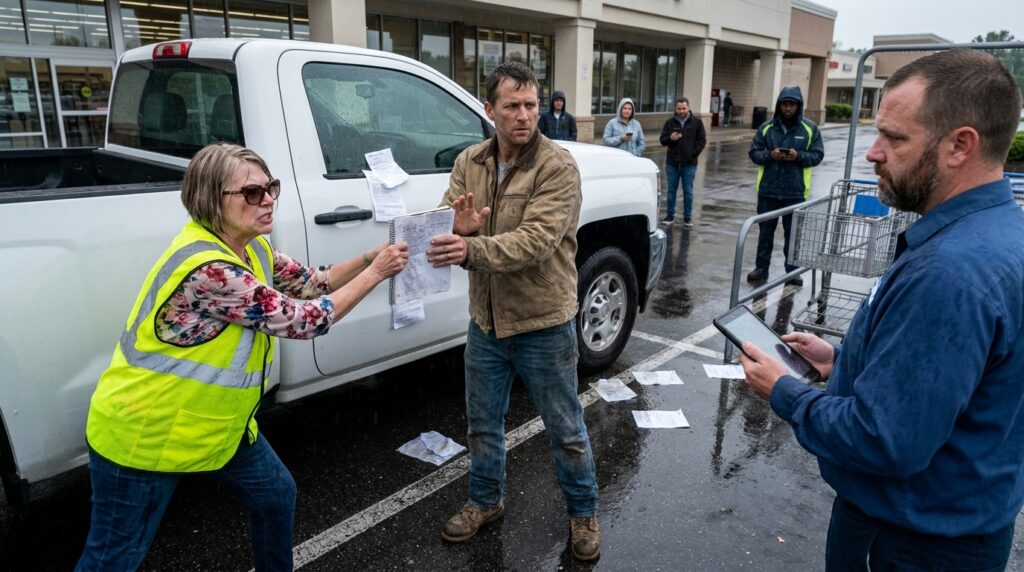
Before Julian could slide his tailgate closed, the harsh glare of high beams cut through the gloom. A dark sedan swung sharply into the adjacent lane, cutting off a delivery van and stopping at an aggressive, diagonal angle right against the rear bumper of Julian’s truck.
The driver-side door flew open with a sharp metallic clatter. Evelyn Vance stepped out, but the confident, rigid posture she had worn earlier was replaced by a frantic, jittery edge. Her neon vest was unzipped halfway, and she clutched a thick stack of laminated notices in one hand, her face flushed with cold and vindictive adrenaline.
“You think you won round one because your manager friend protects his loading dock,” Evelyn shouted over the low rumble of her sedan’s exhaust, marching directly toward Julian with reckless speed. “You haven’t seen the district’s legal leverage yet. We have filed formal injunctions against three different contractors this quarter, and your commercial tag is next on the docket.”
Julian didn’t flinch. He planted his boots firmly against the asphalt, resting his forearms on the cold steel of the truck bed. He watched the way her fingers trembled slightly as she shuffled the laminated sheets, exposing a torn receipt from a commercial print shop in town—an invoice for fifty identical unauthorized parking violation notices, paid out of pocket. The realization hit him with cold clarity: this wasn’t backed by an official municipal budget. This was a private crusade, funded by someone desperately trying to project an illusion of municipal power.
“You’re wasting your ink, Evelyn,” Julian said, his voice cutting through the rising wind with absolute, chilling calm. “A printed card from a copy shop doesn’t carry the weight of a court order.”
“Don’t you dare minimize the authority of the district committee!” she shrieked, stepping so close he could smell the stale coffee and cheap mints on her breath. She slammed a laminated sheet against the side panel of his truck, leaving a dull scuff mark on the clean white paint. “I have neighbors on the city council. I have enforcement logs dating back six months. I can make your business toxic in this county before the week is out.”
A crowd was beginning to form again near the entrance, drawn by the escalation of her voice against the whipping wind. A couple of grocery clerks stepped outside to smoke, their eyes fixed on the spectacle, while a delivery driver paused with a hand on his cart, watching the confrontation unfold with undisguised curiosity.
Julian’s pulse ticked upward, the old defensive anger threating to break through his careful discipline. Every instinct urged him to fire back, to match her volume, to tear the fake citation off his truck and throw it into the gutter. But the memory of past conflicts—where losing his temper had handed victory to people just like her—grounded him. He forced his breathing to deepen, his fingers curling slowly into his palms until the tension dissipated into raw, calculated resolve.
“If you’ve got logs,” Julian said softly, his eyes boring straight into hers, “and if you’ve got council backing, then you won’t mind waiting right here while I call the county sheriff’s non-emergency line to verify your jurisdiction.”
Evelyn froze. The manic confidence in her eyes flickered, replaced instantly by a sharp, panicked dart toward her car. For a split second, the facade completely cracked; the rigid enforcer of the neighborhood dissolved into a cornered woman terrified of an official audit that would expose her fake authority to the people whose respect she was desperately trying to buy.
“You… you’re playing games,” she stammered, her voice losing its theatrical projection, dropping into an ugly, defensive snarl. “You’re harassing me in a public space! I’m calling the authorities myself!”
She turned abruptly, her high heel catching in the deep groove of an asphalt expansion joint. She stumbled hard, dropping half her laminated notices across the wet pavement, scattering papers in the dirt as the wind picked up, driving the first cold drops of rain across the parking lot.