The Weight of the Line: A Novel of Modern Property, Pride, and the Friction of Honest Labor

CHAPTER 1: THE RESISTANT EARTH

“Get that iron out of my dirt before I have the county marshal put you in a cell,” she said, her voice cutting through the humid morning grease before the spade could even clear its first three inches of sod.

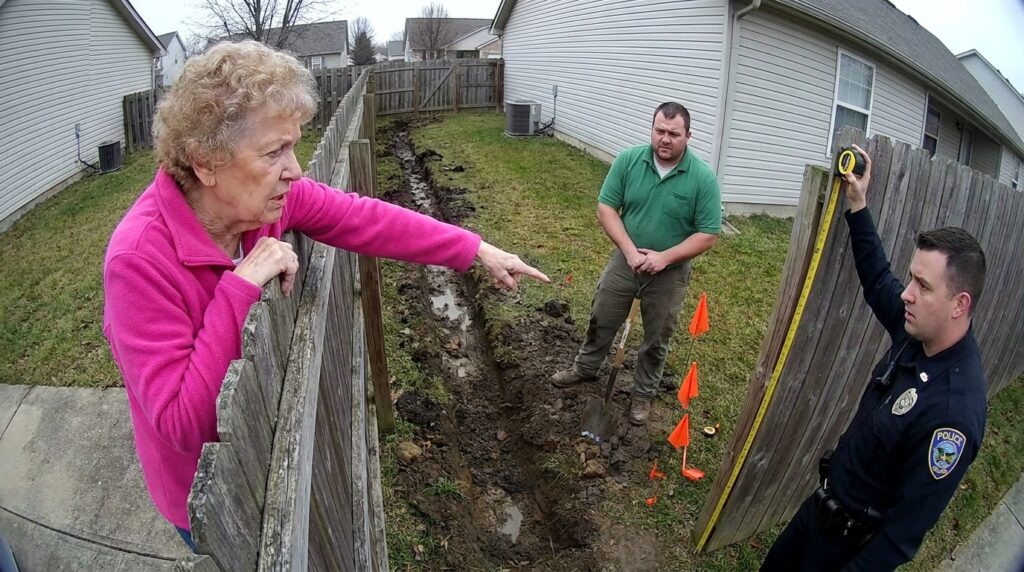
Arthur didn’t look up. He kept his weight centered over the T-handle of the sharpshooter spade, letting his work boots—caked in the gray, unyielding clay of the county line—sink the steel blade deeper into the turf. The soil here was thick with old gravel and matted crabgrass roots that resisted the edge with a dry, rhythmic tearing sound. He could see her shadow through the spaces in the cedar privacy fence: a broad, unmoving outline in a bright pink fleece jacket that seemed to absorb the dull, desaturated morning light.

“I’m just following the city survey lines, ma’am,” Arthur said. His voice was low, flat, and stripped of any heat that could be weaponized against him. He kept his eyes on the ground, tracing the path of the bright orange plastic flags that vibrated slightly in the exhaust of a utility truck idling three houses down.

“Those flags are a lie,” she spat back, her fingers locking onto the top rail of the cedar fence. The wood groaned under the sudden friction of her weight. Her skin was thin as parchment, spots of liver-brown standing out against the pale knuckles as she leaned over the boundary. “My husband set these posts forty years ago. The city doesn’t own a square inch past that ditch line, and you’re digging into my property. Look at me when I’m speaking to you, young man.”

Arthur didn’t turn his head. He knew the shape of her face without looking—the tight, outraged jaw, the oversized sunglasses reflecting the gravel driveway, the absolute certainty of an old resident who believed the earth itself conformed to her memory. Instead, he reached down, wiped a smear of damp, clay-heavy oil from the spade’s shaft with a rag from his back pocket, and stepped half a foot to the left to mark the next cut. The friction of the work polo against his neck was raw from the humidity. He could feel the weight of the neighborhood watching from the low porches across the asphalt strip—quiet, stationary figures waiting to see how much room an ordinary contractor would give a woman who owned the local history.

The air smelled of dry iron, diesel exhaust, and the sharp, sour tang of disturbed weeds.

“I have the county plat map right in the truck, ma’am,” Arthur said softly, his shovel clearing a clod of dark earth that fell away to reveal a glint of grey stone beneath the sod. “The easement allows six feet from the curb. We’re at four.”

“Call them,” she said, her voice dropping into a hard, transactional register that made Arthur’s thumb freeze against the wooden handle. She pulled a heavy white smartphone from her pocket, her thumb already striking the glass with a small, plastic click. “You think because you’ve got a green shirt and a state vest you can slice up a person’s life? We’ll see what the department says about an active trespass.”

Arthur stood perfectly still in the trench, his boots sunk two inches into the newly broken ground. Down in the narrow cut, tucked neatly against the root ball of an encroaching boxwood, something metallic caught the edge of his vision—not the copper tracer wire he was looking for, but a thick, square head of an ancient iron pin that shouldn’t have been there. It was buried deep, its surface pitted with decades of rust that looked exactly like old blood in the gray clay.

The sound of a distant siren began to rise from the bypass, growing louder as it turned into the subdivision.


CHAPTER 2: THE RECONSTRUCTION OF BOUNDARIES

The screech of local police brakes over unswept road gravel cut the humid air before the engine fully died. Arthur didn’t drop the spade; he simply shifted his weight, his work boots sinking deeper into the soft, raw edge of the trench. The damp gray clay held the tread of his leather soles like a mold. Across the cedar rail, the old woman’s hand didn’t shake as she lowered the phone. Her face remained a hard, fixed mask of historical ownership, her bright pink fleece jacket a jarring stain against the muted, sun-bleached tones of the suburban development.

The cruiser door slammed with a heavy, metallic thud that resonated through the soles of Arthur’s feet. Officer Miller—his dark hair cropped short, his utility belt clicking with the rhythmic, plastic weight of institutional routine—stepped onto the grass strip. He didn’t look at the neighbor first, nor at Arthur. His eyes went straight to the bright orange flags, checking the alignment against the curb line before his boots met the edge of the newly turned sod.

“Marilyn,” Miller said, his tone flattened by years of the same domestic boundaries, the same shifting fence lines. “What are we doing out here?”

“He’s trenching my drainage easement, Donald,” she said, her voice dropping into a register that assumed compliance. She pointed a single, liver-spotted finger downward, her nail black with garden loam. “The county plat clearly states the property line terminates four inches out from the cedar posts. He’s already cut through the root ball of the boxwood my husband planted for the bicentennial. It’s willful destruction of private property.”

Arthur wiped his palm against his work pants, leaving a dark streak of mud across the green polo shirt. “The city infrastructure work order is pinned to the dashboard of the utility truck, Officer. Six-foot municipal easement from the asphalt edge. The flags were set by the surveyor on Tuesday morning.”

“The surveyors don’t live here,” Marilyn snapped, her chest rising against the pink fleece. “They don’t know where the old iron pins are. They look at a satellite screen in an office forty miles away and tell an ordinary boy with a shovel where he can dig.”

Miller stepped into the narrow lane between the fence and the open cut, his uniform pants brushing the unclipped weeds. He looked down into the trench, his gaze lingering on the single spade where it remained wedged into the gray clay. He didn’t take sides; he took out his notepad, the leather cover cracked and grayed around the corners from rain and dashboard sun.

“Arthur, right?” the officer asked, not looking up from his grid paper.

“Yes, sir. Municipal Utilities Group.”

“Pull the spade back a second.”

Arthur braced his arms, the muscles in his back tightening as he broke the suction of the heavy clay. The earth gave way with a wet, heavy sigh. As the steel blade cleared the trench, the edge scraped against the square head of the old iron pin Arthur had spotted moments before. The sound was a sharp, high-pitched metallic screech—iron on iron—that made Marilyn lean further over the rail, her sunglasses sliding down the bridge of her nose.

“What was that?” Miller asked, his pen pausing.

“An old marker,” Arthur said, his voice measured. He knelt down in the damp ditch, ignoring the mud that soaked through the knees of his trousers. With his gloved fingers, he cleared away the thick gray clods from the rusted iron head. It wasn’t a standard city survey peg. It was a massive, hand-forged piece of structural iron, thick as a railroad spike, driven deep into the substrate beneath the boxwood roots. It sat exactly six inches inward from where the orange flags ran, completely contradicting the city’s digital map.

Marilyn’s tight jaw loosened slightly, a small, grim smile forming at the corners of her mouth. “That’s the original corner pin from seventy-two. My husband drove it himself when the county re-zoned the orchard lane. That trench is on my land, Donald. You tell him to pack his truck.”

Miller looked from the rusted pin to the orange flags fluttering on their thin wire stems. The discrepancy was physical, tangible, and entirely irregular. He reached down to his utility belt, his fingers finding the brass clip of his heavy steel measuring tape.

“Nobody’s packing anything yet,” Miller said, his voice dropping into the pragmatic register of a man who trusted numbers more than memories. “Let’s verify the property line before anyone keeps digging here.”

Arthur stayed on his knees in the gray mud, his eyes fixed on the rusted iron head. There was something wrong with the clay directly beneath it. It wasn’t the uniform, hard-packed layer of the natural county line. It was loose, dark, and shot through with crumbling bits of decayed asphalt and old gravel, as if someone had dug here long after the orchard was gone, then buried the iron deep to keep the earth from settling.

The officer extended the tape, the silver metal snapping out with a harsh, rhythmic click against the cedar posts.

CHAPTER 3: THE CALIBRATION OF OUTRAGE

The metallic snap of the tape measure split the heavy morning silence like a small pistol shot. Officer Miller didn’t look back to see if Marilyn or Arthur were tracking the line; his focus was pinned to the yellow steel ribbon pressing against the base of the cedar post. The metal tape scraped over dry splinters, its numbers slightly faded by old sweat and utility belt grease.

“Hold that end flush against the cedar, Arthur,” Miller commanded, his voice tight with the dry authority of a county man who spent half his life separating neighbors over twelve inches of dirt.

Arthur didn’t hesitate. He shifted his weight on the slick incline of the trench, his work boots grinding into the newly turned clods. He pressed his gloved thumb against the hook of the tape, pinning it exactly where the weathered cedar post met the clay. The cold through his leather glove was a dull ache. Through the small gap between the slats, he could smell the faint, sour odor of Marilyn’s damp boxwoods and the stale floral perfume she wore like armor.

“Don’t you go pushing that tape into the soft wood, young man,” Marilyn warned. She had stepped down from the higher rail but remained balanced on the brick border of her garden bed, her broad silhouette blotting out the sun from the east. The pink fleece of her sleeve brushed the top wire. “Donald, make sure he’s checking the true face of the post, not the decorative molding. My husband paid for five-inch structural cedar, not the cheap slats they use in the new phase.”

“I know how to read a standard scale, Marilyn,” Miller murmured. He walked backward into the narrow lane, his boots sinking into the loose pile Arthur had shoveled out twenty minutes ago. The tape hummed as it extended, vibrating slightly under the tension. “Arthur, keep your fingers clear of the numbers. I want a clean sightline down to the flag.”

Arthur watched the yellow steel bridge the gap between the residential fence and the municipal excavation. The line was taut, an uncompromising bar of primary yellow cutting across the gray, desaturated landscape of the side yard. As the numbers crept past thirty-six, forty-eight, and sixty inches, the tip of Miller’s boot stopped exactly over the bright orange survey flag. The wire stem of the flag creaked against the silver grommet of the tape.

“Seventy-two inches,” Miller read aloud, his voice flat. He knelt down, his utility belt clicking as the plastic holsters pressed against his hip. “Exactly six feet from the face of the post to the center of the utility marker. The city flags are dead-on the easement boundary, Marilyn. This trench is entirely within the municipal sector.”

The old woman didn’t move. Her jaw remained locked, her reflection frozen in the wide lenses of her sunglasses. For three seconds, the only sound was the distant hum of the concrete mixer working on the cul-de-sac. Then, her fingers tightened on the cedar rail until the old wood gave a distinct, sharp crack.

“The digital maps are wrong,” she said, her voice dropped to a razor-thin whisper that had no age in it. “I told you, Donald. The orchard line was redrawn before you were out of grade school. That rusted iron pin down there—the one his shovel hit—that’s the true monument. The city surveyors never dug deep enough to find it. They just took the easy line.”

Miller sighed, his breath a short, heavy puff that stirred the dust on his notepad. He turned his head toward the trench, looking down at the massive, square head of the forged iron pin Arthur had uncovered beneath the boxwood roots. The iron was ancient, its corners rounded by decades of subterranean moisture, but it remained stubbornly planted in the substrate.

“Arthur,” Miller said, reaching for his flashlight. “Let me see that pin again.”

Arthur shifted back, grounding his shovel to clear a wider shelf in the clay. As he scraped the blade along the side of the ancient spike, more of the irregular substrate fell away. It wasn’t the natural, uniform layer of the local county line. The gray clay here was shot through with dark, oily streaks—bits of pulverized asphalt and a strange, crumbly white stone that looked like old limestone backing. It looked less like an undisturbed property boundary and more like the hasty patch of a deep trench that had been closed before the inspector could arrive.

The officer leaned over the edge, the bright beam of his flashlight cutting through the shadow of the boxwood leaves. He traced the line from the square iron head down to where it disappeared into the darker, loose soil below. His pen remained poised over the grid paper, but he didn’t write.

“That’s not a standard survey marker,” Miller muttered, his thumb tracing the worn leather edge of his notepad. “The head’s too broad. That looks like an old commercial isolation pin from the water district.”

“It’s the property pin,” Marilyn insisted, her voice rising again, reclaiming its volume. She leaned further over the fence, her pink sleeve dipping into the dirt Arthur had thrown up. “My husband had the deeds hand-checked by the registrar in ninety-four. If you let him break ground past that iron, Donald, you’re violating a recorded covenant. I’ll have the town clerk out here by noon.”

Miller stood up slowly, his joints popping. He looked at Arthur, then back at the old woman. The pragmatism in his eyes was being crowded out by the slow, exhausting realization that this wasn’t a standard boundary dispute. There was a history buried in the side yard that the city digital maps hadn’t accounted for—and the old iron pin was sitting right in the middle of it.

“Arthur,” Miller said quietly, adjusting the heavy belt around his waist. “Leave the spade in the dirt for five minutes. I need to call the county recorder’s office from the car. Don’t touch that iron until I get back.”

Arthur didn’t reply. He simply nodded, his palms resting on the worn wood of his shovel handle as the officer turned and walked back toward the idling cruiser, his boots leaving heavy, deep impressions in the raw clay. Through the fence, Arthur could hear Marilyn’s breath—fast, shallow, and ragged with a fear she was trying desperately to disguise as anger.

CHAPTER 4: THE TAUT STRAP

The radio inside Officer Miller’s distant cruiser barked with a burst of static, a dry, robotic voice echoing across the suburban pavement before dissolving into the hum of the neighborhood. Arthur didn’t move from his position in the trench. He kept his hands resting on the worn ash handle of his shovel, using the tool to anchor himself against the slick, sloping walls of gray clay. Across the top rail of the cedar fence, Marilyn remained fixed, her hands gripping the weathered wood so tightly that the white of her knuckles seemed permanently pressed against the grain.

The silence between them grew heavy, filled only with the sharp, rhythmic ticking of the utility truck’s cooling engine down the street. The air carried the cold, sour smell of turned earth mixed with the chemically sweet scent of fertilizer from Marilyn’s lawn borders.

“You think you’re smart, don’t you?” she said, her voice dropping into a low, raspy whisper that barely cleared the cedar slats. Her sunglasses caught the pale morning sun, twin mirrors reflecting Arthur’s mud-stained green polo shirt and the dark gash of the trench. “You think because Donald has to check his little computer in the car, you’ve won something here.”

“I’m not trying to win anything, ma’am,” Arthur said. He kept his eyes on the square head of the iron pin between his boots. The metal was heavily pitted, its rusted scale flaking off under the dampness of the clay to leave dark, greasy stains on his fingertips. “I just have three hundred feet of main line to lay before the county inspector locks the permit pool on Friday.”

“My husband spent thirty years keeping this patch clear,” she said, her chest rising sharply against the bright pink fleece of her jacket. She leaned further over the rail, her shadow stretching across the trench until it touched the blade of Arthur’s shovel. “He knew every line, every pipe, every tile beneath this sod. When the water district tried to run the old secondary main through the orchard lane in ninety-two, he stood right where you’re standing with a cold-rolled bar until they moved the flags. He didn’t let them cut then, and I’m not letting you cut now.”

Arthur didn’t answer. He had heard variations of the orchard lane story from three different residents since his crew entered this development, but none of them had mentioned an active redirection of the main. He knelt down again in the slick mud, the fabric of his work pants drawing in the cold moisture of the substrate. Using his smaller trenching trowel, he carefully scraped away the impacted gray clay surrounding the shaft of the mysterious iron pin.

The deeper he cleared, the more the ground changed. The native clay gave way entirely to a crude, packed layer of coarse gravel and chunks of ancient, broken asphalt that didn’t belong in a residential side yard. It was a localized backfill, poorly compacted and dense with the smell of stagnant water and old petroleum. Two inches below the level of the municipal survey flags, the blade of his trowel hit a flat, horizontal surface with a dull, hollow thud that didn’t sound like natural stone.

Marilyn’s breath hitched. Through the fence, Arthur heard the distinct, sharp rustle of her fleece jacket as she drew back half a step, her boots scraping against the brick border of her garden.

“Leave that alone,” she commanded, the volume returning to her voice, thin and brittle with an edge that wasn’t just anger. “I told you not to touch that iron until Donald got back.”

“I’m just clearing the shelf so the officer can see the base, ma’am,” Arthur said softly. He didn’t look up, but his fingers traced the edge of the horizontal obstruction he had just uncovered. It was an old steel plate, heavily corroded and slick with orange grease, running directly underneath the root ball of Marilyn’s prized boxwood. The iron pin wasn’t a property marker at all—it was a heavy structural stake driven through a pre-drilled eyelet in the plate, anchoring it down into the shifting substrate like a wedge.

Across the lawn, the door of the police cruiser slammed shut with a heavy, double-clicking thud. Officer Miller walked back toward the side yard, his leather duty gear creaking rhythmically with each stride. His notepad was tucked beneath his arm, and his face had settled into the stiff, guarded expression of a public servant who had just been given a bureaucratic headache.

He stopped at the edge of the trench, his eyes going straight to the widened hole Arthur had cleared around the iron head. He didn’t look at Marilyn until he had clicked his heavy flashlight back into its plastic ring on his belt.

“The recorder’s office doesn’t have a record of a private corner pin for this parcel, Marilyn,” Miller said, his voice level but dry. “But they do have an open variance flag from ninety-five that was never signed off by the engineering inspector. The original plat shows the municipal easement extends a full eight feet from the asphalt edge along this entire block because of an old utility junction that was listed as abandoned before the subdivision was platted.”

Marilyn’s fingers twitched on the top rail of the cedar fence. “The city gave up that right when they signed the developer’s covenant, Donald. You know that as well as I do.”

“The city didn’t give up anything,” Miller said, his thumb resting against the leather edge of his notepad. He turned to Arthur, his gaze dropping down to the exposed steel plate beneath the boxwood roots. “Arthur, what did you find down there?”

Arthur wiped his trowel against the grass, his eyes fixed on the point where the rusted iron pin pierced the plate. “It’s a non-municipal anchor, Officer. Someone drove a commercial isolation stake right through a structural cap. It’s sitting directly over the path of our new trench line, six inches deeper than the city flags.”

Miller knelt down, his uniform trousers straining as he leaned into the cut to shine his light onto the orange grease. The yellow beam illuminated the pitted, flaky texture of the steel cap, revealing the faint, stamped letters of an old industrial foundry that had closed before the turn of the century. The discrepancy was no longer a matter of maps or fence lines; it was a physical barrier buried in the gray clay, intentionally hidden beneath a layer of old asphalt and a forty-year-old boxwood hedge.

“Well,” Miller murmured, his pen tracing a sharp, heavy line across his grid paper. “That explains why the digital survey looked clean on the surface. Someone buried this line deep enough to clear the standard agricultural probes, then drove that stake to keep the whole works from shifting toward the house.”

He stood up, looking across the fence at Marilyn. The old woman hadn’t taken her eyes off the exposed steel plate. Her sunglasses had slipped further down her nose, revealing the small, deep-set lines of panic around her eyes that her pink fleece could no longer mask.

CHAPTER 5: THE SUBTERRANEAN ANCHOR

The yellow beam of Officer Miller’s flashlight wavered against the wet, gray walls of the ditch as Arthur shifted his weight, his mud-slicked fingers seeking a firmer grip on the cold ash wood of his shovel handle. The air inside the four-foot cut was growing colder, heavy with the sharp, sour odor of stagnant water and the unmistakable chemical tang of forty-year-old unrefined petroleum.

“Don’t wedge the blade underneath that lip, Arthur,” Miller said, his voice clipped as he leaned over the loose pile of dirt. The leather of his duty belt groaned against his hips. “If that’s an old water district isolation plate, the structural seal could be holding back whatever the developers buried when they cleared the orchard lane.”

Arthur didn’t pull back. He set the tip of the trenching tool against the flange of the steel plate, just three inches from where the ancient square iron pin pierced the metal eyelet. He applied single, deliberate pressure with his boot heel. The steel blade didn’t slice through the clay; instead, it hit the horizontal obstruction with a harsh, vibrating clink that rattled up through his shins and settled into the small of his back. The ground beneath his feet shifted slightly—a subtle, greasy slide of uncompacted gravel and crumbling chunks of black asphalt.

Across the cedar rail, Marilyn let out a sharp, shallow breath. Her knuckles had gone completely white against the gray wood, her broad frame leaning forward so far that the zipper of her pink fleece jacket rattled against the fence slats.

“I told you to leave it be,” she whispered. The heat had left her voice, replaced by a brittle, defensive precision that sounded like a warning. “Donald, tell him to get out of that hole. He’s going to ruin the grade. If he drops the drainage line any lower, my boxwoods won’t survive the winter runoff.”

“The grade isn’t the problem right now, Marilyn,” Miller said without looking at her. He clicked his notepad shut and shoved it into his rear pocket, his gaze locked on the small trickle of dark, iridescent fluid that had just begun to seep from the edge of the corroded steel plate. The fluid was thick, sluggish, and carried the pungent reek of old rust and coal tar. “Arthur, back off half a step. Let me get a look at the stamp on that casing.”

Arthur dropped his shoulder, scraping a heavy wedge of gray clay from the top face of the plate with his smaller hand trowel. The rough iron surface was severely pitted, covered in a thick layer of orange, flaky scale that fell away in brittle crusts under his touch. Beneath the rust, stamped into the iron in raised, blocky letters that had been deformed by decades of underground pressure, were the words: ORCHARD VALE UTILITY CORP — JUNCTION 4 — 1974.

Miller’s flashlight beam held steady on the text. The officer remained completely motionless for three seconds, the low hum of his idling cruiser the only baseline in the quiet suburban side yard.

“Orchard Vale went bankrupt before the county took over the district lines,” Miller murmured, his thumb rubbing the brass edge of his uniform buckle. “The whole system was supposed to be dug out and re-routed when they laid the foundations for this block in ninety-six. The developer’s report stated every single secondary main along this easement was clear and backfilled with standard aggregate.”

“They missed this one,” Arthur said. He knelt down further into the slick, gray mud, his work pants soaking through completely as he traced the perimeter of the plate with his gloved thumb. The metal extended deep into the bank, disappearing directly beneath the concrete footer of Marilyn’s privacy fence. The thick, square iron pin wasn’t an arbitrary boundary marker driven by her husband; it was an active structural locking pin, driven straight through the casing to anchor a massive, un-mapped junction box that was sitting exactly where the municipal contract required Arthur to lay the new six-inch fiberglass conduit.

“My husband didn’t miss anything,” Marilyn said. She stepped down from the garden brick, her boots crunching into the dry gravel of her side path as she walked toward the corner gate. Her face was tight, her oversized sunglasses pushed up into her short gray-blonde hair, revealing small, red-rimmed eyes that looked less angry now than completely exhausted. “He spent three thousand dollars out of his own pocket to keep the county from tearing up the yard when the kids were small. He did what he had to do to protect this house.”

“By driving a commercial anchor into an open variance line without an inspector’s signature, Marilyn?” Miller asked, his voice dropping into a hard, pragmatic register that brooked no neighborly deference. He stood up, his boots leaving two deep, watery imprints in the loose sod at the edge of the trench. “If this box is still connected to the old secondary main down on the bypass, we’re looking at an unpermitted structural bypass sitting directly on the municipal right-of-way.”

Arthur reached down to clear one more handful of the loose limestone backing from the base of the iron pin, but the moment his fingers brushed the rusted shaft, a sharp, hollow crack echoed from the bottom of the cut. The iron spike didn’t just shift; it sheared clean off at the collar, its heavily corroded core revealing a dark, dry void inside the metal.

Immediately, the sluggish trickle of coal tar turned into a steady, bubbling hiss. The dark, oily water began to rise around the toes of Arthur’s leather boots, the foul odor of ancient sewage and old petroleum gas expanding into the humid morning air with the force of an active ventilation leak.

“Get out of the hole, Arthur,” Miller commanded, reaching down to grab the collar of Arthur’s green polo shirt with one heavy, mud-stained hand. “Get out now.”

Arthur scrambled up the slick slope of the ditch, his boots losing traction twice against the wet gray clay before his fingers found purchase on the matted crabgrass roots at the edge. He pulled himself flat onto the sod just as a heavy, hollow thud rattled the bottom of the trench, the steel plate groaning as the internal pressure of the old utility main began to displace the uncompacted gravel beneath the fence.

Across the lawn, three neighbors who had been watching from their porches stepped down onto the asphalt, their phones held low but steady as the foul smell reached the street. Marilyn didn’t look at them. She stood by the cedar gate, her hands tucked deep into the pockets of her pink fleece jacket, watching the dark, oily fluid slowly fill the fresh utility cut until it touched the very bottom of her husband’s weathered cedar posts.

CHAPTER 6: THE STRUCTURAL WEAVE

The gray mud sucked violently at Arthur’s heels as he rolled clear of the trench edge, his chest heaving against the cold grass. The dark, oily water continued to bubble from the sheared mouth of the old iron casing, its surface reflecting a distorted, rainbow sheen under the flat daylight. The foul stench of long-buried coal tar and septic gases expanded outward, a heavy, invisible wall that hit the back of his throat like wood smoke.

Officer Miller stepped back two full paces, his heavy leather duty boots crunching into the dry crushed limestone of the side path. He already had his radio microphone unclipped, his thumb driving down on the side toggle. “Dispatch, this is Unit Four. Upgrade my call at 114 Orchard Lane to a Code Three utility emergency. We have an active breach on an un-mapped commercial main. Contact the municipal environmental coordinator and tell the utility supervisor to pull the pressure logs for the old Orchard Vale loop.”

“Donald, look at the fence!” Marilyn’s voice cut through the static of the officer’s shoulder unit. She had abandoned the security of the gate, her boots sinking straight into the damp sod of her garden border as she scrambled toward the leaning cedar panels. The broad silhouette of her pink fleece jacket shook against the gray background of her house. “It’s dropping! The footer is dropping into that hole!”

Arthur pulled himself up onto his knees, wiping a thick smear of gray clay and pungent grease from his cheek with the sleeve of his polo shirt. The ground beneath the wooden fence posts was visibly groaning. The steady, wet hiss of the escaping fluid was carving out the loose gravel and the pulverized limestone backing that had held the old steel plate in place for thirty years. Deprived of its uncompacted ballast, a four-foot section of the cedar privacy wall began to settle into the trench, the panels twisting out of alignment with a loud, tearing splinter of wood.

“Stay back from that line, Marilyn,” Miller warned, his arm extending horizontally to bar her path as he watched the fence rail warp. “The whole substrate is washing out into Arthur’s cut. If that footer goes, the structural corner of your rear sunroom is sitting less than ten feet from the slide.”

“My husband laid that concrete himself,” she said, her voice fracturing as she watched the black fluid rise toward her ankles. Her hands remained curled into tight fists inside her fleece pockets. “He used four-inch commercial mesh. He told me it would hold anything. He said the city could never undermine the foundation if the iron pin stayed driven.”

Arthur gripped his spade, using the metal neck to stabilize his stance as he stood up on the slick grass strip. He wasn’t tracking her panic; he was looking at the way the dark water was channeling. It wasn’t rising evenly. It was erupting from a targeted void directly beneath the fence line, a cavity where the native clay had been completely replaced by an ancient, unpermitted timber retaining wall that was now rotted through.

“Officer,” Arthur said, his voice flat with the clarity of a man who worked with structural failure every day. “The pin wasn’t driven to mark a property line. Her husband used that iron spike to pin an illegal sleeve over a fractured section of the old bypass main. When they built the sunroom foundation in ninety-six, they poured the concrete directly onto the municipal easement’s safety shelf to hide the repair.”

Miller turned his head sharply, his flashlight beam slicing through the rising mist of petroleum vapor to find the cracked edge of the concrete footer now hanging exposed over the bubbling trench. “Marilyn, is that what happened? When the developer signed the covenant, did your husband bury the old junction box to keep the county from condemning the easement lane?”

The old woman didn’t reply. She stood perfectly still on the waterlogged turf, her face desaturated under the pale sun, her broad frame suddenly looking frail inside the bright pink fabric. She didn’t look at the officer, and she didn’t look at the neighbors who were now retreating down the sidewalk as the septic odor reached the curb. Her eyes were fixed entirely on the exposed, rusted steel plate—the false bottom of her entire estate—now slowly tilting into the municipal mud as the earth reclaimed its history.

“We couldn’t afford the remediation,” she whispered, her lips barely moving against the cold wind. “The developer said if the county found the cracked main under the line, they’d pull the building permits for the whole block. My husband did what he had to do to save our home.”

The sound of heavy diesel engines began to rattle the entrance of the subdivision as the first municipal vacuum truck turned onto Orchard Lane, its warning lights casting a pulsing, orange glow across the gray cedar fences.

CHAPTER 7: THE SUBSIDENCY CLASH

The heavy, dual-piston intake of the municipal vacuum truck hit the narrow side lane with a deafening hydraulic roar that drowned out the low static of Officer Miller’s shoulder radio. The warning beacons on the truck’s cab spun in aggressive, rhythmic orbits, casting long, mechanical slices of orange light across the gray siding of Marilyn’s house. Arthur stood on the trembling turf, his hands clamped tight around the wet handle of his spade, watching the high-pressure suction hose crawl toward the trench like a great, armored snake.

The air had grown intensely bitter, choked with a thick, atomized mist of old sewage, coal tar, and the sharp, hot reek of diesel exhaust.

“Don’t let them drop that tube near the fence line, Donald!” Marilyn screamed. Her voice was thin, completely stripped of its old administrative weight, cracking against the mechanical din of the pumps. She had moved past the broken gate, her boots tracking thick ribbons of gray mud across her own aggregate walkway. The bright pink fleece of her jacket was soaked with the oily spray, turning a deep, bruised magenta under the orange strobe lights. “The concrete under the porch is cracking! I can hear the rebar tearing!”

Miller didn’t answer her. He was shouting commands to the operator in a yellow high-visibility vest who was maneuvering the massive boom arm over the open gash. “Keep the draw away from the footer! We just need to drop the surface pool before the vacuum undermines the primary utility shelf!”

Arthur stepped down onto the slick, uncompromised grass strip near the truck’s rear tires, his eyes locked on the vertical face of the excavation. It was too late for a surface drop. The dark, bubbling fluid had already dissolved the uncompacted limestone ballast three feet back into Marilyn’s lot. With the ancient structural plate now tilted forty-five degrees into the mud, the true bottom of the subdivision’s infrastructure error was fully exposed. The concrete footer of her sunroom—poured directly onto the municipal right-of-way to mask her late husband’s illegal patch—showed a long, jagged fissure that opened three inches wide with every pulse of the vacuum truck’s engine.

The friction of the subgrade was failing in real-time. A heavy block of gray clay, thick with the rotted roots of the boxwood hedge, slid into the bubbling pool with a wet, hollow thud.

“Arthur!” Miller yelled over the roar of the intake. “Get the trench shields from the utility flatbed! We need to wedge the plywood panels against that bank before the whole corner drops!”

Arthur dropped his shovel into the grass and turned toward the street, his boots slipping on the grease-smeared asphalt. He didn’t ask for help; he knew the crew down the block was still locking down the isolation valves on the main bypass. He grabbed the edge of a heavy, steel-rimmed shoring panel from the truck bed, the cold metal biting through his muddy leather gloves with a dull, abrasive ache. As he dragged the sixty-pound sheet back toward the fence line, his shoulders straining against the weight, he could see the neighbors through the gaps in the shifting panels—their faces pale behind their phone screens, documenting the exact moment the historic property line collapsed into a municipal violation.

Marilyn was on her knees now, right at the edge of the brick garden border. She wasn’t watching the neighbors, and she wasn’t watching the police officer. Her hands were sunk into the wet sod, her fingers clawing at the earth as if she could physically hold the concrete footer from dropping into the hole.

“He told me it would hold,” she whispered, her words lost to anyone but Arthur as he dragged the shoring panel past her. Her sunglasses had fallen into the mud, leaving her small, red-rimmed eyes completely unprotected from the glare of the strobe lights. “He said if we kept the city out, the house would outlive us both. He promised me, Arthur.”

Arthur didn’t give her a sympathetic look, but he set the edge of the steel-rimmed panel down right between her muddy fingers and the open trench. He jammed his boot against the frame, driving it deep into the gray clay to form a crude, temporary bulkhead against the sliding foundation. The metal groaned as the weight of her late husband’s unpermitted concrete footer slid forward another fraction of an inch, locking the panel into the earth with a final, unyielding snap of structural friction.

The hiss from the old main didn’t stop, but the rising fluid began to slow, the vacuum tube drawing the black slurry out in a heavy, rhythmic pulse that signaled the closing of the upstream municipal gates.

CHAPTER 8: THE SECURED LINE

“The pressure is down to zero across the entire bypass ring,” the radio on Officer Miller’s shoulder announced, its static sharp but short against the low, heavy idle of the municipal vacuum truck.

Arthur didn’t give a verbal reply. He kept his weight resting over the head of a massive, cold-rolled steel survey monument, his boots planted firmly on the wet, crushed limestone that the crew had just dumped into the washed-out cavity. The foul, oily odor of the ancient coal tar was slowly dissipating, replaced by the crisp, dry dust of fresh aggregate and the clean smell of turned earth. He raised his heavy ten-pound sledgehammer, his muscles burning with the deep, aching exhaustion of a full day’s labor, and brought the face down onto the steel pin with a flat, final clank that echoed down through the subgrade.

The monument sank its final two inches into the substrate, locking the municipal easement boundary into the county bedrock with an unyielding mechanical click.

The side yard had changed its shape entirely. A four-foot section of the weathered cedar privacy fence hung crookedly, suspended by temporary steel cables anchored to the flatbed truck. The exposed concrete footer of the sunroom was no longer hidden behind matted crabgrass or thirty-year-old boxwood roots. It sat naked under the gray afternoon sky, its jagged three-inch structural fissure traced in orange chalk by the county building inspector who had arrived with the remediation crew.

Officer Miller walked slowly along the edge of the newly filled trench, his leather duty gear making a quiet, rhythmic scrape with each step. He checked the alignment of the new steel pin against his digital pad, his face settled into the stiff, dry neutrality of a man who had successfully transferred a neighborhood crisis into a matter of municipal record.

“The county surveyor just logged the amendment, Arthur,” Miller said, his thumb clicking the screen off as he stepped back onto the dry pavement. “The eight-foot easement is permanent now. No one’s moving this marker without a district court order.”

Arthur wiped his brow with the back of his muddy sleeve, leaving a dark gray smear across his forearm. He looked across the new boundary line. Marilyn was sitting on the low brick border of her ruined garden path. She had pulled the sleeves of her wet pink fleece jacket down over her hands, her shoulders hunched forward as she stared at the orange chalk line marking the unpermitted foundation of her home. The broad, authoritative silhouette she had maintained all morning had completely dissolved; she looked like any other resident facing the slow, indifferent machinery of a county citation.

“The structural engineers will issue the stabilization order by tomorrow morning, Marilyn,” Miller said, his voice dropping into a level, transactional register as he stood near the gate. “The county will require a full helical pier installation to underpin the sunroom before they can close the violation file. It’s going to have to be done from the interior.”

She didn’t look up at him. Her eyes remained fixed on the spot where the old forged iron spike had sheared off—the little circle of rusted scale that was already being covered by the gray limestone dust from the utility truck. “He told me it was done right,” she whispered, her voice carrying no heat, just the cold, flat weight of a realization thirty years delayed. “He said the city would never have a reason to look down there if we kept the surface clean.”

Arthur reached down, grabbed his sharpshooter spade from the grass, and tossed it into the open rack of the utility flatbed. The metal hit the iron frame with a sharp, familiar ring that signaled the end of the shift. He didn’t offer a word of comfort, and he didn’t look back at the crooked fence or the cracked foundation as he pulled on the heavy lever of the truck’s hydraulic hoist.

The new fiberglass conduit was already nesting deep in the limestone trench, a clean, smooth line of modern infrastructure running straight through the earth where the old secret used to sit.

“I’ll wait until you’re finished with the paperwork, Officer,” Arthur said, his voice low and flat as he climbed into the cab of the idling truck, his gloved fingers wrapping around the cold steering wheel. “We’ve got another three hundred feet of main to clear before the pool closes on Friday.”

Miller nodded once, his pen drawing the final cross-hatch on his grid paper as the vacuum truck began to coil its heavy hoses, its orange warning lights fading against the gray, unyielding lines of the suburban block.

Similar Posts

Leave a Reply

Your email address will not be published. Required fields are marked *